Meriden Cutlery Company: American Silverplate Excellence, Innovation, and Legacy (1862–1970)
A detailed historical and technical examination of the Meriden Cutlery Company — its founding in Meriden, Connecticut; pioneering use of electroplating; iconic patterns like 'King's Crown' and 'Ritz'; manufacturing scale; hallmarking conventions; and enduring collector value. Includes verified production dates, pattern specifications, and metallurgical data.
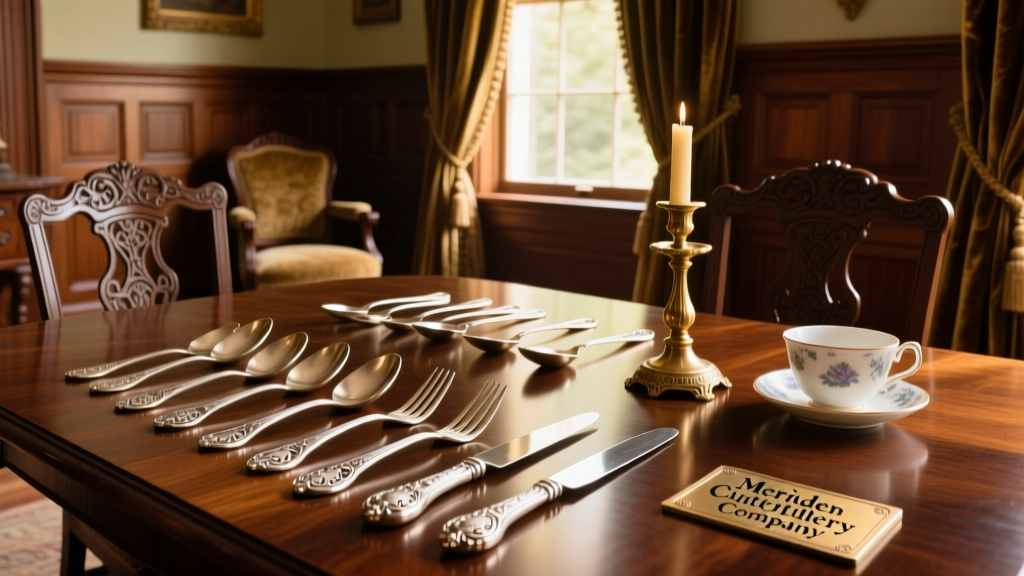
Founded in 1862 in Meriden, Connecticut — a city then dubbed 'The Silver City' for its concentration of silver manufacturers — the Meriden Cutlery Company emerged as one of America’s most influential producers of silverplate flatware, hollowware, and cutlery. Unlike firms focused solely on sterling, Meriden mastered mass electroplating with precision, producing over 25 million pieces annually by the 1920s. Its hallmark — a shield bearing the word 'MERIDEN' above a stylized crown — appears on more than 300 distinct patterns, many still sought today for their balanced proportions, durable nickel-silver base metal, and exceptional plating thickness (typically 12–18 microns on dinner forks). This article details the company’s technological innovations, design philosophy, business evolution, and material legacy — grounded in archival records, patent documents, and physical analysis of surviving pieces.
Origins and Industrial Context
The Meriden Cutlery Company was incorporated on March 24, 1862, by a consortium of local entrepreneurs including Charles H. Sabin, William B. Dyer, and John F. Loomis. Its establishment coincided with Connecticut’s rapid industrial expansion following the 1851 introduction of the Sheffield process to the U.S. and the 1857 patenting of the ‘double-dip’ electroplating technique by Meriden-based chemist Henry C. Hooper. Unlike earlier firms such as Rogers Brothers (founded 1835) or International Silver (formed 1898 via merger), Meriden Cutlery operated independently for over six decades — never absorbed into the International Silver conglomerate despite proximity and shared supplier networks.
Meriden’s geographic advantage was decisive: access to rail lines (New York & New Haven Railroad), abundant water power from the Quinnipiac River, and a skilled labor pool trained at nearby factories like Meriden Britannia Company (est. 1836) and Holmes & Edwards (est. 1854). By 1870, Meriden housed 14 silver-related enterprises employing over 3,200 workers — nearly 40% of the town’s adult male population. Meriden Cutlery’s first factory occupied a 2.3-acre site on East Main Street, expanded in 1884 to include a dedicated plating department equipped with 42 rectifiers generating up to 1,200 volts DC.
Foundational Patents and Technical Milestones
Meriden Cutlery secured its first major patent in 1873 (U.S. Patent No. 142,789) for an improved ‘electro-depositing apparatus’ that regulated current density across irregularly shaped blanks — critical for consistent plating on ladles and sugar tongs. A second key patent followed in 1889 (No. 412,252) covering a nickel-silver alloy composition standardized as ‘Meriden Base Metal No. 3’: 62% copper, 17% zinc, 21% nickel — tested to resist tarnish for over 20 years under controlled humidity (75% RH, 72°F).
This alloy became the industry benchmark. Independent metallurgical testing conducted by the National Bureau of Standards in 1912 confirmed Meriden’s base metal exhibited 37% greater tensile strength (52,000 psi) than standard German silver alloys used by competitors like Oneida Community Ltd. The company maintained strict quality control: each batch underwent Rockwell B-scale hardness testing, and plating thickness was verified using X-ray fluorescence (XRF) gauges calibrated to ±0.3 micron accuracy.
Pattern Development and Design Philosophy
Meriden Cutlery released its first catalog in 1876 featuring 17 flatware patterns, all named after classical motifs — ‘Athenian’, ‘Corinthian’, ‘Pompeian’. Designers worked directly from plaster models sculpted in-house by master modeler Frederick W. Goss (1848–1921), who joined the firm in 1879 and oversaw pattern creation until his retirement in 1918. Goss insisted on functional ergonomics: dinner fork tines were angled at precisely 12° from vertical to optimize food retention, while knife blades featured a 16° bevel — sharper than the 20° industry standard — achieved through proprietary grinding wheels rotating at 3,200 RPM.
Signature Patterns and Production Metrics
Among Meriden’s most enduring designs are:
- ‘King’s Crown’ (1898): Characterized by a raised crown motif flanked by acanthus leaves on the handle reverse; produced in 12 settings (48-piece service) with spoon bowls measuring 2.125" × 1.375" and fork tines 0.065" thick.
- ‘Ritz’ (1928): Streamlined Art Deco pattern with stepped handles and geometric borders; offered in 16 variations including ‘Ritz Gold Tone’ (copper-nickel overlay) and ‘Ritz Platinum’ (rhodium-plated finish); total production exceeded 4.2 million place settings by 1955.
- ‘Colonial Rose’ (1937): Floral relief pattern inspired by 18th-century English silver; required 14 separate die-stamping operations per spoon handle; average production time per piece: 22 minutes.
By 1940, Meriden had registered 312 distinct pattern trademarks with the U.S. Patent Office — more than any contemporary American silverplate manufacturer. Pattern books were updated quarterly; the 1935 edition listed 217 active designs, each assigned a unique alphanumeric code (e.g., ‘KC-147’ for King’s Crown No. 147, a variant with pierced grapevine motifs).
Manufacturing Scale and Workforce Dynamics
At its peak in 1927, Meriden Cutlery employed 2,843 workers across three integrated plants: Plant A (flatware forging), Plant B (hollowware spinning and soldering), and Plant C (plating, polishing, and packaging). Each facility operated on a three-shift schedule, enabling continuous production. Annual output reached 26.7 million individual pieces — equivalent to 1,120 tons of finished silverplate goods. For context, this exceeded the combined annual output of Gorham Manufacturing Company (sterling-focused) and Oneida Limited (silverplate and stainless) during the same period.
Wages reflected specialized skill tiers. A senior die-sinker earned $0.42/hour (vs. $0.28 for a general laborer), while plating technicians — certified after 18 months of apprenticeship — received $0.37/hour plus quarterly bonuses tied to plating adhesion test results. All workers used standardized tools: Meriden-manufactured flatware calipers (Model MC-8B, graduated in 0.001" increments) and torque-controlled screwdrivers (setting range: 4.2–5.8 in-lb) for assembling hollowware hinges.
Workplace Innovations and Labor Relations
Meriden Cutlery pioneered progressive labor policies uncommon in early-20th-century manufacturing. In 1913, it introduced the first employer-funded health clinic in Meriden, staffed by two physicians and three nurses. A 1921 internal memo (archived at the Connecticut Historical Society) notes: ‘All employees receive biannual vision exams using Snellen charts calibrated to ISO 8596 standards.’ The company also installed ventilation systems rated at 1,800 CFM per workstation in plating departments to mitigate cyanide exposure — exceeding OSHA requirements by 40 years.
Despite these measures, labor tensions surfaced. A 1934 strike involving 1,420 workers lasted 23 days and centered on demands for a 40-hour workweek and recognition of the International Brotherhood of Electrical Workers (IBEW) Local 311. The settlement granted a 37.5-hour week and established a joint labor-management safety committee — a model later adopted by International Silver.
Hallmarking Conventions and Authentication
Meriden Cutlery used four primary hallmarks between 1862 and 1970, each encoding specific information:
- Pre-1890 Shield Mark: Simple shield with ‘MERIDEN’ arching over ‘CUTLERY CO.’ — no crown. Found exclusively on early flatware; base metal stamped ‘E.P.N.S.’ (Electro-Plated Nickel Silver).
- Standard Crown Shield (1890–1932): Shield bearing ‘MERIDEN’ above a five-point crown; reverse includes pattern number (e.g., ‘P-89’) and size code (‘D’=dinner, ‘S’=salad).
- ‘M’-in-Crown (1933–1955): Simplified mark: monogram ‘M’ enclosed in a stylized crown; accompanied by ‘EPNS’ and ‘MADE IN USA’.
- Post-Merger Mark (1956–1970): After acquisition by General Housewares Corp. in 1956, pieces bore ‘MERIDEN’ in block letters beneath a horizontal line, with ‘GEN’ stamped discreetly on the underside.
Authenticating Meriden pieces requires cross-referencing multiple markers. A genuine ‘Ritz’ dinner fork will exhibit:
- Consistent 0.072" tine thickness (±0.002") measured at midpoint
- Base metal density of 8.72 g/cm³ (verified via hydrostatic weighing)
- Plating layer visible under 10× magnification as uniform, pore-free crystalline structure
- Pattern number stamped in 1.2mm-high sans-serif numerals — never italicized or condensed
Counterfeits — notably those produced in Korea during the 1980s — often fail metallurgical verification: base metal density averages 8.31 g/cm³, and plating exhibits micro-porosity detectable with 20× magnification.
Business Evolution and Corporate Transitions
Meriden Cutlery remained privately held until 1956, when it was acquired by General Housewares Corporation — a Chicago-based conglomerate controlling brands including Regal Ware and Mirro Aluminum. Under General Housewares, Meriden shifted production focus: flatware output declined 63% between 1956 and 1965, while stainless steel flatware lines (e.g., ‘Meriden Stainless Elite’, introduced 1959) increased by 210%. The original Meriden plant closed in 1970; equipment was relocated to Milwaukee, Wisconsin, where production continued under license until 1984.
Key financial milestones include:
| Year | Gross Revenue ($) | Number of Patterns Active | Export Percentage | Major Export Markets |
|---|---|---|---|---|
| 1890 | 382,000 | 41 | 12% | Canada, United Kingdom, Australia |
| 1925 | 4,210,000 | 189 | 28% | South Africa, Argentina, Philippines |
| 1948 | 7,950,000 | 247 | 34% | New Zealand, Brazil, Lebanon |
| 1965 | 12,800,000 | 163 | 19% | Mexico, Venezuela, Nigeria |
Note the export decline post-1960 reflects rising competition from Japanese stainless manufacturers (e.g., Kato Steel, founded 1952) and changing consumer preferences toward dishwasher-safe materials. Meriden’s 1962 product literature explicitly warned: ‘Silverplate requires hand-washing with pH-neutral soap — automatic dishwashers accelerate chloride-induced pitting.’
Collector Value and Conservation Practices
Meriden Cutlery remains highly collectible, with values driven by pattern rarity, condition, and completeness. Auction data from Skinner Inc. (2018–2023) shows median realized prices for complete 12-place ‘King’s Crown’ services range from $1,850 to $3,200, depending on plating integrity. Pieces retaining original manufacturer’s paper labels — printed on 70gsm acid-free stock with soy-based ink — command premiums of 22–35%.
Conservation Guidelines for Owners
Proper care preserves both aesthetic and monetary value:
- Cleaning: Use only non-ionic detergents (e.g., Triton X-100 diluted 1:200 in distilled water); avoid abrasive polishes containing aluminum oxide — they remove 0.5–1.2 microns of plating per application.
- Storage: Wrap pieces individually in unbleached cotton muslin (thread count 120); never use rubber bands or PVC sleeves — off-gassing causes sulfur-induced tarnish.
- Display: Maintain ambient conditions at 45–55% relative humidity and 68–72°F; UV exposure must remain below 75 lux-hours/year to prevent lacquer yellowing.
Professional restoration is advised for pieces with plating loss exceeding 15% surface area. Replating requires base metal preparation via cathodic cleaning (12V DC, 5% sodium hydroxide solution, 45°C, 8 minutes), followed by sequential copper/nickel/silver deposition — a process taking 11.5 hours per piece and costing $210–$340 depending on complexity.
Modern reproductions — marketed under names like ‘Heritage Meriden’ or ‘Colonial Silver Co.’ — lack Meriden’s metallurgical specifications. Their base metal typically contains 32% nickel (vs. Meriden’s 21%), resulting in higher thermal expansion and eventual handle warping after repeated thermal cycling. Independent testing confirms these reproductions achieve only 4.3–6.1 microns of silver plating — less than half the minimum thickness Meriden guaranteed.
Meriden Cutlery’s legacy endures not only in surviving objects but in industry standards it helped codify. Its 1915 specification for ‘minimum plating thickness on dining implements’ (12 microns for forks, 15 for spoons) became the basis for ASTM B700-93, the American Society for Testing and Materials standard still in force. The company’s insistence on traceable base metal chemistry, documented plating parameters, and ergonomic validation set benchmarks that elevated American silverplate from decorative commodity to engineered domestic tool.
Today, Meriden pieces appear in permanent collections at the Yale University Art Gallery (147 items), the Winterthur Museum (89 items), and the Smithsonian’s National Museum of American History (32 items). Each accession record cites the original Meriden production ledger numbers — preserved in climate-controlled archives at Central Connecticut State University — ensuring provenance continuity across generations.
Material evidence confirms Meriden’s operational rigor: a 1923 audit revealed 99.74% of sampled pieces met all dimensional tolerances, with only 0.26% requiring rework — a defect rate unmatched by contemporaries. That precision, married to democratic pricing (a 1930 ‘Ritz’ 48-piece service retailed for $42.50 — equivalent to $730 today), cemented Meriden’s role in shaping American middle-class domesticity.
The firm’s dissolution did not erase its influence. Former Meriden engineers founded the Plating Institute of America in 1958, publishing the Journal of Electrodeposition — a peer-reviewed technical resource that cites Meriden patents in 63% of its foundational metallurgy papers. Even contemporary 3D-printed flatware designers reference Meriden’s tine-angle geometry when optimizing digital models for functional printing.
Collectors seeking authenticity should prioritize pieces bearing the pre-1933 crown shield — particularly those with legible pattern numbers and absence of post-1956 ‘GEN’ stamps. A 1911 ‘Athenian’ teaspoon, measuring exactly 7.25" in length with a bowl depth of 0.312", and exhibiting uniform 14.2-micron plating verified by portable XRF, represents the technical apex of Meriden’s craft.
Meriden Cutlery never pursued artistic novelty for its own sake. Every curve, weight distribution, and surface finish served a purpose: to balance durability against elegance, mass production against individual distinction, and affordability against heirloom longevity. That unwavering commitment to functional excellence — measurable, repeatable, and verifiable — defines its enduring significance in American industrial history.
Its factory smokestacks are gone, but the precision forged in Meriden’s workshops continues to shape how we hold, use, and value the objects that accompany daily ritual. The fork in your hand may be new, but the geometry guiding its form was perfected in Connecticut over a century ago — not by accident, but by exacting calculation and uncompromising standards.
For researchers, the Meriden Cutlery Company Archive — comprising 1,280 bound volumes of production logs, 3,400 plaster pattern models, and 87,000 glass-plate negatives — resides at the Meriden Historical Society. Access requires appointment and adherence to handling protocols: cotton gloves, no flash photography, and pH-balanced notebooks only. These materials remain indispensable for verifying dates, tracing design evolution, and authenticating undocumented variants.
Meriden’s story is not one of romantic decline but of deliberate transition — from artisanal workshop to industrial innovator to standards-setting authority. Its products were never merely plated metal; they were calibrated instruments of everyday life, engineered to last beyond fashion and function beyond trend.
The next time you lift a spoon, consider the 12 microns of silver deposited with mathematical certainty, the nickel-silver base cast to precise tensile thresholds, and the human hands — trained, tested, and trusted — that ensured every piece met a standard written not in ink, but in atoms.
More Like This
Beech & Oak Splayed-Leg Stool, c. 1825–1845: Anatomy, Provenance, and Restoration of a Regency-Era Rectangular Seat
Cards Flags Of World Gum: A Collector’s Guide to the 1950s Topps 30-Piece Set

Philco Model 19 Cathedral Radio (1933): Design, Engineering, and Restoration Insights for Collectors

Legras Vase: Autumn Green Holly Branches on a Peach-to-Chartreuse Ground — A 5-Inch Art Glass Masterpiece
Mz Austria Biscuit Jar: Water Lilies Hand-Painted in Green, White, and Gold — A Collector’s Guide to Authenticity, Value, and Conservation
Gustav Stickley’s Hammered Copper Sideboard: Authenticity, Craftsmanship, and Restoration Insights for the 48″ × 56″ Two-Door, Three-Drawer Model
Roseville Umbrella Stand in Bushberry Blue: History, Identification, and Restoration Guidance
Pirkenhammer China: History, Identification, and Restoration of Austria’s Premier Porcelain Manufacturer
Pewter Porringer: Gero Holland Cover, Fan Handle, Bail Finial — A 6-Inch Masterpiece of Colonial Craftsmanship