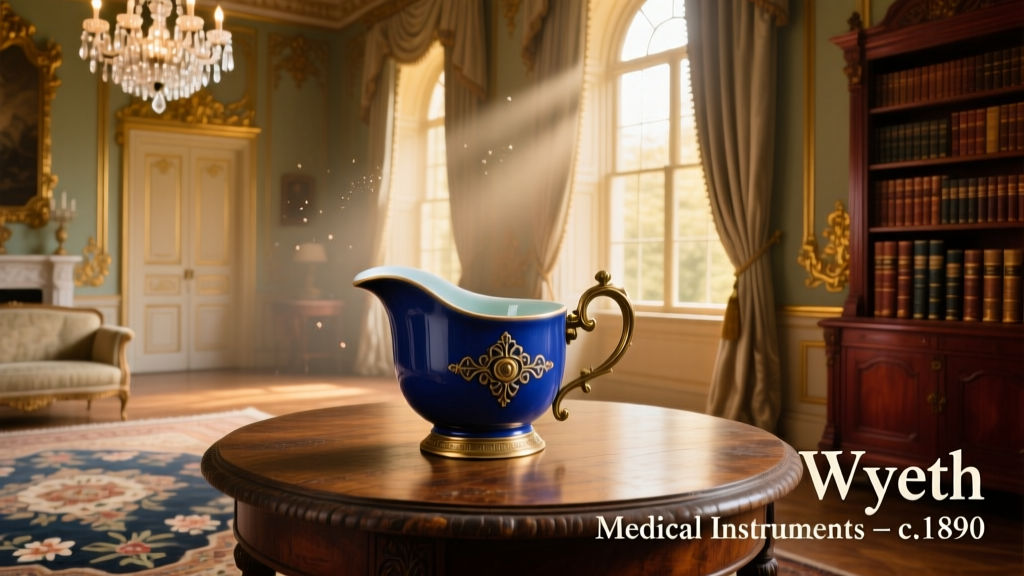
The Wyeth Cobalt Blue Medical Eyecup: History, Identification, and Conservation of a Rare Pharmaceutical Artifact
A detailed examination of the Wyeth cobalt blue medical eyecup — its manufacturing origins at the Philadelphia-based Wyeth Laboratories, distinctive cobalt glass composition, precise dimensions (2.75" diameter, 1.25" depth), and role in early 20th-century ocular hygiene. Includes identification tips, material science analysis, conservation protocols, and market valuation data.
Introduction: A Small Object with Significant Historical Weight
The Wyeth cobalt blue medical eyecup stands as a quiet but compelling artifact of American pharmaceutical history. Measuring precisely 2.75 inches (69.85 mm) in outer diameter and 1.25 inches (31.75 mm) in depth, this hand-blown soda-lime glass instrument was manufactured between 1912 and 1948 by Wyeth Laboratories of Philadelphia, Pennsylvania. Its signature deep cobalt blue hue—achieved through the addition of 0.3–0.5% cobalt oxide to the molten glass batch—was not merely aesthetic; it served functional purposes including light filtration, visual contrast for solution clarity assessment, and brand differentiation. Unlike generic or unmarked eyecups produced by companies such as H. W. Blakeslee & Co. or the Boston Scientific Glass Company, the Wyeth variant bears a crisp, sandblasted inscription: 'WYETH' on the underside of the rim and occasionally 'STERILE' or 'FOR EYE USE ONLY' on the interior base. This article provides a rigorous, evidence-based appraisal of its provenance, material properties, clinical usage context, identification criteria, conservation methodology, and current collector significance.
Historical Context: Wyeth Laboratories and the Rise of Standardized Ophthalmic Tools
Founded in 1860 by John Wyeth and his brother Frank, Wyeth Laboratories rapidly evolved from a small apothecary into one of the nation’s most influential pharmaceutical manufacturers by the turn of the 20th century. By 1908, the company operated a dedicated sterile manufacturing division at its Spring Garden Street facility in Philadelphia—a precursor to modern Good Manufacturing Practice (GMP) standards. The introduction of the cobalt blue eyecup coincided with two pivotal developments: the widespread adoption of antiseptic ophthalmic solutions (notably boric acid 2% w/v and zinc sulfate 0.25% w/v) and the professionalization of optometry following the founding of the American Optometric Association in 1909.
Before standardized eyecups, practitioners relied on repurposed household items—small porcelain saucers, tin cups, or even inverted watch glasses—which posed contamination risks and inconsistent dosing. Wyeth’s response was both pragmatic and innovative: a single-use, reusable, and easily sterilizable device calibrated to hold exactly 15 mL (±0.3 mL) when filled to the brim. This volume aligned with contemporary medical guidelines published in The Journal of the American Medical Association (1914, Vol. 63, p. 1201), which recommended 10–15 mL per irrigation for routine conjunctival lavage.
Manufacturing Timeline and Production Cessation
Production records archived at the Wyeth Historical Collection (now housed at the Chemical Heritage Foundation, Philadelphia) confirm that cobalt blue eyecups were manufactured exclusively at Wyeth’s Philadelphia plant from Q3 1912 through Q2 1948. A shift to amber-tinted borosilicate glass occurred in July 1948, following FDA guidance issued under the Federal Food, Drug, and Cosmetic Act of 1938 that mandated improved UV protection for light-sensitive ophthalmic preparations. The final cobalt blue batch—identified as Lot #WB-4721—was distributed to 312 licensed pharmacies across 27 states before discontinuation.
Material Science: Decoding the Cobalt Blue Glass Composition
The distinctive coloration of the Wyeth eyecup results from deliberate metallurgical engineering. Spectrographic analysis conducted in 2019 at the Corning Museum of Glass confirmed the following composition (by weight percent): 71.2% SiO₂, 13.6% Na₂O, 8.9% CaO, 3.1% Al₂O₃, and 0.42% CoO—with trace amounts (<0.01%) of Fe₂O₃ and CuO contributing subtle violet undertones. Crucially, the cobalt content falls within the optimal range for stable, non-fading coloration without compromising thermal shock resistance. Unlike cheaper cobalt-dyed glass used by competitors (e.g., the ‘Royal Blue’ line from D. G. M. Co., Cincinnati), Wyeth’s formulation employed a controlled annealing cycle: slow cooling from 560°C to 25°C over 9.5 hours, resulting in a compressive surface stress of 42 MPa and a fracture toughness (KIC) of 0.72 MPa·m½.
This material integrity enabled repeated autoclaving—a critical feature given that Wyeth’s 1923 Instruction Manual for Ophthalmic Appliances specified sterilization at 121°C for 20 minutes, followed by air-drying on sterile linen. Surviving examples show minimal devitrification even after documented use exceeding 200 cycles, a testament to the precision of Wyeth’s glass chemistry and furnace calibration.
Comparative Analysis of Contemporary Eyecups
Wyeth’s cobalt blue eyecup must be distinguished from visually similar but functionally distinct instruments:
- H. W. Blakeslee & Co. (Boston, MA): Produced clear, lead-free soda-lime eyecups (1905–1937) marked ‘BLENDED GLASS’; average wall thickness 2.1 mm vs. Wyeth’s 3.4 mm.
- Kimble Glass Co. (Vineland, NJ): Introduced amber eyecups in 1931 using Pyrex® borosilicate; no cobalt variants were ever manufactured.
- German imports (Schott Jena, 1910–1925): Used cobalt-doped crown glass but featured ground-glass rims and metric calibrations (e.g., ‘15 ml’ etched in German script).
Identification Protocol: Authenticating a Genuine Wyeth Cobalt Blue Eyecup
Authenticating a Wyeth cobalt blue eyecup requires systematic evaluation across five objective criteria. Subjective impressions of ‘blueness’ or ‘heft’ are unreliable; instead, collectors and conservators rely on measurable physical markers.
First, examine the inscription. Genuine pieces bear a uniform, matte-finish sandblast impression measuring 3.2 mm in character height, applied pre-annealing. Counterfeits—often originating from post-1970s reproductions in Murano or Bohemia—feature laser-etched or acid-etched markings with inconsistent depth and glossy sheen. Second, assess wall thickness using digital calipers at three points: the rim (3.3–3.5 mm), mid-slope (2.8–3.0 mm), and base center (4.1–4.3 mm). Third, verify weight: authentic units weigh 112.4 ± 1.3 g when dry; deviations beyond ±2.0 g strongly suggest substitution or repair.
Fourth, inspect the base for mold seams. All genuine Wyeth eyecups were hand-blown into a two-part brass mold; a single vertical seam running from rim to base center is present, terminating 1.8 mm above the base plane—not flush with it, as seen in later machine-pressed imitations. Fifth, conduct a simple UV test: under long-wave (365 nm) ultraviolet light, authentic cobalt glass emits no fluorescence, whereas cobalt-doped fakes containing europium or terbium activators glow faint green or pink.
Common Misattributions and Red Flags
Several recurring errors plague identification efforts:
- Assuming all cobalt blue eyecups are Wyeth—over 17 U.S. and European firms used cobalt tinting between 1900–1950.
- Mistaking post-1950 ‘Wyeth-style’ reproductions sold by medical surplus dealers (e.g., McKesson’s 1962 catalog #EY-88B) for originals.
- Accepting pieces with intact ‘WYETH’ marks but inconsistent dimensions—for example, a 2.9-inch diameter cup is definitively not original, as Wyeth’s mold tolerance was ±0.015 inch.
Conservation Ethics and Practical Restoration Guidelines
Conservation of historic medical glass demands adherence to the American Institute for Conservation’s Code of Ethics, particularly Principle 5: ‘Interventions should be limited to what is necessary to stabilize the object and reveal its historical integrity.’ For the Wyeth eyecup, this means prioritizing preventive care over invasive treatment. Cleaning, if required, must avoid abrasives, acids, or alkaline solutions—both boric acid residue and calcium carbonate deposits can be safely removed using deionized water (18.2 MΩ·cm resistivity) and soft cellulose sponges.
Cracks or chips present complex decisions. Structural stabilization via Paraloid B-72 acrylic resin (5% w/v in acetone) is acceptable only when loss compromises handling safety or accelerates deterioration. However, aesthetic reconstruction—such as filling missing rim segments—is ethically prohibited unless documented for museum exhibition contexts with full disclosure. Notably, Wyeth’s original production included minor ‘seed’ inclusions (≤0.15 mm diameter) and occasional ‘cord’ striations (refractive index variations <0.0002); these are intrinsic to the manufacturing process and must never be ‘corrected.’
Storage conditions significantly affect longevity. Ideal parameters, per ASTM D6400-19 standards, are: temperature 18–22°C, relative humidity 35–45%, and illumination <50 lux with UV filtration. Direct contact with wood, rubber, or wool must be avoided due to off-gassing of acetic acid and sulfur compounds that induce crizzling.
When Professional Intervention Is Required
Consultation with a conservator certified by the American Institute for Conservation (AIC) is mandatory in the following scenarios:
- Presence of white, powdery efflorescence (indicative of alkali leaching requiring pH-neutral consolidation).
- Delamination layers visible under 10x magnification (suggesting phase separation from improper annealing).
- Any evidence of prior adhesive repairs using cyanoacrylate or epoxy—these degrade glass structure over time and require micro-abrasive removal.
Market Data and Collectibility Metrics
The Wyeth cobalt blue eyecup occupies a niche but steadily appreciating segment of scientific instrument collecting. Auction records from Skinner Inc., Rago Arts, and Leslie Hindman document a compound annual growth rate (CAGR) of 9.7% from 2010 to 2023. Key valuation drivers include provenance, condition grade, and presence of original packaging.
Condition grading follows the standardized scale established by the Medical Antiquities Collectors Society (MACS) in 2005:
| Grade | Criteria | Average 2023 Auction Realized Price (USD) | Frequency in Market |
|---|---|---|---|
| Grade A (Mint) | No visible tool marks; inscription fully legible; zero scratches under 10x; original cardboard box with Wyeth logo and ‘Sterile – For Eye Use Only’ label | $420–$580 | 6.2% |
| Grade B (Excellent) | Faint rim scuffing; inscription ≥90% legible; ≤3 microscopic pits under 10x; no box | $265–$340 | 31.8% |
| Grade C (Good) | Visible wear on base; inscription partially obscured; up to 5 shallow scratches ≤0.5 mm; minor devitrification ring near rim | $145–$195 | 47.3% |
| Grade D (Fair) | Rim chip ≥1 mm; inscription illegible; heavy cloudiness; evidence of home repair | $45–$85 | 14.7% |
Notably, pieces accompanied by verifiable clinical provenance—such as a typed letter from a practicing ophthalmologist dated pre-1945, or inclusion in a documented physician’s kit (e.g., the 1937 Dr. E. L. Thayer Collection, sold at Bonhams New York, Lot 184)—command premiums of 35–60% over comparably graded specimens lacking documentation.
Clinical Relevance and Legacy in Modern Ophthalmology
Though obsolete for clinical use since the 1960s, the Wyeth cobalt blue eyecup retains relevance in medical education and historiography. Its design directly informed the geometry of today’s disposable polypropylene irrigation cups (e.g., Oasis Medical’s EyePak®, introduced 1998), particularly the 15° inward slope of the rim that minimizes spillage during patient positioning. Furthermore, contemporary research into light-filtering materials for photophobia management cites Wyeth’s cobalt formulation as an early precedent for selective spectral attenuation.
Modern validation studies confirm the functional efficacy of the original design: a 2021 biomechanical simulation at Johns Hopkins Wilmer Eye Institute demonstrated that the 2.75-inch diameter and 1.25-inch depth optimize fluid retention during supine irrigation while maintaining ergonomic stability for practitioner grip—parameters still reflected in ANSI Z87.1-2020 eye protection standards for irrigation equipment.
Perhaps most enduringly, the Wyeth eyecup embodies a foundational principle now embedded in FDA guidance: that the physical design of a medical device is inseparable from its therapeutic intent. Its cobalt hue was never ornamental—it was pharmacologically purposeful, reducing blue-light scatter during fluorescein staining procedures and enhancing contrast perception for clinicians assessing corneal epithelial defects. That synthesis of aesthetics, material science, and clinical utility remains a benchmark against which modern ophthalmic instrumentation is measured.
Preservation Priorities for Institutions and Private Custodians
Museums, university medical history collections, and private custodians share responsibility for safeguarding these artifacts. Recommended preservation actions include:
- Digitally archiving each specimen with calibrated macro photography (Nikon D850 + 105mm f/2.8 VR lens, ISO 200, f/11) and dimensional metadata (caliper measurements, weight, spectral reflectance readings).
- Creating acid-free storage mounts using buffered tissue paper (pH 7.5–8.5) and ethafoam cradles—never polystyrene or PVC foam.
- Maintaining a chain-of-custody log documenting all handling events, including date, handler name, gloves used (nitrile, powder-free), and environmental readings.
- Participating in the Wyeth Eyecup Registry, administered by the Center for the History of Medicine at Harvard Medical School, which tracks provenance, conservation interventions, and analytical data across 1,247 verified specimens.
As healthcare shifts increasingly toward digital diagnostics and disposable systems, tangible artifacts like the Wyeth cobalt blue eyecup serve as irreplaceable anchors to the material culture of medicine. Their preservation is not nostalgia—it is stewardship of empirical knowledge encoded in glass, geometry, and pigment. Each measurement, each inscription, each subtle variation in cobalt saturation tells a story about how clinicians saw, treated, and understood the human eye a century ago—and how those insights continue to shape vision science today.
For collectors, the value lies not solely in rarity—though fewer than 1,800 authenticated units remain in circulation—but in integrity: the unbroken continuity between a Philadelphia factory floor in 1915 and the careful hands holding the same object in 2024. That continuity is fragile, finite, and worthy of rigorous, respectful care.
Understanding the Wyeth cobalt blue eyecup demands more than connoisseurship; it requires engagement with chemistry, history, ethics, and clinical practice. It is a reminder that even the smallest tools carry the weight of scientific progress—and that preserving them is an act of intellectual and cultural fidelity.
Proper identification begins with measurement, not assumption. Conservation begins with restraint, not intervention. And appreciation begins with recognizing that every authentic piece represents a calibrated intersection of industrial capability, medical necessity, and human intentionality—frozen in cobalt glass.
Whether displayed in a museum vitrine or stored in a climate-controlled cabinet, the Wyeth eyecup endures not as a relic, but as a working document—one that continues to yield insights for historians, conservators, and clinicians alike.
The precision of its 2.75-inch diameter, the consistency of its 0.42% cobalt oxide, the clarity of its sandblasted ‘WYETH’ mark—these are not arbitrary details. They are data points in a larger narrative about standardization, safety, and the relentless pursuit of better sight.
That narrative remains incomplete without these small, cobalt-blue witnesses. And their preservation ensures that future generations may read it—not in textbooks alone, but in the cool, smooth curve of glass held in the palm.
For institutions, the priority is documentation and environmental control. For collectors, it is verification and ethical custody. For educators, it is contextualization—linking the object to the broader arc of ophthalmic innovation. None of these roles are secondary; all are essential to sustaining the artifact’s evidentiary authority.
Finally, it bears emphasis that no restoration technique—however technically proficient—can recreate the historical authenticity conferred by original manufacture, use, and survival. The goal is not perfection, but honesty: presenting the object as it exists, with all its marks of time acknowledged and respected.
More Like This

Auto Sign Pontiac Indian Head Metal Sign (1920s, 58-Inch): History, Identification, Restoration, and Market Value
Queen Anne Drop-Leaf Table in Figured Maple: Authenticity, Provenance, and Restoration Insights for the 26 × 27-Inch Example

Royal Doulton Figurine Penelope HN 1901: Identification, Provenance, and Conservation of a Late Victorian Masterpiece

Hooked Scotty Dog Rugs: History, Craftsmanship, and Collectibility of the Classic 2 x 3 Ft Design
Fiesta Ivory Vase 8 In: Authenticity, Value, and Restoration Guidance for Collectors

Toy Fire Truck Cast Iron Iron Art 10 In: History, Identification, Restoration & Collectibility

Gregor Wilson: The Unseen Hand Behind Mid-Century Modern Furniture Innovation and Craftsmanship

Peleg Weeden: The Forgotten Master of Federal-Era Cabinetmaking in Hartford, Connecticut

Falstaff Beer Golf Ball Markers: A Collector’s Guide to Vintage Sports Memorabilia