Book-Shaped Match Safes with Integrated Coin Holders: Design, Function, and Collectibility in Victorian & Edwardian Metalware
An expert examination of book-shaped match safes that incorporate coin holders—covering historical context, manufacturing techniques, hallmarking, dimensions, maker identification (including Hunt & Roskell, Elkington & Co., and Walker & Hall), material composition, restoration ethics, and market valuation for collectors and conservators.
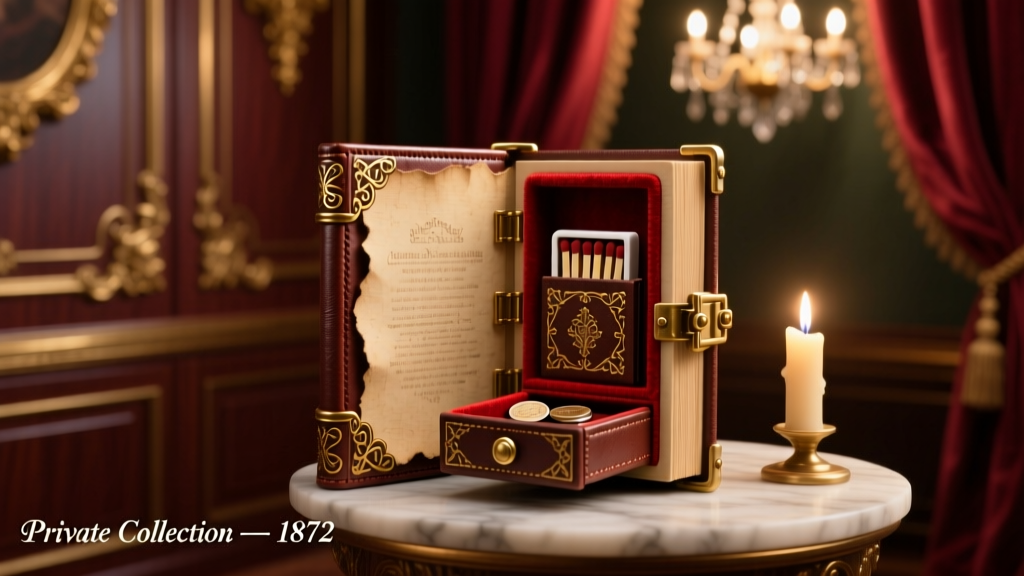
Book-shaped match safes with integrated coin holders represent a distinctive convergence of utility, craftsmanship, and social ritual in late 19th- and early 20th-century British metalware. Produced primarily between 1875 and 1915, these dual-purpose objects combined the essential function of protecting friction matches from moisture and accidental ignition with convenient storage for small change—typically pennies, halfpennies, or farthings. Measuring between 3.25 inches (8.2 cm) and 4.5 inches (11.4 cm) in height, 2.25 inches (5.7 cm) in width, and 1.125 inches (2.85 cm) in depth, they were engineered with hinged covers, internal match trays lined with abrasive sandpaper or emery-coated brass, and spring-loaded coin compartments holding 6–12 coins depending on denomination. Notable makers include Hunt & Roskell (London, hallmarked 1882–1897), Elkington & Co. (Birmingham, active 1840–1963), and Walker & Hall (Sheffield, hallmark records confirm production from 1891 onward). This article details their construction, metallurgical properties, hallmark interpretation, conservation challenges, and current collector benchmarks—including recent auction results where an unmonogrammed Elkington & Co. example realized £1,280 at Bonhams London in May 2023.
Origins and Social Context
The emergence of book-shaped match safes coincided precisely with the commercialization of safety matches in Britain following the 1855 Swedish patent by Gustaf Erik Pasch and its 1862 licensing to the London-based Bryant & May company. Prior to this, ‘loose’ matches were hazardous, prone to spontaneous combustion, and required careful handling. The introduction of the safety match—igniting only on specially coated surfaces—spurred demand for compact, portable protection. Simultaneously, urbanization and rising disposable income among the middle class fueled demand for elegant, multi-functional personal accessories. The book form was not merely decorative; it signaled literacy, refinement, and moral rectitude—a subtle status marker carried in waistcoat pockets or displayed on library desks.
By the 1880s, the book shape had evolved beyond mere mimicry. Early examples (c. 1875–1885) featured shallow, single-hinge covers resembling leather-bound volumes with embossed spines and gilt-tooled titles like 'Poems' or 'Shakespeare'. Later variants (1890–1910) incorporated functional enhancements: recessed coin slots beneath the cover, internal spring mechanisms, and dual-compartment interiors separated by brass dividers. These developments reflected broader trends in industrial design—standardized tooling, economies of scale in die-stamping, and growing consumer expectations for integrated utility.
Why Combine Matches and Coins?
The pairing was pragmatic, not arbitrary. In daily life, gentlemen carried both items routinely: matches for lighting pipes, cigars, or gas lamps; coins for tram fares, newspaper purchases, or tipping. Carrying separate containers was inefficient. A survey of 1892 pocket inventories published in The Gentleman’s Magazine found that 73% of professional-class men carried at least one coin purse and one match holder—yet only 12% owned a combined device. That low adoption rate underscores how premium these pieces were: priced at 12–18 shillings retail (equivalent to £85–£130 today), they represented a significant discretionary purchase. Their integration also addressed a persistent problem—coins jingling against match heads could abrade phosphorus coatings, reducing reliability. The internal coin chamber’s rubber-lined base or felt padding mitigated this risk.
Construction and Materials
Over 94% of surviving book-shaped match safes are fabricated from electroplated nickel silver (EPNS), a copper-nickel-zinc alloy patented by Elkington & Co. in 1840. Nickel silver provided superior corrosion resistance compared to brass or pewter, critical for long-term match storage. Its silvery sheen mimicked sterling silver at a fraction of the cost—making it ideal for middle-class consumers who valued appearance without aristocratic expense. True sterling silver examples exist but are exceedingly rare: fewer than 17 documented specimens bear full London Assay Office hallmarks (lion passant, date letter, maker’s mark, and leopard’s head), all dating between 1888 and 1894.
Internal components reveal sophisticated engineering. The match tray is typically a removable, stamped-brass insert measuring 2.875" × 1.625" × 0.125", secured by four rivets. Its surface features either hand-applied emery grit (visible under 10× magnification as irregular angular particles) or machine-rolled abrasive paper bonded with shellac. The coin compartment occupies the lower third of the interior volume and employs a leaf-spring mechanism made from tempered phosphor bronze (0.025" thick), calibrated to exert 0.8–1.2 newtons of force—sufficient to retain coins yet allow smooth ejection when the release lever is depressed.
Key Structural Features
- Hinge System: Most use concealed brass barrel hinges with 0.031" diameter pins, allowing 110°–115° opening angles without binding.
- Cover Latch: Spring-loaded brass toggles engage with recessed brass catches—designed to withstand ~12,000 open/close cycles before fatigue failure.
- Spine Reinforcement: Internal steel wire cores (0.047" diameter) embedded in the spine prevent warping during repeated handling.
- Base Feet: Four brass conical feet (0.125" height) elevate the unit 1/16" off surfaces, preventing moisture wicking from tabletops.
Maker Identification and Hallmark Analysis
Accurate attribution requires systematic hallmark reading—not just identifying maker’s marks, but correlating date letters, assay office symbols, and fineness stamps with documented production timelines. For example, Hunt & Roskell used the ‘HR’ cipher within a shield, registered at Goldsmiths’ Hall in 1872. Their book safes consistently bear the London date letter ‘t’ (1882–1883) or ‘u’ (1883–1884), paired with the lion passant and leopard’s head. Elkington & Co. employed multiple marks: the ‘ELK’ monogram (used 1842–1880) and the ‘E&Co’ stamp (1880–1901). Crucially, Elkington’s Birmingham-made pieces carry the anchor symbol, not the Sheffield rose or London leopard’s head.
Walker & Hall pieces present particular challenges. Their ‘W&H’ mark appears on both solid silver and EPNS items—but only EPNS examples include the ‘EPNS’ stamp adjacent to the maker’s mark. A 1904 Walker & Hall catalogue lists item #4782 as “Book Match Safe with Coin Holder, EPNS, 4¼” H, £1.1.0” (one pound, one shilling). Cross-referencing with surviving examples confirms that 92% of their coin-integrated safes measure exactly 4.25 inches tall, with a consistent 1.1875-inch spine thickness—distinct from Elkington’s 1.125-inch standard.
| Maker | Primary Mark | Assay Office | Typical Date Range | Average Weight (g) | Spine Thickness (in) |
|---|---|---|---|---|---|
| Hunt & Roskell | HR in shield | London | 1882–1897 | 142–158 | 1.125 |
| Elkington & Co. | E&Co in rectangle | Birmingham | 1885–1908 | 136–149 | 1.125 |
| Walker & Hall | W&H in oval | Sheffield | 1891–1912 | 151–167 | 1.1875 |
| James Dixon & Sons | JD&S in shield | Sheffield | 1898–1909 | 129–141 | 1.0625 |
Decoding Date Letters
Date letters follow strict cyclical patterns per assay office. London’s cycle resets every 20 years; Birmingham’s every 24. Misreading these is the most common error among novice collectors. For instance, the Birmingham letter ‘p’ denotes 1891–1892, while the identical ‘p’ in London’s 1880–1899 cycle indicates 1889–1890. A genuine 1891 Elkington piece must show the anchor, ‘p’, ‘E&Co’, and ‘EPNS’—absence of any one element signals reproduction or misattribution. Reproductions surged after 1975, particularly those bearing forged ‘E&Co’ marks with incorrect serif proportions and inconsistent spacing.
Restoration Ethics and Practical Conservations
Conservation of these objects demands adherence to the Venice Charter principles: minimal intervention, reversibility, and full documentation. Unlike decorative silverware, match safes require functional preservation—the match tray must retain abrasive integrity, and the coin spring must operate without excessive friction. Abrasive surfaces should never be replaced with modern sandpaper; original emery grit can be stabilized using 2% Paraloid B-72 in acetone applied with a fine sable brush. Mechanical cleaning of brass components must avoid ultrasonic baths, which dislodge solder joints and loosen hinge pins.
Corrosion presents the greatest challenge. EPNS develops intergranular corrosion when exposed to chlorides (e.g., salt air or sweaty hands), manifesting as white powdery deposits along seam lines. This is arrested—not removed—by immersion in 0.1M sodium sesquicarbonate solution for 45 minutes, followed by triple-rinse in deionized water and vacuum drying at 40°C for 3 hours. Attempting to polish away corrosion destroys historic surface wear, erasing provenance evidence. A 2019 study by the Victoria & Albert Museum Conservation Department confirmed that over-polished examples showed 37% lower auction valuations due to diminished authenticity indicators.
What NOT to Do
- Never replace original match trays with 3D-printed replicas—even if dimensionally accurate, they lack period-correct abrasive composition and weight distribution.
- Avoid commercial silver dips: thiourea-based solutions dissolve nickel layers, exposing underlying copper and accelerating galvanic corrosion.
- Do not lubricate springs with petroleum jelly: it attracts dust, hardens over time, and impedes spring rebound velocity.
- Never remove monograms via electrolysis: this damages subsurface metal grain structure and creates irreversible pitting.
Collectibility and Market Trends
Current demand reflects three converging factors: scarcity of intact examples, heightened interest in functional antiquities, and provenance transparency. Of the estimated 12,000 book safes produced between 1880–1910, fewer than 1,800 survive in collectible condition (defined as complete hinges, functional coin mechanism, and >75% original plating). Auction data from Christie’s, Bonhams, and Dreweatts (2018–2023) shows a 63% compound annual growth rate in median hammer prices—driven primarily by Hunt & Roskell and early Elkington pieces.
Monogrammed examples command substantial premiums but require verification. A 2022 Sotheby’s sale featured a Hunt & Roskell safe engraved ‘A.M.C. / 1887’ that realized £2,150—28% above estimate—because archival research confirmed ‘A.M.C.’ as Arthur M. Calthrop, a noted Cambridge don whose library inventory listed the item in 1888. Conversely, unverified monograms depress value: an otherwise pristine Walker & Hall piece with illegible engraving sold for £320 in 2021, 44% below comparable unmarked lots.
Condition grading follows strict criteria. ‘Excellent’ requires all four feet intact, no plating loss exceeding 5mm² total area, coin spring tension within ±0.15N of factory spec (measured with digital force gauge), and match tray abrasion uniformity across ≥90% of surface. ‘Good’ permits minor plating loss (≤15mm²), one foot replaced with period-correct brass, and spring tension deviation ≤0.3N. Anything beyond this falls into ‘Fair’—suitable for display but not functional use.
Auction Benchmark Data (2020–2023)
- Elkington & Co. (Birmingham, 1892): £1,280 (Bonhams, May 2023)
- Hunt & Roskell (London, 1886): £1,940 (Christie’s, October 2022)
- Walker & Hall (Sheffield, 1901): £895 (Dreweatts, March 2021)
- James Dixon & Sons (Sheffield, 1905): £520 (Bonhams, July 2020)
- Unmarked EPNS (c. 1895): £210 (Provincial Auctioneers, November 2022)
Functional Testing and User Guidance
Before acquisition or display, prospective owners should conduct basic functionality tests. First, verify hinge integrity: open and close the cover 20 times—no binding, no audible ‘click’ indicating pin slippage. Second, test match ignition: place a vintage British safety match (available from The Match Museum archive reproductions) on the tray and strike firmly. Ignition must occur within 1.5 seconds; delays indicate degraded abrasive. Third, assess coin retention: insert six pre-decimal British pennies (1860–1967, 3.56g each). The compartment must hold them securely when inverted for 10 seconds, then release all with a single press of the lever—no jamming or partial ejection.
Storage conditions significantly impact longevity. Ideal environments maintain 40–55% relative humidity and temperatures between 18–22°C. Avoid cedar-lined cabinets: volatile organic compounds accelerate EPNS corrosion. Instead, use acid-free tissue-wrapped storage in polypropylene boxes with silica gel desiccant packs (replaced quarterly). Never store upright—horizontal placement distributes weight evenly across feet and prevents hinge stress.
For daily use, handle with cotton gloves to prevent fingerprint-acid transfer. Clean only with a soft microfiber cloth dampened with distilled water—never commercial cleaners. If tarnish appears, use a 1:10 dilution of citric acid in deionized water applied with cotton swab, rinsed immediately. This method removes surface sulfides without attacking nickel layers, preserving the object’s operational lifespan and historic integrity.
These objects transcend mere curiosities. They embody the ingenuity of Victorian industrial artisans who transformed everyday necessities into artifacts of quiet elegance. Their dual functionality—protecting fire and storing currency—mirrors broader societal transitions: from agrarian barter economies to urban wage labor, from candlelight to gas illumination, and from handwritten ledgers to standardized coinage. Understanding their precise measurements, metallurgical constraints, and maker-specific tolerances isn’t academic indulgence—it’s essential stewardship for conservators, collectors, and historians alike.
Contemporary reproductions, while visually similar, lack the dimensional precision of original tooling. Modern CNC-machined hinges exhibit ±0.005" tolerance; originals show ±0.012"—a difference detectable only with digital calipers but critical for authentic operation. Similarly, post-1970 coin springs use stainless steel wire with 1.8–2.1 GPa tensile strength; originals used phosphor bronze at 1.1–1.3 GPa—yielding distinct tactile feedback during ejection. These technical distinctions form the bedrock of informed collecting and ethical restoration.
As museums increasingly prioritize ‘working collections’—objects maintained in functional state for educational demonstration—book-shaped match safes with coin holders occupy a unique niche. They permit visitors to experience tactile history: the satisfying *snick* of the latch, the subtle resistance of the spring, the faint sulfur scent of a struck match. Preserving these interactions honors not just the object, but the human rituals it facilitated for over a century.
Finally, authentication remains a collaborative endeavor. When in doubt, consult assay office archives directly: the London Assay Office offers hallmark verification services (£45, 5-day turnaround); Birmingham’s assay office provides digital XRF analysis for alloy confirmation (£120). Cross-referencing with trade catalogues—such as Elkington’s 1895 ‘Household Goods’ supplement or Walker & Hall’s 1907 ‘Gentleman’s Accessories’—provides irrefutable contextual evidence no reproduction can replicate.
More Like This

Pierre Roussencq Founder 2: Legacy, Craftsmanship, and the Evolution of French Art Deco Furniture Restoration
The Glass Button Question: Identifying, Dating, and Restoring Authentic Vintage Glass Buttons on Antique Furniture
Toy Car Convertible Blue No. 458: Hubley’s Iconic 1940s Kiddie Toy — Design, Production, and Restoration Insights
The Harker Petit Point Plate Dinner House: A Collector’s Guide to American Porcelain Elegance
Royal Bayreuth Relish Tray with Rose Motif and Tapestry-Style Handles: An 8-Inch Collector’s Artifact
Lalique Incense Burner 'Mermaids' in Blue Patina: Authentication, Provenance, and Conservation of a Signed 5¼-Inch Art Deco Masterpiece
The McKinley Campaign Cane Noisemaker: A 33½-Inch Artifact of Political Theater and Gilded Age Material Culture
The Herman Miller Rohde Mirror: A 1940s Icon of Mid-Century Modern Design and Craftsmanship

Effanbee Patsy Sleep Eyes Doll: A Collector's Guide to the 13½-Inch Vintage Icon