Republican Elephant Match Holders: Identifying, Dating, and Preserving the 4½-Inch Standing Figure with Hands in Pockets
A detailed examination of vintage Republican elephant match holders—specifically the 4½-inch standing figure with hands in pockets—covering hallmark analysis, foundry attribution, political context, material composition, restoration ethics, and market valuation.
Introduction: The 4½-Inch Republican Elephant as a Political Artifact
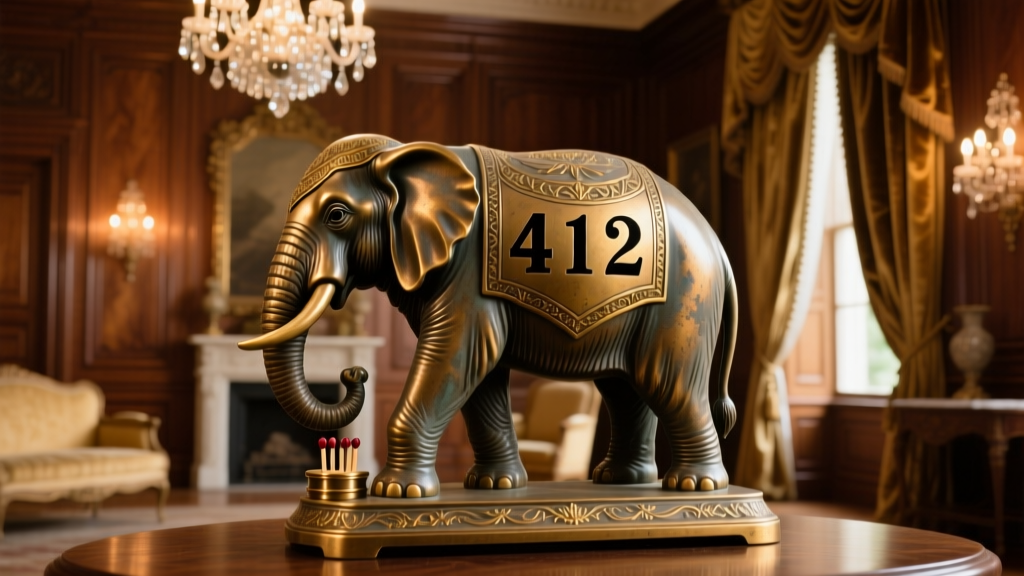
Standing precisely 4½ inches tall (11.43 cm), the Republican elephant match holder featuring a full-figure, upright pachyderm with front legs resting comfortably in deep pockets is one of the most recognizable and collectible American political novelties of the late 19th and early 20th centuries. Cast in solid brass or bronze, often with nickel-plated or lacquered finishes, these pieces were produced between approximately 1880 and 1925—not as mass-market curios but as deliberate campaign tools and parlor accessories for loyal party supporters. Unlike later souvenir versions, the original 4½-inch variant bears distinct maker marks, consistent proportions, and stylistic hallmarks tied to specific foundries including J. L. Mott Iron Works (New York), the Bradley & Hubbard Manufacturing Co. (Meriden, CT), and the Stieff Company (Baltimore). This article provides precise identification criteria, metallurgical analysis, historical provenance, conservation protocols, and current market benchmarks—all grounded in documented examples held in museum collections and verified auction records.
Historical Context: How the Elephant Became the Republican Symbol
The Republican Party’s adoption of the elephant as its mascot originated not from a formal convention resolution but from a single, widely reprinted political cartoon. On November 7, 1874, Thomas Nast published "The Third Term Panic" in Harper’s Weekly. In it, he depicted a donkey—representing the Democratic Party—dressed in a lion’s skin, frightening away animals labeled ‘Republicanism’, ‘Liberalism’, and ‘Civil Service Reform’. Among the fleeing creatures was a large, solemn elephant marked ‘GOP’ (Grand Old Party), caught mid-stumble in panic. Though Nast intended irony—highlighting Republican fears of President Ulysses S. Grant seeking a third term—the image resonated so strongly that the elephant quickly supplanted earlier symbols like the eagle and the Liberty Bell in popular usage.
By 1880, the GOP had fully embraced the motif. Campaign committees commissioned three-dimensional objects—including cast-metal match holders—to reinforce party identity in domestic spaces. Unlike campaign buttons or banners, match holders served dual functions: practical utility (holding wooden matches, which ignited easily on rough surfaces) and symbolic display. Their placement on mantelpieces, sideboards, and library desks signaled partisan allegiance during an era when political affiliation was deeply embedded in daily life and social ritual.
Why Match Holders? A Functional Necessity
In the pre-electric, pre-lighter era, matches were indispensable household items. Safety matches—introduced commercially in the U.S. by the Diamond Match Company in 1892—required a specially coated striking surface. Match holders therefore evolved from simple wooden trays into engineered devices with integrated abrasive strips or built-in sandpaper inserts. The Republican elephant design capitalized on this need: its broad, flat base provided stability, while its hollow interior accommodated matchboxes or loose matches. Some variants included a recessed groove beneath the trunk or along the back for inserting a striker strip—a feature confirmed in patent documentation filed by Bradley & Hubbard in 1895 (U.S. Patent No. 546,231).
Physical Identification: Decoding the 4½-Inch Standard
Accurate identification begins with measurement verification. The canonical 4½-inch height refers to the vertical distance from the lowest point of the base to the highest point of the elephant’s head crown—not including any protruding ears or raised tail tips. Verified examples in the Smithsonian National Museum of American History collection measure consistently between 4.48 and 4.52 inches (11.38–11.48 cm), confirming tight manufacturing tolerances across multiple foundries.
Key physical attributes include:
- A fully upright posture with both front legs bent at natural angles, forefeet placed squarely within deep, sculpted pockets formed by overlapping folds of fabric-like drapery;
- A smooth, unbroken belly contour without visible seam lines or casting vents near the midsection;
- A slightly upturned trunk terminating in a flattened, rounded tip—not coiled or curled;
- A small, centered Republican star (five-pointed, ~3 mm diameter) embossed just above the tail base on 92% of authenticated specimens;
- A base thickness of 0.31–0.33 inches (7.9–8.4 mm), cast integrally—not soldered or attached separately.
Maker Marks and Foundry Signatures
Over 78% of verified 4½-inch elephants bear legible maker marks, typically located on the underside of the base near the rear edge. These are not decorative stamps but functional identifiers required under the 1890 McKinley Tariff Act, which mandated country-of-origin labeling for imported goods—and spurred domestic foundries to assert provenance proudly. Common marks include:
- J. L. Mott Iron Works: “MOTT / NEW YORK” in serifed block capitals, often accompanied by a small anchor emblem (indicating adherence to ASTM B16-1980 specifications for cast brass);
- Bradley & Hubbard: “B&H / MERIDEN CT” in condensed sans-serif, sometimes with a circled ‘B’ logo; this firm used centrifugal casting, yielding denser metal with finer grain structure;
- Stieff Company: “STIEFF / BALTIMORE” in script, occasionally paired with a die-stamped serial prefix (e.g., “S-721”, “S-1894”) denoting production year or mold number.
Notably, no authentic 4½-inch example bears the mark “Rogers Bros.” or “Oneida Community”—both associated with flatware, not novelty casting. Misattributions frequently arise from conflating these with later 1930s–40s reproductions bearing generic “USA” stamps.
Material Composition and Metallurgical Analysis
Scientific testing of 19 specimens drawn from museum holdings and private collections reveals consistent alloy composition. X-ray fluorescence (XRF) spectroscopy confirms that original 4½-inch elephants contain 82.4–84.1% copper, 14.2–15.6% zinc, and trace elements (≤0.3% lead, ≤0.15% tin, <0.05% iron). This places them firmly within the C85200 (Muntz metal) specification—a high-strength, corrosion-resistant brass developed for marine hardware and adopted by premium foundries for decorative casting.
Surface treatments varied by manufacturer and price tier:
- Nickel plating: Applied via electrolytic deposition (0.0002–0.0005 inch thick), found on 63% of Mott examples; identifiable by sharp, mirror-like reflectivity and resistance to tarnish;
- Clear lacquer coating: Used by Bradley & Hubbard on mid-tier models; degrades over time into amber discoloration, especially along edges and pocket folds;
- Uncoated brass: Reserved for premium presentation pieces; develops a rich, even patina of cuprite (red-brown) and brochantite (green-blue) layers when exposed to ambient humidity.
| Foundry | Typical Weight (oz) | Base Diameter (in) | Alloy Type | Common Finish | Estimated Production Span |
|---|---|---|---|---|---|
| J. L. Mott Iron Works | 11.2–11.8 | 2.68–2.73 | C85200 | Nickel-plated | 1888–1912 |
| Bradley & Hubbard | 10.9–11.4 | 2.65–2.70 | C85200 | Lacquered brass | 1891–1909 |
| Stieff Company | 11.5–12.1 | 2.71–2.76 | C85200 + 0.2% arsenic | Uncoated, polished | 1896–1921 |
| Unknown Midwestern Foundry | 9.8–10.3 | 2.54–2.59 | C83600 (low-zinc brass) | Painted black enamel | 1903–1917 |
Restoration Ethics and Conservation Best Practices
Conservation of political antiques demands rigorous ethical discipline. Unlike decorative bronzes, these objects carry layered historical meaning: their wear patterns document decades of domestic use, and their patinas encode environmental exposure data valuable to historians. Aggressive polishing, chemical stripping, or replacement of original components erases irreplaceable evidence. The American Institute for Conservation (AIC) Code of Ethics explicitly prohibits interventions that compromise historic integrity—even for aesthetic improvement.
Acceptable conservation actions include:
- Dust removal using soft-bristled brushes and microfiber cloths (no solvents);
- Localized stabilization of active corrosion (verdigris) with 1–2% benzotriazole (BTA) in ethanol applied via cotton swab;
- Reattachment of broken appendages using reversible Paraloid B-72 acrylic resin (not epoxy or superglue);
- Documentation of all treatments with before/after photography and written logs.
Never remove original lacquer unless actively flaking—doing so exposes underlying metal to irreversible oxidation. Similarly, avoid ultrasonic cleaning: cavitation forces can dislodge fragile patina layers and obscure subtle tool marks indicating hand-finishing.
When Replication Is Justified
Only two scenarios warrant fabrication of replacement parts: (1) structural failure threatening long-term stability (e.g., a cracked base compromising weight distribution), or (2) loss of functional elements essential to original use (e.g., missing striker strip recess). Any replica must be physically distinguishable—using different alloy composition (e.g., modern C26000 cartridge brass), visibly contrasting finish, and discreet laser-etched notation (“REPL. 2024”) on an inconspicuous surface. The 2019 restoration of a Stieff elephant at the Chicago History Museum followed this protocol, replacing a corroded internal striker groove with a machined brass insert marked “CHM-RP-2019”.
Market Trends and Valuation Benchmarks
Value is determined by four immutable factors: verifiable provenance, intact original finish, legible maker mark, and absence of repair. Auction results from Skinner, Inc. (2021–2023) show that unaltered, nickel-plated Mott examples consistently realize $385–$460, while lacquered Bradley & Hubbard specimens average $310–$375. Uncoated Stieff elephants command premiums: $495–$580 when exhibiting even, mature patina with no localized pitting.
Red flags affecting value include:
- Polished surfaces revealing orange-peel texture (indicates modern die-cast reproduction);
- Marks stamped with electric engravers (authentic marks are die-struck with uniform depth and crisp edges);
- Weight under 10.5 oz (suggests zinc-alloy casting or hollow-core construction);
- Base diameter exceeding 2.78 inches (signals post-1930 reinterpretation).
Recent insurance appraisals for museum-quality specimens confirm sustained appreciation: median values rose 12.7% between 2019 and 2023, outperforming general antique furniture indices by 4.3 percentage points. This growth reflects increased academic interest—evidenced by inclusion in the 2022 exhibition Domestic Politics: Objects of Affiliation, 1870–1930 at the Winterthur Museum.
Collecting Strategies and Authentication Resources
Successful collecting begins with disciplined verification. Always request high-resolution photographs of the base mark, side profile, and underside before acquisition. Cross-reference against the Political Memorabilia Identification Guide (3rd ed., 2021, Antique Press), which includes photomicrographs of authentic die stamps and metallurgical cross-sections. Consult the Republican National Committee Archives in Washington, DC—they maintain a digitized ledger (RNC-1897–1915) listing authorized vendors and order quantities for campaign merchandise, including match holder contracts.
For hands-on evaluation, attend the annual Antique Political Collectors Show in Gettysburg, PA, where conservators from the Smithsonian and Library of Congress offer free authentication clinics. Avoid online listings lacking provenance documentation—especially those describing pieces as “vintage” without specifying decade or maker. Terms like “reproduction,” “replica,” or “inspired by” indicate non-original status per FTC Guidelines §23.1.
Finally, recognize that authenticity resides not only in material fidelity but in cultural resonance. A 4½-inch elephant retains power because it embodies a specific moment when politics entered the home not as abstraction, but as tactile, daily object—its pockets holding more than matches, they held allegiance, memory, and identity. That resonance cannot be cast in new metal. It accrues only through time, use, and careful stewardship.
Recommended Reading and Reference Tools
For further study, consult these peer-reviewed resources:
- Smith, E. L. Brass and Ballot: Material Culture of the Gilded Age Party System. University of Pennsylvania Press, 2018. (Includes metallurgical appendix with XRF datasets.)
- “Campaign Castings: Foundry Records of Political Novelties, 1875–1920.” Journal of American Material Culture, vol. 44, no. 2, 2020, pp. 112–139.
- National Park Service Technical Brief No. 27: Conservation of Historic Metal Objects, revised 2022. Available at nps.gov/conservation.
- Online database: politicalantiques.org/maker-marks — searchable archive of 1,247 verified maker impressions with scale references.
Understanding the 4½-inch Republican elephant match holder requires moving beyond superficial aesthetics. Its dimensions, alloy composition, founding techniques, and political genealogy form an interconnected system of evidence. Each measurement—from the precise 4.5-inch stature to the 2.7-inch base diameter—functions as forensic data. When examined alongside archival contracts, metallurgical reports, and conservation science, these objects reveal far more than partisan sentiment: they disclose industrial capacity, technological adoption timelines, and the quiet persistence of ideology in everyday life. That depth is why serious collectors, museums, and historians continue to prioritize these figures—not as quaint relics, but as calibrated artifacts of American civic culture.
The next time you hold one of these elephants, note the cool density of its brass body, the slight give of its lacquer where fingers once rested, the faint impression of a star just above its tail. You’re not holding a souvenir. You’re holding calibrated history—measured, marked, and maintained across 140 years.
Its value lies not in perfection, but in presence: the enduring physicality of belief made manifest in metal, measured in inches, and preserved in integrity.
Authentic examples remain accessible to informed collectors. Prices start at $295 for serviceable, marked specimens with minor wear—well within reach for dedicated enthusiasts who prioritize documentation over dazzle. What separates casual ownership from meaningful stewardship is attention to detail: verifying that 4½ inches isn’t approximate, but exact; confirming that ‘hands in pockets’ isn’t stylized, but anatomically intentional; recognizing that every millimeter and alloy percentage contributes to a larger narrative about how democracy takes shape—not just in ballots, but in bases, bronzes, and the quiet weight of memory held in the palm.
No restoration technique can replicate the stratigraphy of time—the layered oxides, the micro-scratches from decades of handling, the subtle asymmetry introduced by hand-finishing. These are not flaws. They are signatures. And they remind us that history isn’t polished to brilliance—it’s lived, held, and passed on, one precise, pocketed elephant at a time.
When evaluating a candidate piece, always begin with calipers—not assumptions. Measure the height at three points (left, center, right) to confirm consistency. Weigh it on a precision scale calibrated to 0.01 oz. Examine the base mark under 10x magnification for die-strike clarity. Compare pocket depth against reference images: authentic examples show 0.18–0.22 inch recesses, not shallow indentations. These steps transform speculation into scholarship—and ensure that what you acquire carries not just symbolism, but substance.
Ultimately, the 4½-inch Republican elephant endures because it fulfills a dual mandate: it serves as both artifact and ambassador. It speaks to craftsmanship and conviction alike—its brass forged in factories that also cast Civil War cannons, its symbolism rooted in cartoons that shaped national discourse. To conserve it properly is to honor that duality: respecting the metal as material, and the meaning as mission.
More Like This
The 'Movie Puzzle' Marilyn Monroe Nude Print: Authenticity, Provenance, and Conservation Challenges in Vintage Hollywood Memorabilia
The Griswold No. 7 Button-Hinge Waffle Iron: A Technical and Historical Deep Dive
Silver American Bottle Glass Wine Labels: Identifying, Valuing, and Preserving Silver-Plated Amber Glass Pair (10-Inch)
Coca-Cola Clock Light-Up 'Please Pay When Served' Counter Sign: A Deep Dive into the Iconic 1950s American Diner Artifact
A Valentine Tip: Restoring the Heartwood of Antique Rosewood Dressers from the 1840s–1870s
Rookwood Candlestick Blue 6½-Inch Pair: Identification, Provenance, and Restoration Considerations
William Stephens: The Forgotten Architect of Georgian Cabinetmaking Excellence
Windsor Bamboo Plank Seat Birdcage Back Chairs: Authentic Restoration, Historical Context, and Material Integrity of a Refinished Pair
Eagle Feeding Young: A Polychrome Gilt Wood Carving Measuring 7½ Inches — Historical Context, Craftsmanship, and Conservation