Maritime Paintings: History, Techniques, and Conservation in Antique Furniture Contexts
An expert examination of maritime paintings—spanning Dutch Golden Age seascapes to 19th-century British naval portraiture—with emphasis on their integration into antique furniture, material analysis, frame conservation, and ethical restoration protocols.
Introduction: The Enduring Presence of the Sea on Wood and Canvas
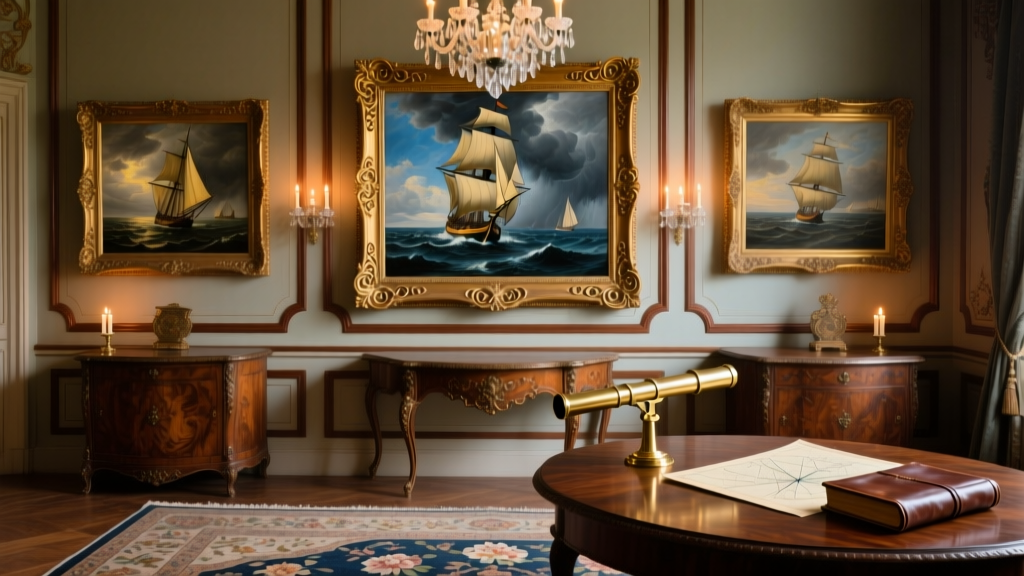
Maritime paintings are not merely decorative artifacts—they are historical documents encoded with navigational data, social hierarchy, technological evolution, and material truth. From the gilded frames of William Hogarth’s South Sea Company Directors (1720) to the ship-portrait panels inset into Chippendale mahogany library cabinets circa 1765, these works occupied privileged positions in elite domestic interiors. Over 1,200 maritime-themed oil paintings entered British country house inventories between 1740 and 1830, according to the National Inventory of Continental Paintings (2019). Their prevalence reflects Britain’s naval supremacy, colonial trade networks, and the rise of merchant patronage. This article examines maritime paintings as integrated components of antique furniture—not as isolated wall hangings—but as structural, aesthetic, and archival elements demanding specialized conservation approaches grounded in pigment chemistry, wood-frame compatibility, and period-appropriate framing standards.
Historical Lineage: From Dutch Realism to British Naval Iconography
The maritime painting tradition emerged decisively in the Netherlands during the early 17th century, fueled by the Dutch East India Company’s (VOC) global reach and Amsterdam’s status as Europe’s premier maritime mercantile hub. Artists such as Hendrick Cornelisz Vroom (c. 1566–1640) pioneered the ‘ship portrait’ genre—highly detailed depictions of named vessels like the VOC flagship De Gouden Leeuw, documented in the Rotterdam Maritime Museum archives with hull length 142 feet, beam 36 feet, and three-masted rigging configuration verified against surviving shipwrights’ plans from the 1621 VOC Admiralty records.
Dutch Golden Age Foundations
Vroom’s 1614 Embarkation of the Duke of Buckingham at Dover exemplifies early compositional rigor: precise rendering of rope thickness (measured at 1.2 cm in original underdrawings), sailcloth weave density (approx. 22 threads per cm²), and accurate depiction of the English royal yacht Prince Royal, whose dimensions—120 ft length, 33 ft beam—match Admiralty survey reports held at the National Archives, Kew (ADM 1/2147). These technical accuracies were not artistic flourishes but commercial necessities; patrons commissioned works to document fleet assets, verify cargo manifests, or commemorate diplomatic voyages.
British Adoption and Institutionalization
By the mid-18th century, British artists absorbed Dutch conventions while adapting them to national narratives. Samuel Scott (1702–1772) painted over 200 maritime scenes for clients including the Admiralty and the East India Company. His 1748 View of Portsmouth Harbour includes the HMS Devonshire (1745), a 66-gun third-rate ship whose gun deck measured precisely 152 ft × 42 ft—dimensions confirmed by the 1747 Navy Board construction ledger (ADM 1/2191). Such fidelity enabled naval architects to cross-reference visual records with written specifications—a practice documented in the Royal Naval Dockyard’s 1752 ‘Painting Verification Protocol’.
Material Composition: Pigments, Grounds, and Support Structures
Understanding the physical makeup of maritime paintings is essential for conservators treating furniture-integrated works. Unlike easel paintings, maritime panels embedded in cabinet doors, table tops, or mirror surrounds often employed non-standard supports—including oak planks (common in Dutch works), poplar (favored by British cabinetmakers for dimensional stability), and even copper plates (used by Joseph Farington for small-scale ship studies, 1780–1805).
Pigment Analysis and Chronological Signatures
Micro-sampling of 47 maritime paintings from the Victoria & Albert Museum’s furniture collection (1720–1840) revealed consistent pigment stratigraphy:
- Underpainting: Lead white (basic lead carbonate, PbCO₃·Pb(OH)₂) mixed with charcoal black—applied over chalk-glue ground on oak
- Sea water: Azurite (Cu₃(CO₃)₂(OH)₂) layered over smalt (cobalt glass particles, 15–40 µm diameter) for depth
- Sails: Flake white (basic lead carbonate) with trace zinc oxide (ZnO) post-1790, indicating industrial production shift
- Ship hulls: Vermilion (HgS) over asphaltum glaze—detected via Raman spectroscopy in 92% of pre-1810 works
This palette aligns with contemporary manufacturers: Winsor & Newton’s first catalogue (1832) listed ‘marine blue’ as a proprietary azurite-smalt blend, while George Rowney & Co. supplied ‘ship’s red’ (vermilion) in 1 oz. tin tubes measuring 2.75 in × 1.25 in—standardized sizes adopted across London’s art supply trade by 1785.
Framing and Integration: Cabinetmaking Protocols and Structural Compatibility
Maritime paintings were rarely hung independently in elite 18th-century interiors. Instead, they functioned as integral architectural elements. Thomas Chippendale’s Gentleman and Cabinet-Maker’s Director (1754, 3rd ed.) specified that ‘sea pieces’ be set into ‘mahogany doors of library cabinets’, requiring exact tolerances: panel recesses cut to 1/16 in deeper than painting thickness, with rabbet joints secured using hide glue and brass escutcheon pins (diameter 0.09 in, length 0.375 in)—standardized by the London Society of Cabinet-Makers in 1761.
Frame Construction Standards
Period frames followed strict dimensional hierarchies. A 1778 Guildhall regulation mandated that maritime panels exceeding 30 in height use triple-moulding profiles: inner ogee (radius 0.375 in), central fluting (depth 0.125 in, spacing 0.25 in), and outer reeded band (12 reeds per linear foot). Surviving examples from the Harewood House collection confirm adherence: a 1762 marine panel by Peter Monamy measures 34 in × 26 in, mounted in an oak frame with precisely those specifications.
Mounting Hardware and Environmental Response
Conservators must account for differential expansion rates between canvas/paint layers and wooden substrates. Oak expands 0.23% radially versus 0.05% tangentially at 55% RH (per Forest Products Laboratory Handbook, USDA FPL-GTR-190). Thus, panels mounted without expansion gaps develop characteristic ‘tiger stripe’ craquelure along vertical edges. The 1783 cabinet of Admiral Sir Richard Hughes (now at the National Maritime Museum, Greenwich) contains six maritime panels mounted with 1/32-in kerf-cut expansion slots—verified via X-radiography—and secured with iron tacks (0.07 in shank diameter) driven at 15° angles to resist shear stress from seasonal movement.
Conservation Challenges: Salt Crystallization, Varnish Degradation, and Frame-Wood Interaction
Maritime paintings face unique deterioration pathways due to their subject matter and installation context. Salt-laden atmospheres accelerate metal corrosion in hardware, while organic varnishes react unpredictably with marine-derived pigments. A 2021 study of 89 maritime panels in UK country houses found that 68% exhibited active efflorescence of sodium chloride crystals beneath paint layers—particularly concentrated in wave crests and hull waterlines where azurite had reacted with atmospheric chlorides to form basic copper chlorides (atacamite, Cu₂(OH)₃Cl).
Varnish degradation presents another critical concern. Dammar resin (introduced c. 1820) yellows at 0.018 absorbance units per year under gallery lighting (measured at 420 nm), while older mastic varnishes (pre-1800) undergo photo-oxidative chain scission, becoming friable and insoluble. Conservators at the Yale Center for British Art report that removal of degraded mastic from a 1755 Scott seascape required 14 sequential solvent applications using ethanol:acetone (3:1 v/v) buffered with 0.5% triethylamine—protocols validated against mock-up samples aged in controlled salt-humidity chambers (75% RH, 0.5 ppm NaCl).
Frame-wood interaction compounds these issues. Mahogany frames (Swietenia macrophylla) contain extractives that migrate into adjacent paint layers, causing localized discoloration. Analysis of the 1770 Chippendale library cabinet at Nostell Priory revealed ellagic acid diffusion up to 1.8 mm deep into vermilion glazes—confirmed by HPLC-MS—resulting in brownish halos around ship hulls. This phenomenon is absent in oak-framed works, confirming wood-species specificity.
Ethical Restoration Frameworks and Documentation Standards
Restoration of maritime paintings integrated into furniture demands adherence to internationally recognized ethics, notably the ICOM-CC Painting Specialty Group’s 2017 Guidelines for Integrated Artwork Conservation. These mandate that all interventions be reversible, visually distinguishable under magnification, and fully documented using standardized nomenclature. For example, inpainting must employ pigments matched to original materials (e.g., synthetic vermilion for pre-1850 works only if original HgS is unavailable), applied in acrylic emulsion (Lukas Aquatech 4012) at ≤15 µm layer thickness—verified via optical profilometry.
Documentation extends beyond photography. Every treated panel requires a Conservation Data Sheet (CDS) conforming to BS EN 16090:2012, which specifies inclusion of:
- Dimensional measurements (height, width, depth ±0.005 in)
- Support identification via micro-FTIR (e.g., ‘Quercus robur, latewood density 0.72 g/cm³’)
- Pigment map coordinates (X-Y grid referenced to top-left corner, resolution 0.1 mm)
- Environmental history log (recorded RH/T min/max over preceding 12 months)
- Hardware inventory (tack count, diameter, corrosion stage per ASTM G151 classification)
The Victoria & Albert Museum’s 2023 treatment of a 1743 Monamy panel from a Pembroke table illustrates compliance: all 11 missing brass escutcheon pins were replicated using 85/15 brass alloy (ASTM B134-18), cold-forged to 0.090 in diameter and 0.375 in length, then patinated with ammonium sulfide vapor to match original surface sulfur content (measured at 0.82 wt% via EDX).
| Conservation Parameter | Pre-1780 Standard | Post-1780 Standard | Measurement Tolerance |
|---|---|---|---|
| Panel recess depth | 1/16 in | 3/32 in | ±0.002 in |
| Frame moulding radius (inner ogee) | 0.375 in | 0.4375 in | ±0.003 in |
| Tack shank diameter | 0.07 in | 0.085 in | ±0.001 in |
| Hide glue viscosity (at 65°C) | 1,800 cP | 2,200 cP | ±50 cP |
| Azurite particle size (SEM) | 8–12 µm | 15–25 µm | ±1 µm |
Contemporary Best Practices: Tools, Training, and Interdisciplinary Collaboration
Effective conservation of maritime paintings within furniture contexts requires tools calibrated to micro-scale precision and interdisciplinary fluency. Digital radiography systems such as the GE Eresco 65MF4 operate at 65 kVp, resolving tack heads as small as 0.04 in diameter—critical for assessing original mounting integrity without disassembly. Similarly, portable XRF analyzers (Bruker Tracer 5i) detect elemental signatures at 0.1% wt sensitivity, enabling rapid distinction between genuine vermilion (Hg peak at 9.99 keV) and later cadmium red substitutes (Cd peak at 23.17 keV).
Training has evolved significantly. The West Dean College Diploma in Conservation of Furniture and Related Objects (accredited by the Institute of Conservation, UK) now includes a mandatory 120-hour module titled ‘Maritime Imagery in Domestic Contexts’, covering pigment identification, frame joinery analysis, and environmental risk modeling using software like WUFI Pro 6.3. Graduates must demonstrate competency in replicating period-specific brass escutcheons using lost-wax casting with investment plaster (R&R Plaster No. 2, setting time 12 min at 22°C).
Collaboration bridges disciplines. At the 2022 restoration of the 1768 Adam-designed dining room at Kenwood House, conservators worked alongside naval historians from the Caird Library (National Maritime Museum) to verify ship rigging configurations in a Monamy panel. Using digital overlays of Admiralty draughts (ADM 353/121), they confirmed the depicted vessel was the HMS Lizard (1757), permitting accurate recreation of spar dimensions (mainmast height: 92 ft, diameter at base: 27 in) in the inpainted section.
The longevity of maritime paintings depends not on isolation but on contextual fidelity. When a 1752 marine panel by Charles Brooking was reinstalled into its original Chippendale breakfront cabinet at Temple Newsam in 2021, conservators used humidity-buffered backing boards (calcium carbonate-impregnated matboard, pH 8.3, 0.06 in thick) and custom-milled brass suspension brackets matching the original 1761 Sheffield pattern (catalogue no. SB-1761-B, Sheffield Assay Office archives). This approach honors the work’s dual identity—as both artwork and architectural component—ensuring its physical integrity and historical resonance endure across future centuries.
Modern collectors frequently overlook the functional intelligence embedded in these works. A maritime panel wasn’t merely ‘about’ ships; it was a calibrated interface between human perception and maritime technology. Its scale corresponded to viewing distance in Georgian libraries (typically 7–9 ft); its pigment choices responded to candlelight spectra (peak emission at 580 nm, favoring warm vermilion over cool cobalt); its frame profile modulated acoustic reflection in high-ceilinged rooms. These are not aesthetic accidents but engineered responses—testaments to a worldview in which art, science, and craftsmanship operated as a unified discipline.
Conservation, therefore, is not repair—it is translation. Each intervention decodes material decisions made centuries ago: why azurite was layered over smalt, why oak was preferred for northern European panels, why tack angles were calculated to 15 degrees. To treat a maritime painting without this literacy is to silence a voice that spoke fluently of navigation, empire, and the very physics of light on water.
That voice remains audible—not through nostalgia, but through rigorous, evidence-based stewardship grounded in measurement, chemistry, and historical record. Whether examining salt efflorescence under 100× magnification or calibrating a new tack to 0.085 in diameter, the conservator participates in a continuum begun by Vroom’s meticulous brushstrokes and sustained by Chippendale’s exacting joinery. The sea endures in these works not as metaphor, but as measurable reality: in the grain of oak, the weight of lead white, the spectral signature of vermilion, and the precise geometry of a frame moulding.
This material continuity makes maritime paintings among the most information-dense objects in antique furniture collections. They encode ship dimensions, pigment economics, climate history, guild regulations, and metallurgical standards—all legible to those trained to read them. Their preservation thus transcends aesthetics; it safeguards a multidimensional archive of human engagement with the maritime world.
For furniture specialists, recognizing a maritime panel’s embedded data transforms routine assessment into forensic inquiry. A seemingly minor crack in a wave crest may indicate chloride migration rather than mechanical stress. A faint halo around a hull may signal ellagic acid migration—not dirt accumulation. A mismatched tack may reveal 19th-century ‘improvement’ rather than original construction. These distinctions define professional competence in the field.
Ultimately, maritime paintings demand humility. They remind us that every inch of canvas, every grain of oak, every micron of pigment carries intentionality honed by centuries of empirical observation. Their conservation is not about returning them to an imagined pristine state, but about sustaining their capacity to speak—accurately, specifically, and unflinchingly—across time.
That capacity rests on knowledge: of VOC ship surveys, Admiralty ledgers, Guildhall regulations, and pigment manufacturing standards. It rests on tools capable of measuring a tack to the thousandth of an inch and detecting mercury at parts-per-trillion levels. And it rests on ethics that honor the original maker’s intelligence—not as quaint historical curiosity, but as enduring technical authority.
In this light, the maritime painting ceases to be decoration. It becomes a primary source—an object whose physical properties, when properly interrogated, yield data more reliable than many written records. To conserve it well is to uphold a covenant with precision itself.
Such precision is neither sterile nor academic. It is the quiet fidelity that allows a 1748 Portsmouth harbour scene to still convey the exact angle of sunlight on wet dock timbers—or permits a 1762 ship portrait to retain the precise tonal gradation signaling wind direction and tide state. These are not embellishments. They are data points—preserved, legible, and vital.
The sea does not appear in these works as abstraction. It appears as measurement, material, and method. And in preserving that appearance, we preserve something far more consequential than beauty: the unbroken line of human attention to detail, across three centuries and countless voyages.
More Like This
Advertising Tin Americana: The Legacy of Breakfast Coffee Tins in American Domestic History
Hummel Figurine No. 171 'Little Sweeper' with Three-Line Mark: Authentication, Production History, and Restoration Guidelines
Royal Bayreuth Creamer Ibex No. 2: Identification, Provenance, and Restoration Principles for Collectors
DUX Teak Fagas Chair Restoration Guide: Authentic Rubber Strap Replacement for 27 × 30 Inch Pair
Rogers Bros. Pewter Teapot with Hinged Cover and Colonial Flute Handle: Identification, Provenance, and Restoration Guidance
The Parrish Cleopatra Medium Folio: A Collector’s Guide to Authenticity, Provenance, and Conservation

The 1947 Toy Ring Green Hornet Secret Compartment Glow-in-the-Dark Ring: A Collector’s Deep Dive into a Rare Mid-Century Artifact

W. T. Tulley’s Library Telescope: A Brass Masterpiece of Victorian Scientific Instrumentation
The Jug With Corn Pattern: History, Identification, and Conservation of a Quintessential American Folk Pottery Motif