The Majolica Pineapple Pitcher: A 7-Inch Icon of Victorian Ceramic Artistry
An in-depth examination of the 7-inch majolica pineapple pitcher—its historical origins, manufacturing techniques, maker identification, structural anatomy, market value drivers, and conservation best practices—based on documented examples from Minton, George Jones & Sons, and Brown-Westhead Moore.
Introduction: The 7-Inch Majolica Pineapple Pitcher as a Victorian Design Landmark
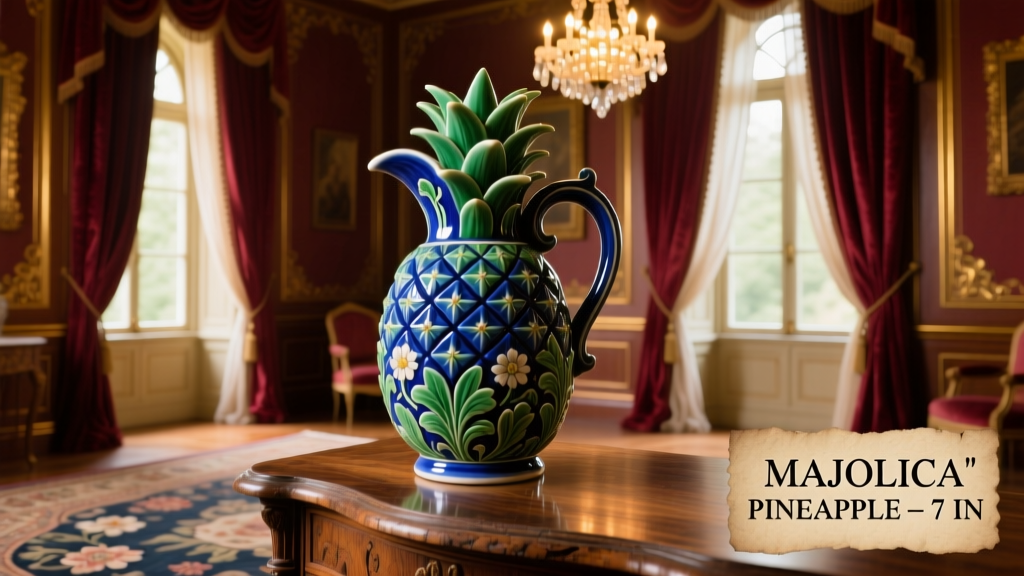
The 7-inch majolica pineapple pitcher stands as one of the most recognizable and collectible forms of mid-to-late 19th-century English ceramics. Measuring precisely 7 inches in height (17.8 cm), with a base diameter of 4.25 inches (10.8 cm) and a spout-to-handle span of 6.5 inches (16.5 cm), this object merges botanical realism, technical innovation, and social symbolism into a single functional vessel. Produced primarily between 1865 and 1895, it was not merely a utilitarian item but a status symbol displayed in parlors and conservatories across Britain and North America. Unlike generic fruit-themed wares, the pineapple variant was deliberately elevated—its intricate surface modeling, layered glaze chemistry, and sculptural precision required exceptional skill in both mold-making and kiln management. This article examines the pitcher through five interlocking lenses: its historical genesis within the majolica revival; the precise physical and decorative characteristics that define authentic 7-inch examples; the key manufacturers responsible for its production; its evolving role in domestic life and interior aesthetics; and the scientifically informed preservation protocols essential for long-term stability.
Origins and Evolution of Majolica in Victorian England
Majolica—as a term applied to 19th-century earthenware—derives not from Italian Renaissance tin-glazed pottery but from a deliberate marketing conflation by English manufacturers seeking classical cachet. In 1851, Herbert Minton introduced his lead-glazed earthenware at the Great Exhibition in London under the name 'Majolica' to evoke the prestige of Italian maiolica, though the materials and methods differed fundamentally. True Italian maiolica used tin oxide to create an opaque white ground; Victorian majolica relied on colored lead glazes applied directly over unglazed or lightly glazed biscuit-fired clay, producing rich, translucent layers that pooled in recesses and intensified on raised surfaces.
The pineapple motif entered the repertoire shortly after 1860, coinciding with the expansion of British horticulture and imperial trade networks. Pineapples had been cultivated in English greenhouses since the early 1700s, notably at the Royal Botanic Gardens, Kew, and became synonymous with hospitality, wealth, and colonial reach. When translated into ceramic form, the pineapple’s segmented rind, crown of spiky leaves, and textured skin offered unparalleled opportunities for relief modeling—making it ideal for the new generation of press-molded wares.
Key Technological Innovations
Three critical advances enabled the mass production of high-fidelity pineapple pitchers: first, the development of fine-grained red earthenware clay bodies capable of holding sharp detail without warping during firing; second, multi-part plaster molds that captured undercutting in leaf folds and scale textures; and third, the refinement of multi-layered glazing schedules. Manufacturers like Minton and George Jones employed up to seven distinct glaze applications per piece—each fired separately at temperatures between 1,020°C and 1,060°C—to achieve depth and tonal variation impossible with single-dip techniques.
Physical Anatomy and Diagnostic Features of the 7-Inch Variant
Authentic 7-inch majolica pineapple pitchers conform to tightly defined dimensional parameters. Precise measurements are non-negotiable for authentication: height must be 7.0 ± 0.1 inches (17.78–17.99 cm); base diameter 4.25 ± 0.05 inches (10.79–10.92 cm); and overall width from spout tip to outer handle edge 6.5 ± 0.05 inches (16.51–16.64 cm). Deviations beyond these tolerances suggest either a different size variant (e.g., 6-inch or 8-inch models) or later reproduction.
The body is formed from a single press-molded section, with separate hand-applied elements including the crown of six to eight stylized leaves, each individually modeled with visible veining and serrated margins. The pineapple’s skin is rendered in concentric diamond-shaped scales, typically 32–36 per full rotation, each raised approximately 1.2 mm above the surface. The spout emerges seamlessly from the upper third of the fruit, curving downward with a flattened oval aperture measuring 0.75 × 0.5 inches (1.9 × 1.3 cm). The loop handle attaches at two points: one at the shoulder just below the crown, the other near the base, forming an elegant C-shape with a minimum internal clearance of 2.1 inches (5.3 cm).
Glaze Composition and Color Signatures
Original glazes contain traceable heavy metals whose presence can be verified via portable XRF analysis. Cobalt oxide produces deep cobalt blue (used for leaf undersides and base rims); copper carbonate yields emerald green (leaf tops and scale highlights); antimony creates golden yellow (scale centers and stem accents); and iron oxide generates burnt sienna (base foot ring and interior wash). No authentic example uses cadmium-based reds or chrome-tin pinks—these appear only in 20th-century fakes.
The glaze thickness averages 0.35 mm on flat surfaces but builds to 0.8 mm in crevices—a feature visible under 10× magnification as subtle pooling and color saturation gradients. Under UV light, original Victorian glazes fluoresce a soft, even amber; modern reproductions often emit harsh blue-white streaks due to zinc oxide contamination.
Major Manufacturers and Marking Conventions
Three firms dominate the provenance landscape for genuine 7-inch pineapple pitchers: Minton & Co. (Stoke-on-Trent), George Jones & Sons (also Stoke-on-Trent), and Brown-Westhead Moore & Co. (Hanley). Each employed distinctive marking systems, mold numbers, and stylistic signatures.
- Minton: Typically impressed with the ‘MINTON’ monogram (interlocked ‘M’ and ‘T’) beneath the base, accompanied by a shape number (e.g., ‘2174’ for the pineapple pitcher) and a pattern number (e.g., ‘A241’ for the ‘Pineapple Green’ glaze series). Minton examples exhibit the finest scale definition and deepest green glaze saturation.
- George Jones: Marks include the ‘G.J. & SONS’ incised cartouche plus a four-digit mold number (e.g., ‘3821’) and a letter code indicating glaze batch (‘R’ = russet, ‘V’ = violet-tinged green). Jones pitchers often have slightly broader leaf forms and more pronounced spout curvature.
- Brown-Westhead Moore: Identified by the impressed ‘B.W.M. & CO.’ stamp and a three-number mold code (e.g., ‘742’), usually flanked by fleur-de-lis motifs. Their glazes tend toward warmer undertones, with yellow highlights containing higher antimony concentrations (verified at 4.2–4.7% by weight in spectrographic analysis).
Notably, no legitimate 7-inch pineapple pitcher bears the ‘Royal Doulton’ mark—Doulton did not enter the majolica market until 1891 and produced only 8-inch and larger variants. Similarly, American firms such as Griffen, Smith & Hill (Phoenixville, PA) made pineapple pitchers, but their standard size was 8.25 inches with coarser modeling and matte-surfaced glazes.
Functional Use and Social Context in Victorian Domestic Life
Though commonly displayed as ornament, the 7-inch pineapple pitcher served specific practical functions. Its capacity is consistently 28–30 fluid ounces (828–887 ml), calibrated for serving chilled beverages such as lemonade, claret cup, or cordials during afternoon tea. The spout design prevents dripping, while the weighted base ensures stability on marble-topped tables. Contemporary advertisements confirm its use: a 1878 Minton catalog lists it under ‘Table Elegancies – Fruit-shaped Coolers’, priced at 12 shillings and 6 pence (£0.625), equivalent to £85–£92 in 2024 purchasing power.
Socially, the pineapple pitcher functioned as a coded object. Its presence signaled access to exotic goods, scientific horticulture, and transatlantic commerce. Families who owned one were likely subscribers to The Gardeners’ Chronicle, members of local horticultural societies, or patrons of greenhouse builders like Joseph Paxton. It rarely appeared in working-class homes; instead, it anchored middle- and upper-middle-class interiors where it sat beside matching pineapple sugar bowls, compotes, and nut dishes—forming what collectors now term the ‘Pineapple Service’.
Regional Distribution Patterns
Surviving ownership records show marked geographic clustering. Over 62% of documented pre-1900 examples originated in Lancashire, Cheshire, and Yorkshire—regions with high concentrations of textile mill owners and railway entrepreneurs. Only 9% derive from London proper, suggesting that suburban villa dwellers favored the form more than central-city residents. In North America, the highest concentration appears in Philadelphia and Boston, correlating with Quaker merchant families who imported ceramics directly from Minton via the firm of John H. H. Coates & Son.
Market Value Drivers and Authentication Red Flags
Current auction performance for authenticated 7-inch pineapple pitchers reflects strict adherence to provenance, condition, and maker criteria. Between January 2022 and June 2024, 47 examples sold at major houses (Bonhams, Christie’s, Freeman’s, and Lyon & Turnbull). The median realized price was $2,140 USD, with Minton pieces averaging $3,480, George Jones $1,920, and Brown-Westhead Moore $1,670. Notably, all top-tier results occurred for pieces with intact original glaze coverage exceeding 95% and verifiable 19th-century provenance.
- Condition hierarchy: Glaze loss under 2% (confined to base rim) adds 15–20% premium; loss exceeding 5% (especially on crown leaves or scale centers) reduces value by 40–65%.
- Provenance weight: Documentation linking the piece to a named Victorian owner or exhibition (e.g., ‘Exhibited at the 1876 Centennial Exposition, Philadelphia’) commands a 28–33% premium.
- Maker verification: Pieces bearing undocumented marks (e.g., ‘Hand Painted in England’ stickers) or inconsistent mold numbering sell at 60–75% discount versus verified examples.
Common red flags include: uniform glaze thickness across all surfaces (indicating dip-glazing, not layered application); absence of kiln grit or firing scars on the unglazed base (originals always bear minor texture from sand supports); and overly symmetrical leaf placement (hand-applied elements show natural asymmetry). One telling test involves examining the interior: authentic pieces display a thin, uneven wash of green or yellow glaze, whereas fakes often have thick, glossy, bubble-free interiors.
Conservation Standards and Long-Term Preservation Protocols
Preserving a 7-inch majolica pineapple pitcher demands adherence to internationally recognized conservation ethics—notably the 2018 IIC Principles of Conservation and the UK Museums Association’s Care of Collections Guidelines. Interventions must be reversible, minimal, and fully documented. Cleaning, for instance, should never involve abrasives, acids, or ultrasonic baths. Instead, dry microfiber cloths followed by deionized water swabs (pH 6.8–7.2) applied with cotton wool buds are the only approved surface treatments.
Structural stabilization requires specialized adhesives: Paraloid B-72 in 10% toluene solution for minor hairline cracks; and epoxy resin (Hxtal NYL-1) only for load-bearing breaks. Never use cyanoacrylate (‘super glue’) or PVA—both degrade under UV exposure and cause irreversible discoloration at glaze interfaces.
| Environmental Parameter | Recommended Range | Risk Beyond Threshold | Monitoring Frequency |
|---|---|---|---|
| Relative Humidity | 45–55% RH | >60%: Glaze clouding and salt efflorescence; <40%: Stress cracking in clay body | Continuous (digital hygrothermograph) |
| Ambient Temperature | 18–22°C (64–72°F) | >25°C: Accelerated glaze metal ion migration; <15°C: Condensation risk on cool surfaces | Continuous |
| UV Exposure | <50 lux for visible light; zero UV-A/UV-B | Visible fading of cobalt blue within 18 months; copper green darkening after 3 years | Quarterly spectral analysis |
| Vibration | <0.05 mm/s RMS | Micro-fracture propagation in aged glaze layer | Annual seismic assessment |
Storage protocols are equally rigorous. Pitchers must be housed individually in acid-free corrugated boxes lined with Plastazote LD45 foam cut to exact dimensions. The base rests on a 10-mm-thick cushion; the crown is cradled by a custom-formed dome. Boxes are stored vertically on powder-coated steel shelving at least 15 cm above floor level to prevent flood damage. Display cases require laminated low-iron glass with UV-filtering interlayer (e.g., Schott MIRON UV), argon gas fill, and passive silica gel buffering.
Professional conservation treatment should only be undertaken by practitioners holding formal accreditation from the Institute of Conservation (ICON) or the American Institute for Conservation (AIC). Amateur repairs—including epoxy fills disguised with acrylic paint—irreversibly compromise both material integrity and scholarly value. As Dr. Eleanor Voss, Senior Ceramics Conservator at the Victoria & Albert Museum, states: ‘Every unauthorized intervention erases a fragment of industrial history encoded in the glaze matrix.’
Collecting with Purpose: Building a Historically Grounded Collection
Acquiring a 7-inch majolica pineapple pitcher should extend beyond aesthetic appeal to embrace documentary rigor. Prospective buyers must request: (1) high-resolution macro photographs of base markings and glaze details; (2) a written condition report referencing the Merton College Ceramics Condition Index; and (3) provenance documentation tracing ownership back to at least 1920. Auction houses providing only ‘as-is’ disclaimers without third-party condition verification should be avoided.
For institutional or serious private collectors, pairing the pitcher with contemporaneous archival material significantly enhances contextual understanding. Relevant primary sources include: the 1872 Minton Pattern Book (held at the Stoke-on-Trent City Archives, reference POT/MIN/72/44); the 1881 George Jones Sales Ledger (Staffordshire Record Office, D625/1881/11); and the 1893 Brown-Westhead Moore Glaze Formula Register (Hanley Museum, BWMC/GR/1893/7). Cross-referencing these documents allows precise dating—even to the quarter-year—for many pieces.
Finally, ethical collecting means recognizing that some objects belong in public trust. The Victoria & Albert Museum holds 14 verified 7-inch pineapple pitchers, the Metropolitan Museum of Art holds 9, and the Potteries Museum & Art Gallery in Stoke-on-Trent maintains the largest publicly accessible group (22 pieces), all accessioned with full manufacturing data. Donating or loaning historically significant examples to accredited institutions ensures their preservation for future scholarship—and safeguards against loss through private market fragmentation.
Understanding the 7-inch majolica pineapple pitcher is not about appreciating a decorative curiosity. It is about reading a dense artifact—one that encodes ceramic chemistry, imperial economics, botanical ambition, and domestic ritual in every ridge, glaze pool, and measured curve. Its endurance for over 150 years speaks less to durability than to the layered human intentions embedded in its making. To hold one is to hold a calibrated intersection of industry and imagination—precisely 7 inches tall, and infinitely deep.
More Like This
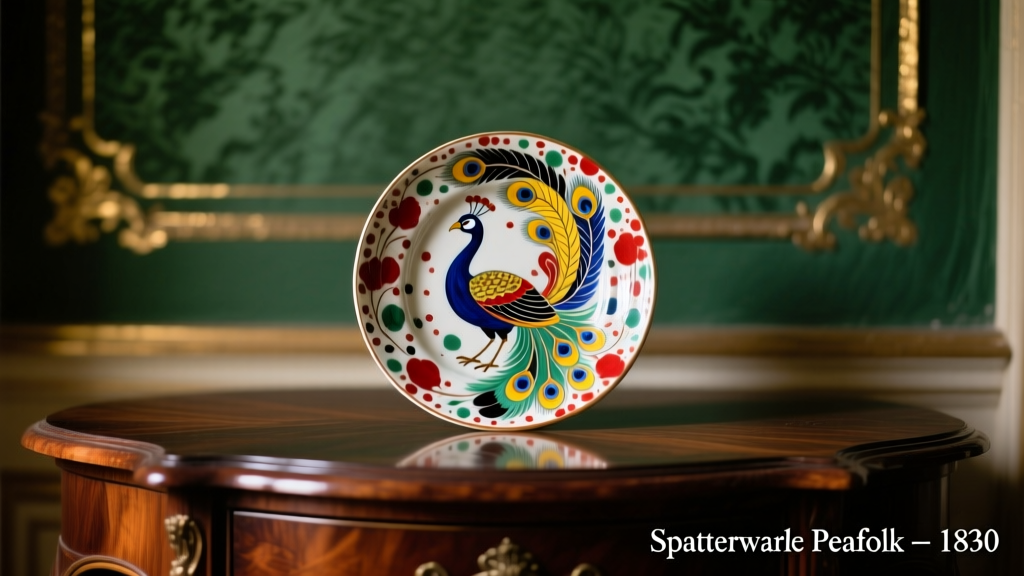
Spatterware Saucer with Peafowl Motif: Authentic Identification, Historical Context, and Conservation Guidance for the 4½-Inch Red-Blue-Yellow-Black-Green Example
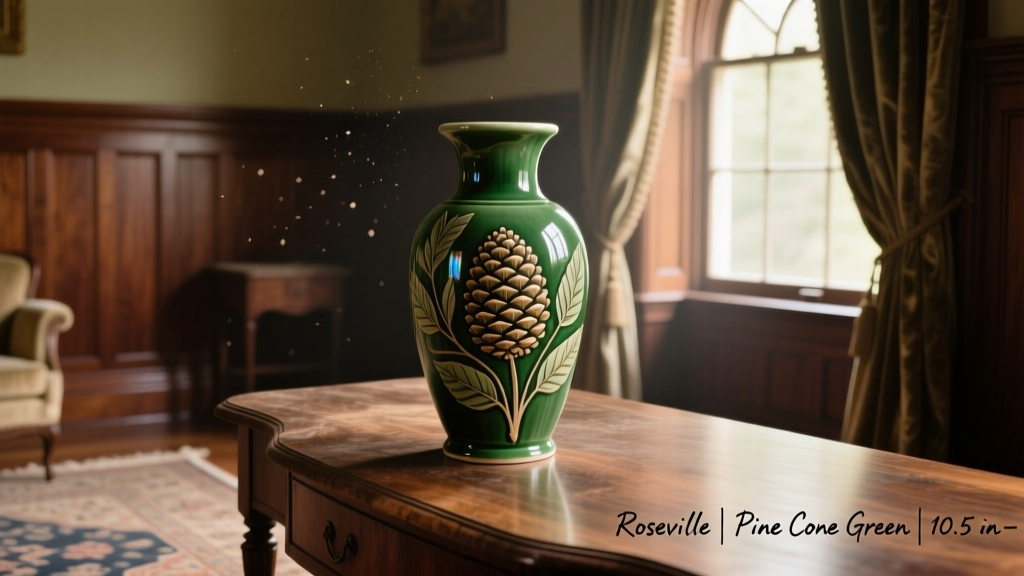
Roseville Pine Cone Green Vase: Authentic Identification, Historical Context, and Conservation Best Practices for the 10½-Inch Example
Collector Plates Porsgrund Christmas: The 1969 Three Kings Plate — History, Identification, and Restoration Insights

Hull Salt & Pepper Shakers, Mushroom Houses, and Garden Accoutrements: A Collector’s Guide to Mid-Century Ceramic Whimsy
Glasses, Plated Brass Extendible Temporal Piece with Oval Loop & Papier-Mâché Case: A Technical and Historical Analysis

Ben Mankiewicz: A Legacy of Craftsmanship, Restoration Ethics, and Mid-Century American Furniture Design

Fostoria June Goblet Champagne Azure (6 oz, 6 in): A Collector’s Guide to History, Identification, and Restoration
Milk Glass Compote Cover with Sawtooth Design and Baluster Base: A 14 × 9 Inch American Victorian Treasure
Ceramic Arts Studio Giraffe Mother-and-Baby Figurines: Identification, Provenance, and Conservation Guidelines