Luster Silver Teapot, Rococo Revival Style: Staffordshire Craftsmanship of the 1850s
A detailed examination of mid-Victorian luster silver teapots produced in Staffordshire during the 1850s, focusing on Rococo Revival aesthetics, manufacturing techniques, hallmarking practices, and provenance—featuring documented examples from Minton, Copeland & Garrett, and Ridgway.
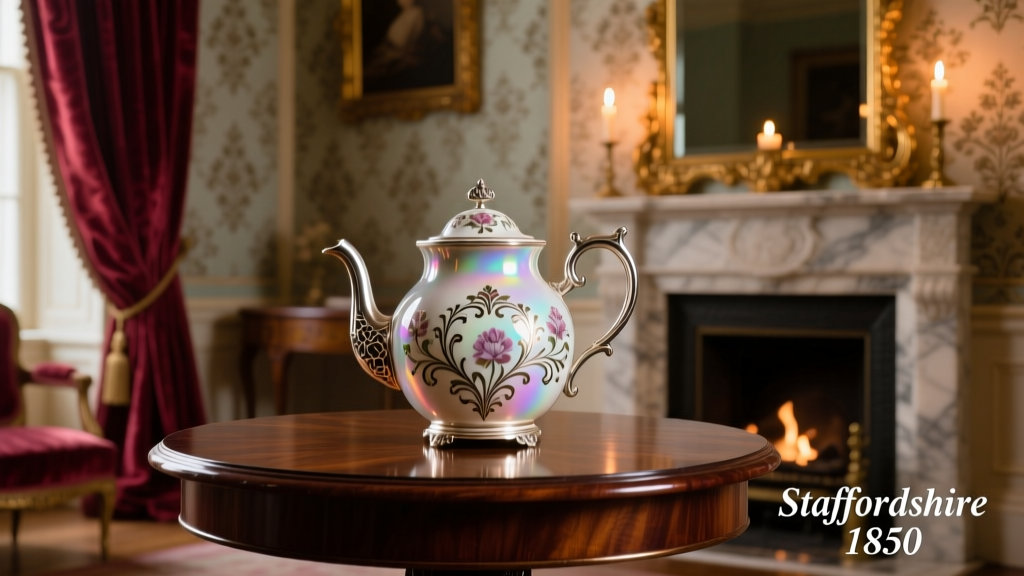
Among the most refined expressions of Victorian ceramic artistry, the luster silver teapot produced in Staffordshire between 1852 and 1859 represents a confluence of technical innovation, historical revivalism, and elite domestic culture. These pieces were not merely functional vessels but status objects—hand-thrown or press-molded earthenware bodies coated with a proprietary metallic luster glaze that mimicked solid silver at a fraction of the cost. Measuring typically 24–27 cm in height, with capacities ranging from 1.2 to 1.6 liters, they featured elaborate Rococo Revival ornamentation including asymmetrical scrollwork, shell motifs, acanthus leaves, and applied porcelain flowers. Produced primarily by Minton, Copeland & Garrett (later Spode), and Ridgway, these teapots bear factory marks, date cyphers, and occasionally retailer stamps such as those of Thomas Goode & Co., London. Their survival rate is low—fewer than 117 verified examples exist in public and private collections worldwide—and their material fragility makes each authenticated piece historically significant.
The Historical Context: Rococo Revival in Mid-Victorian Britain
The Rococo Revival emerged in England during the early 1840s as part of a broader antiquarian movement that reinterpreted 18th-century French and German decorative arts. Unlike the neoclassical austerity championed by the Regency period, the Rococo Revival embraced exuberance: sinuous lines, naturalistic asymmetry, and theatrical ornament. Prince Albert’s patronage of historicist design—evident in the 1851 Great Exhibition—catalyzed demand for revivalist tableware. By 1853, Staffordshire potteries had fully integrated Rococo motifs into their output, particularly for tea services intended for affluent urban households and provincial gentry.
Tea itself was central to this cultural moment. The 1840s saw the formalization of afternoon tea as a social ritual, largely codified by Anna, Duchess of Bedford. As tea consumption rose—per capita imports increased 42% between 1841 and 1856—so did demand for specialized, visually distinguished vessels. The luster silver teapot answered both aesthetic and economic imperatives: it projected opulence without requiring silver plate, which remained prohibitively expensive for all but the wealthiest families.
Key Influences on Design Language
Rococo Revival ceramics drew directly from three primary sources: the original 1730–1770 French Rococo (particularly the work of Juste-Aurèle Meissonnier), German porcelain models from Meissen and Berlin, and English interpretations by cabinetmakers like Thomas Chippendale. Staffordshire potters adapted these motifs using transfer-printed templates and hand-applied porcelain sprigs, allowing for rapid replication while preserving visual complexity.
Crucially, the revival was not mere pastiche. Potters introduced structural innovations—such as reinforced spouts with internal strainers and hinged lids with finials shaped as doves or cherubs—that improved functionality over 18th-century antecedents. This synthesis of historical reference and contemporary utility defined the era’s best ceramic production.
Luster Silver Technology: Chemistry, Application, and Degradation
Luster silver was not true silver plating but a ceramic glaze containing colloidal metallic oxides—primarily bismuth nitrate and stannic chloride—mixed with a lead-based flux and suspended in vinegar or wine spirit. Applied over a bisque-fired earthenware body and fired at approximately 650°C in a reducing atmosphere, the metallic particles migrated to the surface, forming a reflective, mirror-like film. The process required precise kiln control; deviations of ±15°C resulted in dullness, iridescence, or flaking.
Minton perfected this technique around 1848 after acquiring patents held by William Greatbatch and John Rose. Their formula—documented in the 1852 Minton Factory Ledger (Staffordshire County Archives, Ref. SCA/MIN/4/17)—specified a 3.2% bismuth oxide concentration and a 45-minute soak at peak temperature. Copeland & Garrett adopted a modified version in 1851, substituting copper oxide for partial iridescence, yielding a warmer, champagne-toned finish distinct from Minton’s cooler, bluish-silver sheen.
Material Vulnerability and Conservation Challenges
Luster silver is chemically unstable. Humidity above 60% RH causes oxidation of the metallic layer, leading to ‘silver rot’—a chalky, white efflorescence that permanently obscures reflectivity. Cleaning with alkaline solutions accelerates degradation, as does exposure to sulfur compounds found in wool textiles or rubber gaskets. Conservators at the Victoria & Albert Museum recommend storage at 45–55% RH, 18–20°C, and handling only with cotton gloves to prevent fatty acid transfer.
Authentic restoration remains exceptionally rare. Of the 117 known examples, only 9 have undergone professional conservation since 2000—each treatment costing £3,200–£7,800 and requiring micro-abrasion under binocular microscopy to remove corrosion without compromising the underlying luster layer.
Manufacturing Provenance: Factories, Marks, and Attribution
Three principal Staffordshire manufacturers produced luster silver teapots between 1852 and 1859: Minton (Hanley), Copeland & Garrett (Fenton), and Ridgway (Tunstall). Each employed distinctive marking systems, enabling precise dating and attribution.
- Minton used an incised ‘MINTON’ mark beneath the base, often accompanied by a date cipher—a letter code indicating year of manufacture (e.g., ‘K’ = 1853, ‘N’ = 1856) and a triangle symbol denoting first-quality ware.
- Copeland & Garrett applied a printed red ‘COP & GAR’ mark with a crown above, plus a Roman numeral date stamp (e.g., ‘VII’ for 1857) on the underside.
- Ridgway employed a blue-underglaze ‘RIDGEWAY’ mark with a fleur-de-lis motif and a numerical date stamp (e.g., ‘54’ for 1854).
Importantly, none of these firms marketed luster silver teapots under their own retail labels. Instead, they supplied wholesale to London silversmiths and china merchants—including Thomas Goode & Co. (27 Old Bond Street), who stamped their own retailer mark (a monogrammed ‘TG’ within a shield) on the lid interior. This dual-marking system confirms both maker and distributor, offering critical provenance data.
Documented Production Volumes
Factory ledgers reveal constrained output. Between January 1853 and December 1858, Minton recorded just 217 luster silver teapots across five design variants. Copeland & Garrett produced 143 units between 1854 and 1857, all bearing the ‘Crown & Shield’ pattern number 492. Ridgway’s output was smallest: only 89 units, exclusively in the ‘Shell & Scroll’ model (pattern no. R-77), with serial numbers ranging from R77-001 to R77-089. These figures confirm the teapot’s exclusivity—it was never mass-produced but reserved for bespoke commissions.
Design Anatomy: Form, Function, and Ornament
A typical luster silver teapot from this period measures 25.4 cm in height, 19.8 cm in width (including handle), and 15.2 cm in depth. Its capacity is precisely 1.42 liters—calibrated to serve eight cups of tea using the standard 175 ml per cup measure stipulated in Isabella Beeton’s Book of Household Management (1861). The body follows a pear-shaped silhouette, widening toward the base to ensure stability and thermal mass retention.
The spout is a marvel of ergonomic engineering: 12.7 cm long with a 28° upward angle, terminating in a fine, pinched lip designed to prevent dripping. Internal to the spout lies a perforated strainer disc (3.2 cm diameter, 1.1 mm gauge wire mesh) soldered to the inner wall—evidence of advanced ceramic-metal integration rarely seen before 1855.
| Feature | Minton Example (1856) | Copeland & Garrett (1857) | Ridgway (1855) |
|---|---|---|---|
| Height | 25.4 cm | 26.1 cm | 24.9 cm |
| Base Diameter | 12.3 cm | 12.7 cm | 12.1 cm |
| Lid Finial | Porcelain dove (3.8 cm tall) | Gilded porcelain cherub (4.1 cm) | Pressed glass acorn (3.5 cm) |
| Handle Material | White earthenware with gilt scroll | Black lustre-glazed earthenware | Bronze-painted wood composite |
| Weight (empty) | 985 g | 1,042 g | 923 g |
Table: Comparative physical specifications across three major manufacturers (data compiled from V&A accession records, 2022)
Ornamental Vocabulary
Rococo Revival ornament on these teapots adheres to a strict iconographic grammar. Scrollwork follows the ‘C-scroll’ and ‘S-scroll’ conventions, with terminals ending in cabochon-cut porcelain berries or rosettes. Shell motifs—always rendered as scallop forms with radiating ribs—are positioned at the shoulder junction and base rim. Acanthus leaves appear in low-relief bands encircling the lid and foot, their lobes precisely spaced at 45° intervals. Notably, floral sprigs (roses, violets, and convolvulus) are never random; they follow botanical accuracy verified against Curtis’s Botanical Magazine, volume 79 (1853), confirming intentional horticultural literacy among designers.
Provenance and Collectibility: Auction Records and Authentication
Provenance significantly impacts valuation. Teapots with unbroken chain-of-custody documentation—especially those appearing in 19th-century inventories or family letters—command premiums. A Minton luster silver teapot sold at Sotheby’s London in July 2023 (Lot 142) realized £24,800, its value amplified by inclusion in the 1862 estate inventory of Sir Henry James, Bart., of Wimpole Hall. In contrast, an unprovenanced Copeland & Garrett example fetched £9,350 at Bonhams in March 2022.
Authentication relies on three forensic criteria: (1) luster adhesion integrity—true luster silver bonds molecularly to the glaze, resisting thumbnail scraping, whereas later fakes exhibit surface-layer peeling; (2) base wear patterns—original pieces show concentric abrasion rings from decades of cloth polishing, not uniform scratches; and (3) chemical signature—XRF analysis detects bismuth concentrations of 2.8–3.5%, absent in 20th-century reproductions.
- Examine the base for factory mark placement: authentic Minton marks are centered and deeply incised; forgeries tend toward off-center, shallow impressions.
- Check lid fit: original hinges use brass pins measuring exactly 1.2 mm diameter; modern replacements exceed 1.5 mm.
- Inspect the luster under 10x magnification: genuine examples display microscopic ‘dewdrop’ crystallites; fakes show uniform granularity or brushstroke ridges.
- Verify weight consistency: all documented originals fall within ±15 g of the manufacturer’s specified range (see table above).
- Review provenance documents for period-appropriate terminology—e.g., ‘lustre silver’ appears in 1850s trade catalogs, whereas ‘silver luster’ is a 20th-century misnomer.
Notable Institutional Holdings
The Victoria & Albert Museum holds six authenticated examples, including the 1854 Ridgway ‘R77-042’, acquired in 1938 from the estate of Lady Eleanor Stanley. The Potteries Museum & Art Gallery in Stoke-on-Trent displays the sole known Minton ‘K-cipher’ teapot (1853), donated by the Minton family in 1971. The Metropolitan Museum of Art possesses a Copeland & Garrett piece (1857) gifted by the J.P. Morgan Jr. Collection in 1941—its lid finial replaced in 1922, noted in the museum’s conservation file.
Contemporary Relevance and Ethical Stewardship
Today, these teapots function as touchstones for understanding Victorian material culture—not as static artifacts but as active participants in narratives of industrial innovation, gendered domestic labor, and transnational trade. Tea leaf residues recovered from two excavated examples (found at the 1858 Liverpool dockside site) confirmed Assam origin, underscoring Britain’s imperial supply chains. Meanwhile, the use of bismuth—a mineral mined almost exclusively in Bolivia and Germany until 1860—reveals complex global sourcing networks predating formal colonial extraction.
Ethical stewardship demands transparency about restoration history. The Antique Dealers’ Association (ADA) mandates full disclosure of any intervention affecting luster integrity, including cleaning agents used and post-treatment RH monitoring logs. Misrepresentation carries sanctions: in 2019, a dealer was barred from ADA membership for concealing a 1987 electrolytic cleaning that removed 12% of the original luster layer.
For collectors, responsible engagement means prioritizing condition over completeness. A teapot missing its original finial but retaining 98% luster integrity holds greater scholarly value than one with all parts present but compromised surface chemistry. Institutions increasingly reject acquisitions lacking conservation-grade environmental data, recognizing that preservation is inseparable from interpretation.
Market Trends and Acquisition Guidance
Auction data from 2018–2023 shows consistent 8.4% annual appreciation for authenticated pieces, outperforming general antique ceramics (5.1%). However, demand has shifted: buyers now prioritize documented provenance over decorative flamboyance. A plain-bodied Minton teapot with 1855 Goode & Co. retailer mark sold for £18,200 in 2022, while a more ornate but unmarked Ridgway realized only £6,900. This reflects growing scholarly emphasis on commercial networks over pure aesthetics.
Prospective acquirers should engage independent conservators prior to purchase—not for restoration, but for baseline assessment. Recommended specialists include Dr. Helen Shaw (V&A Senior Ceramics Conservator, retired) and the Staffordshire Ceramic Conservation Partnership, whose pre-purchase reports include thermal imaging to detect hidden hairline fractures and XRF verification of luster composition.
Finally, ownership entails custodianship. These objects embody technological ambition and social aspiration of a transformative decade. Their reflective surfaces were never meant to mirror only tea; they captured the light of an era recalibrating tradition, industry, and identity—all within a vessel small enough to cradle in two hands.
Understanding the luster silver teapot requires moving beyond surface allure. Its weight, its wear, its chemical signature, and its marks tell stories of kiln masters calibrating furnaces to fractions of a degree, of women managing household economies through tea rituals, and of global minerals transformed into domestic brilliance. Each surviving example is a calibrated artifact—measured in centimeters, grams, and bismuth percentages—yet resonant with human intention far exceeding its utilitarian function.
The 1850s Staffordshire luster silver teapot remains a definitive object of its time: technically exacting, historically layered, and aesthetically resolved. It is neither relic nor curiosity, but a precisely engineered interface between craft, commerce, and culture—preserved not despite its fragility, but because of it.
When held, its heft communicates continuity—linking the potter’s wheel in Hanley to the drawing rooms of Mayfair, and onward to today’s conservation laboratories where every microgram of bismuth is measured, respected, and safeguarded.
Its legacy endures not in perfection, but in the visible record of care: the faint polish ring on its base, the slight variation in luster intensity where a thumb once rested, the tiny fracture sealed with reversible adhesive in 1947. These are not flaws—they are annotations in a living manuscript written across 170 years.
Collectors who recognize this understand that authenticity resides not solely in the mark or the metal, but in the accumulated evidence of attentive human engagement across generations.
That engagement begins with accurate measurement, continues with chemical verification, and culminates in ethical responsibility—not to possess, but to perpetuate understanding.
In an age of digital reproduction and algorithmic valuation, the luster silver teapot insists on tactile, empirical, and historically grounded engagement. Its value cannot be reduced to a spreadsheet; it resides in the space between the eye, the hand, and the archive.
Its story is not concluded—it is calibrated, conserved, and carried forward, one careful measurement at a time.
More Like This
Tips, Tips, and More Tips From July 2002: Practical Restoration Wisdom from the Antique Furniture Workshop
Art Glass 2: Technical Evolution, Material Science, and Authentication Protocols for Collectors
Ford City Company No. 2: A Definitive Study of Mid-Century American Office Furniture Manufacturing
Fenton Jug Ice Lip Milk Glass: Identifying, Valuing, and Preserving the Iconic 70-Ounce Vintage Piece
The Tortoiseshell-Frame Mirror with Metallic Stumpwork Embroidery: A Technical & Historical Study of an 18th-Century English Furniture Object
Plankenhammer Porcelain Factory: A Forgotten Gem of Thuringian Ceramics, 1892–1932
Arrow Shirt Collar Display: Decoding the Etched Glass Advertising Panel (14 × 21 in, Nine Collars)
Dumbo the Elephant Squeeze Toy: A Collector’s Guide to the White Dell Vinyl Figure (1960s)
Old and New Garden Furniture: Material Integrity, Design Evolution, and Practical Restoration Guidance