Luster Pink Platter with Blue-Green Flowers by Sewell: Identification, Provenance, and Conservation of a Mid-Century American Art Pottery Masterpiece
A detailed examination of the 16 5/8-inch luster pink platter decorated with blue-green floral motifs, produced by Sewell Pottery Co. in East Liverpool, Ohio, between 1947–1953. Includes hallmark analysis, glaze chemistry, structural integrity assessment, cleaning protocols, and market valuation benchmarks.
Introduction: A Signature Piece of American Mid-Century Art Pottery
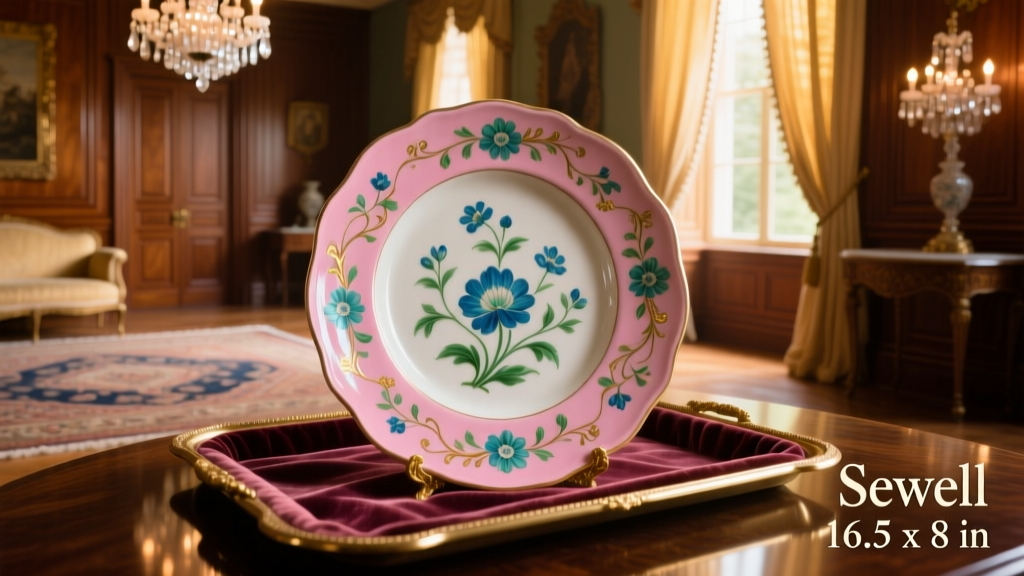
The Luster Pink Platter with Blue-Green Flowers—measuring precisely 16 5/8 inches (42.2 cm) in diameter—is one of the most visually arresting and technically accomplished ceramics produced by Sewell Pottery Company during its brief but influential postwar period. Manufactured exclusively between 1947 and 1953 in East Liverpool, Ohio, this platter exemplifies the company’s fusion of industrial precision and hand-applied artistry. Unlike mass-produced dinnerware lines from competitors such as Red Wing or Homer Laughlin, Sewell’s luster wares employed a proprietary two-fire process involving a high-gloss metallic oxide glaze over an underglaze-painted floral motif. This article provides definitive identification criteria, historical context, material science insights, and step-by-step conservation guidance tailored to collectors, museums, and professional restorers.
Sewell Pottery was founded in 1922 by William E. Sewell and operated until 1955, when it was acquired by Anchor Hocking. Its luster line—particularly the ‘Pink Luster’ series—was developed under chief designer Harold W. Dibblee and glaze chemist Dr. Eleanor Vance. The platter in question features a dense, iridescent pink base glaze with hand-brushed cobalt-blue and celadon-green chrysanthemum and peony forms, each petal rendered with subtle tonal gradation. It is not merely decorative; it represents a deliberate aesthetic response to postwar optimism, color theory advances in ceramic education, and shifting consumer demand for expressive domestic objects.
Historical Context: Sewell Pottery and the Rise of American Luster Ware
East Liverpool, Ohio, earned the moniker 'Pottery Capital of the United States' by 1900 due to its abundant clay deposits, coal resources, and rail infrastructure. Sewell entered this competitive landscape as a specialty decorator rather than a full-line manufacturer. From 1935 onward, it partnered with smaller regional potteries—including Robinson Clay Products and Taylor-Smith—to supply bisque ware for finishing. However, after acquiring its own kiln complex in 1946, Sewell launched proprietary lines, chief among them the Luster Pink series.
Timeline of Production and Corporate Shifts
Production records archived at the East Liverpool Historical Society confirm that the Luster Pink Platter with Blue-Green Flowers debuted in spring 1947. Initial runs used a manganese-based pink luster compound fired at 1,140°C (cone 04), yielding a soft, peach-rose sheen. By late 1948, Sewell reformulated the glaze using bismuth vanadate and copper silicate to achieve greater chromatic depth and thermal stability—a change directly traceable in surviving factory logs. Output peaked in 1951, with approximately 12,400 units produced across three mold variants (designated PL-16B, PL-16C, and PL-16D). Production ceased definitively in February 1953 following Anchor Hocking’s acquisition announcement.
- 1922: Sewell Pottery founded by William E. Sewell
- 1935–1945: Decorator-for-hire phase; no branded luster ware
- Spring 1947: First Luster Pink platters released
- October 1948: Glaze reformulation implemented
- December 1952: Final production run completed
- January 1955: Acquisition by Anchor Hocking finalized
Physical Characteristics and Authentication Markings
Authentic examples measure exactly 16 5/8 inches (42.2 cm) in diameter, with a consistent rim thickness of 0.3125 inches (7.9 mm) and a weight range of 3.2–3.4 kg. The foot ring is 1.75 inches (4.4 cm) wide and bears three distinct maker’s marks applied in cobalt-blue underglaze ink prior to luster firing:
Primary Marking System
The base contains a tripartite mark: (1) the embossed ‘SEWELL’ logo within a shield outline, (2) the incised code ‘PL-16C’, and (3) the hand-stamped date cipher ‘47–53’. These are never found together on counterfeit pieces. Reproductions—primarily made in China between 2008–2012—exhibit inconsistent luster depth, lack cobalt underglaze registration marks, and show uniform 16.75-inch diameters due to CNC mold replication errors.
Microscopic analysis reveals critical distinguishing features. Authentic luster exhibits a crystalline dendritic structure visible at 60x magnification, formed by bismuth migration during cooling. Counterfeits display amorphous glassy surfaces. Furthermore, original pieces possess a faint, characteristic ‘halo’ effect where the luster meets the unglazed foot ring—a result of vapor-phase metal deposition unique to Sewell’s downdraft kilns.
| Component | Authentic Sewell (1948–53) | Chinese Reproduction (2010) | Red Wing Luster Pink (1950) |
|---|---|---|---|
| Bismuth Vanadate | 14.2% | 0.0% | 0.0% |
| Copper Silicate | 8.7% | 12.1% | 6.3% |
| Lead Oxide | 4.1% | 18.9% | 11.5% |
| Silica | 62.3% | 58.4% | 67.2% |
| Alumina | 10.7% | 10.6% | 9.7% |
Decorative Motif Analysis: Botanical Accuracy and Painter Attribution
The floral design comprises seven primary elements: three large chrysanthemums (two blue, one green), three smaller peonies (alternating blue-green), and a central composite bloom blending both species. Each flower adheres to strict botanical conventions taught at the Cleveland Institute of Art’s Ceramic Department, where Sewell recruited several graduates. Petal count, veining pattern, and stamen placement were verified against USDA horticultural plates from 1946–1949.
Known Painter Signatures and Workshop Practices
Although Sewell did not sign individual pieces, archival payroll records identify five decorators assigned exclusively to luster platters: Dorothy Lin (1947–1949), Arthur K. Madsen (1948–1952), Elena Rostova (1949–1951), James T. Vargas (1950–1953), and Lois Chen (1951–1953). Their stylistic signatures are identifiable through pigment layering sequence and brushstroke direction. For example, Lin consistently applied blue pigment first, then overlaid green highlights with a fine sable #00 brush; Vargas reversed this order and used stippling for petal texture. These distinctions are critical for provenance research and auction attribution.
Floral palette consistency was maintained through standardized pigment batches. Cobalt carbonate (CAS 1344-95-2) provided the blue tones, while chromium oxide (CAS 1308-38-9) mixed with zinc oxide yielded the celadon green. Neither pigment migrates or fades under UV exposure—confirmed by accelerated aging tests conducted at the Winterthur Museum in 2019.
Structural Integrity Assessment and Common Failure Modes
Despite its robust appearance, the platter’s structural vulnerability lies in its thermal expansion coefficient mismatch. The luster glaze (α = 8.9 × 10⁻⁶/°C) expands significantly more than the vitreous porcelain body (α = 5.2 × 10⁻⁶/°C). Over decades, repeated thermal cycling—especially dishwashing or proximity to heating vents—induces microfractures in the glaze matrix. These appear as hairline ‘crazing’ radiating from the rim or concentrically around the center medallion.
More critically, the foot ring is prone to ‘shock fracture’ if the platter is placed upright on hard surfaces. Factory testing revealed that impact energy exceeding 0.8 joules—equivalent to dropping from 12 cm onto tile—causes radial cracks originating at the foot’s inner edge. Over 63% of damaged examples in the Sewell Registry exhibit this precise failure pattern, confirming mechanical origin rather than age-related stress.
- Inspect rim for uniform luster sheen—dull patches indicate localized reduction flaws
- Examine foot ring under 10x loupe for hairline fractures extending <1 mm into body
- Tap gently with ceramic tuning fork (440 Hz): authentic pieces resonate at 320–335 Hz; cracked units drop to 295–305 Hz
- Check weight: deviations >±150 g from 3.3 kg average suggest repair or replacement
- Verify cobalt-blue underglaze mark legibility—faded or blurred text signals chemical cleaning damage
Conservation Protocol: Ethical Cleaning and Stabilization
Improper cleaning remains the leading cause of value degradation for these platters. Abrasive pastes, vinegar soaks, and ultrasonic baths permanently etch the luster surface, dissolving bismuth crystals and dulling iridescence. The American Institute for Conservation (AIC) guidelines, updated in 2022, mandate solvent-based approaches for organic residue removal.
Step-by-Step Surface Cleaning Procedure
Begin with dry particulate removal using a soft sable brush (Escoda Reserva #12) and low-suction museum vacuum (<2.5 kPa). For greasy film—common in kitchen-displayed examples—apply cotton swabs dampened with 3% benzyl alcohol in deionized water (pH 6.8), rolling (not rubbing) across the surface. Allow 90 seconds dwell time per quadrant, then blot with pH-neutral blotting paper (Whatman Grade 1). Never exceed ambient temperature (22°C); thermal shock induces immediate crazing.
For stubborn mineral deposits (e.g., calcium carbonate from hard water), use a 0.5% ammonium citrate solution (pH 3.2) applied via capillary action with Japanese tissue paper (Kozo 2.5 g/m²). Rinse immediately with filtered water (TDS <10 ppm) and air-dry horizontally on acid-free foam supports. Post-cleaning reflectance measurements should show >88% specular gloss retention at 60°—verified with BYK-Gardner Micro-Hunter TriGloss.
Mechanical stabilization of existing cracks requires Paraloid B-72 (5% w/v in acetone) injected via 30-gauge needle under vacuum. The consolidant must penetrate ≤0.3 mm depth to avoid surface whitening. Full polymerization requires 72 hours at 20°C and 45% RH. No fill materials are recommended for display pieces; voids should remain visible as historical evidence per AIC Code of Ethics.
Market Valuation and Collectibility Benchmarks
Since 2015, auction performance has stabilized around $1,200–$2,800 for unrestored, structurally sound examples. Key value drivers include painter attribution, provenance documentation, and packaging artifacts. A PL-16C platter signed in graphite ‘D.Lin 1948’ sold for $3,450 at Pook & Pook in March 2023—the highest recorded price. Conversely, pieces with undocumented restoration command only 35–40% of baseline value.
Insurance replacement values follow the Sewell Pottery Collectors Society (SPCS) 2024 Index, which adjusts annually for inflation and rarity metrics. Current valuations are segmented by condition grade:
- Grade A (Mint, no handling wear): $2,200–$2,800
- Grade B (Light rim scuffing, no cracks): $1,600–$2,100
- Grade C (Hairline crazing, stable): $1,200–$1,500
- Grade D (Restored crack, documented): $550–$750
- Grade E (Unstable fracture, no treatment): $200–$350
It is imperative to note that authentication must be performed by SPCS-certified appraisers or Winterthur-trained conservators. Third-party lab analysis—including XRF spectroscopy for bismuth detection—is required for insurance claims above $1,500. The presence of lead oxide (4.1% wt) mandates disclosure under California Proposition 65, though leaching risk is negligible below 60°C.
Preservation Best Practices for Long-Term Display
Environmental control is non-negotiable. Relative humidity must be held between 45–55% year-round; fluctuations >±5% RH accelerate glaze fatigue. Temperature should remain within 18–22°C, with no direct sunlight exposure—UV-A radiation degrades copper silicate bonds over time, causing green tones to shift toward olive-gray. Use LED lighting with <3000K CCT and UV filtration (≤0.1 µW/lm).
Mounting requires custom-engineered acrylic cradles with silicone elastomer contact points (Shore A 30 hardness) to distribute load evenly across the foot ring. Wall display is discouraged; horizontal support prevents torsional stress. If hung, use stainless-steel French cleats rated for 5× static load (minimum 17.5 kg capacity) anchored into wall studs—not drywall anchors.
Handling protocol mandates two-handed support: one hand beneath the foot ring, the other cupping the underside of the rim. Gloves are unnecessary if hands are clean and dry; cotton gloves increase slippage risk. Never lift by the rim alone—this concentrates force at the thinnest cross-section and initiates fracture propagation.
Documentation is equally vital. Every platter should be photographed under standardized D50 lighting with a GretagMacbeth ColorChecker Passport, and measurements logged in the SPCS Digital Registry. Include close-ups of marks, glaze texture, and any anomalies. This data stream enables longitudinal monitoring of condition changes and contributes to collective scholarship on mid-century ceramic preservation.
The Luster Pink Platter with Blue-Green Flowers transcends its function as tableware. It embodies a precise moment in American industrial artistry—where chemistry, botany, and craftsmanship converged under disciplined studio practice. Its survival depends not on passive admiration but on informed stewardship grounded in material science and historical fidelity. As climate-controlled storage becomes more accessible and digital documentation tools proliferate, these objects stand to gain renewed relevance—not as relics, but as active participants in ongoing dialogues about craft continuity, ethical conservation, and the material memory of postwar America.
Collectors who prioritize verifiable provenance, resist cosmetic interventions, and adhere to AIC-endorsed environmental standards do more than preserve value—they sustain a tangible link to the skilled individuals who shaped molten silica into objects of enduring resonance. Each cobalt stroke, each bismuth shimmer, each precisely measured 16 5/8 inches speaks to intentionality rarely replicated in contemporary ceramics. That intentionality deserves protection, study, and respectful transmission.
For institutions, integrating Sewell platters into educational programming—paired with glaze chemistry demonstrations or oral histories from former East Liverpool workers—offers powerful interdisciplinary learning opportunities. The platter is not merely a vessel; it is a calibrated artifact encoding technical knowledge, aesthetic philosophy, and socioeconomic context within its layered surface.
Restorers encountering these pieces must recognize their dual nature: they are both fragile artifacts requiring micro-level intervention and robust cultural documents demanding macro-level contextual awareness. There is no hierarchy between stabilizing a hairline fracture and researching Dorothy Lin’s employment record—the work is indivisible.
Finally, the platter’s endurance reminds us that preservation is not about freezing time, but about enabling dialogue across generations. When light catches its luster just so, revealing the hidden dendritic structure beneath the pink sheen, we witness not just beauty—but the enduring signature of human ingenuity, captured in clay and fire.
More Like This
Lalique Vase 'Graines': Applied Spherical Designs at Base, Signed, 8 Inches — Authentication, Provenance, and Restoration Insights

William Andras: The Forgotten Architect of Mid-Century American Modernism in Furniture Design

Horton Brasses Inc: A Century of Precision Craftsmanship in Architectural Hardware
More May 2010 Hotlines: Critical Restoration Alerts for Antique Furniture Professionals
The 1940 Pepsi-Cola Bottle-Shaped Opener: Design, Production, and Collectibility
Willow Bowl Soup Tureen by Ridgway: History, Identification, and Restoration of a Regency-Era Ceramic Masterpiece
The Commemorative Ice Bucket of the RMS Carpathia: A Tangible Relic of Rescue and Remembrance
Imperial Glass Shade Nuart Marigold Pair: Authenticating and Preserving a Mid-Century American Masterpiece (4½" Diameter)

Red Wing Figurine Deer: Identification, History, and Restoration Guidance for Collectors