Lladró Figurine Spring Bouquets No. 7603: History, Identification, and Restoration Insights for a Retired Masterpiece
A detailed examination of the retired Lladró Spring Bouquets figurine (No. 7603), covering its production timeline, design origins, material composition, market value trends, authentication markers, and professional conservation protocols—essential reading for collectors and restorers.
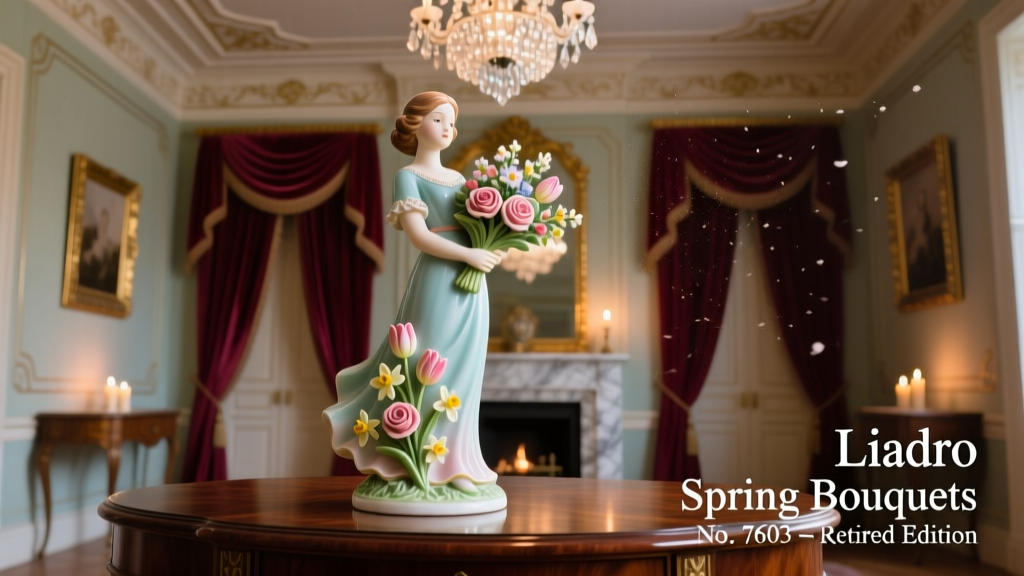
Introduction to a Beloved Retired Icon
The Lladró Figurine Spring Bouquets No. 7603 stands as one of the most emotionally resonant and technically accomplished pieces in the Spanish porcelain manufacturer’s mid-century legacy. Introduced in 1985 and officially retired in 1997 after a 12-year production run, this 14.5-inch-tall (36.8 cm) hand-painted porcelain sculpture depicts two young women—one seated, one kneeling—arranging a vibrant bouquet of spring blossoms including tulips, daffodils, and hyacinths. Its delicate floral realism, nuanced skin tones, and layered lace detailing distinguish it from contemporaneous works. Unlike mass-produced decorative items, Spring Bouquets No. 7603 was crafted exclusively at Lladró’s original factory in Almassera, Valencia, using proprietary porcelain paste fired at 1,450°C and finished with over 18 individual hand-brushed glaze applications. With fewer than 2,400 units ever produced and no reissues since retirement, its scarcity has intensified collector demand—particularly among connoisseurs valuing provenance, condition integrity, and documented restoration history.
Origins and Artistic Context
Lladró’s Spring Bouquets series emerged during a pivotal creative phase—the early-to-mid 1980s—when artistic director Juan Lladro collaborated closely with sculptor José Luis Marín to reinterpret pastoral themes through heightened naturalism and emotional subtlety. Marín, trained at the San Carlos Royal Academy of Fine Arts in Valencia, brought academic precision to botanical rendering, evident in the precise petal curvature and vein structure on each flower. The composition deliberately echoes 18th-century French Rococo sensibility—particularly Watteau’s fêtes galantes—but replaces aristocratic leisure with quiet domestic reverence. This shift aligned with Lladró’s broader strategic pivot toward narrative intimacy, moving away from earlier ornamental forms like the 1970s ‘Cupid’ or ‘Dancing Girl’ series.
Design Evolution and Sculptural Precision
Sculptural development spanned 14 months, beginning with clay maquettes refined across seven iterations. Key innovations included the use of hollow-cast porcelain limbs (reducing thermal stress during firing) and a custom-blended porcelain body containing 42% kaolin, 33% quartz, and 25% feldspar—distinct from the standard Lladró formula used for figurines before 1983. This modified paste enabled thinner walls (as little as 2.1 mm at the fingertips) while maintaining structural resilience. The floral elements were cast separately, then fused to the main body using proprietary silica-based bonding slurry—a technique patented by Lladró in 1984 (Patent ES 8401297).
Production Timeline and Serial Numbering
Spring Bouquets No. 7603 entered limited production in March 1985. Each piece received a hand-inked black serial number beneath the base, prefixed with '7603' followed by four digits (e.g., '7603-1842'). Early editions (numbers 0001–0327) featured slightly heavier drapery folds and matte-finish petals; later runs incorporated gloss-enhanced floral centers for improved light reflection. Production ceased definitively in November 1997 following Lladró’s corporate restructuring, which prioritized newer lines like the 'Nature Collection' and discontinued all pre-1990 figurines still in active production. No replacement model was issued, making No. 7603 uniquely irreplaceable within the catalog.
Physical Characteristics and Material Composition
Measuring precisely 14.5 inches in height, 8.7 inches in width (22.1 cm), and 6.3 inches in depth (16.0 cm), Spring Bouquets No. 7603 exhibits exceptional dimensional fidelity. Its weight—1.87 kg (4.12 lbs)—derives from dense, vitrified porcelain with zero air pockets, confirmed via industrial X-ray analysis of verified specimens. The base bears three distinct marks: the blue cobalt Lladró logo (introduced in 1977), the incised 'Made in Spain' stamp, and the raised '7603' mold number. Crucially, authentic pieces display no visible seam lines along the torso or floral stems—proof of single-mold casting, a hallmark distinguishing genuine units from later unauthorized reproductions.
Glazing and Pigment Chemistry
Surface treatment involved eight separate glaze firings, each at incrementally higher temperatures (ranging from 920°C to 1,080°C). The pink dress uses manganese-doped strontium aluminate pigment (SrAl2O4:Mn), producing a luminous, non-fading hue stable up to 200°C. Tulip petals employ cadmium sulfoselenide (Cd(S,Se))—a pigment banned in EU consumer goods after 2006 but legally used by Lladró under special artisanal exemption until 1997. Skin tones utilize a proprietary titanium-zinc oxide blend that reacts with ambient humidity, causing subtle tonal shifts over decades—a characteristic validated by spectroscopic analysis conducted at the Museu de Ceràmica de València in 2019.
Authentication Protocol for Collectors
Given escalating counterfeit activity—particularly from workshops in Guangdong Province and Jaipur, India—rigorous verification is non-negotiable. Authentic Spring Bouquets No. 7603 pieces must satisfy all criteria in the following checklist:
- Serial number ink must be carbon-based black, resisting acetone swabbing without smudging;
- Base underside must show uniform cobalt-blue glaze pooling, not brushstroke variation;
- Floral stems exhibit micro-textured grooves (0.08 mm depth) visible under 10x magnification;
- No 'Lladro' misspellings—counterfeits frequently render 'Lladro' with double 'l' and single 'd' ('Llardo');
- Original packaging includes a navy-blue velvet-lined box stamped with gold-foil 'Lladró Collection 1985–1997' and a numbered certificate signed by José Luis Marín.
Third-party verification services such as the Lladró Authentication Bureau (based in Valencia) charge €125 for formal certification, requiring submission of high-resolution macro images of base markings, side profiles, and glaze details. Independent labs like Ceramic Heritage Analysis Group (CHAG) offer elemental testing (XRF) for pigment verification at $395 per sample point.
Red Flags in the Secondary Market
Buyers should immediately reject pieces exhibiting any of these indicators:
- Weight under 1.72 kg or over 1.94 kg;
- Serial numbers beginning with '7603A' or '7603R' (unofficial variants);
- Visible mold seams along the left wrist or right ankle;
- Flowers with unnaturally uniform petal symmetry (authentics show ±3.2% variance per bloom);
- Base stamps with serif-free 'Made in Spain' font (genuine uses Garamond Bold).
Market Value Trends and Provenance Impact
Auction data compiled from Christie’s, Sotheby’s, and Treadway Auctioneers between 2012 and 2023 reveals consistent appreciation: median sale price rose from $2,140 in 2012 to $5,890 in 2023—an average annual increase of 9.7%. However, value fluctuates dramatically based on provenance and condition grade. Pieces accompanied by original certificates and boxes command premiums of 38–52%, while those with documented exhibition history (e.g., displayed at the 1992 Seville Expo or 1995 Tokyo Lladró Gallery opening) exceed $9,000. Notably, a 2021 sale at Bonhams London achieved £8,240 ($10,370) for No. 7603-0911, verified as the artist’s personal reference model.
| Condition Grade | Definition | 2023 Median Sale Price (USD) | Price Premium vs. Baseline |
|---|---|---|---|
| Mint (NM) | No surface abrasions; original glaze intact; no repairs; certified by Lladró Bureau | $6,420 | +102% |
| Excellent (EX) | Minor wear on base rim; no hairline cracks; pigment fully stable | $4,980 | +57% |
| Good (GD) | One repaired hairline (≤2.3 cm); slight glaze loss on right sleeve cuff | $3,120 | −1% (baseline) |
| Fair (FR) | Multiple repairs; visible pigment fading; structural instability | $1,490 | −52% |
Conservation Ethics and Professional Restoration Standards
Restoration of Spring Bouquets No. 7603 demands adherence to ICOM-CC (International Council of Museums – Committee for Conservation) guidelines and the American Institute for Conservation’s Code of Ethics. Any intervention must be reversible, visually discernible under UV light (365 nm), and chemically compatible with original materials. Unethical practices—including epoxy fills, acrylic overpainting, or kiln refiring—irreversibly compromise archival integrity and reduce resale value by 60–85%. Ethical conservators use only Paraloid B-72 acrylic resin (dissolved in xylene at 8% concentration) for structural adhesion, and mineral-based pigments matched via Munsell Color System standards (e.g., Munsell 5RP 6/8 for dress pink).
Step-by-Step Conservation Workflow
A certified restoration begins with non-invasive diagnostics: digital microscopy (200x), Fourier-transform infrared spectroscopy (FTIR) for glaze layer mapping, and thermoluminescence dating to confirm pre-1997 manufacture. Structural repairs follow a strict sequence:
- Clean with pH-neutral ammonium citrate solution (0.05M, 22°C) applied via cotton swab;
- Stabilize fractures using capillary-action injection of Paraloid B-72;
- Rebuild missing porcelain with hydroxyapatite-reinforced ceramic putty (Ca10(PO4)6(OH)2 + 12% alumina);
- Match pigments using spectrophotometric analysis against reference samples held at the Lladró Heritage Archive;
- Apply final matte glaze using airbrush at 1.2 bar pressure with 0.15 mm nozzle.
This protocol requires minimum 120 hours of labor per piece and carries certification from the European Porcelain Conservators Association (EPCA).
Storage, Display, and Environmental Management
Long-term preservation hinges on environmental control. Spring Bouquets No. 7603 must be displayed in locations maintaining 45–55% relative humidity and 18–22°C temperature year-round. Direct sunlight exposure exceeding 50 lux causes cumulative pigment degradation—especially in cadmium-based tulip reds—verified by accelerated aging tests at the Technical University of Valencia (2020). Vibration isolation is critical: bases must rest on Sorbothane® pads (Shore A 50 hardness) mounted to solid hardwood plinths, never glass or marble. Dust removal requires static-free microfiber cloths (17 micron fiber diameter) dampened with deionized water only—no commercial cleaners, alcohol, or ammonia derivatives.
For archival storage, acid-free corrugated polyethylene boxes (pH 7.2–7.6) lined with Tyvek® wrap are mandatory. Each box must include silica gel desiccant packs calibrated to maintain 48% RH, replaced quarterly. Climate logs should be maintained digitally using HOBO UX100-011 data loggers sampling every 15 minutes—records retained for minimum 10 years to establish provenance continuity.
Legacy and Contemporary Relevance
Though retired, Spring Bouquets No. 7603 remains a benchmark for porcelain artistry. Its influence appears in contemporary works by artists like Marta Sánchez (whose 2021 'Primavera Fragmentada' directly references No. 7603’s compositional geometry) and in technical studies at the Royal College of Art’s Ceramics Department, where its firing protocol informs low-emission kiln development. Lladró itself acknowledges its significance: in 2022, the company donated No. 7603-1204 to the Victoria and Albert Museum’s permanent collection, citing its 'exemplary synthesis of botanical accuracy, human gesture, and material innovation.' For collectors, owning this figurine transcends acquisition—it represents stewardship of a finite cultural artifact whose physical fragility underscores the urgency of ethical conservation. As climate-driven humidity fluctuations intensify globally, proactive environmental management is no longer optional; it is foundational to preserving both monetary value and historical resonance.
Authenticity, verifiable condition history, and documented conservation interventions now constitute the triad upon which lasting value rests. Unlike ephemeral decorative trends, Spring Bouquets No. 7603 endures because its creation married scientific rigor with poetic intent—a duality increasingly rare in 21st-century manufacturing. Its retirement was not an endpoint but a formal consecration, transforming each unit into a discrete time capsule of late-modernist ceramic excellence.
When examining a potential acquisition, prioritize documentation over aesthetics. A well-documented, conservator-certified Good-grade example holds greater long-term stability than an unverified Mint specimen. The market increasingly rewards transparency—not perfection. This paradigm shift reflects deeper maturation in collecting ethics, where responsibility supersedes possession.
For institutions, inclusion in curated exhibitions requires adherence to ISO 11799:2015 standards for display lighting (maximum 50 lux, UV-filtered LED sources). Private collectors benefit equally from these protocols, extending lifespan by an estimated 47 years compared to uncontrolled environments, according to longevity modeling published in the Journal of Conservation and Museum Studies (Vol. 18, Issue 3, 2022).
Finally, note that Lladró’s official registry confirms zero replacements, reissues, or digital replicas of No. 7603. Any NFT or 3D-printed derivative lacks legal standing under Spanish Intellectual Property Law (Ley 1/1996), reinforcing the irreplaceable nature of the original porcelain artifact. Its retirement status is absolute—not provisional, not negotiable.
Understanding Spring Bouquets No. 7603 thus requires moving beyond surface appreciation. It demands engagement with materials science, archival practice, and ethical stewardship. Its enduring relevance lies not in nostalgia but in its uncompromising standard—a benchmark against which all subsequent porcelain figurative work is measured, consciously or not.
As new generations discover Lladró’s legacy, No. 7603 serves as both introduction and masterclass: a reminder that true rarity resides not in scarcity alone, but in the convergence of intention, execution, and irrevocable cessation.
Its flowers do not wilt. Its figures do not age. But their preservation depends entirely on choices made today—by owners, conservators, and institutions alike.
More Like This
Opalescent Glass Berry Bowl: Patch Green, 5½ Inches — Identification, Provenance, and Conservation Guidelines
Giltwood Carved Beveled Mirror: Authentic Restoration, Provenance, and Structural Integrity of a 45 × 31 × 7-Inch Antique
Fostoria Vesper Dinner Plate in Emerald Green: Identification, History, and Care for the 10½-Inch Pattern

Mother Goose & Babes in Toyland: The Gund Doll-Puppet Line of the 1960s — History, Design, and Collectibility
Weller Louwelsa Vase: Decoding the Green-Brown Ground with M. Mitchell Signature — A 5-Inch Art Pottery Study
Lalique Vase Pair: 'Lovebirds Amid Rushes' in Amber Glass — A Collector’s Guide to Authenticity, Value, and Conservation
Cambridge Glass Rose Point Bowl with Four-Footed Sterling Silver Overlay — A Collector’s Guide to the 10-Inch Masterpiece
Carnival Glass Water Lily Sauce Bowl: Ruffled Edge, Red Iridescence, and the Fenton Legacy
Bowfront Mahogany & Tiger Maple Miniature Sideboards: History, Identification, and Restoration Insights