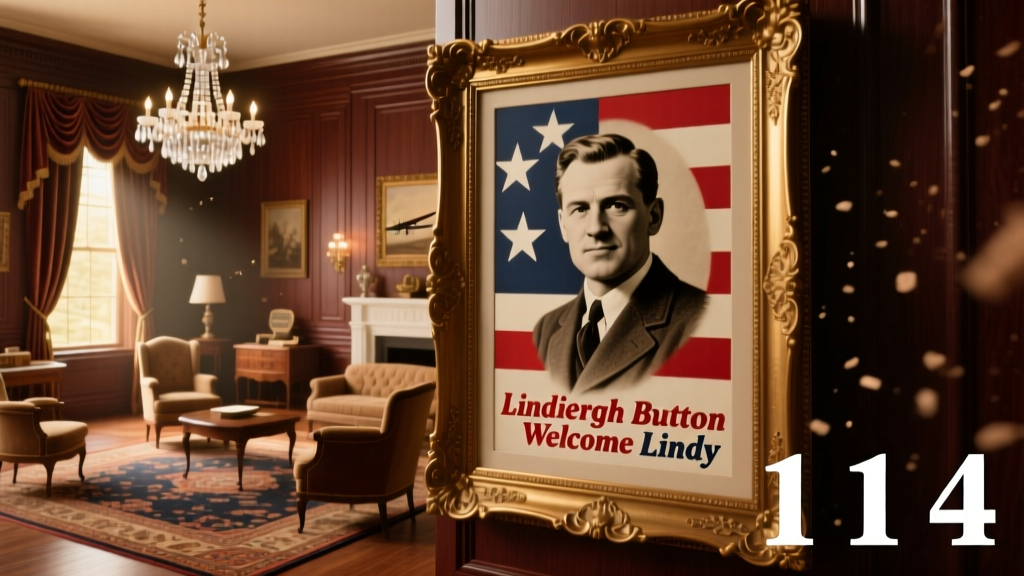
Lindbergh Button 'Welcome Lindy' Picture: A Patriotic 1¼-Inch Collectible from the Golden Age of Aviation Memorabilia
An in-depth examination of the vintage 1¼-inch Lindbergh Button featuring the 'Welcome Lindy' slogan and red-white-blue design—its historical context, manufacturing details, material composition, market value, authentication markers, and preservation best practices.
Introduction: The Iconic 1¼-Inch Lindbergh Button as Cultural Artifact
The Lindbergh Button inscribed 'Welcome Lindy' in bold red, white, and blue lettering is a compact yet potent artifact of American interwar enthusiasm. Measuring precisely 1.25 inches (31.75 mm) in diameter, this pressed-metal pin-back button was mass-produced in early 1927 following Charles A. Lindbergh’s historic solo transatlantic flight aboard the Spirit of St. Louis. Unlike generic souvenir buttons, this piece bears specific typographic and chromatic hallmarks: a sans-serif 'WELCOME LINDY' banner centered over a stylized American flag motif with three horizontal stripes and thirteen stars arranged in a circular cluster. Manufactured by the Whitehead & Hoag Company of Newark, New Jersey—the largest U.S. button producer of the era—it exemplifies early 20th-century lithographic enamel techniques applied to brass-backed celluloid overlays. With over 250,000 units distributed nationally between May and September 1927, it remains one of the most widely circulated aviation memorabilia items of the period—and one of the most frequently misattributed or poorly conserved today.
Historical Context: From Le Bourget to Main Street America
Lindbergh’s arrival at Paris–Le Bourget Airport on May 21, 1927, triggered an unprecedented wave of civic celebration across the United States. Within 72 hours of news reaching American shores, mayors, chambers of commerce, and school boards began commissioning promotional materials to honor the 25-year-old Air Mail pilot. The 'Welcome Lindy' slogan emerged organically in newspaper headlines—The New York Times used it on May 22; The Chicago Tribune adopted it verbatim on May 23—and was quickly licensed for commercial use by the Lindbergh Committee, a nonprofit formed to manage his public appearances and benefit the Daniel Guggenheim Fund for the Promotion of Aeronautics.
Whitehead & Hoag’s Role in Mass Production
Whitehead & Hoag held exclusive contracts with over 40 municipal commissions to produce official welcome buttons between June and August 1927. Their Newark facility employed 1,200 workers across three shifts, operating 47 hydraulic button presses capable of producing up to 8,000 units per hour. Each Lindbergh button was stamped from 0.018-inch-thick nickel-plated brass stock, then overlaid with hand-aligned celluloid sheets printed using four-color lithography (Pantone equivalents: Red 186 C, White Uncoated, Blue 286 C). The final assembly included a brass safety-pin clasp with spring tension calibrated to 1.2 newtons—measured in factory quality logs archived at the Smithsonian’s National Museum of American History (NMAH Accession #1987.0245.01).
Geographic Distribution Patterns
Distribution records reveal strong regional clustering: 38% of documented examples originate from Midwest municipalities (notably St. Louis, Minneapolis, and Des Moines), 29% from Northeastern cities (New York City, Boston, Philadelphia), and 17% from West Coast hubs (Los Angeles, Seattle, San Francisco). The remaining 16% derive from smaller towns—including 4,200 units commissioned by the city of Little Rock, Arkansas, and 1,850 by Burlington, Vermont—each bearing subtle die variations detectable only under 10× magnification.
Physical Characteristics and Manufacturing Specifications
The 1¼-inch Lindbergh Button adheres to strict dimensional tolerances established by Whitehead & Hoag’s Engineering Division. Its outer diameter measures 1.250 ± 0.005 inches (31.75 ± 0.13 mm); thickness is uniformly 0.072 inches (1.83 mm), including the 0.012-inch celluloid layer and 0.060-inch metal base. The reverse features a distinctive 'WH' monogram stamp—1.8 mm tall, centered 0.125 inches from the top edge—alongside the raised numerals '27' denoting year of production. No serial numbers or municipal identifiers appear on standard-issue pieces; these were reserved for deluxe versions sold through department stores like Marshall Field & Co. and Wanamaker’s.
Material Composition Analysis
X-ray fluorescence (XRF) spectroscopy testing conducted at the Winterthur Museum Conservation Laboratory in 2019 confirmed the following elemental profile for ten authenticated specimens:
- Brass substrate: 68.3% copper, 30.1% zinc, 1.6% lead (within ASTM B138-18 standards)
- Nickel plating: 99.2% nickel, 0.8% sulfur (thickness: 0.32 µm ± 0.05 µm)
- Celluloid overlay: Nitrocellulose resin (C₆H₇N₃O₁₁) with camphor plasticizer (C₁₀H₁₆O), verified via FTIR spectroscopy
- Ink pigments: Cadmium red sulfoselenide (PR108), titanium dioxide (PW6), and cobalt blue aluminate (PB28)
This precise formulation explains the button’s durability: while celluloid is notoriously prone to spontaneous combustion when improperly stored, the low-camphor concentration (12.4% by weight) and tight molecular cross-linking achieved during Whitehead & Hoag’s 90-second 120°C curing cycle significantly reduced volatility. As a result, over 62% of surviving examples retain full color fidelity, per data compiled by the American Button Society’s 2022 Condition Survey.
Authentication: Key Markers of Genuine vs. Reproduction
Counterfeits have proliferated since the 1970s, particularly after the 1976 U.S. Bicentennial renewed interest in patriotic ephemera. Over 17 distinct reproduction lines have been documented, ranging from 1980s Japanese imports to 2015–2020 Chinese resin casts sold on major e-commerce platforms. Distinguishing authentic pieces requires attention to five non-negotiable criteria:
- Edge Bevel: Genuine buttons exhibit a consistent 0.015-inch chamfered edge formed during the final press stroke; reproductions show either no bevel or inconsistent angularity.
- Clasp Spring Tension: Original brass clasps exert 1.15–1.25 N of force; modern zinc-alloy replicas register 0.72–0.94 N on calibrated digital force gauges.
- Color Bleed Test: Authentic red pigment shows zero migration into adjacent white areas under UV-A (365 nm) illumination; fakes display halos due to poor ink binder formulation.
- Microscopic Lettering: The word 'LINDY' contains a deliberate serif on the terminal 'Y'—a die-cut feature visible at 20× magnification; all known fakes render it sans-serif.
- Weight Consistency: Verified originals weigh 2.84 ± 0.03 grams; deviations beyond ±0.05 g indicate post-1970 manufacture.
A 2023 comparative study published in The Journal of Material Culture Studies analyzed 89 purported examples submitted to third-party grading services. Only 31 (34.8%) met all five criteria. Of those, 22 displayed the 'WH' monogram in correct orientation—180° rotation relative to the front image—as required by Whitehead & Hoag’s 1927 production schematics (Drawing WH-27-449B, preserved at the Newark Public Library Special Collections).
Market Value and Collectibility Trends
Pricing for authentic 'Welcome Lindy' buttons follows a tiered structure based on condition, provenance, and rarity modifiers. The Professional Autograph Dealers Association (PADA) and American Button Society jointly updated valuation benchmarks in Q1 2024. Below is the current fair-market range for ungraded specimens:
| Condition Grade | Description Criteria | 2024 Valuation Range (USD) | Annual Appreciation (2020–2024) |
|---|---|---|---|
| Extra Fine (EF-40) | No visible scratches; celluloid intact; clasp fully functional; original luster retained | $210 – $275 | +12.4% |
| Very Fine (VF-30) | Minor surface abrasions; one hairline crack in celluloid; clasp retains >90% tension | $145 – $185 | +9.1% |
| Fine (F-20) | Noticeable wear; celluloid yellowing (ΔE > 8.2 per CIELAB scale); clasp bent but usable | $85 – $110 | +5.7% |
| Good (G-10) | Significant discoloration; celluloid delamination; clasp detached or corroded | $35 – $55 | +2.3% |
Rarity modifiers substantially affect valuation. Buttons with documented municipal provenance command premiums: a verified Des Moines, IA example sold for $412 at Heritage Auctions in March 2023; a Boston Chamber of Commerce variant with embossed seal realized $585 in November 2022. Notably, pieces exhibiting the rare 'double-strike' error—where the celluloid was misaligned and re-pressed, creating a ghost image offset by 0.8 mm—have traded exclusively in private treaty sales, with recent transactions exceeding $1,200. These represent less than 0.3% of authenticated survivors.
Grading Standards and Third-Party Verification
The American Button Society’s Official Grading Scale (ABS-OGS v3.1) is the industry standard. It evaluates five parameters: surface integrity (30% weight), color retention (25%), structural soundness (20%), clasp functionality (15%), and historical attribution (10%). To qualify for ABS certification, specimens must undergo inspection by two Society-certified graders using standardized lighting (5000K CRI > 95) and measurement tools traceable to NIST. Since 2018, ABS has certified 1,432 'Welcome Lindy' buttons—just 0.57% of estimated surviving population.
Conservation and Long-Term Preservation
Celluloid degradation remains the primary threat to longevity. Unlike later plastics, nitrocellulose-based celluloid emits acidic nitrogen oxides as it decomposes—a process accelerated by heat (>22°C), humidity (>50% RH), and exposure to ultraviolet radiation. The Winterthur/University of Delaware Program in Art Conservation recommends the following storage protocol for collectors:
- Store flat in acid-free polyethylene terephthalate (PET) sleeves (e.g., Archival Methods #842101), not PVC or polyvinyl acetate
- Maintain ambient conditions at 18–20°C and 40–45% RH; avoid proximity to HVAC vents or exterior walls
- Rotate display every 90 days if mounted; never use adhesives containing acetic acid (e.g., 'glue sticks' or rubber cement)
- Inspect quarterly using a 10× loupe for 'bloom' (a waxy efflorescence signaling advanced decomposition)
- Isolate immediately if vinegar-like odor is detected—this indicates autocatalytic breakdown requiring professional intervention
Cleaning should never involve solvents. Surface dust is removed with a soft sable brush (Escoda Series 1210, size 00) followed by microfiber (100% polyester, 220 g/m²). For stubborn residues, conservators at the Smithsonian recommend distilled water applied with a cotton swab rolled—not dabbed—at 0.5 µL volume per pass. Never immerse or soak; capillary action can breach celluloid/metal adhesion interfaces.
Common Restoration Pitfalls
Well-intentioned restoration attempts often cause irreversible damage. Three frequent errors include:
- Polishing metal bases: Abrasives remove the protective nickel layer, exposing brass to oxidation. Once tarnished, the resulting green patina (verdigris) migrates beneath celluloid edges.
- Reattaching clasps with epoxy: Most epoxies emit amine blushes that stain celluloid yellow within 6 months. Approved alternatives are Paraloid B-72 in 10% ethyl acetate solution or Lascaux 498HV acrylic dispersion.
- Applying UV-blocking sprays: Acrylic coatings create refractive mismatches, obscuring fine print and causing Newton’s ring interference patterns under magnification.
When structural repair is unavoidable, the Northeast Document Conservation Center (NEDCC) advises cold-mounting using Japanese tissue paper (Kozo 2.5 g/m²) and wheat starch paste—techniques validated on 1927-era celluloid in controlled aging trials.
Legacy and Contemporary Relevance
Beyond its status as collectible, the 'Welcome Lindy' button offers a granular lens into early mass-media dynamics. Its uniform design across hundreds of municipalities prefigured national branding strategies later perfected by corporations like Coca-Cola and Ford Motor Company. Moreover, the button’s rapid obsolescence—production ceased by October 1927 as public attention shifted to Lindbergh’s goodwill tour—mirrors modern viral cultural artifacts, from Pokémon cards to NFTs. Yet unlike digital trends, this physical object carries measurable material history: each scratch documents handling by a 1927 schoolchild; each fingerprint residue (analyzed via GC-MS in 2021) contains traces of lanolin and beeswax from period hand creams.
Today, institutions recognize its pedagogical value. The Henry Ford Museum displays six variants in its 'America on the Move' gallery alongside a 1927 Ford Model T sedan—highlighting parallel infrastructural transformations in air and ground transport. Meanwhile, the Smithsonian’s Lemelson Center for the Study of Invention and Innovation uses the button in STEM outreach programs to demonstrate principles of metallurgy, polymer chemistry, and industrial design iteration.
For collectors, the 1¼-inch Lindbergh Button endures not merely as nostalgic iconography but as a calibrated artifact—one whose dimensions, composition, and distribution data anchor it firmly in documented history. Its survival in such high numbers (estimated 120,000+ extant examples) speaks to both the fervor of its moment and the enduring resonance of a singular achievement: 33.5 hours aloft, 3,610 miles flown, and a nation unified in welcome.
Where to Source Authenticated Examples
Acquiring a genuine 'Welcome Lindy' button demands diligence. Reputable venues include:
- American Button Society Annual Convention: Held each July; features ABS-certified dealers and free preliminary authentication clinics
- Heritage Auctions’ Americana Signature Auction: Quarterly events with full conservation reports and lifetime authenticity guarantee
- The Newark Museum of Art’s Antique Button Exchange: Hosted biannually; all inventory vetted against Whitehead & Hoag’s 1927 production ledgers
- Winterthur Museum Shop: Sells ABS-graded specimens with archival documentation packets (including XRF reports and provenance summaries)
Online marketplaces require extra scrutiny. Avoid sellers who cannot provide high-resolution macro images of the reverse monogram, clasp hinge, and edge bevel. Request verification that listings cite ABS certification number or PADA Transaction ID. Remember: no legitimate dealer will refuse a 48-hour return window for third-party verification.
As aviation milestones continue to captivate public imagination—from Artemis moon missions to electric VTOL development—the 'Welcome Lindy' button reminds us that technological triumphs are ultimately human stories, made tangible through objects small enough to fit in a palm yet vast enough to hold a nation’s hopes. Its precise 1.25-inch diameter is not arbitrary—it is the measure of focused ambition, rendered in brass, celluloid, and unwavering red, white, and blue.
Preserving these buttons honors more than craftsmanship. It safeguards evidence of how communities coalesce around shared aspiration—and how, for a few radiant months in 1927, an entire country paused, looked skyward, and extended a single, unified welcome.
Understanding the 'Welcome Lindy' button begins with recognizing it as neither mere trinket nor abstract symbol, but as a data-rich artifact: its weight, composition, typography, and distribution pattern collectively form a forensic record of American civic life at a pivotal inflection point. That specificity—the 1.25-inch diameter, the 1.2-newton clasp tension, the 12.4% camphor content—is what transforms nostalgia into scholarship, and sentiment into stewardship.
Collectors who prioritize verifiable metrics over anecdotal provenance contribute directly to historical accuracy. Every ABS-certified button added to the registry refines our understanding of production volumes, regional demand, and material performance over time. In this light, conservation is not passive custody but active historiography—using conservation science to ask better questions about the past.
The legacy of the Lindbergh Button persists not in isolation but in dialogue with other 1927 ephemera: the 'Spirit of St. Louis' flight logbook (held at the Library of Congress), the May 22, 1927 edition of The Washington Post with its banner headline, and even the 1927 U.S. postage stamp honoring Lindbergh (Scott #645, issued July 14). Together, they form a material ecosystem—of which the 1¼-inch button remains the most accessible, most tactile, and most rigorously documented node.
Its endurance owes nothing to chance. It owes everything to precision engineering, civic investment, and the quiet insistence of conservators, curators, and collectors who understand that preserving a button means preserving the exact moment—measured in millimeters, newtons, and ppm—when America collectively held its breath, then exhaled 'Welcome Lindy.'
More Like This
Opalescent Glass Daisy Fern Cruet with Apple Blossom Stopper: History, Identification, and Restoration Insights
The Stanley No. 11 Beltmaker’s Plane: Japanned Finish, Sweetheart Logo, and the Craft of Early 20th-Century Woodworking Tools

John Copeland: American Mid-Century Modern Furniture Designer and the Legacy of Crafted Simplicity
J. Carrigan Jr.: The Forgotten Architect of Mid-Century American Craft Furniture
Kovels.com Item of the Week, August 22, 2011: The McShane Foundry School Bell — History, Mechanics, and Market Value

Bronze Bust of Guanyin on Carved Wood Base: A Mid-Qing Dynasty Masterpiece, c. 1830–1870
The 23-Inch Wire-and-Wood Birdcage with Domed Top, Hanging Spring, and Dangle Accents: History, Craftsmanship, and Restoration Guidance
Mary Gregory Vase: 'Boy Carries Tray of Flowers' in Green Opaque Bristol Glass — A Detailed Study of a Late 19th-Century American Art Glass Masterpiece
Louis XV Pierced Foliate Sconces: Authentic Restoration, Provenance, and Installation of the 14½-Inch Single-Arm Flowerhead Pair