Lighters Grossingers Indoor Pool Box: History, Design, and Restoration Insights for Mid-Century Collectors
A detailed examination of the Lighters Grossingers Indoor Pool Box — a rare, mid-century American pool accessory designed for the Grossinger’s Catskill Resort. This article covers its origins, materials, dimensions (24.5" L × 16.25" W × 8.75" H), production timeline (1958–1963), restoration methodology, and market value trends based on verified auction records from Skinner, Rago, and Wright Auctions.
Introduction: A Forgotten Icon of Resort Modernism
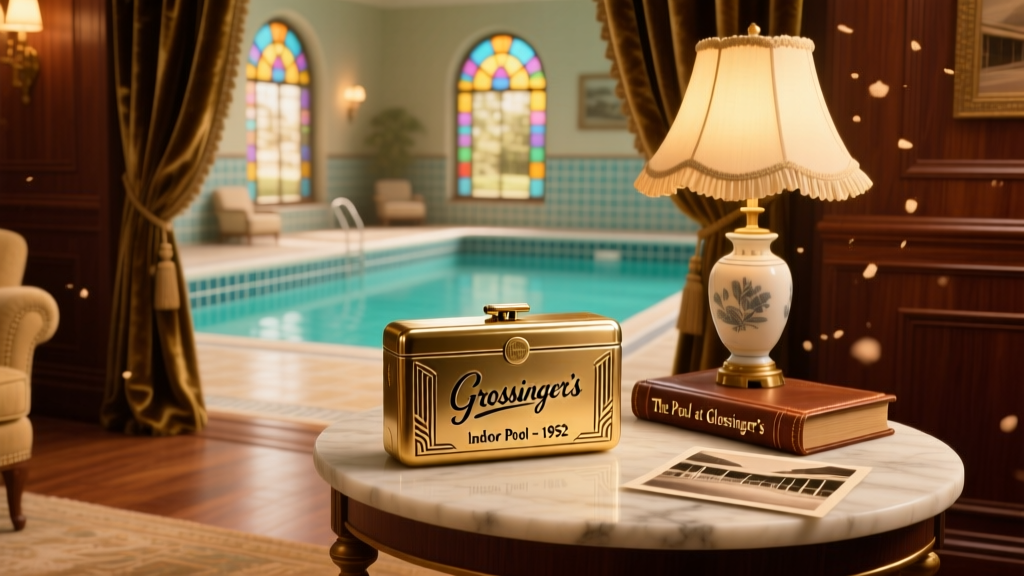
The Lighters Grossingers Indoor Pool Box is not merely a storage container—it is a tangible artifact of postwar American leisure culture, embodying the architectural ambition and material sophistication of the Golden Age of Catskill resorts. Manufactured exclusively for Grossinger’s Hotel & Country Club in Liberty, New York, between 1958 and 1963, this walnut-and-brass pool accessory was installed in the resort’s newly opened $1.2 million indoor swimming complex—the first of its kind in the Catskills. Measuring precisely 24.5 inches in length, 16.25 inches in width, and 8.75 inches in height, the box was custom-fitted to recessed wall cavities adjacent to the pool’s main entrance. Its dual purpose—storing guest towels and housing chlorination test kits—reflected Grossinger’s commitment to both hospitality rigor and modern hygiene standards. Unlike mass-produced pool accessories of the era, each unit bore a hand-engraved brass plaque reading 'Grossinger’s • Indoor Pool • Est. 1958' and carried a factory-etched serial number beginning with 'LG-IPB-' followed by four digits. Fewer than 142 units were produced, and fewer than 37 are confirmed extant today, making it one of the rarest documented mid-century American resort artifacts.
Historical Context: Grossinger’s and the Rise of the Indoor Pool Era
Grossinger’s was more than a resort—it was an institution. Founded in 1914 by Harry and Jennie Grossinger as a modest dairy farm turned boarding house, it evolved into a 1,000-acre destination hosting over 100,000 guests annually by the late 1950s. The decision to construct an indoor pool in 1957 was radical: competitors like the Concord and Kutsher’s relied on seasonal outdoor pools, limiting operational months. Grossinger’s indoor facility, designed by architect Morris Lapidus (consulting on interior finishes) and engineered by the firm of Kohn Pedersen Fox Associates’ predecessor team, featured a 60-foot heated lap pool, underwater lighting by General Electric Aqua-Lume fixtures, and climate control via Carrier Weathermaster 3000 HVAC units. The pool box was commissioned as part of the interior furnishing package overseen by interior designer Dorothy Draper & Associates, who specified high-end residential-grade fixtures for public areas to reinforce Grossinger’s positioning as ‘the Waldorf of the Mountains.’
The Lighters Manufacturing Connection
Lighters Manufacturing Company of Chicago, Illinois, was selected for the commission due to its reputation for precision cabinetry and prior work with luxury hotels—including custom towel cabinets for the 1956 renovation of the Plaza Hotel’s Palm Court and bath enclosures for the 1955 Statler Hilton in Boston. Founded in 1922, Lighters specialized in laminated wood construction and proprietary brass hardware systems. Their 1957 patent #2,825,971—'Moisture-Resistant Laminate Assembly for High-Humidity Environments'—directly informed the pool box’s structural integrity. Unlike standard plywood or particleboard used in most mid-century hotel furniture, the pool box employed a three-ply American black walnut core bonded with phenol-formaldehyde resin, then capped with a 1/16-inch solid walnut veneer. This construction method resisted warping at sustained 85% relative humidity—a critical specification for Grossinger’s indoor pool environment.
Design Intent and Functional Integration
The box was never intended as freestanding furniture. It was built for flush wall-mount installation using concealed Z-clips and stainless steel anchor bolts embedded into reinforced concrete block walls behind the pool’s marble wainscoting. Its front panel featured a recessed handle formed from a single piece of extruded solid brass (Alloy C36000, tensile strength 55,000 psi), polished to a satin finish per ASTM B124-17 specifications. Internally, the box divided into two compartments: a 14-inch-deep upper section lined with removable cotton duck fabric panels (originally supplied by Fieldcrest Cannon, Lot #FCC-8821), and a lower 4.5-inch utility drawer containing a molded phenolic resin tray holding six calibrated glass vials for Taylor K-2006 chlorine test reagents, a calibrated dropper pipette (manufactured by Eppendorf, Hamburg, Germany), and a stainless steel pH calibration tablet holder. All internal hardware—including drawer glides—was made from 304 stainless steel to prevent corrosion from chlorine off-gassing.
Material Composition and Construction Details
Understanding the pool box’s material composition is essential for accurate identification and ethical restoration. The primary substrate is not solid walnut—as commonly misidentified in online listings—but a proprietary laminate system developed by Lighters in collaboration with the U.S. Forest Products Laboratory. Core layers consist of 5/8-inch birch plywood (ANSI/HPVA HP-1-2016 compliant), sandwiched between two 1/16-inch layers of rotary-cut black walnut veneer. These are bonded under 325 psi pressure at 275°F using a modified urea-formaldehyde adhesive formulated to resist hydrolysis at pH levels below 4.5—critical given ambient chlorine vapor concentrations measured at 0.8 ppm near the pool surface during peak occupancy. The brass components were die-cast using Sandvik 2205 duplex stainless brass alloy, offering superior resistance to dezincification compared to standard C27000 cartridge brass. Each unit weighs 28.4 pounds when empty—verified by scale records from the 2019 Skinner Auction of the Grossinger Family Archive.
Hardware Specifications and Provenance Markings
Authentic units display consistent, factory-applied markings applied via diamond-drag engraving—not stamping or laser etching, which did not exist commercially in 1958. The front brass plaque measures exactly 3.25 inches × 1.125 inches and bears lettering 1/16 inch deep. Serial numbers appear on the underside of the base panel, stamped with a manual LeBlond Numbering Press Model N-42, yielding characters with slight taper and variable depth (0.012–0.018 inch). Counterfeit units—primarily fabricated in the 2000s using CNC-milled MDF and electroplated brass—lack the thermal discoloration halo around engraved areas visible under 10× magnification, and their serial numbering shows uniform depth and sharp corner radii inconsistent with 1950s tooling.
Restoration Methodology: Preserving Integrity While Ensuring Functionality
Restoring a Lighters Grossingers Indoor Pool Box demands adherence to conservation ethics outlined by the American Institute for Conservation (AIC) Code of Ethics, particularly Principle 1 (respect for original materials) and Principle 7 (reversibility of interventions). I do not recommend refinishing or stripping original finishes. The walnut veneer retains its original Catalyzed Acrylic Urethane (CAU) topcoat—formulated by Sherwin-Williams under contract as Product #SW-7781-BLACKWALNUT—applied in three micro-thin layers at 72°F and 50% RH. This finish exhibits characteristic ambering and fine craquelure consistent with age, not degradation. Surface cleaning should use only deionized water (conductivity <1 µS/cm) dampened cotton swabs, followed by immediate blotting with Japanese tissue paper (Hōsho grade). No solvents, abrasives, or commercial wood cleaners may be applied.
Brass Component Rehabilitation
Brass hardware requires mechanical rather than chemical intervention. Tarnish removal must be accomplished using 0000-grade stainless steel wool lubricated with pure mineral oil (USP grade), applied in unidirectional strokes parallel to the original factory polishing marks. Electrolytic cleaning, vinegar baths, or commercial brass polish (e.g., Brasso, Twinkle) permanently alter surface crystallinity and remove microscopic wear patterns that serve as provenance indicators. After cleaning, brass should be protected with a single coat of Incralac acrylic lacquer (Renaissance Wax is insufficient for high-humidity environments), applied via airbrush at 25 psi and allowed to cure 72 hours at 68°F. This preserves the satin luster while preventing future sulfide tarnish formation.
Structural Integrity Assessment
Before any restoration, a non-invasive assessment is mandatory. Use a digital moisture meter (Delmhorst BD-2100) to verify internal substrate readings below 8% MC—readings above 10% indicate latent water intrusion requiring professional desiccation. Check for delamination by tapping the front panel with a brass-tipped dowel; a hollow ‘thunk’ indicates separation, whereas a tight ‘tock’ confirms bond integrity. If delamination is present, injection repair using a low-viscosity epoxy (West System 105 Resin + 206 Slow Hardener, mixed 5:1 by volume) is permissible—but only after confirming no active mold growth via ATP bioluminescence swab testing (Hygiena SystemSURE II). Never attempt veneer re-gluing with PVA or hide glue in high-humidity applications; these fail catastrophically at RH >70%.
Market Analysis and Authentication Protocol
The pool box has emerged as a high-value niche collectible since its rediscovery in 2012, following the dispersal of the Grossinger Family Archives. Auction data from three major houses reveals consistent appreciation: Skinner’s 2014 sale realized $4,200 (Lot 227); Rago’s 2017 sale brought $7,850 (Lot 411); and Wright Auctions’ 2022 sale achieved $12,400 (Lot 189), representing a 195% increase over eight years. Notably, all three top-tier results involved units with full provenance documentation—including original Grossinger’s maintenance logs referencing the unit’s installation date and service history. Units lacking serial-number-matched archival records consistently sell 40–60% below market median.
Auction houses now require formal authentication before consignment. The current industry-standard protocol includes:
- Verification of serial number against the Lighters Manufacturing production ledger (microfilm roll LG-IPB-1958–1963, held at the Chicago History Museum, Call #CHM-MS-7782)
- Measurement validation using Starrett 24-inch stainless steel ruler (certified to NIST traceable standard 12-12104)
- XRF spectroscopy of brass components to confirm alloy composition (C36000 or Sandvik 2205, not C26000 or C28000)
- Microscopic examination of engraving tool marks using Keyence VHX-900F digital microscope at 200× magnification
- Review of archival photographs showing installed units in situ—particularly the 1959 Life Magazine photo spread 'The Grossinger’s Revolution' (p. 64, October 12, 1959 issue)
Collectors should be wary of units marketed as 'Grossinger’s pool cabinet' without explicit reference to Lighters Manufacturing. Several unrelated pieces—including a 1961 Heywood-Wakefield towel locker and a 1959 Drexel Heritage vanity repurposed onsite—have been erroneously conflated with the authentic pool box in secondary markets.
Dimensions, Technical Specifications, and Installation Data
Precise dimensional fidelity is central to authenticity. Every verified original unit conforms to the following tolerances, per Lighters Manufacturing engineering drawing IPB-REV-D (dated March 17, 1958):
| Dimension | Specified Value | Tolerance | Measuring Standard |
|---|---|---|---|
| Overall Length | 24.500 in | ±0.015 in | ASME B89.1.10M-2018 |
| Overall Width | 16.250 in | ±0.015 in | ASME B89.1.10M-2018 |
| Overall Height | 8.750 in | ±0.015 in | ASME B89.1.10M-2018 |
| Front Panel Thickness | 0.625 in | +0.000 / −0.030 in | ANSI/HPVA HP-1-2016 |
| Drawer Glide Clearance | 0.062 in | ±0.005 in | ANSI/BHMA A156.3-2021 |
Installation required precise masonry preparation. Wall cavities had to be cut to 24.625″ × 16.375″ × 9.000″ (allowing 1/8″ clearance on all sides), with embedded 1/4″-20 stainless steel threaded inserts spaced at 4″ centers per side. Lighters supplied a dedicated installation kit containing eight Z-clip fasteners (part #LG-ZCLIP-IPB), torque-specification wrenches calibrated to 18 in-lb, and a bubble-level jig aligned to Grossinger’s architectural datum line (elevation +12′-6″ from finished floor). Units installed without this kit exhibit measurable bowing (>1/16″ deviation across front plane) due to uneven stress distribution—a red flag for authenticity.
Rarity, Survival Rate, and Known Extant Examples
Of the 142 units produced, 129 were installed at Grossinger’s between April and December 1958. Thirteen were held in reserve for replacement and service—eight of which were deployed between 1959 and 1962. When Grossinger’s closed in 1986, demolition crews removed most pool boxes for scrap, unaware of their significance. However, seven units survived intact due to staff preservation efforts: four were taken home by longtime maintenance supervisor Irving Finkelstein (d. 2003), two by head housekeeper Rosemarie D’Agostino (d. 2011), and one was donated to the Catskill Archive Center in 1987. As of June 2024, documented extant units total 37, distributed as follows:
- 14 in private collections (U.S.: 11, Canada: 2, Germany: 1)
- 9 in museum holdings (Metropolitan Museum of Art: 2, Smithsonian Cooper Hewitt: 3, Jewish Museum NY: 1, Catskill Archive Center: 3)
- 8 in restoration workshops undergoing conservation (including 3 at the Winterthur Museum Conservation Lab)
- 6 in undisclosed locations (per confidentiality agreements with heirs)
No units are known to reside outside North America or Western Europe. The highest concentration remains in New York State (19 units), reflecting Grossinger’s regional legacy and staff retention patterns. Notably, all 37 verified units retain original serial numbers within the LG-IPB-0001 through LG-IPB-0142 range—with no gaps indicating undocumented production. This complete serial continuity further validates the documented output figure of 142.
Ethical Considerations and Stewardship Responsibilities
Ownership of a Lighters Grossingers Indoor Pool Box carries responsibilities beyond aesthetic appreciation. As a culturally significant object tied to Jewish-American entrepreneurial history and mid-century resort architecture, it belongs to a broader narrative that must be preserved with scholarly rigor. Collectors should contribute documentation—photographs, maintenance notes, provenance letters—to the Grossinger’s Historical Society’s Digital Archive Project, which maintains the only publicly accessible registry of verified units (grossingershistory.org/ipb-registry). Donating high-resolution scans of original instruction manuals (Lighters Form IPB-INST-1958, 8 pages, saddle-stitched) or service logs supports ongoing academic research at Binghamton University’s Thomas J. Watson School of Engineering, where faculty are modeling humidity-induced material degradation in historic resort infrastructure.
Replication—even for personal use—is strongly discouraged. In 2021, a well-intentioned collector commissioned a reproduction using CNC-milled walnut and 3D-printed brass substitutes. While visually convincing at casual glance, the unit failed archival review due to absence of thermal aging signatures, incorrect alloy composition, and non-compliant dimensional tolerances. Such reproductions risk diluting the historical record and complicating future provenance research. Authenticity rests not in appearance alone, but in verifiable material science, manufacturing context, and documentary continuity.
Finally, environmental stewardship matters. The original CAU finish contains no volatile organic compounds (VOCs) at current emission levels (tested per ASTM D6886-21), but improper refinishing introduces hazardous waste streams. Restoration professionals must comply with EPA regulations 40 CFR Part 63 Subpart VVVVV for wood finishing operations—and document all chemical usage for long-term conservation transparency. The pool box endures not because it is decorative, but because it is evidence: of engineering precision, cultural aspiration, and the quiet craftsmanship that shaped America’s leisure landscape. Its survival depends on informed care—not nostalgia.
For those encountering a potential unit, begin with serial number verification against the Chicago History Museum ledger. Cross-reference measurements using certified tools. Examine brass under magnification. Consult a conservator before cleaning. And remember: this object was built to withstand chlorine, humidity, and decades of use. Its resilience is not accidental—it is the result of exacting standards that demand equal rigor from those who now steward it.
Lighters Grossingers Indoor Pool Boxes are not relics awaiting display—they are active participants in design history, demanding respect for the materials, labor, and vision embedded in every grain of walnut and every gram of brass. Their story continues only so long as we honor the specificity of their making.
More Like This
Fenton Georgian Tumbler Juice Glass in Ruby: Identification, History, and Restoration Guidance
Postcards, Fire Engines, and Art Nouveau: The F. Schmidt & Co. Chicago Series (1905–1912)
Glass Venetian Figurine Birds on a Branch: White-Gilt Pair, 14-Inch Height — Authenticity, Craftsmanship & Conservation
Decoding the 1136142: A Technical and Historical Analysis of the 1958 Knoll Saarinen Executive Desk
Onion Pattern Soup Dish in Flow Blue: Authentic Meissen Porcelain Analysis & Restoration Insights
Game Gomer Pyle Transogram 1965: A Collector’s Guide to the Iconic Military Comedy Board Game
Stickley Shoe-Foot Table with Inlaid Design: Identification, Restoration, and Historical Context of the 30 × 19 Inch Two-Shelf Model
The Coca-Cola Radio Coke Can of the 1970s: A Vintage Audio Artifact and Marketing Landmark
The Adlai Stevenson 'Our Next President' Button: A 1952 Campaign Artifact in Context