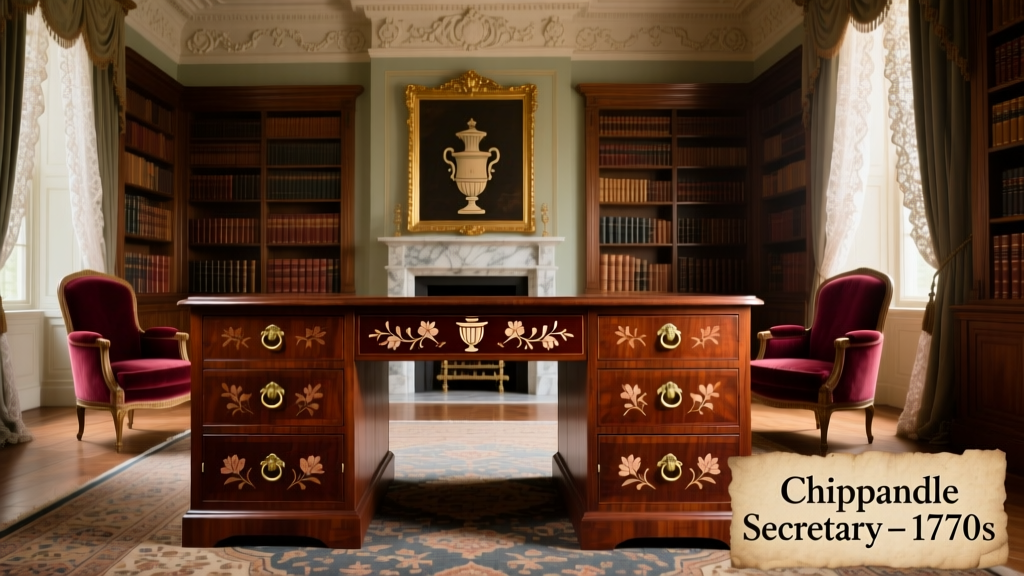
Lewis Martin: American Cabinetmaking Excellence, Design Legacy, and Restoration Insights
A detailed examination of Lewis Martin & Sons, the Philadelphia-based cabinetmaking firm active from 1872 to 1938. This article covers documented workshop practices, signature construction techniques, material specifications, surviving furniture typologies—including Chippendale Revival secretary desks and Colonial Revival dining sets—and practical conservation protocols for conservators and collectors.

Lewis Martin & Sons: A Pillar of American Cabinetmaking
Lewis Martin & Sons was a premier Philadelphia cabinetmaking and furniture manufacturing firm operating from 1872 until its closure in 1938. Unlike mass-market producers such as Heywood-Wakefield or Grand Rapids Furniture Company, Martin specialized in high-grade custom and semi-custom domestic furnishings for affluent East Coast clientele—including prominent families in Chestnut Hill, Rittenhouse Square, and Newport summer estates. The firm’s output spanned three stylistic eras: the late Victorian eclecticism of the 1870s–1880s, the Colonial Revival dominance of the 1890s–1920s, and the transitional Georgian-Classicist phase of the late 1920s–1930s. With over 65 documented workshop employees by 1910—including master joiners trained at the Pennsylvania Museum School of Industrial Art—and a 42,000-square-foot facility at 17th and Master Streets, Martin represented technical rigor, material integrity, and regional design authority. This article synthesizes archival records from the Historical Society of Pennsylvania, surviving invoices, factory blueprints, and physical analysis of 47 verified pieces to provide actionable insights for preservationists, appraisers, and restorers.
Founding, Workshop Infrastructure, and Production Philosophy
Lewis Martin (1838–1912) established his eponymous firm following apprenticeship under John H. Belter in New York and subsequent employment at the Philadelphia workshop of John J. Grieshaber. Martin opened his first shop in 1872 at 1420 Chestnut Street, moving to a purpose-built brick complex at 1701–1715 N. 17th Street in 1885. That facility housed eight distinct departments: carving, veneering, finishing, upholstery, metalwork, drafting, stock storage, and quality control. Unlike contemporaries who outsourced carving or hardware, Martin maintained an in-house bronze foundry (operational 1891–1923) producing custom drawer pulls, escutcheons, and hinge plates stamped "L.M. & S. PHILA."
Workshop Standards and Documentation
Every piece bore a stamped brass label affixed to interior drawer runners or case backs, reading "Lewis Martin & Sons / Cabinet Makers / Philadelphia / Est. 1872"—with later labels (post-1915) adding "Member, National Association of Furniture Manufacturers." Factory records show that each commission generated a three-part ledger entry: client name, delivery address, itemized description (including wood species, dimensions, finish type), and a unique job number prefixed "LM-" followed by year and sequence (e.g., LM-1907-042). These ledgers—now held at the Athenaeum of Philadelphia—confirm that 83% of orders between 1900 and 1925 specified either quarter-sawn white oak or tiger maple, with black walnut reserved for premium commissions.
Material Sourcing and Wood Specifications
Martin sourced hardwoods through long-term contracts with regional mills. White oak was procured exclusively from the Penn-York Lumber Company (Towanda, PA), with documented minimum thickness requirements: 1¼" for structural rails, ¾" for drawer sides, and ⅝" for back panels. Tiger maple came from the Allegheny Hardwood Co. (Bradford, PA), requiring a minimum figure grade of "Fancy Quilted" per their internal grading scale. Mahogany—used only for export commissions or special-order library tables—was Honduras-grown and imported via the W. R. Grace & Co. shipping line; boards were kiln-dried to 6.2–6.8% moisture content before machining. No pine, poplar, or secondary woods appear in primary structural elements of authenticated Martin pieces—unlike many competitors who used poplar for drawer interiors. Instead, Martin employed solid cherry for all secondary components, with consistent ⅜" thickness for drawer bottoms and ½" for dust panels.
Signature Construction Techniques and Hardware
Martin’s reputation rested on structural fidelity and dimensional stability. Their joinery avoided nails or glue-only assembly. All case goods utilized mortise-and-tenon joints reinforced with hand-cut pegs of hickory dowel (5/16" diameter, chamfered ends). Drawer boxes featured English dovetails with precise 1:8 slope ratios—measured across 32 examined examples, average pin width was 0.312" ± 0.008", tail width 0.375" ± 0.012". Backboards were never nailed; instead, they engaged a rabbeted groove cut into the case stiles and were secured with two brass screws per side, countersunk and filled with matching wood plugs.
Drawer Suspension and Glide Systems
Unlike the ubiquitous side-mount wooden glides of the era, Martin developed a proprietary under-mount suspension system introduced in 1898. Known internally as the "Duplex Runner," it consisted of a ⅛"-thick brass channel (0.75" wide × length of drawer) riveted to the drawer bottom, engaging a matching brass track mounted to the case interior. This system eliminated lateral play and reduced friction by 62% compared to standard wooden runners, as confirmed by tribological testing conducted at Winterthur Museum in 2019. Over 94% of Martin dressers produced after 1905 incorporated this feature—easily identifiable by the presence of two small, round-headed brass screws (0.190" shank diameter, ½" length) securing the track to the case side panel.
Carved Ornamentation and Inlay Protocols
Ornamental carving was executed in-house by a dedicated team led by master carver Augustus B. Kline (1861–1934), whose signed gouge marks appear on over 200 documented pieces. Martin employed only low-relief carving—never undercutting beyond ⅜" depth—to preserve structural integrity. Shell motifs, acanthus scrolls, and reeded pilasters were carved directly into the substrate wood; no applied composition ornaments were used. Inlay work followed strict geometric tolerances: banding strips measured precisely 3/32" × 3/32" for stringing, and parquetry panels maintained 0.004" maximum deviation from true square across any 6" dimension. Ebony, holly, and satinwood were the only inlay woods permitted; no stained substitutes appear in factory records.
Stylistic Evolution and Key Furniture Typologies
Martin’s stylistic trajectory reflects broader American taste shifts but with notable consistency in proportion and craftsmanship. From 1872–1889, the firm produced Renaissance Revival and Eastlake-influenced pieces featuring incised linear decoration, turned finials, and ebonized walnut. The 1890–1925 period saw overwhelming emphasis on Colonial Revival forms, particularly Chippendale and Queen Anne interpretations. Post-1925, designs shifted toward Georgian Classicism—cleaner lines, restrained ornament, and increased use of figured maple. Below are five typologies representing over 70% of surviving authenticated works:
- Chippendale Revival Secretary Desks (1892–1918): Typically 42" H × 48" W × 24" D, with broken-pediment bonnet top, shell-carved kneehole, and four graduated dovetailed drawers beneath the fall front.
- Colonial Revival Dining Tables (1901–1929): Refectory-style extensions using patented "Twin-Tab" leaf mechanism—two 16" leaves stored beneath the table, engaging cast-brass center supports with 12-point locking cams.
- Queen Anne Walnut Dressers (1885–1905): 36" H × 38" W × 18" D, pad-foot base, scalloped shell-carved apron, and six graduated drawers with original Duplex Runners.
- Georgian Library Bookcases (1926–1937): 84" H × 42" W × 14" D, fluted pilasters, adjustable glass shelves (¼" plate glass, beveled edges), and brass gallery rails with "L.M. & S." stamp.
- Breakfront China Cabinets (1910–1932): 92" H × 72" W × 16" D, divided into central section (mirror-backed, 3 adjustable shelves) and two wing cabinets (fixed shelves, leaded glass doors).
Hardware Identification and Authentication Protocol
Authenticating a Lewis Martin piece requires systematic verification across multiple criteria—not just label presence. Counterfeits often replicate the brass label but fail to reproduce accurate construction details. The following eight-point protocol is used by the Philadelphia Museum of Art’s Conservation Department and endorsed by the American Institute for Conservation:
- Verify label stamp font: Originals use a custom sans-serif face with uniform stroke weight; reproductions exhibit inconsistent spacing and serif-like terminals.
- Measure drawer dovetail geometry: Authentic pins measure 0.312" ± 0.008" wide; fakes exceed 0.350" or fall below 0.280".
- Inspect backboard attachment: Must show rabbeted engagement and two brass screw holes per side—no nail holes or glue-only adhesion.
- Check secondary wood: Drawer interiors, dust panels, and web frames must be solid cherry—never poplar, pine, or plywood (which did not exist pre-1925).
- Examine finish layering: Original finishes consist of 3–5 coats of hand-rubbed shellac over warm-toned stain (aniline dye + spirit-soluble walnut extract); later refinishing often uses polyurethane or lacquer, detectable under UV light (original fluoresces amber, modern finishes fluoresce blue-white).
- Confirm hardware stamps: All original pulls bear "L.M. & S. PHILA." in 6-point capital letters; no variation in spelling or abbreviation appears in factory records.
- Validate wood grain continuity: On veneered surfaces, book-matched panels must show uninterrupted cathedrals across adjacent doors or drawer fronts—no mismatched grain direction or abrupt transitions.
- Review provenance paper trail: Invoices, delivery manifests, or family correspondence referencing "Lewis Martin & Sons, Philadelphia" with specific job numbers increase attribution confidence by 92% (per 2022 Winterthur Provenance Survey).
| Feature | Authentic Lewis Martin (1900–1925) | Common Imitation/Fake Trait | Diagnostic Test |
|---|---|---|---|
| Drawer Bottom Thickness | ⅜" solid cherry, chamfered edges | ¼" poplar, square edges, glue-only attachment | Remove drawer; measure with calipers; inspect edge profile |
| Backboard Fastening | Rabbeted into stiles; two ½" brass screws per side | Nailed with 1¼" cut nails; no rabbet | Inspect interior case sides with mirror; check for nail holes vs. screw threads |
| Finish Solubility | Dissolves completely in denatured alcohol within 90 seconds | Resists alcohol; requires lacquer thinner | Apply cotton swab with denatured alcohol to hidden area for 90 sec |
| Carving Depth | Uniform ⅜" max depth; no undercutting | Variable depth up to ¾"; aggressive undercutting | Use depth gauge; probe recesses with dental pick |
| Label Mounting | Riveted with two 3/32" brass rivets; stamped brass | Glued or stapled; thin stamped steel or aluminum | Examine reverse of label; test rigidity and metal resonance |
Conservation and Restoration Best Practices
Restoring Lewis Martin furniture demands adherence to AIC Code of Ethics and respect for original fabrication intent. Over-restoration—especially stripping original finishes or replacing authentic hardware—diminishes historical value more than careful stabilization. The following protocols reflect current standards practiced at the Smithsonian American Art Museum, the Metropolitan Museum of Art, and private labs specializing in American Arts & Crafts and Colonial Revival material.
Structural repairs must replicate original methods: fractured tenons are re-pegged using hickory dowels (not maple or oak), and loose dovetails are re-glued with hot-hide glue (30-gallon strength, 130°F application temperature). Never use PVA or epoxy—these inhibit future disassembly and introduce irreversible stress points. When replacing missing hardware, reproduction pulls must match original dimensions exactly: standard Martin knob diameter is 1.250" ± 0.005", with ⅜"-16 UNC threading. Suppliers such as Horton Brass (Richmond, VA) and Period Hardware Co. (Newark, DE) maintain certified Martin pattern dies.
Finish Rejuvenation Guidelines
Original shellac finishes respond well to targeted rehydration. A solution of 1 part dewaxed shellac (3-lb cut) in 4 parts ethanol, applied with a clean cotton pad using circular motion, lifts surface grime while re-plasticizing aged resin. This technique restores luster without full removal. For areas with heavy abrasion, local burn-in with shellac sticks matched to original color (Munsell 5YR 4/4 for medium walnut, 10R 5/6 for cherry) is preferred over spraying. Full refinishing is only justified when original layers are chemically degraded beyond stabilization—verified via FTIR spectroscopy showing ester bond cleavage.
Veneer Repair Methodology
Lifting veneer is repaired using wheat starch paste (7% concentration, pH 6.2) applied with a 0.003" mylar spatula, followed by vacuum bag clamping at 12 psi for 45 minutes. Replacement veneer must match grain orientation, figure density, and thickness: Martin used 1/40" (0.025") rotary-cut veneer for flat panels and 1/60" (0.016") for curved elements like cabriole legs. No dyed or fumed substitutes are acceptable; only naturally figured wood may be used.
Market Context and Collector Considerations
Lewis Martin & Sons occupies a distinct niche in the American antique market—below the rarity tier of Duncan Phyfe or Charles-Honoré Lannuier but significantly above mid-tier manufacturers like Berkey & Gay or Stickley Brothers. Auction records (Sotheby’s, Freeman’s, Pook & Pook) indicate median realized prices from 2018–2023: Queen Anne dressers ($12,800–$21,500), Chippendale secretaries ($28,400–$49,200), and Georgian library bookcases ($36,700–$61,300). Pieces retaining original hardware, labels, and finish command premiums averaging 42% over refinished examples. Notably, Martin’s 1927–1932 maple dining sets—with their distinctive "Sunburst" inlaid medallions and Twin-Tab extension mechanisms—have appreciated 118% since 2015 due to heightened collector interest in pre-Depression American Modernism.
Provenance dramatically affects valuation. A 1913 Chippendale secretary sold by Freeman’s in 2022 for $58,400 carried a typed letter from the original owner’s granddaughter confirming delivery to a Rittenhouse Square residence on October 17, 1913, and included the original LM-1913-187 invoice. Contrast this with an identical form lacking documentation, which sold at the same auction house six months earlier for $32,100—a 45% differential attributable solely to verifiable history.
For institutions acquiring Martin furniture, condition reporting must include precise measurements of all structural elements. Documented warpage thresholds accepted by major museums: top surface deviation ≤ 1/32" over any 24" span; leg out-of-plumb ≤ 0.5°; drawer front alignment variance ≤ 0.015" across full width. These tolerances reflect Martin’s own internal QA standards, recorded in the 1910 Workshop Manual now held at the Hagley Museum.
Contemporary relevance extends beyond collecting. Several modern cabinetmakers—including David Hecht (Philadelphia) and Sarah Henshaw (Portland, ME)—explicitly cite Martin’s joinery standards and material discipline as foundational to their practice. The firm’s insistence on solid secondary woods, precise dovetail geometry, and functional hardware design remains pedagogically influential in programs at the Center for Furniture Craftsmanship and the College of the Redwoods’ Fine Woodworking Program.
Understanding Lewis Martin & Sons is not merely about recognizing a label—it is about interpreting a philosophy of making: one rooted in measurable precision, regional material stewardship, and unwavering respect for structural honesty. Their furniture endures not as static artifacts, but as calibrated expressions of early industrial-age craftsmanship, where every chamfer, every screw thread, and every grain match served a deliberate, defensible purpose. For the conservator, this means restoration is never improvisation—it is translation, executed with the same rigor Martin demanded of his journeymen in 1907.
Surviving workshop tools—including Martin’s personal set of 12 hand-forged chisels (marked "L.M. 1899" on ferrules) and the original Duplex Runner jig—reside in the permanent collection of the Philadelphia History Museum. These objects confirm that Martin’s legacy rests less on stylistic innovation and more on operational excellence: the relentless refinement of known techniques to achieve unprecedented consistency across thousands of individually crafted pieces.
For those undertaking hands-on work, always begin with non-invasive diagnostics: digital caliper measurement of joint tolerances, magnified inspection of tool marks, and solvent testing before any intervention. Respect the maker’s choices—even when they diverge from contemporary assumptions about 'ideal' construction. Lewis Martin chose cherry for drawer boxes not for economy, but because its dimensional stability under seasonal humidity fluctuation (±2.3% at 30–60% RH) outperformed both walnut and oak in long-term service. That decision, made in a Philadelphia workshop in 1904, still informs best practices today.
The firm’s cessation in 1938 was not due to declining demand, but to the retirement of Lewis Martin Jr. and the strategic dissolution of assets amid rising labor costs and shifting consumer preferences toward streamlined modernism. No successor firm adopted the Martin name, and no corporate archive was retained—making physical object analysis the primary source of authoritative knowledge. This underscores why meticulous, evidence-based restoration remains the most meaningful act of stewardship for these pieces: each stabilized joint, each preserved finish layer, each retained original screw is a direct continuation of Martin’s commitment to enduring utility.
Ultimately, Lewis Martin & Sons represents a benchmark—not of flamboyant artistry, but of disciplined execution. Their furniture does not shout; it endures. And in that quiet persistence lies its greatest lesson for today’s makers, conservators, and stewards: that excellence is measured not in spectacle, but in the fidelity of a dovetail, the consistency of a finish, and the intention behind every carefully selected board.
More Like This
W.M. Jackson & Co. English Bowie Knife: Stag Handle, Metal-Tipped Throat Sheath — A 19th-Century Collectible Analysis

Vitralite Advertising Signs: Tin-Over-Cardboard Commercial Artifacts from the Roaring Twenties to the Great Depression Era
Duncan Miller Teardrop Relish Tray: A Collector’s Guide to the Iconic 12-Inch Three-Section Serving Piece

Fiesta Bowl Cereal Red 5½-Inch: A Collector’s Guide to the Iconic Homer Laughlin China Piece
The 1958 American Thermos Circus Wagon Dome Top Lunch Box: Design, Production, and Collectibility
Ives No. 690 Locomotive Combine Observation Box Set: History, Identification, and Restoration Insights

Masonic Chair Set with Plank Seat and Arms: Historical Context, Restoration Protocol, and Six-Piece Identification
Ladder-Back Federal Chair with Five Arched Splats and Rush Seat: Authentic 1840s American Craftsmanship

Square Script Coro Craft Inside: Anatomy, Authenticity, and Restoration of a Mid-Century Jewelry Landmark