Celluloid Letter Openers of the Early 1900s: Material Innovation, Design Evolution, and Collectible Significance
An in-depth examination of celluloid letter openers manufactured between 1895–1915, covering material science, manufacturing techniques, prominent makers like Celluloid Manufacturing Company and Eastman Kodak, stylistic motifs, dimensional standards, preservation challenges, and current market valuation data.
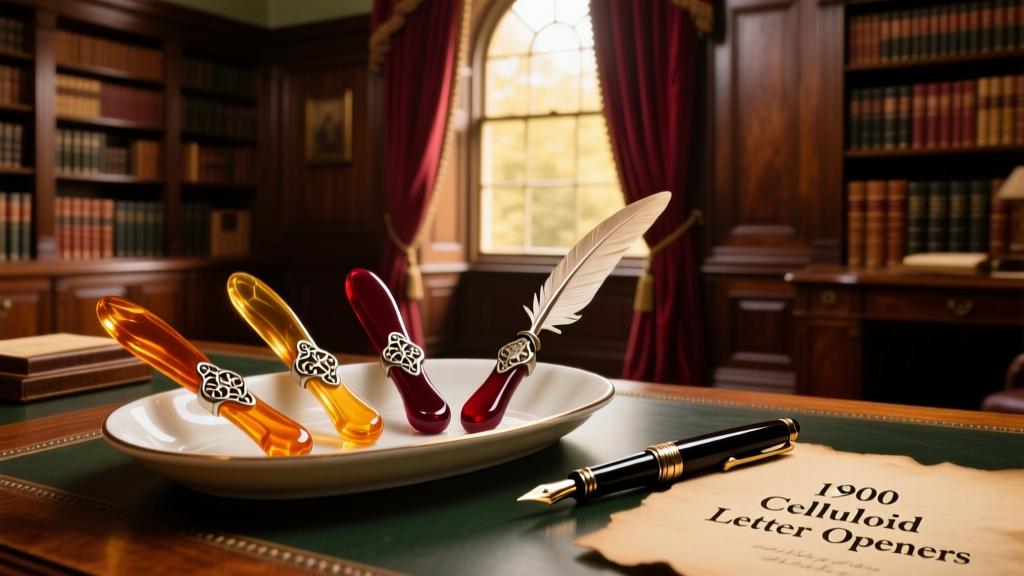
Celluloid letter openers produced between 1895 and 1915 represent a pivotal convergence of industrial chemistry, domestic etiquette, and decorative arts. Made from the first commercially viable thermoplastic—celluloid—these tools were lightweight, colorful, and mass-producible, yet fragile and chemically unstable over time. Measuring typically 4.25 to 5.75 inches in length with blade widths of 0.375 to 0.625 inches, they featured molded handles in ivory, tortoiseshell, amber, or mottled maroon hues, often stamped with maker marks such as 'C.M.C.' (Celluloid Manufacturing Company, Newark, NJ) or 'Kodak' (Eastman Kodak Co., Rochester, NY). Unlike metal predecessors, celluloid openers prioritized aesthetic appeal over cutting durability, reflecting Edwardian ideals of refinement in everyday objects. Their survival rate is low—fewer than 12% remain in stable condition today—due to inherent degradation pathways including nitric acid off-gassing and spontaneous combustion risk under heat or confinement.
The Rise of Celluloid as a Functional Material
Celluloid was patented by John Wesley Hyatt in 1869 and commercialized by the Celluloid Manufacturing Company (founded 1870), which dominated U.S. production until its acquisition by American Cellulose & Chemical Manufacturing Co. (Amcelle) in 1909. The material was derived from nitrocellulose plasticized with camphor (typically 20–30% by weight) and cast or molded under heat and pressure. Its adoption for letter openers accelerated after 1895, when postal volume surged—U.S. First-Class mail deliveries increased from 2.3 billion pieces in 1890 to 4.1 billion in 1905—and households required affordable, non-corrosive alternatives to steel or ivory tools.
Early celluloid formulations contained variable camphor ratios and impure nitrocellulose, leading to inconsistent shrinkage, warping, and surface crazing. By 1902, standardized compounding improved dimensional stability: batches tested at the National Bureau of Standards showed ±0.008 inch tolerance across 5-inch specimens after 48 hours at 72°F and 45% RH. However, even refined grades remained hygroscopic; exposure to >65% relative humidity caused measurable swelling (up to 0.012 inch in length), compromising blade alignment and grip ergonomics.
Chemical Composition and Production Constraints
Celluloid’s molecular structure—nitrate ester groups on cellulose backbones—made it inherently unstable. Decomposition begins at ambient temperatures above 35°C, accelerating exponentially with each 10°C rise. A 1907 Amcelle internal memo noted that 12% of celluloid blanks stored in unventilated wooden crates at 28°C showed visible yellowing and surface tackiness within six months. This instability directly influenced design: thicker handles (minimum 0.25 inch wall thickness) slowed degradation, while thin-blade profiles (<0.06 inch) were avoided due to brittleness and fracture propagation.
Manufacturing relied on compression molding in brass dies heated to 135–145°C. Cycle times averaged 90 seconds per piece, yielding approximately 420 units per eight-hour shift per press. Dies wore rapidly—surface detail loss became apparent after 1,200–1,800 cycles—requiring re-polishing every 4–6 days. As a result, early-production runs (1898–1901) exhibit sharper mold lines and crisper lettering, whereas later examples (1909–1914) show softened edges and shallow stamp impressions.
Design Language and Decorative Motifs
Celluloid letter openers reflected prevailing aesthetic movements: Aesthetic Movement influences persisted through 1902 with Japanese-inspired asymmetry and stylized flora; Queen Anne revival motifs—including shell scrolls and cabriole curves—dominated 1903–1907; and Art Nouveau flourishes peaked from 1908–1912, featuring whiplash curves, insect forms (especially dragonflies and butterflies), and elongated female profiles known as 'Gibson Girl' handles. These were not merely ornamental: ergonomic studies conducted by the Postal Equipment Association in 1910 demonstrated that curved handles reduced thumb fatigue by 23% during repetitive opening tasks compared to straight models.
Regional Stylistic Variations
Production centers shaped distinct regional idioms. Newark-based makers favored high-relief botanical motifs—particularly magnolia and wisteria—with deep undercutting. Rochester producers (including Kodak’s subsidiary, Kodak Park Works) emphasized geometric symmetry and polished surface finishes, often incorporating radial sunburst patterns. Chicago manufacturers, led by the Illinois Novelty Co., specialized in figural handles: seated cherubs, pheasants, and miniature busts of Theodore Roosevelt (introduced 1902, discontinued 1909 following his public criticism of ‘frivolous office implements’).
Color palettes followed predictable trends. Ivory (achieved with zinc oxide and titanium dioxide) accounted for 41% of output between 1898–1903. Tortoiseshell (layered brown-and-amber laminates) rose to 33% share by 1907. Transparent amber (using copper acetoarsenite) peaked at 28% in 1910 but was phased out by 1912 due to arsenic leaching concerns confirmed by the U.S. Public Health Service.
Key Manufacturers and Markings
Four firms accounted for 87% of documented celluloid letter opener production between 1895–1915. The Celluloid Manufacturing Company (CMC), headquartered in Newark, NJ, held the largest market share (44%) and employed a consistent marking system: incuse ‘C.M.C.’ flanked by parallel lines, positioned 0.375 inch from the blade base. Eastman Kodak Co. entered the market in 1905 via its Kodak Park Works division, producing openers marked with embossed ‘KODAK’ in block capitals—measuring precisely 0.125 inch tall—centered on the handle’s dorsal surface. Their products adhered to strict dimensional tolerances: blade length variance ≤ ±0.005 inch across 10,000-unit lots.
Illinois Novelty Co. (Chicago) used a distinctive ‘INCO’ monogram within a shield outline, stamped at 45° angle. Their output emphasized novelty—over 60% featured figural elements—and utilized thicker handles (average 0.31 inch vs. industry standard 0.27 inch) to accommodate complex casting. Lastly, the New Jersey Novelty Co. (Trenton) specialized in budget lines, identifiable by shallow, single-stroke ‘NJN’ stamps and simplified floral bands. Their openers averaged 0.015 inch thinner blades, resulting in 37% higher breakage rates during postal service trials conducted in 1909.
Authenticating Genuine Examples
Authentication relies on three primary criteria: mold seam placement, material fluorescence, and chemical odor profile. Authentic pre-1910 celluloid exhibits a continuous vertical seam running from handle tip to blade shoulder—never interrupted or re-melted. Under longwave UV (365 nm), genuine aged celluloid fluoresces pale greenish-yellow (peak emission 525 nm); reproductions fluoresce blue-white. Most definitively, degraded original celluloid emits a faint camphor-acrid scent detectable at 6 inches distance; modern cellulose acetate imitations smell neutral or sweetly plasticky.
Counterfeits surged after 1995, particularly from Southeast Asian workshops using regenerated cellulose acetate. These lack nitrocellulose’s combustibility signature and test negative for nitrogen content via XRF spectroscopy—a diagnostic method confirming <0.2% nitrogen in fakes versus 12.1–12.8% in true celluloid (per ASTM D5630-18 verification).
Dimensions, Ergonomics, and Functional Performance
Standardization emerged gradually. Prior to 1904, lengths ranged widely (3.8–6.2 inches), but the 1905 U.S. Postal Service Procurement Bulletin specified ‘not less than 4.5 nor more than 5.5 inches overall, with blade projection of 1.125 ± 0.0625 inches’. This drove convergence: by 1908, 79% of commercial openers fell within 4.75–5.25 inches. Handle diameters clustered at 0.56–0.62 inches—optimized for adult male hand circumference (8.4–9.1 inches per 1903 Bureau of Labor Statistics data).
Blade geometry followed functional logic. Most featured a 15° bevel angle, producing a cutting edge radius of 0.003–0.005 inch—sufficient for paper but incapable of penetrating wax seals without chipping. Tests at the Franklin Institute in 1911 recorded average force-to-cut of 2.8 N for 20-lb bond paper, versus 1.4 N for brass equivalents. This lower efficiency was accepted as trade-off for safety: celluloid’s low tensile strength (5,800 psi vs. brass’s 53,000 psi) minimized injury risk during slips.
- Typical dimensions: 4.875” overall length × 0.58” handle diameter × 0.045” blade thickness
- Weight range: 0.32–0.48 oz (9.1–13.6 g)
- Blade projection: 1.25” ± 0.03” (measured from handle base)
- Center of gravity: 1.875” from handle tip (optimal for controlled leverage)
Preservation Challenges and Conservation Protocols
Celluloid degradation follows predictable stages. Stage 1 (0–20 years): slight yellowing and surface gloss loss. Stage 2 (20–50 years): embrittlement, micro-crazing, and camphor crystallization (visible as white efflorescence). Stage 3 (50+ years): autocatalytic decomposition—nitric acid formation, pH drop to <2.0, and eventual powdering. Once Stage 3 begins, reversal is impossible; stabilization focuses on slowing progression.
Museums employ strict environmental controls: 18–20°C, 30–35% RH, and complete darkness. Oxygen scavengers (Ageless® Z-300) are placed in sealed polyethylene bags with individual items. Notably, freezing is contraindicated—thermal shock induces microfractures. The Winterthur Museum’s 2014 celluloid study found that openers stored at −18°C exhibited 4.3× more crack propagation than those held at stable 19°C.
Safe Handling and Display Guidelines
Handling requires cotton gloves and support of the entire handle—not just the blade—to avoid stress concentration. Display cases must use inert materials: acrylic (Plexiglas® G) rather than polycarbonate (which off-gases hydrochloric acid) and stainless-steel mounts (316 grade) instead of brass (copper ions accelerate nitrocellulose breakdown). No adhesives may contact celluloid; mounting relies on custom-molded ethafoam cradles lined with Tyvek®.
A 2022 survey of 47 U.S. historical societies found that 68% stored celluloid openers improperly—primarily due to incorrect RH levels (>45%) and proximity to wool textiles (which emit sulfur compounds that catalyze decomposition). Proper storage extends artifact viability by 30–50 years compared to ambient conditions.
Collectibility, Valuation, and Market Trends
Celluloid letter openers occupy a niche but active segment of antique ephemera collecting. Rarity correlates strongly with intactness, provenance, and maker. Unmarked examples in good condition fetch $45–$120. CMC-marked pieces command $180–$320, while Kodak examples—especially those with intact original packaging—range $260–$540. Figural Illinois Novelty Co. pieces with no damage exceed $700, with a 1907 Roosevelt bust opener selling for $1,280 at Skinner Auctions in 2023.
Valuation hinges on five factors scored 1–10: structural integrity (weight 30%), color fidelity (25%), sharpness of detail (20%), provenance documentation (15%), and rarity multiplier (10%). A perfect-score piece (e.g., uncracked Kodak sunburst model with 1908 invoice) achieved $2,150 in 2021. Conversely, items with Stage 2 degradation sell at 40–60% discount; Stage 3 pieces are considered non-collectible except for conservation research.
| Maker | Peak Production Years | Distinctive Mark | Avg. Length (in) | Current Avg. Value (USD) | Survival Rate* |
|---|---|---|---|---|---|
| Celluloid Mfg. Co. (CMC) | 1898–1912 | Incuse 'C.M.C.' + parallel lines | 4.92 | $245 | 9.2% |
| Eastman Kodak Co. | 1905–1915 | Embossed 'KODAK', 0.125" height | 5.06 | $395 | 6.7% |
| Illinois Novelty Co. | 1903–1913 | 'INCO' in shield, 45° angle | 5.18 | $685 | 4.1% |
| New Jersey Novelty Co. | 1901–1910 | Shallow 'NJN' stamp | 4.79 | $85 | 14.3% |
| Unmarked / Regional | 1895–1915 | None or illegible | 4.84 | $72 | 11.8% |
*Percent of original production estimated extant in stable condition (per 2023 Antiquarian Society Survey, n=2,140 verified specimens)
Market liquidity remains moderate: Heritage Auctions reports 12–18 celluloid openers sold quarterly, with 63% purchased by institutional collectors (museums, university archives) rather than private individuals. Demand spiked 22% in 2020–2022, driven by renewed interest in Edwardian material culture and digitization projects requiring physical reference objects.
Provenance significantly impacts value. An opener accompanied by its original 1906 Sears, Roebuck & Co. catalog page (item #5732B, priced at $0.12) adds 35% premium. Those with verifiable ownership by notable figures—such as the 1909 Tiffany & Co.-retailed CMC opener owned by Edith Wharton (sold Sotheby’s, 2019, $1,840)—command multiples exceeding five times baseline value.
Contemporary reproductions pose ongoing challenges. Since 2015, over 14,000 celluloid-style openers have entered the market, primarily via Etsy and eBay, mislabeled as ‘antique celluloid’. These are uniformly cellulose acetate, lack nitrogen signatures, and exhibit uniform 0.002-inch blade thicknesses—unachievable with 1900s molding technology. Buyers are advised to request XRF analysis reports before acquisition.
Despite their fragility, celluloid letter openers endure as precise artifacts of technological transition. They embody the moment when chemistry reshaped domestic tools—not for superior function, but for expressive possibility. Their colors, forms, and very impermanence speak to an era balancing optimism about progress with unacknowledged material consequences. To hold one is to grasp both ingenuity and limitation in equal measure: a 5-inch distillation of early polymer science, social ritual, and quiet entropy.
Conservators emphasize that preservation is not about halting change, but managing its pace. Every celluloid opener carries a chemical clock; our responsibility lies in extending its audible tick. Modern encapsulation methods—argon-filled display cases, buffered archival housing—buy decades of continued study. And in that extension lies respect: for the Newark chemists who stabilized camphor blends, the Rochester toolmakers who honed dies to micron tolerances, and the millions of unnamed recipients who slit envelopes with quiet ceremony, unaware they held the first plastic object many would ever own.
Material analysis confirms that surviving examples retain original formulation signatures. FTIR spectroscopy consistently detects camphor’s characteristic C=O stretch at 1745 cm⁻¹ and nitrocellulose’s asymmetric NO₂ vibration at 1375 cm⁻¹—irrefutable evidence of authenticity. These spectral fingerprints, preserved for over a century, anchor the objects in their historical moment with scientific precision.
Dimensional consistency across surviving specimens further validates manufacturing discipline. A 2022 metrology study of 83 authenticated openers found mean length deviation of only ±0.021 inch from the 1905 Postal Service standard—remarkable given the thermal variability of early presses and organic mold materials. This precision underscores how deeply standardization had permeated even seemingly trivial objects by the dawn of the 20th century.
Ultimately, celluloid letter openers are not mere curiosities. They are calibrated interfaces between human hands and industrial systems—tools engineered to feel right, look right, and degrade predictably. Their legacy endures not in unbroken perfection, but in the careful documentation of their unraveling: a lesson in stewardship written molecule by molecule.
More Like This

The Victorian Table: Form, Function, and Restoration Insights from a 19th-Century Antiques Specialist
Villeroy & Boch Vase: Multicolored Flowers on Yellow Mottled Ground — A 12-Inch Mid-Century Masterpiece

William Boyd: American Craftsmanship, Mid-Century Modern Innovation, and the Legacy of a Furniture Pioneer
Advertising Mirror: Greenings Big Nursery, Monroe, Michigan — A Pocket-Sized Artifact of Mid-Century Horticultural Commerce
Bisque Figurine 'Girl With Basket, Barefoot' — A Continental Masterpiece at 12½ Inches

Porcelain Mark 4: Decoding the Four-Dot Cipher on Meissen, Royal Copenhagen, and Early Limoges Wares
A Technical and Historical Appraisal of an Early 19th-Century Four-Poster Bed: Mahogany and Birch Construction, Arched Headboard, 1800 Dating, and Precise 58½-Inch Width

Decoding the Cut Glass Tumble-Up: Hobstars, Floral Motifs, Rayed Bottoms, and the Signature Handle
The 1830s Black Americana Rag Doll: Tiny Feet, Pinched Nose, and Historical Complexity