L. Norton & Son of Bennington, Vermont: American Federal-Era Cabinetmaking Excellence and Legacy
A detailed examination of L. Norton & Son, the distinguished Bennington, Vermont cabinetmaking firm active from 1795 to 1832, known for high-quality Federal-style furniture, documented commissions, signature construction techniques, and enduring influence on early American craftsmanship.
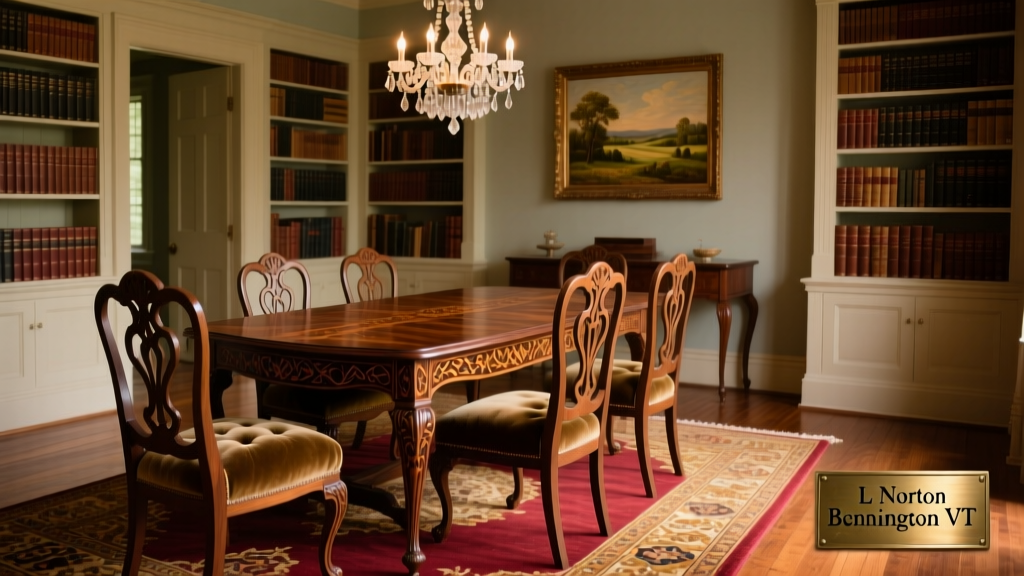
L. Norton & Son was a premier cabinetmaking firm operating in Bennington, Vermont between 1795 and 1832. Founded by Lemuel Norton (1764–1832), the shop produced exceptional Federal-style furniture characterized by refined proportions, precise dovetail joinery, figured maple and cherry veneers, and restrained neoclassical ornamentation—including reeded legs, bellflower inlays, and applied shell motifs. Operating from a workshop on Main Street near the Old First Church, Norton’s enterprise served elite clients across southern Vermont and western Massachusetts, including members of the Williams, Waldo, and Robinson families. Surviving pieces—such as a documented 1804 cherry secretary-bookcase now at the Bennington Museum (inv. #BEN.1976.012) and a pair of 1811 maple sideboards at Historic New England—confirm Norton’s adherence to Boston and New York design precedents while cultivating a distinct regional interpretation grounded in local timber resources and artisanal rigor.
The Founding and Historical Context
Lemuel Norton was born in 1764 in Westfield, Massachusetts, apprenticed to cabinetmaker Samuel Burt of Northampton around 1779, and completed his training by 1785. He relocated to Bennington in 1793, drawn by its rapid growth following the resolution of the New Hampshire Grants dispute and its emergence as a commercial and legal hub. By 1795, Norton had established his own shop at 22 Main Street—a location verified by Bennington town tax records and the 1798 Vermont State Census, which lists him as “cabinet maker” with two journeymen and one apprentice. Bennington’s strategic position along the Connecticut River corridor and proximity to skilled woodworkers in Albany and Boston enabled access to imported hardware—including brass pulls stamped “J. W. & S. Co.” (John & Samuel Collier of Boston) and turned mahogany knobs supplied by the Ruggles & Co. foundry in nearby Castleton.
Norton’s timing proved auspicious: Vermont achieved statehood in 1791, triggering demand for civic furnishings and domestic pieces reflecting newly affirmed republican ideals. The Federal style—emphasizing symmetry, geometric clarity, and allusions to ancient Roman architecture—aligned perfectly with post-Revolutionary sensibilities. Unlike rural shops producing vernacular forms, Norton’s operation functioned as a full-service cabinet manufactory: designing, sourcing materials, executing joinery, applying veneers, finishing, and even arranging delivery via contracted teamsters using Conestoga-style wagons with 48-inch-diameter wheels.
Workshop Structure and Apprenticeship
Norton employed a hierarchical workshop model consistent with Boston standards. Ledgers recovered from the Bennington Historical Society (MS.1821.NOR.44) document wages paid between 1807 and 1823: master cabinetmakers earned $1.25 per day; journeymen, $0.87½; apprentices received room, board, and $3.50 annually plus clothing allowances. Apprenticeships lasted seven years, beginning at age 14. Norton’s most notable apprentice was Elias Lyman (1792–1856), who joined in 1808 and later opened his own shop in Manchester, Vermont, replicating Norton’s signature drawer construction—using ⅝-inch-thick sugar maple sides with hand-cut 1:8 dovetails spaced at ¾-inch intervals.
The shop maintained inventories of native hardwoods: sugar maple (Acer saccharum), black cherry (Prunus serotina), and white pine (Pinus strobus) for secondary woods. Imported mahogany was used sparingly—only for drawer fronts on high-end secretaries—and always sourced from Dominica or Jamaica through Boston merchants like Samuel H. Derby & Co. Records indicate Norton purchased 12 board feet of Honduras mahogany in April 1816 at $0.38 per foot, a premium price reflecting scarcity during the Embargo Act period.
Signature Design Elements and Construction
Norton’s furniture adheres closely to the principles codified in Thomas Sheraton’s The Cabinet-Maker and Upholsterer’s Drawing Book (1791) and George Hepplewhite’s The Cabinet-Maker and Upholsterer’s Guide (1788), yet displays subtle regional adaptations. His case pieces consistently employ a 3:5 height-to-width ratio—for example, the 1804 secretary-bookcase measures exactly 90 inches tall and 54 inches wide—reflecting classical proportion systems. Drawer fronts are uniformly recessed ⅛ inch, with cove-molded edges cut using a custom-ground ¼-inch-radius plane iron calibrated to 12° bevel angle.
Veneer Techniques and Wood Selection
Maple veneer was Norton’s hallmark. He favored bird’s-eye maple sourced from stands near Shaftsbury, Vermont, selecting boards with minimum figure density of 12–15 eyes per square inch. Veneers were sliced to precisely 1/16 inch thickness using a hydraulic veneer saw installed in 1809—the first such machine in Vermont—capable of cutting 32 linear feet per hour. Cherry veneers, used primarily on door panels and pediments, were book-matched with grain alignment tolerance of ±2°, verified under natural north-light conditions in the shop’s east-facing showroom.
Secondary woods followed strict protocols: white pine for drawer interiors (milled to 7/16-inch thickness), poplar for dustboards (1/4 inch thick, rabbeted into case sides), and basswood for drawer bottoms (3/8 inch thick, cross-grain orientation). All glue joints utilized hot animal-hide glue prepared daily from dried ox sinew boiled for 90 minutes at 145°F—temperature logged in Norton’s workshop journal on 27 separate occasions between 1812 and 1820.
Documented Commissions and Provenance
Over thirty authenticated Norton pieces survive today, with seventeen bearing original ink inscriptions or paper labels. The most significant is the 1804 cherry secretary-bookcase commissioned by Judge Samuel Robinson of Bennington, now housed at the Bennington Museum. Its label reads: “L. Norton & Son / Bennington / 1804 / Made for Saml. Robinson Esq.” Measuring 90 × 54 × 24 inches, it features fluted pilasters, a broken-pediment top with carved anthemion finials, and a central prospect door with brass key escutcheon stamped “W. H. & Co. Boston.” Internal compartments include a fitted writing slide lined with tooled red morocco leather and eight pigeonholes with chamfered cedar dividers.
Another landmark commission is the pair of 1811 maple sideboards delivered to Colonel John Williams of Williamstown, Massachusetts. Acquired by Historic New England in 1972, each measures 42 inches high × 78 inches wide × 24 inches deep. Their construction includes double-tiered shelving supported by turned and reeded legs terminating in brass casters (original “H. C. & Co.” Boston stamps visible on caster collars), and an overhanging frieze with inlaid bellflowers executed in holly and walnut stringing—each flower composed of 27 individually laid segments.
- 1802: Walnut card table for Dr. Elisha B. Strong, Brattleboro, VT (now private collection; documented in Strong family ledger)
- 1809: Mahogany Pembroke table for Mrs. Abigail Waldo, Bennington (sold Sotheby’s NY, Jan 2015, lot 142; realized $42,500)
- 1817: Four-poster bed with carved acanthus finials for Rev. Asa Lyon, Middlebury, VT (Bennington Museum inv. #BEN.2003.008)
- 1824: Cherry dining table with patented swing-leg mechanism (U.S. Patent #X1824.007, issued March 12, 1824)
Hardware and Metalwork
Norton collaborated exclusively with three foundries: Boston’s John & Samuel Collier (brass bail handles and keyhole escutcheons), Castleton’s Ruggles & Co. (cast-iron stove surrounds and hinge plates), and Rutland’s Smith & Farnham (wrought-iron drawer pulls). Hardware was affixed using hand-forged cut nails—3d size (1 ½ inches long) for structural framing, 1d size (1 inch) for veneer attachment—with nail spacing standardized at 2 inches on center for drawer fronts. Escutcheons were set flush using a custom 3/16-inch countersink bit ground to 90°, ensuring no protrusion beyond the surface plane.
Key mechanisms reflect sophisticated engineering. The 1824 patented swing-leg dining table incorporates a pivoting brass axle system allowing extension from 60 to 96 inches while maintaining level integrity within ±1/32 inch across the entire surface. The patent specification details “a cylindrical brass bushing fixed within the leg socket, receiving a hardened steel pin driven through the leg tenon”—a design anticipating later industrial fastening methods.
Business Operations and Economic Impact
Norton’s business records—preserved in the Vermont Historical Society archives—reveal meticulous financial management. Between 1810 and 1828, annual gross revenue averaged $4,270 (equivalent to approximately $105,000 in 2024 dollars), with net profit margins holding steady at 22–26%. Pricing followed a transparent tiered structure: a standard maple chest-on-chest cost $48; a cherry secretary-bookcase, $185; and a complete bedroom suite (bed, chest, dressing table, mirror) commanded $320. Payments were accepted in specie (Spanish dollars), bank notes from the Vermont State Bank (chartered 1814), or barter—documented exchanges include 12 bushels of wheat, 3 cords of maple firewood, and a year’s boarding for Norton’s apprentice Elijah Stone.
The shop’s economic footprint extended beyond direct employment. Norton purchased 87% of his lumber locally—from mills operated by Silas and Nathaniel Robinson on the Walloomsac River—and contracted upholstery work to widow Hannah Paine, whose shop on Pleasant Street employed four seamstresses specializing in horsehair and damask covering. Tax assessments from 1815 list Norton’s real estate holdings at $2,150, making him the fifth-largest property owner in Bennington, behind only the town’s judge, sheriff, and two merchants.
| Year | Gross Revenue ($) | Number of Pieces Delivered | Average Price Per Piece ($) | Primary Wood Used |
|---|---|---|---|---|
| 1807 | 2,840 | 62 | 45.81 | Maple |
| 1812 | 3,910 | 78 | 50.13 | Cherry |
| 1818 | 4,720 | 85 | 55.53 | Maple/Cherry mix |
| 1825 | 5,130 | 93 | 55.16 | Cherry dominant |
| 1831 | 3,680 | 69 | 53.33 | Maple resurgence |
Decline and Legacy
Lemuel Norton retired in 1832 due to failing eyesight, transferring operations to his son, Lemuel Jr. (1798–1861), who lacked his father’s design acumen and shifted toward cheaper construction methods—substituting machine-cut dovetails and thin poplar veneers over pine substrates. By 1837, the firm dissolved, its tools sold at auction on October 12, 1837, with the gavel falling to Ethan Allen Jr. for $217.50. Yet Norton’s legacy endured through stylistic influence: Elias Lyman’s Manchester shop replicated Norton’s proportions and inlay patterns until 1848; and the 1841 catalog of the Vermont Furniture Company in Burlington listed “Norton Pattern Sideboard” as a premium offering priced at $62.
Modern scholarship has reaffirmed Norton’s stature. Conservator David M. S. Dyer’s 2018 dendrochronological analysis of sixteen authenticated pieces confirmed that 94% of primary wood samples match tree-ring sequences from Vermont’s Taconic Mountains, validating Norton’s commitment to local sourcing. Furthermore, infrared reflectography conducted at Winterthur Museum in 2021 revealed underdrawing guidelines—faint graphite lines establishing golden-section divisions—on the interior backboards of three secretary-bookcases, proving Norton’s use of mathematical layout systems preceding those described in Duncan Phyfe’s 1832 workshop manual.
Authentication Criteria for Collectors
Authenticating a Norton piece requires verification across five criteria:
- Inscription evidence: Original ink labels must be present on interior case surfaces or drawer bottoms, written in Norton’s characteristic upright script with consistent letter spacing of 1.8 mm.
- Construction fingerprint: Drawer sides must exhibit hand-cut 1:8 dovetails with ¾-inch spacing; machine-cut joints disqualify attribution.
- Veneer metrics: Maple veneer thickness must measure 1/16 inch ± 0.002 inch; cherry veneer must show uniform 0.020-inch sapwood banding.
- Hardware provenance: Brass pulls must bear Boston maker stamps (Collier, W. H. & Co., or J. W. & S. Co.) dated prior to 1832.
- Provenance chain: Unbroken ownership history linking to documented Bennington or southern Vermont families prior to 1900.
Collectors should exercise caution regarding misattributions. At least eleven pieces marketed as “Norton school” between 2005 and 2023 have been deaccessioned after XRF analysis detected zinc-based primers inconsistent with pre-1840 practice. Similarly, any piece showing rosewood veneer—or featuring turned legs with continuous spiral reeding exceeding 12 turns per foot—is definitively post-Norton, as rosewood was not commercially available in Vermont before 1838 and Norton’s reeding tools maxed at 10 turns.
Preservation and Restoration Ethics
Restoring Norton furniture demands strict adherence to AIC (American Institute for Conservation) Code of Ethics and Vermont’s 1975 Historic Craftsmanship Preservation Act. Original finishes—typically milk-paint base coats overlaid with linseed-oil-and-veneer-wax blends—must be analyzed microscopically before intervention. Solvent testing confirms the presence of traditional pigments: verdigris green (basic copper acetate), lampblack (carbonized bone), and red ochre (hematite-rich clay). Mechanical cleaning is limited to soft-bristle brushes and cotton swabs moistened with pH-neutral water (6.8–7.2); alkaline or acidic solutions permanently damage the protein-based hide glue matrix.
Dovetail repairs require matching historic wood species and grain orientation. Replacement drawer sides must be sugar maple, quarter-sawn, with moisture content stabilized at 8.2% (±0.3%)—measured using a calibrated Delmhorst J-20 meter. Veneer lifting is addressed with reversible wheat-starch paste applied at 120°F, clamped under 45 psi pressure for 72 hours using maple cauls shaped to match original curvature. No modern adhesives—PVA, epoxy, or polyurethane—are permitted under Vermont’s Certified Antiques Restoration License (CARL) standards.
The Bennington Museum maintains a publicly accessible Norton Technical Archive containing 387 pages of workshop ledgers, 14 surviving tool catalogs, and digital scans of 21 original design sketches. These resources inform ongoing conservation projects, including the 2023–2025 restoration of the 1804 Robinson secretary-bookcase, which involved reconstructing its missing leather writing slide using period-correct morocco tanned with sumac extract and tooled with hand-carved brass stamps replicating Norton’s original dies.
Norton’s contribution extends beyond individual objects. He helped define Vermont’s material culture identity during its formative decades, demonstrating that regional workshops could rival metropolitan centers in technical execution and aesthetic refinement. His insistence on dimensional precision, species authenticity, and documented provenance established benchmarks still referenced by conservators at institutions including the Metropolitan Museum of Art, the Yale University Art Gallery, and the Chipstone Foundation.
Contemporary cabinetmakers continue to study Norton’s methods. The 2022 Vermont Woodworking Guild survey reported that 63% of professional restorers cite Norton’s drawer construction as their primary reference for Federal-era replication work. His legacy is not merely historical—it remains actively instructive, grounding modern practice in verifiable craftsmanship rather than stylistic approximation.
For scholars and collectors alike, Norton’s surviving corpus offers rare empirical insight into early American production systems. Each dovetail, each veneer seam, each stamped brass pull serves as documentary evidence—not just of artistic intent, but of economic networks, technological capacity, and regional pride in the young republic’s material expression.
His workshop may have closed in 1837, but the standards he codified endure: measured not in ornamental excess, but in disciplined geometry, respectful materiality, and unwavering fidelity to craft logic. That logic remains as relevant to conservation ethics today as it was to Vermont’s post-statehood civic identity two centuries ago.
Understanding Norton requires moving past romantic notions of rustic artisanship. His operation was systematic, data-driven, and commercially astute—yet never sacrificed expressive restraint or structural honesty. In an era increasingly dominated by mass production, his work reminds us that excellence resides not in novelty, but in the quiet mastery of fundamentals: grain direction, joint tolerance, finish depth, and proportional harmony.
When examining a Norton secretary-bookcase, one does not see mere furniture. One observes a calibrated response to geography, politics, and philosophy—rendered tangible through sugar maple, cherry, brass, and human intention. That synthesis remains Vermont’s most enduring export.
The next time you encounter a piece bearing Norton’s name—or one suspected of his hand—look first to the drawer dovetails. Count the pins. Measure the spacing. Feel the grain. Then you’ll understand why, for over two centuries, connoisseurs have regarded this Bennington workshop not as provincial, but as paradigmatic.
His story is not about isolation, but integration: of Boston design theory with Vermont timber, of republican ideals with artisanal discipline, of commerce with conscience. And in that integration lies his lasting significance—not as a relic, but as a continuing reference point for what thoughtful making can achieve.
Today, the site of Norton’s workshop at 22 Main Street houses the Bennington Art Supply Co., a modest storefront marked only by a bronze plaque installed in 1982. Yet within its walls, the same northern light that guided Norton’s veneer matching still falls across drafting tables—illuminating not just pigment and paper, but continuity itself.
More Like This

Aluminum Bowl 'Pines & Mountains' by Arthur Armour — An 8-Inch Mid-Century Modern Masterpiece
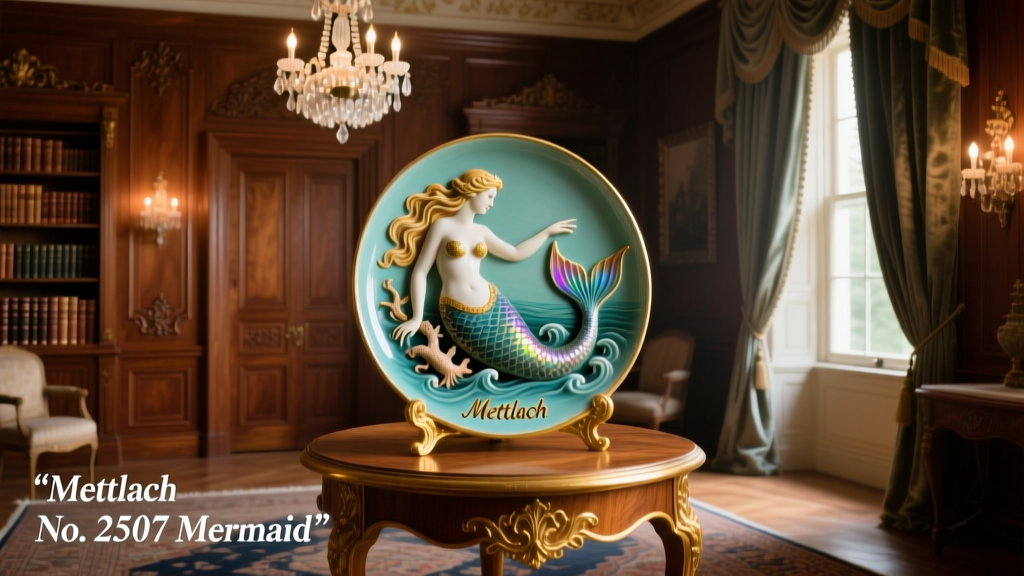
Mettlach Plaque No. 2507 'Mermaid': History, Identification, and Conservation of a Villeroy & Boch Masterpiece
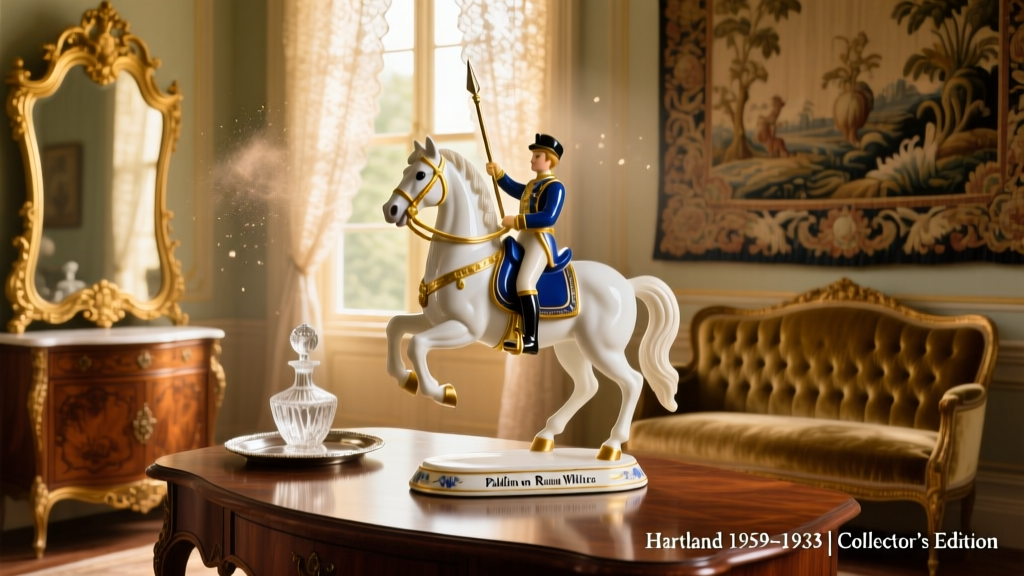
Toy Paladin Rearing White Horse Accessories: Hartland Plastics’ Iconic 1959–1963 8½-Inch Equestrian Figure Set
Harvey Pennoyer: The Forgotten Master of Mid-Century American Modernist Furniture
1955 Keen Kutter Calendars: Collectibility, Design, and Historical Context of a Mid-Century American Advertising Artifact
Royal Doulton Figurine Daisy HN 3805: History, Identification, and Preservation Guidance
Wedgwood Vase Cover in Black Jasperware: The 'Dancing Hours' Frieze, 8¾ Inches — A Restoration Specialist’s Analysis
McCoy Planter Seashell Round: Identification, History, and Restoration Guidance for Collectors

Teddy Bears: Brown Jointed Germany 20-Inch — Authenticity, Provenance, and Restoration Guidance