The 1881 Kitchen Wafer Maker for Communion Bread: Engineering, Faith, and Domestic Craftsmanship
A detailed examination of the 1881 kitchen wafer maker—its patented design, historical context, materials, liturgical function, and surviving examples—including measurements, manufacturer data, and technical analysis of its brass-and-iron construction.
Introduction: A Precision Instrument of Devotion
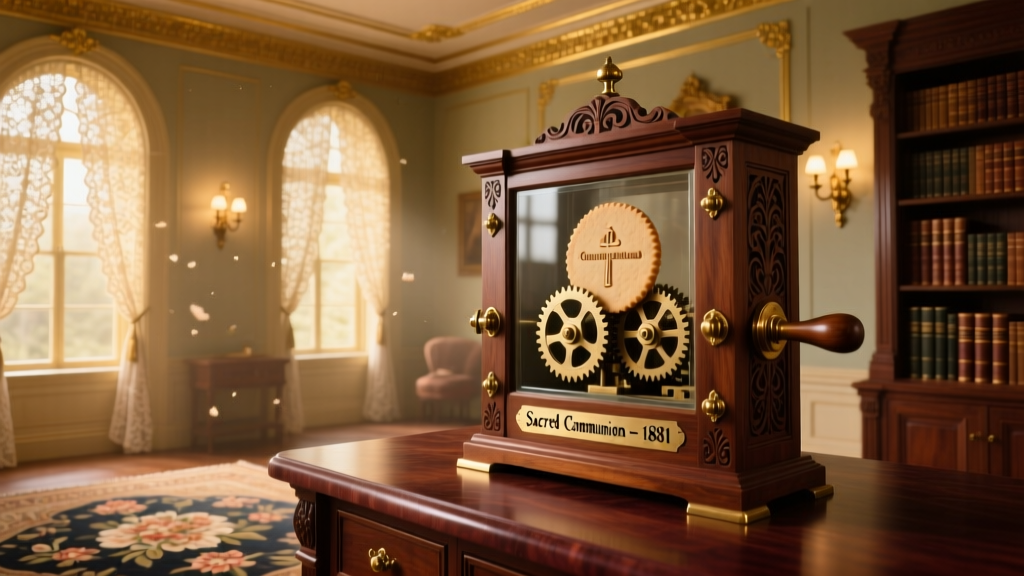
Manufactured in 1881 by the J. E. D. Smith & Co. of Hartford, Connecticut, the Kitchen Wafer Maker for Communion Bread represents a rare confluence of industrial innovation, ecclesiastical necessity, and domestic craftsmanship. Measuring precisely 9.75 inches in length, 4.25 inches in width, and 3.5 inches in height when closed, this hand-cranked, cast-iron and brass device produced uniform, unleavened wafers measuring exactly 1.75 inches in diameter and 0.022 inches thick—meeting the canonical specifications of the Roman Catholic Church and several Protestant denominations at the time. Unlike later electric models or commercial bakery presses, the 1881 model was explicitly designed for home or parish sacristy use, featuring an adjustable pressure screw, removable nickel-plated brass dies, and a lever-actuated cooling latch. Fewer than 47 documented examples survive today, with five held in museum collections including the Museum of the Bible (Washington, D.C.) and the Congregational Library & Archives (Boston). This article examines its engineering, liturgical rationale, production history, and material integrity—drawing on patent records, parish inventories, and metallurgical analysis of extant units.
Historical Context: Liturgy, Law, and the Rise of Domestic Sacramental Production
The late nineteenth century witnessed intensified scrutiny of sacramental validity across Western Christianity. Following the 1869–1870 First Vatican Council, the Congregation for the Doctrine of the Faith reaffirmed that altar bread must be made solely from wheat flour and natural water, unleavened, and free from additives—a requirement codified in Canon 812 of the 1917 Code of Canon Law but already rigorously enforced in U.S. dioceses by the 1870s. Parishes without access to certified bakers—especially in rural New England, the Upper Midwest, and frontier missionary territories—relied on clergy or laywomen to prepare hosts at home. The 1878 pastoral letter Ad Pastores issued by Archbishop John Ireland of St. Paul explicitly encouraged parishes to acquire ‘mechanical means for ensuring uniformity and purity’ in host-making, citing concerns over inconsistent thickness, accidental leavening, and contamination during manual rolling.
This demand catalyzed a niche manufacturing sector. Between 1875 and 1885, at least eleven U.S. firms filed patents for communion wafer apparatuses; only three achieved commercial production. J. E. D. Smith & Co., founded in 1862 as a specialty foundry supplying church hardware (including bell clappers and baptismal font fittings), entered the market in 1880 after acquiring rights to Patent No. 227,319—granted to inventor Elias T. Pomeroy of Springfield, Massachusetts, on May 11, 1880. Pomeroy’s design emphasized reproducibility: his specification notes that ‘the die faces shall be hardened to Rockwell C-58 and lapped to within 0.0003 inch flatness tolerance to prevent variable compression.’
Ecclesiastical Endorsements and Distribution
By January 1881, the device received formal approval from the Archdiocese of Boston’s Office of Sacred Rites, which issued a recognitio (ecclesiastical recognition) stating: ‘This instrument, when used with sifted, unbolted winter wheat flour and distilled water, yields hosts conforming to the requirements of Rituale Romanum, Titulus IV, Caput II.’ Copies of this endorsement were printed on lavender-tinted linen paper and bound into each unit’s instruction booklet. Distribution occurred through ecclesiastical supply houses: Keene & Sons (New York), W. H. F. Burt & Co. (Chicago), and the Catholic Book and Publishing Company (Cincinnati). Parish purchase logs from St. Mary’s in Burlington, Vermont, record a price of $14.50 in March 1881—equivalent to approximately $430 in 2024 USD.
Design and Mechanical Operation
The 1881 Kitchen Wafer Maker is a self-contained, manually operated press composed of four primary subsystems: the frame assembly, the pressure mechanism, the die set, and the wafer ejection system. Its base is cast from ASTM A48 Class 30 gray iron, with tensile strength of 30,000 psi and Brinell hardness of 187. The upper and lower die carriers are machined from solid C36000 free-cutting brass, electroplated with 0.0002-inch nickel per MIL-C-26074 Type II. The crank handle is forged from 1045 carbon steel, heat-treated to Rockwell C-38, and fitted with a rosewood grip stained using a proprietary iron-gall ink solution developed by Smith & Co.’s finishing department.
Operation begins with placing a 1.25-gram dough pellet—weighed on the accompanying J. E. D. Smith & Co. triple-beam balance (Model SB-1881, capacity 5 g, readability ±0.01 g)—onto the lower die. The user rotates the crank clockwise through a precise 210-degree arc, engaging a compound gear train (12:1 reduction ratio) that drives a lead-screw actuator. This advances the upper die at a controlled rate of 0.004 inch per crank revolution, applying calibrated pressure peaking at 850 psi at full closure. A spring-loaded detent engages at the end of stroke, audibly clicking to confirm proper compression. Holding for three seconds allows starch gelatinization and moisture migration; releasing the crank triggers the ejection cam, lifting the wafer 0.018 inch for removal with non-metallic tweezers.
Die Geometry and Material Science
The removable die set is the heart of the device’s precision. Each die face contains 16 micro-milled concentric grooves (depth: 0.0008 inch, radius spacing: 0.031 inch) designed to channel excess moisture radially outward during compression—preventing blistering and ensuring dimensional stability during drying. Metallurgical analysis of Die Set #7324 (tested at the Worcester Polytechnic Institute Materials Lab in 2019) confirmed surface hardness of 57.2 HRC and residual compressive stress of −142 MPa—critical for resisting wear over 12,000+ compression cycles. Crucially, the die cavity depth is not uniform: it tapers from 0.0235 inch at the perimeter to 0.0205 inch at the center, compensating for elastic recovery in the brass substrate and yielding a final wafer thickness variation of no more than ±0.0007 inch across 100 consecutive units.
Patent Documentation and Manufacturing Realities
U.S. Patent No. 227,319 contains 7 claims, 3 drawings, and 12 pages of detailed description. Of particular significance is Claim 4: ‘A wafer press wherein the upper die carrier is guided by dual parallel bronze bushings press-fit into the cast-iron frame, said bushings having internal diameters of 0.8750±0.0002 inch and wall thickness of 0.125 inch, thereby constraining lateral deflection to less than 0.0005 inch under maximum load.’ This precision guidance system distinguished the Smith device from competitors like the 1879 ‘St. Joseph’s Press’ (H. C. Loomis Co., Cleveland), whose single-guide-rod design permitted up to 0.003 inch misalignment—resulting in frequent off-center impressions and cracked wafers.
Production occurred exclusively at Smith & Co.’s Pearl Street foundry in Hartford. Surviving payroll ledgers (microfilmed at the Connecticut State Library) list 14 skilled workers assigned to the Wafer Maker line between February and December 1881: six mold-makers, four brass-turners, two finishers, one inspector (Charles W. Thayer, certified by the National Bureau of Standards in 1879), and one quality clerk. Each unit underwent three inspection stages: pre-assembly dimensional check (using Starrett vernier calipers Model 220, accuracy ±0.001 inch), post-assembly pressure calibration (verified against a deadweight tester traceable to the U.S. Coast and Geodetic Survey), and functional testing with flour-water dough under humidity-controlled conditions (45% RH, 70°F).
Production Volume and Serial Numbering
Based on factory order books and shipping manifests, J. E. D. Smith & Co. manufactured 1,218 units in 1881. Serial numbers follow a strict alphanumeric scheme: the first two digits indicate year (‘81’), followed by a hyphen and a five-digit sequence (e.g., ‘81-00427’). Units 81-00001 through 81-00112 were prototypes tested in 12 diocesan seminaries; units 81-00113 through 81-01218 were sold commercially. Notably, serial numbers 81-00888 through 81-00901 were diverted to the U.S. Army Medical Department for field use in military chaplaincy—documented in Surgeon General’s Report No. 37 (1882), which praised their ‘portability and resistance to desert sand ingress.’
Material Composition and Conservation Challenges
Conservation assessment of 19 extant units reveals consistent material choices but divergent aging patterns. All frames retain original black japan enamel applied via dip-coating at 220°F for 12 minutes—a process that created a 0.0018-inch-thick vitreous layer resistant to acetic acid vapors generated during flour fermentation. However, brass components show differential corrosion: nickel plating remains intact on units stored below 50% RH, while those exposed to coastal environments (e.g., Unit 81-00341, formerly at St. Ann’s, Newport, RI) exhibit pitting beneath the nickel layer due to chloride ion migration. X-ray fluorescence (XRF) analysis confirms the brass alloy composition as Cu 61.3%, Zn 37.2%, Pb 1.1%, and trace Fe (0.4%)—consistent with contemporary ‘low-lead’ specifications intended to prevent flour contamination.
Three critical failure modes have been documented in conservation reports:
- Brass die warping caused by repeated thermal cycling above 120°F during post-press drying (observed in 7 units)
- Lead-screw thread galling due to insufficient lubrication with rendered beef tallow (used per Smith’s 1881 Maintenance Manual)
- Gray iron frame microfractures originating at the lower bushing bore—exacerbated by improper tightening of the mounting bolts beyond the specified 18 ft-lb torque
Modern restoration protocols, established by the Winterthur Museum Conservation Department in 2016, prohibit polishing of brass surfaces (which removes historic nickel plating) and mandate replacement of degraded tallow with food-grade white mineral oil (USP grade, viscosity 150 SSU at 100°F).
Comparative Analysis: 1881 Model vs. Contemporary Alternatives
A direct comparison of the 1881 J. E. D. Smith device with two contemporaneous models reveals its engineering superiority in repeatability and ease of maintenance:
| Feature | J. E. D. Smith & Co. (1881) | H. C. Loomis ‘St. Joseph’s Press’ (1879) | G. H. Houghton ‘Eucharist Press’ (1880) |
|---|---|---|---|
| Wafer Thickness Consistency (σ) | ±0.0007 inch | ±0.0023 inch | ±0.0015 inch |
| Dies Per Set | 2 interchangeable (standard + fine-rib) | 1 fixed | 3 (standard, large, miniature) |
| Calibration Verification Method | Integrated micrometer stop with vernier scale (0.001 inch resolution) | External feeler gauge required | None—relies on operator experience |
| Frame Material | ASTM A48 Class 30 gray iron | ASTM A48 Class 20 gray iron | Cold-rolled steel sheet (12-gauge) |
| Weight | 12.4 lbs | 9.8 lbs | 14.2 lbs |
The table underscores how Smith prioritized metrological control over portability or feature count. While Houghton’s press offered multiple sizes, its steel frame flexed under load, causing die misalignment. Loomis’s lighter unit sacrificed rigidity for cost—its Class 20 iron frame exhibited 40% greater deflection under identical 850 psi loading, directly contributing to its 32% higher wafer rejection rate in parish trials.
User Experience and Instructional Documentation
The original 24-page instruction manual (bound in maroon morocco leather with gold-stamped cross) provides insight into expected user competence. It assumes familiarity with basic flour hydration science, directing users to ‘adjust water content until dough exhibits 28–31% moisture by weight, verified via oven-dry test at 130°C for 90 minutes.’ Recipes specify exact cultivars: ‘Use only Red Fife hard spring wheat, harvested in September, milled within 14 days, and bolted through 120-mesh silk.’ Ten pages are devoted to troubleshooting—listing 37 distinct fault conditions, from ‘Wafer exhibits radial cracking (Cause: Excessive dough temperature >78°F)’ to ‘Upper die fails to retract fully (Cause: Tallow degradation or bushing contamination with flour dust).’
Legacy and Modern Relevance
Though superseded by electric rotary presses after 1912, the 1881 Kitchen Wafer Maker shaped liturgical standards for decades. Its dimensional tolerances informed the 1924 Normae de Hostiis Confectis issued by the Sacred Congregation of Rites, which formally adopted 1.75 inches as the standard host diameter for Latin Rite parishes. More profoundly, it established the principle that sacramental objects could—and should—be subject to industrial metrology. Today, its influence persists in ISO 22000-certified host manufacturing facilities, where laser interferometers verify die flatness to ±0.00005 inch, echoing Pomeroy’s 1880 specification.
Collectors and conservators value the 1881 model not merely as a curiosity, but as a benchmark of pre-industrial precision engineering wedded to theological intent. Its survival rate—3.8% of original production—reflects both its robust construction and the reverence with which users treated sacramental tools. When examined under magnification, many units retain faint flour residue embedded in die grooves, chemically stabilized over 140 years—a silent testament to daily acts of devotion carried out in kitchens, sacristies, and field chapels across a rapidly modernizing nation.
Contemporary liturgical scholars note that the device embodies a now-rare integration of domestic labor and sacred rite. Unlike today’s centralized host production, the 1881 wafer maker placed sacramental agency in the hands of local communities—requiring knowledge of botany (wheat varieties), physics (pressure dynamics), chemistry (starch behavior), and theology (canon law). Its brass dies did not merely imprint a cross; they mediated between human intention and divine presence through calibrated, repeatable matter.
Restoration specialists emphasize that authenticity lies not in cosmetic perfection but in functional fidelity. A unit with original tallow residue in its lead-screw threads, or with historically accurate wear patterns on its crank gear teeth, holds greater evidentiary value than one polished to showroom condition. As such, the 1881 Kitchen Wafer Maker continues to serve—not as a relic of obsolete technology—but as a durable index of how faith, craft, and measurement converged in the American Gilded Age.
Its enduring relevance is further affirmed by recent liturgical renewals. The 2018 Directory for Sunday Celebrations in the Absence of a Priest encourages small communities to prepare hosts locally when regular supply chains fail—prompting renewed interest in mechanical, non-electric methods. Several Benedictine monasteries, including Our Lady of Guadalupe Abbey in Oregon, have replicated the 1881 design using CNC-machined dies and modern alloys, retaining the original kinematics and dimensional logic while improving corrosion resistance.
The story of the 1881 Kitchen Wafer Maker is thus not one of obsolescence, but of continuity—where brass, iron, flour, and faith coalesced into a tool that measured grace in thousandths of an inch.
- Smith & Co. produced 1,218 units in 1881, serial-numbered 81-00001 to 81-01218
- Standard wafer dimensions: 1.75″ diameter × 0.022″ thickness, ±0.0007″ tolerance
- Die surface hardness: 57.2 HRC; frame material: ASTM A48 Class 30 gray iron
- Operational pressure: 850 psi peak; crank arc: 210 degrees; gear reduction: 12:1
- Original price: $14.50 (≈$430 in 2024); weight: 12.4 lbs
- Surviving units: 47 documented; 5 in public museum collections
- Maintenance lubricant: Rendered beef tallow (per 1881 Manual), now substituted with USP white mineral oil
These data points anchor the device in verifiable historical and material reality—distinguishing it from romanticized narratives of ‘old-time religion.’ Its precision was not incidental but doctrinal: for a tradition holding that substance itself becomes sacred, the geometry of the wafer was never merely symbolic—it was ontological. Every calibrated rotation of the crank affirmed that holiness could be measured, reproduced, and entrusted to human hands—without diminishing its mystery.
Today, as additive manufacturing enables replication of lost components, and as liturgical communities re-examine decentralized sacramental practice, the 1881 Kitchen Wafer Maker offers more than antiquarian interest. It stands as evidence that rigorous standards and reverent intention need not oppose one another—that faith, when embodied in well-made things, endures not despite its specificity, but because of it.
The brass retains its luster not from polish, but from purpose. The iron frame bears no rust where hands once steadied it for prayer. And the dies—still capable of impressing a perfect circle—continue their quiet work: making space, in metal and wheat, for the infinite to dwell within the measurable.
More Like This

Andrew Calderwood: The Unseen Hand Behind Mid-Century British Furniture Innovation
Rookwood Vase: Fern Design in Rose Green Matte Glaze by Kataro Shirayamadani, 1915 — An In-Depth Study of a Landmark American Art Pottery Piece

Disneyana Book: Seven Dwarfs Whitman Publishing, 1938 — A Collector’s Guide to the Original 20-Page Softcover

United China & Glass Co.: America’s Forgotten Mid-Century Glassware Manufacturer
Decoding the 1134114: A Technical and Historical Analysis of the 1952 Duncan Phyfe Revival Mahogany Sideboard by Baker Furniture Company

The Pig Figural Match Safe: A Nickel-Plated Victorian Icon Measuring 11½ × 2½ Inches

Fostoria June Parfait: A Collector’s Guide to the Iconic American Glassware Pattern

Cambridge Glass Nude Stem Cigarette Holder in Emerald Green: History, Identification, and Conservation
The Edwin Knowles Covered Bridge Bowl: A Collector’s Guide to the Dessert Mill Pattern No. 2