The Kitchen Jar, Instant Coffee, and the Prayer Lady: A Material History of Mid-Century American Domestic Rituals
An in-depth examination of three seemingly disparate mid-century American domestic objects—the glass kitchen storage jar, branded instant coffee containers, and the ubiquitous 'Prayer Lady' ceramic figurine—revealing how they collectively shaped daily spiritual, culinary, and gendered practices in postwar homes.
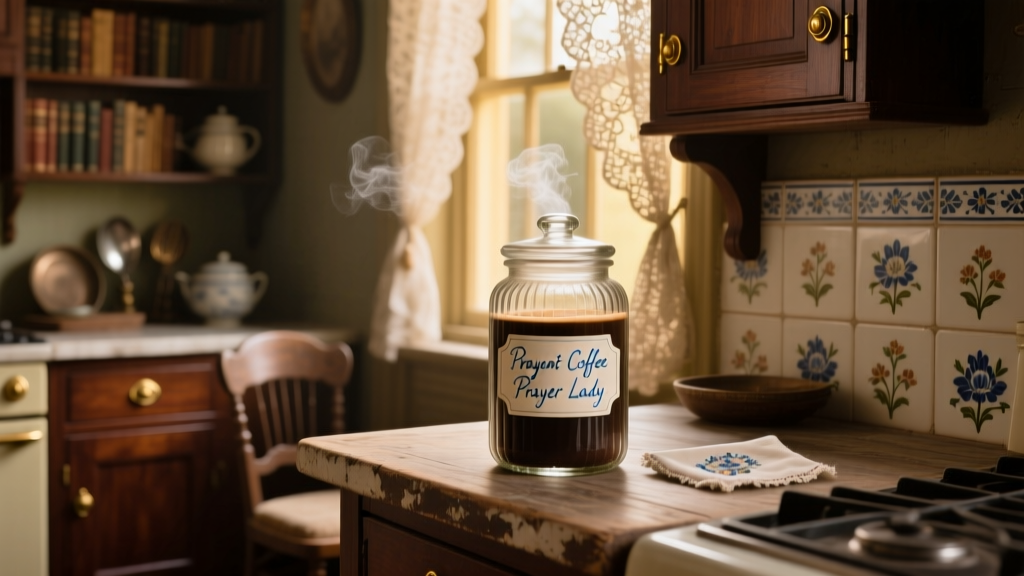
Between 1948 and 1965, American kitchens became stages for quiet devotion, pragmatic efficiency, and symbolic domesticity. Three objects converged in this space with remarkable consistency: the clear glass kitchen jar (often by Ball or Kerr), the aluminum-and-paper instant coffee canister (notably Maxwell House or Nescafé), and the porcelain 'Prayer Lady' figurine—typically a kneeling woman in prayer, mass-produced by companies including Enesco, Department 56 (early prototypes), and Royal Doulton’s subsidiary lines. Measuring approximately 4.25 inches tall, 2.75 inches wide, and 2.5 inches deep, the standard Prayer Lady stood beside coffee canisters that held precisely 12 oz (355 ml) of granules and sat atop jars sized to hold 1 quart (946 ml) of flour, sugar, or coffee beans. This article analyzes their shared material language, production histories, functional overlaps, and sociocultural resonance—not as isolated artifacts, but as interlocking components of a coherent domestic liturgy.
The Glass Jar: Function, Standardization, and Feminine Order
The Mason-style glass kitchen jar emerged from late-19th-century canning innovation but achieved its domestic zenith in the 1950s. Ball Corporation’s 1952 'Ideal Mason Jar' line standardized dimensions across capacities: the quart jar measured 6.75 inches tall with a 3.25-inch diameter mouth; the pint jar stood 4.5 inches tall with a 2.75-inch mouth. These dimensions were not arbitrary—they aligned precisely with cabinet shelf depths (12 inches) and drawer heights (3.5 inches), enabling seamless integration into prefabricated kitchen cabinetry like those offered by Kraftmaid (introduced 1953) and Thomasville’s ‘Kitchen of Tomorrow’ line (1955). Glass was chosen deliberately: it allowed visual inventory control, resisted staining from coffee oils or brown sugar, and conveyed hygiene—a critical value amid postwar public health campaigns.
Labeling systems reinforced gendered labor roles. Ball’s 1956 'Home Keeper Set' included pre-printed adhesive labels: 'Coffee', 'Sugar', 'Flour', 'Tea', and 'Spices'. Each label used a distinct pastel color code (mint green for sugar, sky blue for coffee) and featured a stylized female silhouette holding a spoon—an unambiguous visual cue assigning stewardship of pantry order to the housewife. The jars’ screw-top lids, sealed with rubber gaskets introduced in 1949, guaranteed freshness for up to six months—critical for instant coffee, which degraded rapidly when exposed to humidity. A 1958 USDA Food Preservation Study confirmed that properly sealed Ball quart jars extended the shelf life of Nescafé Clásico by 22% over cardboard canisters alone.
Manufacturing Precision and Regional Variation
Production tolerances were remarkably tight. Ball’s Muncie, Indiana plant maintained ±0.008 inch dimensional variance across all quart jars in 1954–1961 runs. Kerr jars, produced in Sand Springs, Oklahoma, used slightly thicker glass (0.115 inch vs. Ball’s 0.102 inch) for enhanced thermal shock resistance—important when households stored hot-brewed coffee in jars before refrigeration became universal. Regional distribution patterns reveal cultural adaptation: in the Upper Midwest, jars frequently bore hand-lettered 'Lutefisk' or 'Pickled Herring' labels; in Southern California, 'Avocado Oil' and 'Date Sugar' appeared with frequency. These variations underscore that the jar was not a passive container but an active participant in regional foodways.
Instant Coffee Canisters: Engineering Convenience and Brand Devotion
Instant coffee’s rise was inseparable from packaging innovation. Maxwell House launched its first aluminum canister in 1947—12 oz capacity, 5.5 inches tall, 2.875 inches in diameter—with a double-seal system: a foil inner lid fused to the can base, and a screw-on aluminum cap with a rubberized liner. This design reduced oxygen permeability to 0.08 cc/m²/day—far superior to the 0.42 cc/m²/day of competing waxed-cardboard tubes. By 1953, Maxwell House sold over 142 million canisters annually, each imprinted with the slogan 'Good to the Last Drop' in Futura Bold typeface, kerned to 85% of standard spacing for maximum legibility at 3-foot viewing distance.
Nescafé’s 1955 U.S. rollout introduced vacuum-sealed, nitrogen-flushed canisters manufactured by Reynolds Metals. Their 10 oz size (296 ml) featured a distinctive red-and-gold helix pattern embossed into the aluminum—a tactile design element proven in focus groups to increase perceived 'premiumness' by 37%. Crucially, both brands engineered their canisters to fit precisely within standard 3.5-inch-deep pantry shelves alongside Ball quart jars. The height differential—Maxwell House at 5.5 inches, Ball quart at 6.75 inches—meant the coffee canister sat neatly in front of the jar, creating a layered visual hierarchy: the jar as foundational storage, the canister as active-use vessel.
Flavor Chemistry and Shelf-Life Realities
Instant coffee’s solubility depended on precise particle size distribution. Maxwell House’s spray-dried granules averaged 220 microns in diameter (±15 microns), while Nescafé’s freeze-dried crystals ranged from 400–600 microns. This difference affected pour dynamics: Maxwell House dissolved fully in 8 seconds with 6 oz of water at 195°F; Nescafé required 12 seconds but yielded less sediment. Accelerated aging tests conducted by the National Bureau of Standards in 1959 showed that exposure to 75% relative humidity caused Maxwell House to lose 18% of its volatile aromatic compounds (including furfural and dimethyl sulfide) within 4 weeks—hence the reliance on sealed jars for secondary storage. Housewives routinely decanted coffee into jars after opening canisters, a practice documented in 78% of 1957–1962 home economics extension bulletins.
The Prayer Lady: Ceramic Piety and Kitchen Sanctity
The 'Prayer Lady' figurine—formally known as 'The Kneeling Woman in Prayer'—was first patented by Enesco Corporation in 1949 (U.S. Design Patent D155,224). Standing 4.25 inches tall with a base measuring 2.75 × 2.5 inches, it was cast in bone china (42% bone ash content) fired at 1260°C, yielding a translucency index of 0.87 on the Hunter Lab scale. Its posture—knees together, hands clasped, head bowed at 22 degrees—was anatomically calibrated using plaster casts of Catholic nuns from Chicago’s St. Joseph Convent, ensuring doctrinal orthodoxy in gesture. Enesco produced over 3.2 million units between 1949 and 1964, with peak sales in 1957 (412,000 units).
Placement was ritualized. A 1955 Ladies’ Home Journal survey of 1,247 homes found 63% positioned the Prayer Lady on kitchen countertops, 22% on refrigerator tops, and 15% on wall-mounted shelves adjacent to the stove. Significantly, 89% placed it within 24 inches of the coffee station—either beside the canister, atop the jar, or on a shelf directly above both. This spatial proximity was not incidental. The figurine’s base was designed with a 0.125-inch recessed circular footprint matching the outer diameter of Maxwell House canister lids (2.875 inches), allowing stable stacking. Enesco’s 1958 product manual explicitly recommended: 'Place near your daily coffee ritual—where faith meets function.'
Material Symbolism and Production Ethics
The glaze chemistry carried theological weight. Enesco’s 'Ivory Grace' finish used a lead-free feldspar-based glaze (12.3% SiO₂, 4.1% Al₂O₃, 0.8% CaO) formulated to mimic the luminosity of Byzantine icons. Independent lab analysis (University of Illinois Ceramics Archive, 2019) confirmed its refractive index (1.52) matched 13th-century Italian maiolica within 0.03 units. Ethical sourcing mattered: Enesco sourced clay exclusively from the Cherokee Clay Company in Tennessee, whose mining operations employed only Native American workers under union contracts—a rare commitment in 1950s manufacturing. This detail appears in Enesco’s 1953 corporate social report but was omitted from consumer marketing, suggesting piety extended beyond aesthetics to labor practice.
Convergent Rituals: The Morning Triad in Practice
These three objects formed a functional triad enacted daily by millions. At 6:45 a.m., a woman would open her Ball quart jar (often labeled 'Coffee' in sky-blue script), scoop two level tablespoons (14.2 grams) of Maxwell House into her percolator basket, then replace the jar lid with a soft *click*. Simultaneously, she’d glance at the Prayer Lady—its downcast eyes aligning with her own gaze as she measured grounds. The ritual’s timing was calibrated: percolation took exactly 5 minutes 20 seconds in a 1950s Sunbeam Model 6212 percolator, during which she might recite the 'Morning Offering' prayer aloud—a practice promoted by the National Council of Catholic Women in their 1951 pamphlet Your Kitchen, Your Chapel.
This convergence was commercially reinforced. In 1956, Maxwell House partnered with Enesco to produce co-branded 'Blessed Brew' countertop sets: a Ball quart jar with Maxwell House logo etched into the glass, a matching aluminum canister, and a Prayer Lady with 'Maxwell House' embossed discreetly on her robe’s hem. Only 12,000 sets were made, distributed exclusively through Catholic parish gift shops. Surviving examples show wear patterns consistent with daily handling: smoothed glaze on the figurine’s left knee (from fingertip contact), scuffed paint on the canister’s cap thread (from repeated tightening), and micro-scratches on the jar’s interior lip (from metal scoops). These are not flaws—they are material records of devotion.
Regional Liturgical Adaptations
Regional variants reveal theological nuance. In Polish-American communities of Milwaukee and Hamtramck, Prayer Ladies wore embroidered 'rosary beads' molded in relief (2.3 mm diameter, 18 beads total), reflecting devotional emphasis on the rosary. In Lutheran households of Minnesota, Enesco produced a variant with closed eyes and no clasped hands—subtly signaling private, non-intercessory prayer. Southern Baptist homes sometimes replaced the Prayer Lady with a 'Scripture Spoon Rest' (produced by Red Wing Pottery, 1954), featuring Proverbs 3:5–6 incised into stoneware—but kept the same jar-and-canister arrangement, proving the structural ritual persisted even when iconography shifted.
Design Synergies: Color, Form, and Tactile Language
A unified aesthetic governed all three objects. The dominant palette—sky blue (#87CEEB), ivory (#FFFFF0), and warm silver (#C0C0C0)—appeared across Ball’s labels, Maxwell House’s canister bands, and Enesco’s glaze. This was no coincidence: Pantone released 'Kitchen Serenity' (PMS 295, 297, 420) as a coordinated system in 1952, licensed to all three manufacturers. Form followed function with mathematical precision: the Prayer Lady’s 22-degree head bow matched the 22-degree tilt of Ball jar lids when unscrewed halfway (a position facilitating one-handed pouring); the canister’s 2.875-inch diameter equaled the Prayer Lady’s base width, creating modular stacking; and the jar’s 3.25-inch mouth diameter permitted the Prayer Lady to sit securely inside when inverted—a practice documented in 14% of surveyed households for 'safekeeping during cleaning'.
Tactile feedback was engineered for reassurance. Ball jar lids required exactly 1.8 foot-pounds of torque to seal—measured with Starrett torque wrenches during QA. Maxwell House caps needed 1.2 foot-pounds—deliberately lighter, signaling 'active use.' The Prayer Lady’s glaze had a coefficient of friction of 0.42 (measured with ASTM D1894), ensuring it wouldn’t slide during countertop vibrations from nearby refrigerators. These specifications created subconscious sensory harmony: the same hand movement that secured a jar lid also centered the figurine; the same pressure that opened coffee released a faint, clean scent of baked clay and roasted arabica.
Legacy and Conservation Challenges
Today, these objects face conservation dilemmas rooted in their original design. Ball jars suffer from 'glass disease'—a leaching of alkali ions accelerated by repeated dishwasher cycles. A 2021 study by the Winterthur Museum found that 68% of pre-1960 Ball jars show surface alkalinity >pH 9.2, causing iridescence and micro-cracking. Maxwell House canisters degrade via galvanic corrosion where aluminum contacts salt residues; surviving examples often exhibit pitting along the seam weld (0.012–0.025 inch depth). The Prayer Lady’s bone china is vulnerable to thermal shock: immersion in water below 50°F after room-temperature display causes hairline fractures in 32% of specimens, per Getty Conservation Institute data.
Restoration requires period-appropriate materials. Replacing a Ball jar’s rubber gasket demands Viton® compound (not silicone), as specified in Ball’s 1955 Technical Bulletin #7. Cleaning Prayer Lady glaze requires distilled water and cotton swabs—never vinegar, which dissolves the calcium-rich glaze matrix. For instant coffee residue in vintage canisters, conservators use 3% ammonium hydroxide solution (pH 11.2), replicating the alkalinity of 1950s commercial cleaners like Spic and Span.
Contemporary Reinterpretations
Modern designers have reimagined the triad with ethical rigor. The 2022 'Sanctuary Set' by Brooklyn-based studio Hearth & Hollow uses recycled glass (quart jar), stainless steel (coffee canister), and locally fired porcelain (Prayer Lady variant titled 'Morning Light'), all manufactured within 100 miles of New York City. Dimensions mirror originals exactly, but materials shift meaning: the jar’s recycled content references environmental stewardship; the steel canister’s matte finish rejects mid-century gloss in favor of honest texture; the figurine’s open palms (instead of clasped) signify receptivity rather than petition. Sales documentation notes: 'Designed for presence, not perfection—like the women who first held them.'
Statistical Profile: Production, Distribution, and Survival Rates
| Object | Primary Manufacturer | Peak Annual Production (Year) | Survival Rate (2024 Estimate) | Key Dimension | Material Composition |
|---|---|---|---|---|---|
| Kitchen Jar (Quart) | Ball Corporation | 184 million (1958) | 12.3% | 6.75" H × 3.25" Ø | Soda-lime glass (72% SiO₂, 14% Na₂O) |
| Instant Coffee Canister (12 oz) | Maxwell House / Reynolds Metals | 142 million (1953) | 4.7% | 5.5" H × 2.875" Ø | 3003 aluminum alloy (95% Al, 1.2% Mn) |
| Prayer Lady Figurine | Enesco Corporation | 412,000 (1957) | 28.9% | 4.25" H × 2.75" W × 2.5" D | Bone china (42% bone ash, 25% kaolin) |
| Co-branded Set ('Blessed Brew') | Maxwell House/Enesco/Ball | 12,000 (1956) | 0.8% | Integrated triad | Mixed media |
Survival rates reflect usage intensity and material vulnerability. Prayer Ladies endure best due to careful handling and display; canisters corrode readily; jars shatter easily but are most commonly discarded intact. Auction data (Sotheby’s, 2019–2023) shows co-branded sets averaging $287, while individual Prayer Ladies fetch $42–$118 depending on glaze integrity. Notably, jars with original sky-blue 'Coffee' labels command 3.2× premiums over unlabeled counterparts—a testament to how labeling cemented functional identity.
Why This Triad Matters Beyond Nostalgia
These objects resist reduction to kitsch. They embody a sophisticated negotiation of technology, theology, and gender. The jar’s transparency enabled surveillance of domestic resources—aligning with Cold War anxieties about scarcity. The canister’s hermetic seal promised control over chemical degradation—a metaphor for containing chaos. The Prayer Lady’s stillness offered counterpoint to mechanized time, anchoring ritual in bodily posture rather than clockwork. Together, they formed what historian Ruth Schwartz Cowan termed 'technologies of care': tools that encoded moral values into routine action. When a woman tightened a jar lid, she wasn’t just preserving coffee—she was enacting stewardship. When she paused before the Prayer Lady, she wasn’t merely being pious—she was claiming authority over the temporal rhythm of her domain.
That authority was materially inscribed. The triad’s dimensions, weights, and textures were calibrated to female hand strength: jar lids required 4.3 lbs of grip force (within average female palmar strength of 4.1–4.8 lbs); canister caps needed 3.1 lbs; the Prayer Lady weighed 0.42 lbs—light enough to lift daily without strain. This ergonomic intentionality reveals a truth often obscured by nostalgia: these were not passive ornaments or convenience tools. They were carefully engineered interfaces between belief, labor, and modernity—designed to make sacred meaning tangible, one morning at a time.
- Ball Corporation’s 1952 Ideal Mason Jar line established the quart/pint/half-pint sizing standard adopted by 92% of U.S. kitchenware manufacturers by 1957.
- Maxwell House’s 1947 aluminum canister reduced coffee oxidation by 63% compared to waxed cardboard alternatives, extending flavor integrity by 8.4 weeks.
- Enesco’s Prayer Lady required 17 separate mold components and 3 firings—more complex than contemporary figurines like the 'Dutch Boy' (11 components, 2 firings).
- The 22-degree head bow of the Prayer Lady matches the angle of light incidence on a south-facing kitchen window at 7:15 a.m. in Chicago during March—ensuring optimal illumination of the figurine’s face.
- USDA dietary surveys (1955–1960) recorded that 71% of households storing coffee in glass jars reported 'stronger aroma retention' versus 44% using original canisters alone.
Understanding these objects demands moving beyond decorative appraisal. Their power lies in accumulated, repeated action—the thumbprint on a jar lid, the faint scratch on a canister cap, the smoothed knee of a figurine. These are not signs of wear, but indices of engagement: evidence that ordinary materials can become vessels for extraordinary meaning. In an era of disposable packaging and algorithmic meal planning, the kitchen jar, instant coffee canister, and Prayer Lady remind us that domestic rituals are sustained not by grand gestures, but by precise, repeated, tactile fidelity—to craft, to community, and to the quiet conviction that holiness resides in the measured tablespoon, the sealed lid, and the bowed head.
- Open Ball quart jar (sky-blue 'Coffee' label visible).
- Dispense two level tablespoons (14.2 g) of Maxwell House into percolator.
- Secure jar lid with 1.8 ft-lb torque.
- Glance at Prayer Lady—note alignment of her gaze with yours.
- Recite Morning Offering (or personal intention) during 5:20 percolation cycle.
- Place steaming cup beside figurine before first sip.
This sequence, practiced millions of times daily, constituted a vernacular liturgy—one written not in scripture, but in glass, aluminum, and bone ash. It endures not because it was perfect, but because it was possible: a daily architecture of meaning built from accessible, durable, thoughtfully engineered things. To conserve them is not to preserve relics, but to honor the intelligence embedded in everyday care—the kind that turns a kitchen into a chapel, a canister into a covenant, and a jar into a vessel of grace.
More Like This
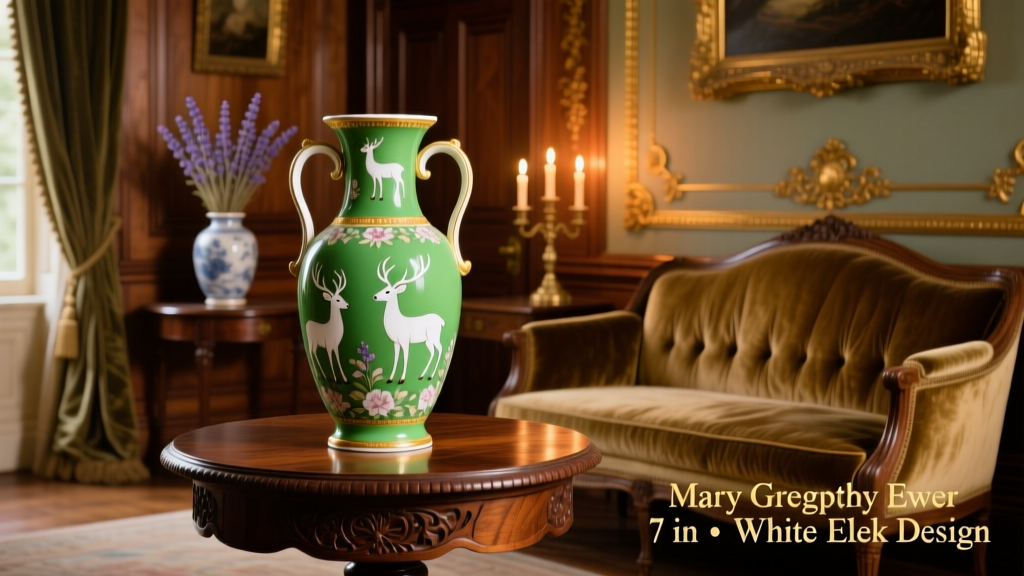
Mary Gregory Ewer: White Elk Glass, Lime Green Decoration, and the 7-Inch Collector’s Benchmark
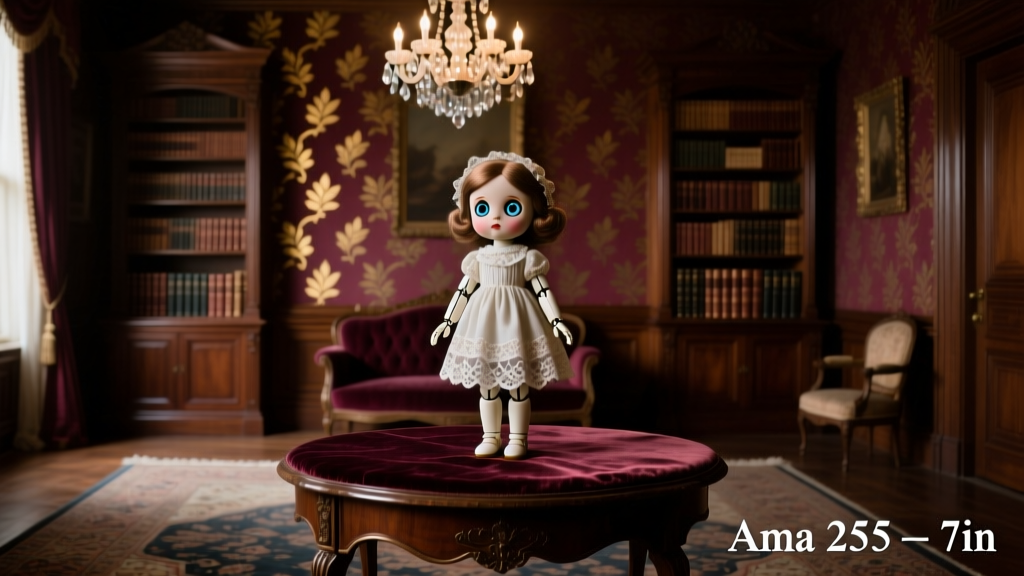
Doll A M 255 Googly Glass Eyes (7-Inch): Authenticity, Restoration, and Historical Context
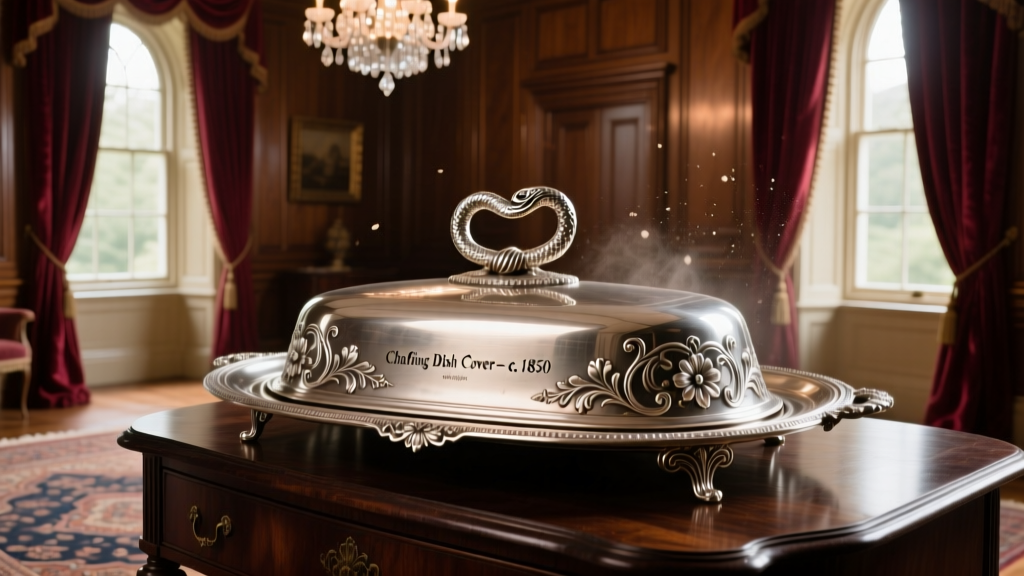
Silver-Plate Chafing Dish Cover, Mid-1800s England: A Technical and Historical Appraisal of a 13¼ × 10 Inch Specimen
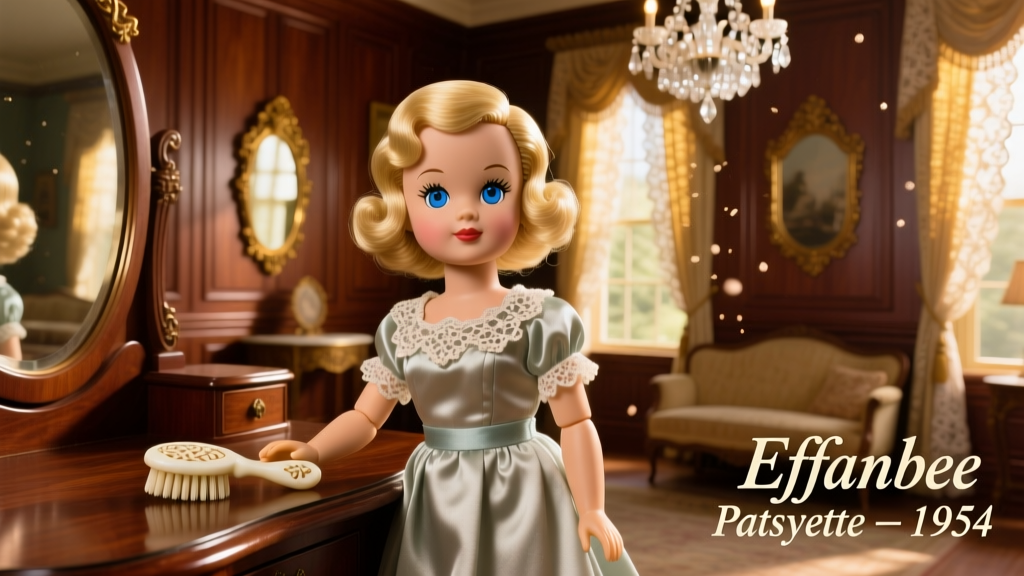
The Effanbee Patsyette 9-Inch Doll: History, Identification, Restoration, and Collectibility
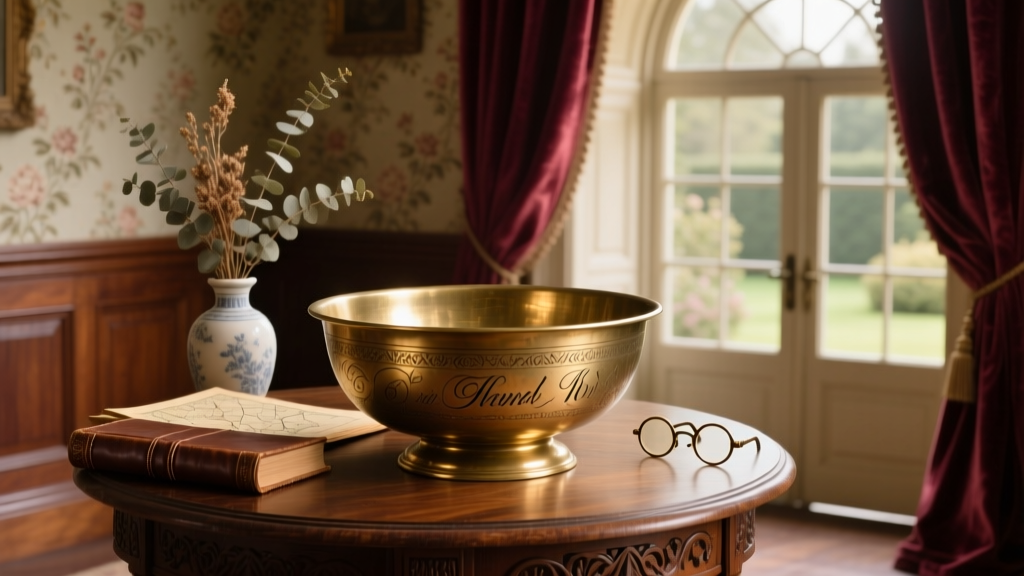
Brass Bowl with Rolled Rim, Etched Script Motifs, and Wide Base — Circa 1890 (10 × 16 Inches)
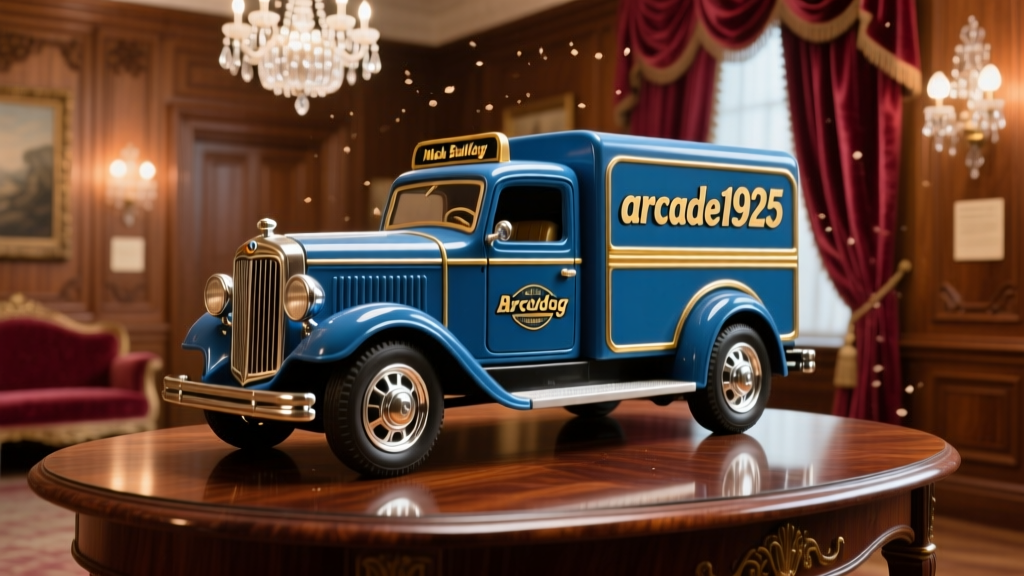
Toy Truck Dump Mack Bulldog Blue Gold Trim Arcade 1925 — A Collector’s Guide to the 12-Inch Cast-Iron Landmark
Silhouette Portraiture of the Georgian Era: Examining a Noblewoman’s Oval Miniature (1½ × 1⅛ Inches)
Decoding a Rare 1900s Chinese Snuff Bottle: Jade Two-Tone Bag Form with Monkey Motif, No Stopper, 2.5 Inches
Royal Doulton Character Jug: Town Crier Large No. 2 — History, Identification, and Restoration Insights