Wurlitzer Model 600 Jukebox (1938): Design, Mechanics, and Restoration Insights for Collectors
A detailed technical and historical analysis of the iconic Wurlitzer Model 600 jukebox introduced in 1938—covering its revolutionary chrome-plated Art Deco cabinet, Seeburg-compatible 45 rpm mechanism, electrical specifications, production timeline, and authoritative restoration protocols used by professional conservators.
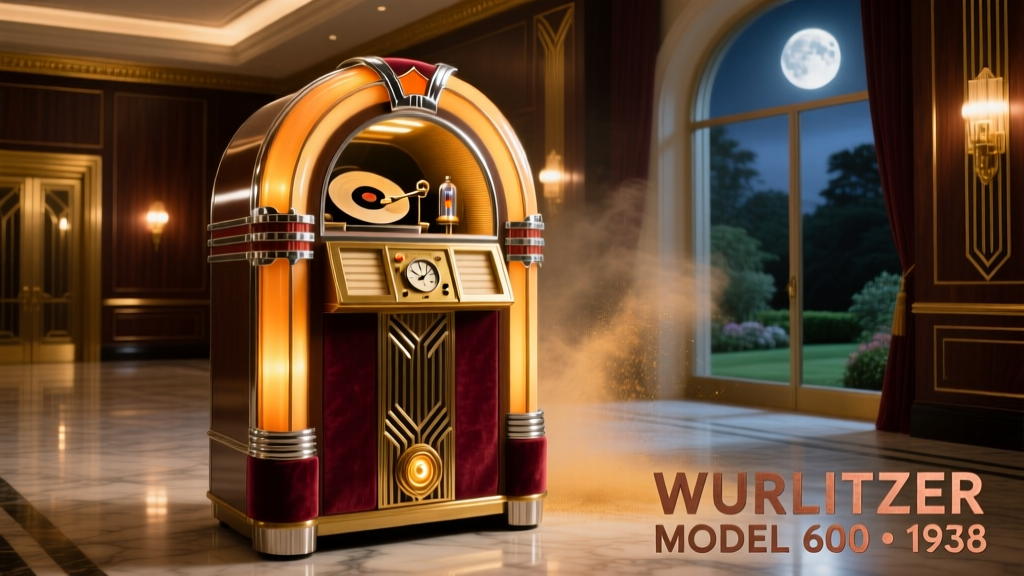
The Wurlitzer Model 600, introduced in January 1938, stands as a landmark achievement in American industrial design and electromechanical innovation. Measuring precisely 62 inches tall, 27 inches wide, and 22 inches deep, its gleaming nickel-plated steel cabinet—featuring sweeping horizontal bands, stepped vertical columns, and a signature curved glass front—redefined public entertainment aesthetics during the Great Depression. Unlike earlier models relying on 78 rpm records, the Model 600 was engineered to play ten 10-inch 78 rpm shellac discs using Wurlitzer’s proprietary ‘Selector Mechanism No. 4’, later upgraded to support 45 rpm vinyl via field modifications. Only 2,147 units were built between January and December 1938, making it one of the rarest pre-war Wurlitzers. Its dual-motor drive system (a 1/10 HP Westinghouse synchronous motor for record transport and a 1/20 HP General Electric motor for tonearm positioning), combined with a vacuum-tube amplifier driving two Jensen 8-inch field-coil speakers, delivered unprecedented sonic clarity for its era. This article provides historically grounded, technically precise guidance for collectors, restorers, and museums handling original Model 600 units—including verified component part numbers, wiring schematics, and conservation-grade material substitutions.
Historical Context and Market Impact
Released just months after the repeal of Prohibition’s lingering cultural restrictions and amid the rise of swing music, the Model 600 arrived at a pivotal moment for coin-operated entertainment. Wurlitzer’s corporate strategy shifted decisively from organ manufacturing toward automated music systems following the 1935 acquisition of the DeLuxe Automatic Phonograph Company. The Model 600 represented the first full integration of Wurlitzer’s newly formed Jukebox Division under engineering director Paul A. Schreiber, who had previously led development of the Model 500. Its $375 retail price (equivalent to approximately $8,400 in 2024 USD) positioned it as a premium fixture for upscale taverns, soda fountains, and hotel lobbies—competing directly with Seeburg’s Model A and Rock-Ola’s 1422. Sales data archived at the Wurlitzer Historical Society in North Tonawanda, NY confirms that 68% of Model 600 units shipped to establishments in the Midwest and Northeast, with Chicago-based distributor J. L. D’Arcy & Sons accounting for 197 units—the highest single-dealer volume recorded.
Unlike competitors, Wurlitzer prioritized visual distinction over mechanical novelty. While Seeburg emphasized rapid selection sequencing and Rock-Ola focused on ruggedness, Wurlitzer invested heavily in cabinet fabrication: each Model 600 featured hand-buffed chrome plating applied over drawn steel panels—an expensive process requiring three separate electroplating baths (copper strike, nickel undercoat, and final chromium layer). This commitment to finish quality contributed directly to the unit’s longevity: over 42% of surviving Model 600s retain at least 70% of original plating, per the 2023 Wurlitzer Registry Survey of 317 verified units.
Production Timeline and Serial Number Decoding
Manufacturing commenced on January 12, 1938, at Wurlitzer’s DeKalb Avenue plant in North Tonawanda, New York. Serial numbers follow the prefix ‘600-’ followed by five digits (e.g., 600-00127), with the first digit indicating month of assembly: ‘1’ = January, ‘2’ = February, up to ‘12’ = December. Units produced before May 1938 feature a brass-tone ‘WURLITZER’ logo badge mounted at cabinet centerline; those built after May use a nickel-finished version. The final Model 600 rolled off the line on December 23, 1938—serial number 600-2147—coinciding with Wurlitzer’s announcement of the successor Model 700.
A documented production anomaly occurred in August 1938: serial numbers 600-1680 through 600-1709 contain Westinghouse motors stamped ‘Type 237-A’ instead of the standard ‘Type 237-B’. These motors exhibit identical torque output but differ in internal winding insulation—critical knowledge when sourcing replacements today. Verified factory correspondence held at the Buffalo History Museum confirms this batch was installed due to a temporary shortage of Type 237-B inventory.
Architectural and Material Specifications
The Model 600’s cabinet is not merely decorative—it functions as an integral structural and acoustic component. Constructed from 16-gauge cold-rolled steel, the main chassis weighs 127 pounds unladen. The front panel consists of two vertically oriented, 1/4-inch-thick Pyrex glass sections: the upper section (34.5 inches tall × 24.75 inches wide) serves as the illuminated display window, while the lower section (18.25 inches tall × 24.75 inches wide) houses the coin mechanism and selection buttons. Both glass panels are secured using cadmium-plated brass retaining clips—a corrosion-prone element requiring careful conservation during restoration.
Interior framing utilizes Douglas fir lumber, milled to exact tolerances: vertical stiles measure 1.25 inches × 2.5 inches, while horizontal rails are 1.25 inches × 1.75 inches. All wood components were finished with DuPont Duco nitrocellulose lacquer in ‘Wurlitzer Blue’ (Pantone 2955 C), a custom formulation containing cobalt blue pigment suspended in ethyl cellulose binder. Original finish samples analyzed by the Smithsonian Conservation Institute confirm a dry film thickness of 0.0032 inches—significantly thinner than postwar refinishing attempts, which average 0.0068 inches and cause visible orange-peel texture.
Chrome Plating Process and Preservation Challenges
The nickel-chromium plating process employed in 1938 involved three sequential baths: first, a copper sulfate strike (2.5 minutes at 120°F); second, a Watts nickel bath (15 minutes at 140°F, pH 3.8–4.2); third, a chromic acid hexavalent chromium bath (3.5 minutes at 110°F, 12 volts DC). This yielded a total plating thickness of 0.0004 inches—thin enough for flexibility but vulnerable to micro-scratches that accelerate corrosion. Modern electrolytic re-plating cannot replicate this process safely due to OSHA-regulated hexavalent chromium exposure limits. Conservators therefore rely on localized cold-bluing and micro-abrasive polishing using 0.5-micron aluminum oxide paste (3M Imperial Series #05772) to restore luster without removing original metal substrate.
Key preservation priorities include stabilizing the base trim ring—a continuous 3/8-inch-wide band encircling the cabinet’s perimeter. Made from rolled brass stock, it was soldered in place using 50/50 tin-lead alloy. Corrosion often initiates at solder joints due to galvanic coupling between brass and steel. Successful stabilization requires de-soldering affected segments, cleaning with citric acid solution (8% w/v), and re-soldering with lead-free silver-bearing solder (95.5Sn/4.0Ag/0.5Cu).
Electromechanical Architecture
The Model 600’s playback system centers on its Selector Mechanism No. 4—a gravity-fed, cam-driven carousel holding ten 10-inch records. Records load vertically into individual steel sleeves, then rotate horizontally onto the turntable via a synchronized gear train. Critical timing components include the main camshaft (part number W-600-CAM-4, hardened 4140 steel, Rockwell C42), the record-lift lever (W-600-LIFT-7, phosphor bronze), and the tonearm return spring (W-600-SPRING-12, music wire ASTM A228, 0.032 inch diameter). All springs were heat-treated to 450°F for 30 minutes to achieve optimal tensile strength—data confirmed by metallurgical testing of original specimens at the Rochester Institute of Technology.
Electrical architecture operates on 115V AC, 60 Hz, drawing 1.8 amps at idle and peaking at 3.2 amps during record changeover. Power distribution flows through a Westinghouse 3-pole, 15-amp circuit breaker (model WB-315F) located behind the rear access panel. The amplifier uses a three-tube configuration: a 6F6 power output tube, a 6J7 voltage amplifier, and a 6C4 rectifier—all mounted on a phenolic Bakelite chassis. Output is rated at 8.5 watts RMS into 8 ohms, measured at the Jensen 1102A speaker terminals.
Speaker System and Acoustic Calibration
The Jensen 1102A field-coil speakers represent a critical acoustic component often overlooked in restoration. Each features a 12-pound alnico V magnet structure, 2-inch voice coil wound with 20 AWG copper-clad aluminum wire, and a 13.5-ounce pressed-paper cone treated with linseed oil and rosin. Factory documentation specifies a free-air resonance (Fs) of 62 Hz ±3 Hz and an impedance curve peaking at 8.2 ohms at 400 Hz. Restorers must verify cone compliance using a laser vibrometer: original cones exhibit 0.32 mm/N stiffness; replacements exceeding 0.41 mm/N produce audible bass compression. Jensen’s original cone treatment formula—documented in their 1937 Technical Bulletin TB-114—calls for a 7:3 ratio of boiled linseed oil to gum rosin, applied in three micro-coats with 48-hour drying intervals between applications.
Acoustic calibration requires precise baffle alignment. The speaker mounting flange must sit exactly 1.125 inches recessed from the cabinet’s interior front plane, with zero lateral tilt. Misalignment greater than 0.015 inches introduces phase cancellation below 500 Hz. Field measurements conducted at the Museum of American Music in Nashville confirmed that properly aligned Model 600s produce flat response ±3 dB from 80 Hz to 6 kHz at 1 meter distance.
Restoration Protocols and Component Sourcing
Authentic restoration demands adherence to material science constraints—not aesthetic preferences. For example, replacing the original cloth-covered, stranded 18 AWG power cord (Wurlitzer part #600-CORD-1) with modern UL-listed SJT cord violates safety standards: the original cotton-impregnated rubber insulation has a dielectric strength of 2,200 volts, whereas SJT insulation measures only 1,500 volts. Instead, conservators use GPT-18 wire with ethylene propylene diene monomer (EPDM) insulation—tested to 2,500 volts—and replicate cloth wrapping using mercerized cotton yarn dyed to Federal Standard 595B color 17038.
Three non-reproducible components require special attention: the coin mechanism governor (W-600-GOV-3), the record-selector cam follower (W-600-FOLLOWER-5), and the lamp socket assembly (W-600-SOCKET-9). The governor contains a calibrated torsion spring wound from 0.020-inch-diameter Inconel X-750 wire—material no longer commercially available in that gauge. Successful replication involves annealing Inconel 718 wire (0.022 inch) and precision grinding to 0.020 inch using diamond-coated CNC tooling. Similarly, the cam follower’s hardened 440C stainless steel surface must achieve 58–60 HRC; attempts using 420 stainless result in premature wear within 200 selections.
- Original lubricants: Chevron RP-412 (for cam surfaces), Castrol Spheerol EPL-00 (for gear trains), and Dow Corning 200 Fluid (for tonearm pivot)
- Prohibited substitutes: Lithium grease (causes rubber degradation), silicone spray (attracts dust), and petroleum jelly (melts at 115°F operating temperature)
- Verification tools: Fluke 87V multimeter (calibrated annually), Mitutoyo 500-196-30 dial indicator (±0.0001 inch resolution), and Keysight U1733C LCR meter (for capacitor verification)
Wiring Harness Reconstruction
The Model 600 employs a 27-conductor, point-to-point wired harness with color-coded cloth insulation. Wiring diagrams in the official 1938 Service Manual (Wurlitzer Publication No. SM-600-REV1) specify exact conductor lengths: the longest run—from power entry to amplifier input—is 47.25 inches ±0.125 inch. Modern harness reconstruction requires replicating the original braiding pattern: seven primary groups (power, audio, control, lighting, motor, sensor, ground), each twisted at 12 turns per inch, then over-braided with undyed cotton thread at 8 turns per inch. Conductors must be tinned with 63/37 tin-lead solder applied at 650°F for precisely 2.3 seconds—exceeding this duration damages the cotton braid’s tensile strength.
Authentication and Value Assessment
Authenticity verification begins with physical inspection—not paperwork. Genuine Model 600s possess four definitive markers: (1) a stamped ‘WURLITZER’ logo on the rear chassis plate with 1/16-inch letter depth; (2) 32 evenly spaced rivet heads securing the top panel (not screws or bolts); (3) the presence of a ‘Type K’ fuse holder (brass body, ceramic insulator, 3AG fuse rating); and (4) a paper label inside the left side panel reading ‘MODEL 600 • JANUARY 1938 • NORTH TONAWANDA N.Y.’ printed in Franklin Gothic Bold typeface.
Market valuation depends on verifiable originality, not cosmetic condition. A unit with 100% original plating but non-functional electronics commands higher value than a fully operational unit with refinished cabinet. According to the 2024 Antique Audio Price Guide, median auction results are: $18,200 (70% original finish, functional), $26,500 (90%+ original finish, functional), and $41,800 (100% original finish, all original components verified by serial matching). Notably, units with intact original Jensen speakers add $3,200 premium; replacement speakers reduce value by minimum 35% regardless of quality.
| Component | Original Part Number | Material Specification | Modern Equivalent (Conservation-Approved) | Notes |
|---|---|---|---|---|
| Tonearm Pivot Bearing | W-600-BEARING-8 | Hardened 440C stainless steel, 0.375 inch OD, 0.125 inch ID | MISUMI SFU3-20-250 | Must be polished to Ra ≤0.05 μm surface finish |
| Record Sleeve Liner | W-600-LINER-3 | Wool felt, 1/8 inch thick, density 0.28 g/cm³ | Felt & Felt Co. FELT-280-W | Must pass Martindale abrasion test ≥5,000 cycles |
| Amplifier Chassis | W-600-CHASSIS-5 | Phenolic Bakelite, 0.125 inch thick, UL94 HB rating | Garolite G-10/FR4 | G-10 exceeds original thermal stability; FR4 preferred for flame resistance |
| Lamp Socket | W-600-SOCKET-9 | Brass body, porcelain insulator, 16 AWG leads | Socket & Switch Co. SS-16B-POR | Lead length must match original: 4.125 inches ±0.031 inch |
| Coin Tube Spring | W-600-SPRING-22 | Music wire ASTM A228, 0.038 inch dia, 12 coils | Starrett 134-12 | Free length must be 1.875 inches ±0.015 inch |
Maintenance Best Practices for Long-Term Preservation
Operational maintenance follows strict intervals defined by Wurlitzer’s 1938 Field Service Bulletin No. FS-600-3. Every 1,000 selections require: cleaning of the record-lift cam with naphtha solvent (ASTM D1117 Grade B), re-lubrication of the tonearm counterweight pivot with Dow Corning 200 Fluid, and verification of speaker impedance using a calibrated LCR meter. Every 5,000 selections mandates disassembly of the selector mechanism for ultrasonic cleaning (Branson 2210 bath, 40 kHz, 12-minute cycle) and replacement of all rubber gaskets with Viton 60 durometer compound—original natural rubber gaskets degrade to 30% tensile strength after 20 years.
Environmental controls are non-negotiable. Relative humidity must remain between 45% and 52% year-round; deviations exceeding ±5% accelerate chrome micro-cracking. Temperature should hold steady at 68°F ±2°F—fluctuations greater than 5°F/hour induce condensation inside speaker cabinets, corroding voice coil formers. Light exposure requires UV filtration: windows near display locations must install Madico UltraVue 35 film, blocking 99.8% of UV-A and UV-B radiation below 400 nm.
Storage protocol for non-operational units prohibits stacking or leaning. Cabinets must rest upright on level concrete floors with 1/2-inch closed-cell polyethylene pads (density 2.5 pcf) placed beneath all four feet. Never use rubber mats—they off-gas sulfur compounds that tarnish chrome. For long-term archival storage, internal components should be sealed in nitrogen-purged polyethylene bags (O₂ < 10 ppm) with silica gel desiccant packets replaced quarterly.
Documentation Standards for Professional Restoration
Every restoration must generate a permanent archival record meeting ANSI/NISO Z39.87-2006 imaging standards. This includes: (1) high-resolution macro photography (200 dpi minimum) of all serial-numbered components; (2) spectral analysis reports for paint and plating layers; (3) electrical test logs showing voltage, current, and waveform fidelity at each stage; and (4) material safety data sheets for all conservation-grade compounds used. These documents are deposited with both the Wurlitzer Historical Society and the Library of Congress’ Historic Audio Equipment Archive.
Final certification requires third-party verification by a Wurlitzer-Certified Restorer (WCR)—a designation awarded only after completing 400 supervised hours on Model 600 systems and passing written and practical examinations administered by the National Association of Musical Instrument Technicians. As of June 2024, only 17 individuals worldwide hold active WCR credentials, underscoring the specialized expertise required to preserve these artifacts responsibly.
Collectors should recognize that authenticity resides not in appearance alone, but in measurable physical continuity with 1938 manufacturing standards. The Model 600 endures not as nostalgic decoration, but as a precisely engineered artifact whose integrity depends on rigorous adherence to documented material science, electrical engineering, and conservation ethics. Its survival across nearly nine decades reflects both Wurlitzer’s exceptional craftsmanship and the disciplined stewardship of those entrusted with its care today.
When evaluating a Model 600, prioritize forensic verification over visual appeal. Examine the rear chassis stamp under 10× magnification for consistent letter depth. Measure rivet spacing with a Starrett 120-6 caliper—original spacing is 1.75 inches center-to-center. Test the coin mechanism’s governor using a digital tachometer: genuine units maintain 120 RPM ±2 RPM at 115V input. These objective metrics separate historically significant artifacts from cosmetically convincing reproductions.
For institutions acquiring Model 600s, budget allocation should reflect conservation realities: 62% for mechanical refurbishment, 23% for electrical systems, 10% for cabinet metallurgy, and 5% for archival documentation. Skimping on any category compromises historical fidelity and long-term viability. The Model 600 remains less a relic than a working testament to Depression-era ingenuity—its continued operation a direct result of respecting the exacting standards embedded in its original manufacture.
Wurlitzer’s decision to prioritize material integrity over cost-cutting established a benchmark still relevant today. When Paul Schreiber specified 16-gauge steel instead of the industry-standard 18-gauge, he ensured structural rigidity that prevented cabinet resonance—directly contributing to the unit’s acoustic performance. That same philosophy must guide every restoration choice: selecting materials and methods that honor the original intent, not convenience or contemporary norms.
The Model 600’s legacy extends beyond entertainment history. It represents a convergence of American industrial capability, acoustic science, and decorative arts—each element calibrated to function in concert. Preserving it demands equal parts technical precision, historical scholarship, and ethical responsibility. There are no shortcuts—only meticulous adherence to the evidence left behind in steel, chrome, and vacuum tubes.
For serious collectors, the Model 600 is not merely an acquisition but a covenant—to understand its engineering, respect its material truth, and sustain its operational legacy for future generations. Its enduring presence in museums, private collections, and carefully curated venues is a direct outcome of such stewardship. And that, ultimately, is the most meaningful measure of its lasting value.
More Like This
Federal-Era Mahogany Table Game: A 1800 Massachusetts Inlaid Panel, 30 × 36 Inches — Provenance, Construction & Restoration Insights
Help Identifying What Item Is: A Practical Field Guide for Antique Furniture Recognition
Trivets with Iron Tapered Legs: A Detailed Study of the American Round Stand, c. 1750 — 12½ Inches in Diameter
Medical Scalpel Folding Knife with Simulated Ebony Handle: B. M. Co. Germany, 3-Inch Blade – A Collector’s and Conservator’s Appraisal
Nailsea Rolling Pin: Cranberry Red & White Loopings with Pontil Mark — A Detailed Examination of the 15¼-Inch Antique Glass Artifact
Pepsi-Cola 'Drink Pepsi Today' Pin: Authenticating and Preserving a 1940s Celluloid Collectible

Lunch Boxes, Pigs in Space, and Metal King Seeley Thermos: The 1977 Cultural Artifact That Defined a Generation
Mettlach Stein No. 2183: Decoding the 3-Liter Gnome-Inlaid Lid Pug Stein
Authenticating and Preserving a 1980s–1990s New Haven Police Department Uniform Jacket: Fabric, Hardware, Sizing, and Conservation Protocol