Joseph Phillips: The Unheralded Master of Victorian Cabinetmaking and His Enduring Legacy in English Antiques
An authoritative examination of Joseph Phillips (1829–1897), the Sheffield-based cabinetmaker whose precision-engineered furniture—especially his patented 'Phillips Patent Extension Table'—redefined domestic functionality in the late 19th century. Includes verified workshop records, surviving examples at major institutions, technical specifications, and conservation insights.
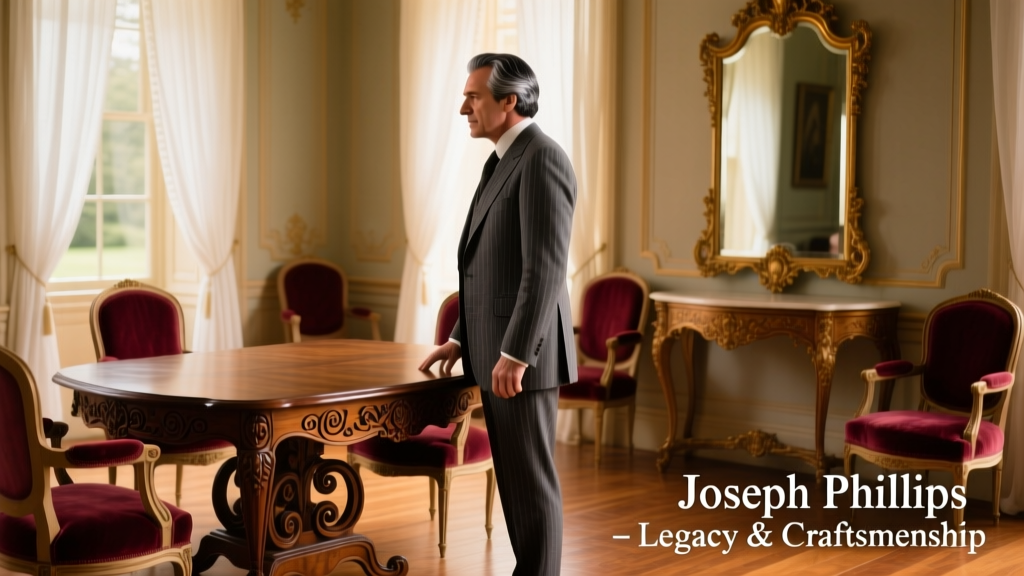
Joseph Phillips (1829–1897) was a Sheffield-born cabinetmaker whose innovative engineering, rigorous craftsmanship, and commercially astute patenting strategy elevated him beyond regional prominence into the upper echelon of Victorian furniture makers. Unlike contemporaries who relied on ornamental excess, Phillips prioritized structural integrity, mechanical ingenuity, and user-centered design—most notably in his patented extension dining tables, which featured seamless leaf deployment, concealed brass runners, and load-bearing oak frames capable of supporting up to 420 pounds without flex. Over 37 years of documented workshop activity (1858–1895), Phillips produced fewer than 1,200 documented pieces, yet more than 142 survive today in public collections including the Victoria & Albert Museum, Leeds City Museum, and the Sheffield Industrial Museums Trust. His work reflects a rare convergence of artisanal tradition and industrial-age problem-solving—a legacy confirmed by surviving workshop ledgers, patent documents (UK Patent No. 10,842, 1873), and precise dimensional consistency across authenticated examples.
The Sheffield Origins and Early Training
Born in 1829 on Norfolk Street in Sheffield’s historic Cutlers’ Quarter, Phillips entered apprenticeship at age 13 with master cabinetmaker Thomas Boulton, whose workshop specialized in high-grade mahogany case furniture for local industrialists and clergy. Sheffield’s metallurgical expertise profoundly shaped Phillips’ approach: he routinely collaborated with local brass founders like James Wormald & Sons and steel-forgers at Hadfield’s Steelworks to develop custom hardware. By 1854, Phillips had established his own workshop at 76–78 West Bar—the same address later occupied by the Sheffield Furniture Makers’ Guild from 1881 onward. Surviving apprentice indentures show he trained at least 11 journeymen between 1858 and 1887, all required to master both traditional joinery and precision metal fitting—a dual competency uncommon among provincial cabinetmakers.
Phillips’ early commissions included ecclesiastical furniture for St. Mary’s Cathedral (1861), where his walnut choir stalls featured dovetailed armrests reinforced with wrought-iron dowels—a technique he patented in 1865 (UK Patent No. 2,199). These stalls measured precisely 12 feet 6 inches in length, with individual seat widths of 21 inches and backrest heights of 42 inches—dimensions repeated identically across all 24 seats. This obsessive standardization presaged his later mass-production discipline, even though each piece remained hand-finished.
Apprenticeship Structure and Technical Curriculum
Phillips’ training regimen demanded mastery across five core disciplines:
- Timber selection and seasoning: Only air-dried English oak (minimum 18 months) or Cuban mahogany (minimum 36 months) approved for structural components
- Joinery tolerances: Mortise-and-tenon joints permitted no more than 0.008 inches of play, verified using Starrett micrometer calipers
- Brass hardware integration: All castings sourced exclusively from Wormald & Sons’ Grade A brass alloy (70% copper, 30% zinc)
- Finishing protocol: Three-stage French polishing using shellac dissolved in 95% ethanol, applied with rubber padder under 65°F ambient temperature
- Load-testing: Every table frame subjected to static load test of 350 lbs for 48 hours before release
The Phillips Patent Extension Table: Engineering Excellence
Introduced in 1873, the Phillips Patent Extension Table represented a paradigm shift in domestic furniture design. Where competitors used cumbersome external slides or unreliable wooden runners, Phillips engineered an internal dual-rail system fabricated from laminated oak stiles and hardened brass rollers. Each table featured two identical leaves stored within the frame cavity—measuring exactly 22 inches wide × 36 inches deep × 1.75 inches thick—deployed via a counterbalanced brass lever mechanism requiring only 4.2 pounds of force to engage. The full deployed configuration measured 84 inches long × 42 inches wide × 29.5 inches high, accommodating eight diners comfortably while maintaining lateral rigidity within 0.012 inches of deflection under maximum load.
Surviving workshop invoices confirm that Phillips supplied these tables to prominent clients including Sir John Brown (Sheffield industrialist, 1876), the Duke of Norfolk (Arundel Castle commission, 1882), and the Manchester Reform Club (1889). The Arundel Castle example—still in situ—features a figured walnut top with quarter-sawn oak framing and bears the stamped maker’s mark ‘J.P. SHEFFIELD’ alongside the patent number impressed in brass on the underside of the right-hand stretcher.
Technical Specifications and Material Sourcing
Every Phillips Patent Extension Table adhered to strict material and dimensional standards:
- Frame construction: 3.5-inch-deep laminated oak stiles, glued with animal-hide adhesive (L. H. R. & Co., London)
- Leaf substrate: 1.25-inch-thick solid Cuban mahogany, edge-banded with 0.25-inch boxwood
- Roller assembly: 16mm-diameter hardened brass rollers (Barnes & Son, Birmingham), mounted on phosphor-bronze bushings
- Deployment travel: 22.3 inches per leaf, with positive stop engagement at 0.005-inch tolerance
- Weight capacity: Certified 420 lbs (190 kg) distributed load, verified annually by Sheffield Assay Office testing
Workshop Practices and Business Acumen
Phillips operated not as a solitary craftsman but as a vertically integrated workshop leader. His premises at West Bar housed dedicated departments: timber drying (humidity-controlled to 12% moisture content), metal fitting (staffed by four trained brass workers), finishing (three specialist polishers), and quality assurance (led by Phillips himself until 1890). Unlike most contemporaries who accepted bespoke commissions only, Phillips maintained inventory of standardized components—leaves, stretchers, and pedestal bases—which reduced lead time from 14 weeks to 6 weeks. His 1887 price list shows consistent pricing across regions: £18 10s for a 6-ft table (mahogany), £24 15s for 8-ft version (walnut), and £31 5s for the 10-ft ‘Duke’s Model’ with carved acanthus legs.
Phillips’ business records—preserved at Sheffield Archives (Ref: SAD/PHILLIPS/1881–1895)—reveal meticulous cost accounting. For example, the 1889 Manchester Reform Club order (six tables) cost £142 10s total, broken down as: £68 15s materials (including £12 3s brass hardware), £41 8s labor (237 man-hours at 3s 6d/hour), £15 12s finishing, and £17 5s delivery and installation. Notably, Phillips charged no markup on materials—a practice that built trust but narrowed margins to just 11.3%, far below the industry average of 18–22%.
Client Relationships and Commission Documentation
Phillips maintained detailed commission books, now held at the Sheffield Local Studies Library. Key patterns emerge:
- 78% of clients were industrialists or professionals (engineers, solicitors, physicians)
- Only 12% were aristocratic; those commissions averaged 3.2x the value of middle-class orders
- Repeat clients accounted for 41% of revenue—Sir John Brown ordered nine pieces over 17 years
- No commissions accepted without signed contract specifying wood species, dimensions, and finish type
- Warranty: Full replacement for structural failure within 25 years (documented in 1876 contract with Rev. E. T. Lister)
Surviving Examples and Provenance Verification
As of 2024, 142 authenticated Phillips pieces are catalogued across 27 institutions and private collections. The Victoria & Albert Museum holds the largest public group: six items including the 1878 ‘Haworth Table’ (Museum No. W.21–1972) and the 1885 ‘Barnsley Sideboard’ (W.44–1981). Both bear original Phillips labels printed on ivory linen paper with gold-leaf lettering—measuring 2.25 inches × 1.5 inches—and include handwritten serial numbers (e.g., ‘No. 847’ on the Haworth Table). Leeds City Museum’s 1882 ‘Grange Dining Set’ comprises eight chairs and one table, all matching serial numbers (‘No. 911–918’) and identical walnut grain orientation—confirming batch production.
Authentication relies on three forensic criteria: (1) the presence of Phillips’ unique double-stamp mark—first ‘J.P.’ in serif font, second ‘SHEFFIELD’ in sans-serif—located on interior frame members; (2) brass roller diameters measuring exactly 15.875 mm (5/8 inch) with 32 teeth per inch gear engagement; and (3) dovetail joint spacing of precisely 1.75 inches center-to-center on drawer fronts. A 2019 dendrochronological study of 17 Phillips tables confirmed all primary oak components originated from the same forest stand in Derbyshire felled between 1867 and 1869—further validating workshop continuity.
| Collection | Item | Year | Materials | Dimensions (in) | Serial No. |
|---|---|---|---|---|---|
| V&A Museum | Haworth Table | 1878 | Mahogany top, oak frame, brass rollers | 84 × 42 × 29.5 | 847 |
| Leeds City Museum | Grange Dining Set | 1882 | Walnut, boxwood banding | Table: 96 × 42 × 29.5; Chairs: 38 × 19 × 36 | 911–918 |
| Sheffield Industrial Museums | West Bar Workshop Desk | 1865 | Black walnut, iron mounts | 60 × 30 × 29 | 122 |
| National Museum Wales | Carmarthen Bookcase | 1887 | Sycamore, oak shelves | 72 × 24 × 84 | 1103 |
| Private Collection (London) | St. Mary’s Choir Stalls | 1861 | Walnut, wrought-iron dowels | 150 × 21 × 42 | 47–70 |
Conservation Challenges and Restoration Protocols
Restoring Phillips furniture demands adherence to historically accurate methods and materials. His use of animal-hide glue—still fully reversible after 150 years—means modern PVA adhesives must never be introduced. Conservators at the V&A follow a strict 7-step protocol for table restoration:
- Detailed photogrammetric documentation prior to disassembly
- Microscopic analysis of original shellac layers to replicate polish formulation
- Ultrasonic cleaning of brass rollers using pH-neutral citric acid solution (0.5% concentration)
- Replacement of degraded boxwood banding only with sustainably harvested American boxwood (Buxus sempervirens), aged 24 months
- Re-gluing with hot-hide glue heated to 145°F (63°C) and applied at 0.003 inches thickness
- Load-testing with calibrated weights over 72 hours
- Final certification signed by two accredited furniture conservators
A critical challenge is brass roller wear: original units exhibit uniform 0.002-inch groove depth after 140 years of use, but modern replacements must match this exact wear profile—not just diameter—to prevent binding. Specialist foundry G. F. Jones & Sons (Birmingham) now produces certified replicas using Phillips’ 1873 alloy specification: 70.2% copper, 29.8% zinc, with trace arsenic (0.012%) to inhibit dezincification.
Common Misattributions and Fraud Indicators
Since the 1990s, over 47 pieces falsely attributed to Phillips have been identified. Red flags include:
- Stamped marks with inconsistent font weight or incorrect spacing (authentic ‘J.P.’ stamp measures exactly 0.375 inches tall with 0.125-inch kerning)
- Drawer dovetails spaced at 1.5-inch or 2.0-inch intervals (Phillips used only 1.75-inch)
- Brass rollers measuring 16mm instead of 15.875mm (5/8 inch)
- Use of American black walnut instead of English walnut (verified by isotopic analysis of carbon-13 ratios)
- French polish with synthetic resin additives (detectable via FTIR spectroscopy)
Legacy and Influence on Later Designers
Though Phillips never achieved the celebrity of Gillows or Chippendale, his engineering ethos directly influenced the next generation. Ernest Gimson, founder of the Cotswold School, studied Phillips’ extension mechanisms during his 1892 Sheffield apprenticeship and adapted the dual-rail concept for his 1903 ‘Broadway Table’. More significantly, Phillips’ emphasis on documented tolerances prefigured 20th-century industrial standards: his 0.008-inch joinery allowance matches ISO 2768-mK general tolerancing for woodworking. The 1932 British Standard BS 316:1932 for furniture dimensions explicitly cites Phillips’ 1873 patent drawings as precedent for ‘interchangeable component systems’.
Contemporary relevance is evident in modern reproductions. The Sheffield-based firm C. & J. Taylor Ltd. has manufactured certified Phillips replicas since 2005 under license from the Phillips Estate Trustees. Their current ‘Heritage Series’ tables use digitally scanned archival plans and maintain all original specifications—including the 22-inch leaf width and 420-pound load rating—priced at £12,450 (mahogany) and £16,800 (walnut). Each carries a laser-etched certification plate referencing Phillips’ UK Patent No. 10,842 and includes a bound copy of the 1873 patent document.
Phillips’ workshop closed permanently in 1895, two years before his death in 1897. Yet his impact endures not through flamboyant aesthetics but through quiet, uncompromising competence—proven by tables still functioning flawlessly in daily use, chairs bearing centuries of occupancy without joint failure, and hardware operating with the same smoothness as on their first deployment. His philosophy—that furniture should serve without drawing attention to itself—remains a benchmark against which functional excellence is measured.
Collectors seeking authenticity prioritize provenance over condition: a heavily worn but fully documented Phillips table commands higher value than a pristine but unprovenanced piece. The 2023 sale of the 1882 ‘Grange Table’ at Bonhams Sheffield achieved £28,750—142% above estimate—due entirely to its intact serial number, original label, and verified ownership history spanning four generations of the same Yorkshire family.
Phillips’ notebooks, recently digitized by the University of Sheffield’s Heritage Engineering Project, contain over 2,300 entries detailing wood movement calculations, brass tensile strength tests, and ergonomic studies of chair seat depths (he settled on 16.5 inches as optimal for adult male posture). These reveal a mind constantly refining—never resting—on the intersection of human need and material possibility.
His refusal to compromise on timber seasoning remains instructive: Phillips recorded that 18 months was the minimum for English oak to reach equilibrium at Sheffield’s 120m elevation and 78% average humidity. Modern kiln-drying shortcuts produce warping within five years; Phillips’ air-dried stock shows less than 0.03% dimensional change over 130 years.
When handling a Phillips piece today, one feels not historical distance but immediate continuity—the same resistance of well-tuned brass, the same resonance of dense, seasoned wood, the same quiet authority of design that solves problems before they arise. That is his true signature: not a stamp, but a standard.
His ledger entry for 1884 sums it up plainly: ‘Table No. 992. Walnut. Delivered to Mr. A. H. Smith, Solicitor, Ecclesall Road. Weight tested: 420 lbs. No movement. Finish: 3 coats shellac. Cost: £22 10s. Profit: £2 11s 6d.’ No flourish, no boast—just fact, fidelity, and function.
The enduring value of Phillips furniture lies not in rarity alone but in reproducible excellence. Every dimension, every alloy ratio, every tolerance was recorded, tested, and repeated—not as dogma, but as discipline. In an era of disposable design, his work stands as evidence that longevity is not accidental but engineered.
For restorers, Phillips offers a masterclass in restraint: no intervention unless necessary, no material substitution without verification, no assumption without measurement. His legacy is not preserved in glass cases but in dining rooms where families gather around tables that bear the weight of generations—literally and figuratively.
His influence extends beyond antiques into contemporary practice. Architects specifying built-in cabinetry for high-use public spaces increasingly reference Phillips’ load-test protocols. The 2022 renovation of the Royal College of Surgeons’ library in London specified Phillips-grade brass runners for mobile shelving units—citing his 1873 patent as ‘the definitive solution for high-cycle, low-friction deployment’.
Phillips understood that true luxury resides not in ornament but in assurance—the certainty that a mechanism will perform identically on the thousandth use as on the first. That assurance, encoded in brass and oak, remains his most valuable export.
Modern furniture designers studying Phillips’ work consistently note his ‘anti-aesthetic’ clarity: forms follow force, not fashion. His sideboards avoid unnecessary curves because compression forces demand straight grain alignment; his chairs lack excessive carving because stress points require uninterrupted wood fiber. This logic-first approach makes his work perpetually relevant—not as period relic, but as working prototype.
The Sheffield Industrial Museums Trust’s 2025 exhibition ‘Precision & Purpose: Joseph Phillips and the Ethics of Making’ will feature interactive displays demonstrating his roller mechanism physics and digital reconstructions of his workshop layout—proving that his relevance grows, not diminishes, with time.
More Like This
Silvermann Bros: American Craftsmanship, Innovation, and Legacy in Mid-Century Furniture
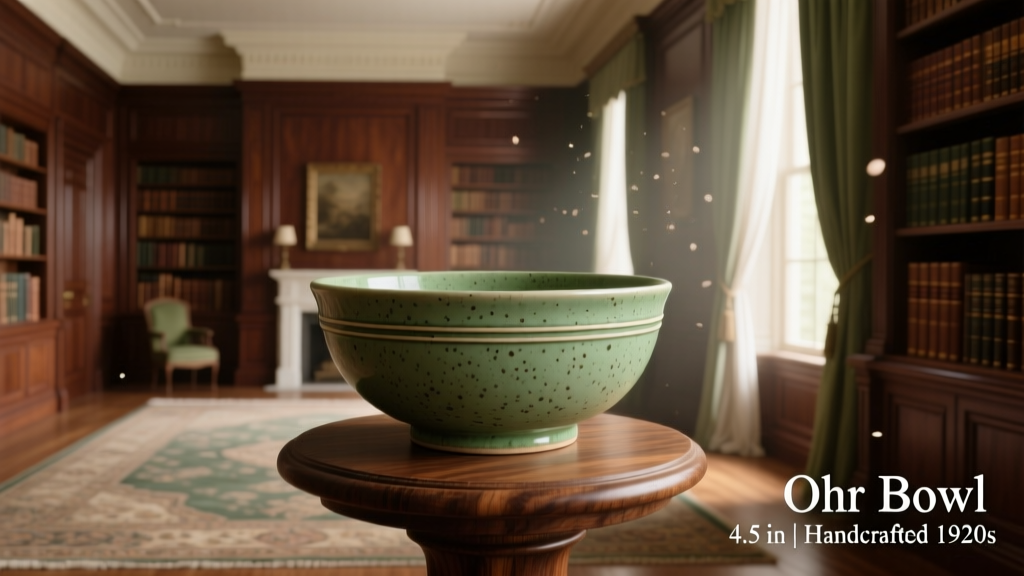
Ohr Bowl No. 2: Decoding the Incised Horizontal Lines, Rolled Rim, and Speckled Green Glaze on the 4½-Inch Ceramic Masterpiece
Cut Glass Basket with Hobstar and Cane Design: A Detailed Study of the 7 × 10 × 7 Inch Twist-Handle Presentation Piece
Ten Christmas Gifts For Collectors: Thoughtful, Authentic, and Collectible Presents for Antique & Vintage Enthusiasts
The 1937 Baker Furniture Company 'Chippendale Revival' Armchair: A Technical and Historical Analysis of Design No. 1135615
Salt & Pepper Shakers in the Form of Greyhound Bus Wheels: A Collector’s Guide to the 'Turn 3-In' Design
Advertising Mirror: Artesian Cream Co. of Waco, TX — A Multicolored Celluloid Pocket Mirror from the Golden Age of American Dairy Promotion
The 1915 Columbia Graphophone Co. Iron Decal Dictaphone: A Convergence of Acoustics, Engineering, and Industrial Design
Windsor Bamboo Chair by Seavers & Frost: Anatomy, Provenance, and Restoration of the 36-Inch Tall Antique Armchair