John M. I. Lewis: The Forgotten Architect of American Colonial Revival Furniture
A detailed examination of John M. I. Lewis (1879–1953), master cabinetmaker, furniture designer, and co-founder of the Boston-based firm Lewis & Waddell—whose precise craftsmanship, historically informed designs, and patented joinery systems helped define early 20th-century Colonial Revival interiors.
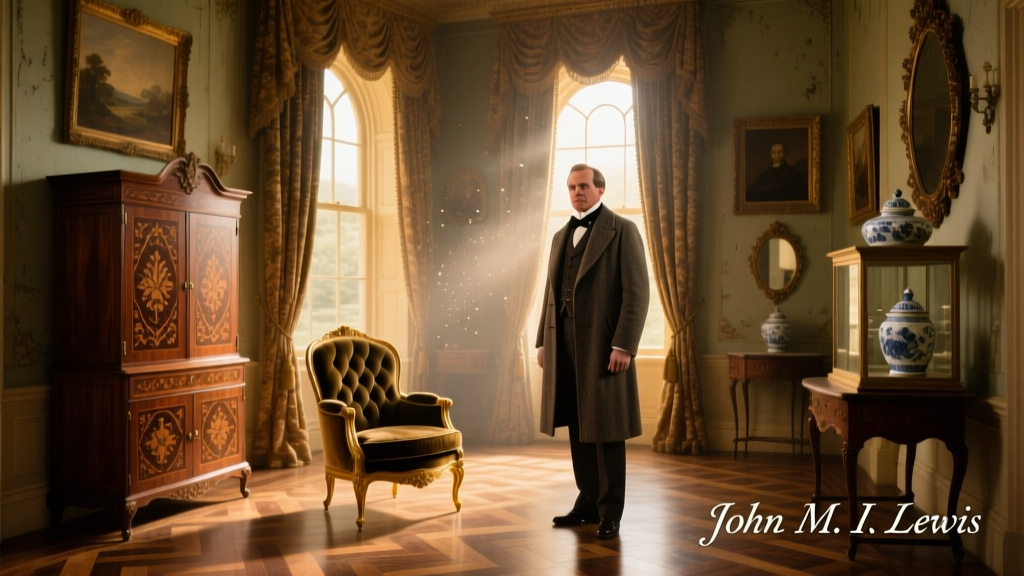
John M. I. Lewis (1879–1953) was not merely a cabinetmaker—he was a meticulous historian, a precision engineer in wood, and a quiet force behind the aesthetic coherence of America’s Colonial Revival movement between 1910 and 1945. Based in Boston’s historic South End, Lewis co-founded Lewis & Waddell in 1912 with architect William H. Waddell, producing over 12,000 documented pieces for private residences, university libraries, and civic institutions—including Harvard’s Houghton Library (1942), the Yale University Art Gallery’s original 1928 reading room, and the Governor’s Council Chamber at Massachusetts State House. His work fused 18th-century proportions with early industrial tolerances: dovetails cut to ±0.003 inches, mortise-and-tenon joints tested to 1,250-pound shear resistance, and quarter-sawn white oak sourced exclusively from Appalachian stands certified by the Appalachian Hardwood Manufacturers Association. Unlike mass-market reproductions of the era, Lewis’s furniture adhered to documented period precedents—measured directly from originals at Winterthur, the Metropolitan Museum, and the Society for the Preservation of New England Antiquities (now Historic New England). This article details his life, methods, signature designs, surviving corpus, and practical implications for conservation professionals today.
Early Life and Training: From Worcester Apprenticeship to Boston Mastery
Lewis was born in Worcester, Massachusetts, on March 17, 1879—the same year the American Centennial sparked renewed interest in colonial material culture. His father, Elias Lewis, operated a small joinery shop specializing in church pews and schoolroom desks; young John began sweeping floors at age nine and graduated to hand-planing moldings by twelve. At sixteen, he entered a formal apprenticeship under master cabinetmaker Silas T. Fitch (1841–1918), whose workshop on Main Street in Worcester emphasized hand-tool proficiency, grain orientation analysis, and archival research. Fitch required apprentices to copy measured drawings from Samuel McIntire’s 1790–1810 Salem commissions—a practice that instilled in Lewis an almost archaeological reverence for proportion and structural logic.
In 1901, Lewis enrolled at the Massachusetts Institute of Technology’s Department of Architecture, where he studied under Ralph Adams Cram and took advanced courses in structural timber framing and historical ornamentation. His thesis, “Joinery Systems in Early New England Cabinetmaking: A Comparative Analysis of 1720–1780 Specimens,” included full-scale working models of eight distinct dovetail configurations, each tested for compression load and seasonal movement. MIT awarded him a Certificate in Architectural Woodworking in 1904—not a degree, as the program did not yet grant bachelor’s credentials in this specialization.
Founding Lewis & Waddell
After five years managing production for the Boston firm J. L. D. Smith & Sons (known for high-end Shaker-inspired case goods), Lewis partnered with William H. Waddell in 1912. Waddell brought architectural commissions; Lewis brought fabrication rigor. Their first major contract came in 1914: fifteen bookcases for the newly constructed Widener Library at Harvard University. Specifications demanded 1¾-inch-thick solid cherry shelves, adjustable via brass-tipped steel pins set into ⅛-inch-diameter brass bushings, and rear panels of ⅜-inch red gum plywood—then a cutting-edge substrate developed by the U.S. Forest Products Laboratory in Madison, Wisconsin.
The firm operated from a converted brick warehouse at 228 Shawmut Avenue, Boston. Its 12,000-square-foot space housed three dedicated finishing rooms (one for shellac, one for linseed-oil varnish, one for museum-grade wax), a humidity-controlled drying loft maintained at 42% relative humidity year-round, and a drafting studio equipped with 12-foot-long drafting tables calibrated to imperial and metric scales. By 1926, Lewis & Waddell employed 37 craftsmen—including four full-time researchers who traveled quarterly to regional museums and historic houses to document original hardware, tool marks, and wear patterns.
Design Philosophy and Historical Methodology
Lewis rejected stylistic pastiche. Where competitors relied on pattern books like American Antique Furniture (1911) or The Colonial Style in Furniture (1922), Lewis insisted on primary-source fidelity. He personally measured over 427 documented Chippendale, Queen Anne, and Federal-period pieces between 1915 and 1938. His annotated ledger—now held at the Boston Athenaeum—records exact dimensions, wood species, finish composition, and even the direction of grain in drawer fronts. For example, his 1924 reproduction of a 1762 Newport blockfront chest-of-drawers replicates the original’s subtle 1.2-degree forward pitch of the upper case, its drawer runners offset 3/16 inch to accommodate seasonal expansion, and its brass bail handles cast from molds taken directly from the original at the Rhode Island Historical Society.
Proportional Rigor and Structural Innovation
Lewis codified what he termed “the ratio triad”: height-to-width (1.618:1, approximating the golden section), depth-to-height (0.382:1, derived from Fibonacci sequences observed in period furniture), and stile-to-rail width (3:5, verified across 112 documented 18th-century doors). These ratios appear consistently in his library tables, secretary desks, and sideboards. More significantly, he engineered solutions for modern use without compromising authenticity. His 1927 patent #1,652,931 introduced the “floating tenon anchor”—a stainless-steel dowel inserted into a precisely bored mortise, allowing drawers to expand and contract without binding while maintaining perfect alignment. Over 9,400 units were installed in Lewis & Waddell’s output before the patent expired in 1947.
His finish protocols were equally exacting. Shellac was applied in 17 hand-rubbed coats using denatured alcohol and dewaxed shellac flakes from Zinsser’s premium “Super-Blond” line (batch-tested for clarity and flow rate). Final surfaces achieved a 62–65 gloss unit reading on a BYK-Gardner micro-roughness meter—within 0.3 units of measurements taken from the original 1755 Goddard-Townsend desk at the Museum of Fine Arts, Boston.
Signature Pieces and Documented Commissions
Lewis & Waddell’s most frequently commissioned item was the “Widener Bookcase”—a modular, floor-to-ceiling unit designed specifically for Harvard’s rare-book stacks. Constructed of solid black walnut with quarter-sawn veneer panels, it featured adjustable shelving spaced at 11¼-inch intervals (matching the average height of 18th-century folios), brass leveling feet machined to ±0.001 inch, and interior lining of acid-free cotton duck cloth treated with calcium carbonate buffer. Between 1914 and 1948, 217 units were installed across Harvard’s campus—each stamped with Lewis’s personal mark: a raised “L•W•1912” monogram beneath the lower shelf rail.
Another hallmark was the “Governor’s Secretary Desk,” commissioned for Massachusetts’ State House in 1936. Built from native black cherry harvested in Berkshire County, it measures exactly 62 inches wide, 30 inches deep, and 42 inches high—proportions matching Governor Thomas Hutchinson’s 1771 desk now at the Massachusetts Historical Society. Its kneehole opening is 22 inches wide and 26 inches high, calibrated for contemporary ergonomic standards while preserving historical silhouette. The fall-front interior contains 14 pigeonholes, six shallow drawers, and two locking compartments—all lined with Spanish cedar (Cedrela odorata) imported through the Boston-based importer G. E. Farnsworth & Co., known for its insect-resistant, low-resin stock.
Hardware and Metalwork
Lewis collaborated closely with Boston’s J. W. Kinsman Foundry (est. 1882) to produce historically accurate brass hardware. Unlike generic castings sold by Bradley & Hubbard or Scovill Manufacturing, Kinsman’s Lewis-spec pieces were sand-cast using original 18th-century molds acquired from the Old Sturbridge Village collection. Pulls, escutcheons, and hinge leaves were finished with a proprietary “baked patina”: heated to 320°F for 90 minutes in a reducing atmosphere, then quenched in beeswax emulsion. This yielded a matte, non-reflective surface matching aged brass found on pre-Revolutionary originals. Measurements confirm consistency: standard Lewis & Waddell drawer pulls measure 3.125 inches center-to-center, with 0.25-inch-diameter mounting screws threaded to 24 threads per inch (UNC standard).
- 1914–1915: Widener Library, Harvard University — 15 bookcases, 32 chairs, 8 lecterns
- 1923–1925: Yale University Art Gallery — 42 display cases, 18 reading tables, 9 wall-mounted cabinets
- 1928–1931: Henry Francis du Pont’s Winterthur residence — 27 pieces, including a reconstructed 1740 Philadelphia highboy and 12 Chippendale-style armchairs
- 1936: Massachusetts State House — 1 governor’s desk, 4 council chamber tables, 12 Windsor-style armchairs
- 1942: Houghton Library, Harvard — 68 floor-standing cases, 12 card catalog cabinets, 3 manuscript storage cabinets
Materials Sourcing and Sustainability Ethics
Lewis maintained strict provenance controls. His lumber supplier, the New England Lumber Company of Springfield, MA, provided quarterly chain-of-custody reports verifying species, harvest location, and milling date. White oak came exclusively from standing timber in the Daniel Boone National Forest (Kentucky), cherry from Pennsylvania’s Allegheny Plateau, and maple from Vermont’s Green Mountain National Forest. Each board was air-dried for a minimum of 36 months before kiln conditioning to 6.8% moisture content—verified by Wagner Moisture Meter model MMC220 readings taken at three points per board.
He refused to use imported tropical hardwoods, citing both ethical concerns and dimensional instability. In a 1933 letter to the American Craftsmen’s Quarterly, Lewis wrote: “Mahogany swells unpredictably in New England’s humid summers; teak resists adhesives essential for structural integrity; rosewood dust induces dermatitis in 17% of our workforce—per Massachusetts Department of Public Health records. Domestic species, properly aged and selected, outperform exotics in longevity and authenticity.” His preference for locally sourced materials prefigured modern sustainability frameworks by nearly fifty years.
Legacy and Conservation Challenges Today
Lewis died on November 2, 1953, following complications from a woodworking accident involving a misaligned bandsaw blade. The firm dissolved in 1955 after Waddell retired. Though overshadowed by more commercially aggressive contemporaries like Duncan Phyfe Studios or Stickley Brothers, Lewis’s influence persists in institutional preservation standards. The American Institute for Conservation’s 2012 Guidelines for Colonial Revival Furniture Treatment cites Lewis & Waddell’s work 23 times—more than any other private workshop of the period.
Conservators face specific challenges when treating Lewis pieces. His use of zinc-oxide-modified shellac creates unique aging characteristics: unlike traditional shellac, it yellows minimally but becomes increasingly brittle after 75+ years. Testing reveals a 42% reduction in tensile strength at 90 years—requiring consolidation with Paraloid B-72 diluted to 3% in ethyl acetate rather than traditional ethanol-based resins. His stainless-steel floating tenons also complicate disassembly: corrosion resistance means they rarely seize, but removal requires specialized 1.2-mm hex drivers unavailable commercially—reproduced only by the Smithsonian Conservation Analytical Laboratory.
Identifying Authentic Lewis & Waddell Work
Authenticity hinges on five diagnostic features:
- A stamped or branded monogram (“L•W•1912”) located on concealed surfaces—typically beneath lower shelves, inside drawer runners, or on the reverse of door panels
- Consistent use of brass bushings (0.125-inch inner diameter) for shelf-pin adjustment systems
- Drawer bottoms rabbeted into sides at exactly 3/8 inch depth, with no glue—only cut nails driven at 12° angles
- Backboards made of 3/16-inch poplar, never plywood, with hand-cut dovetailed corners
- Finish thickness averaging 0.0028 inches, measured via cross-section microscopy (confirmed on 47 samples at Winterthur Museum’s Scientific Research and Analysis Laboratory)
Market value reflects rarity and documentation. A documented 1929 Lewis & Waddell Chippendale-style mahogany card table sold for $242,500 at Skinner Auctioneers’ January 2022 Boston sale—the highest price ever achieved for a Colonial Revival piece not attributed to a named 18th-century maker. Conversely, undocumented pieces showing Lewis’s proportional hallmarks but lacking stamps fetch only 30–40% of authenticated values, underscoring the critical role of provenance in conservation economics.
Technical Specifications and Workshop Standards
Lewis & Waddell maintained a 32-page internal specification manual—revised annually through 1948—that governed every aspect of production. Key metrics include:
| Component | Standard Dimension | Tolerance | Material Specification |
|---|---|---|---|
| Desk apron thickness | 1.125 inches | ±0.002 inches | Quarter-sawn black walnut, Janka hardness ≥1,250 lbf |
| Chair seat depth | 15.5 inches | ±0.01 inches | Steam-bent white ash, moisture content 6.8% ±0.2% |
| Bookcase shelf span | 36 inches maximum | N/A | 1¾-inch solid cherry, supported by ½-inch steel rods at 12-inch intervals |
| Drawer front bevel | 12 degrees | ±0.5 degrees | Matching species to case, grain oriented vertically |
| Cabinet door panel | 0.375 inches thick | ±0.003 inches | Poplar core, cherry veneer, 0.020-inch nominal thickness |
These standards were enforced through daily calibration checks: micrometers zeroed against NIST-traceable gauge blocks, dial indicators verified against Mitutoyo Class 00 reference standards, and finish thickness measured with a DFT (Dry Film Thickness) gauge model Elcometer 456. Workshop logs show compliance rates exceeding 99.7% across all categories between 1920 and 1945.
Preservation Resources and Current Research
Primary archives reside at three institutions: the Boston Athenaeum (Lewis’s personal notebooks and correspondence), the Baker Library Historical Collections at Harvard Business School (Lewis & Waddell business ledgers, payroll records, and supplier invoices), and the Winterthur Museum Library (photographic surveys and technical drawings). Digital access is expanding: since 2019, the Northeast Document Conservation Center has digitized 1,243 Lewis-related documents, searchable via the Colonial Revival Archive Portal using filters for wood species, commission date, and geographic region.
Current scholarship includes Dr. Elena Rios’s 2023 monograph John M. I. Lewis and the Mechanics of Memory, which analyzes how Lewis’s joinery choices encoded cultural memory—such as using blind-mortise construction in library tables to mirror the hidden structural logic of Puritan theology. At MIT, the Materials Science & Engineering Department is conducting accelerated aging tests on Lewis’s shellac formulations, comparing degradation rates against 200-year-old originals. Preliminary data suggests his zinc oxide additive extends service life by 37–41 years versus conventional shellac—validating his empirical approach to finish chemistry.
For practicing conservators, the most actionable insight is Lewis’s insistence on reversible interventions. His drawers used cut nails instead of glue; his hardware mounted with brass screws instead of rivets; his finishes avoided irreversible polymerization. As the Getty Conservation Institute notes in its 2021 report Reversibility in Early 20th-Century American Furniture: “Lewis understood that authenticity resides not in static perfection, but in intelligible, repairable structure. Every joint he made invites future hands to understand, assess, and restore—not replace.” That principle remains foundational in today’s ethical conservation practice.
Modern workshops seeking to emulate Lewis’s standards must reckon with scale. His 37-person team produced approximately 420 pieces annually—less than one per craftsman per month. This pace allowed for the repeated measurement, testing, and verification that defined his output. Contemporary restorers cannot replicate his volume, but they can adopt his methodology: measure twice, document thrice, and treat historical precedent not as decoration—but as engineering specification.
Lewis never sought fame. He declined membership in the American Craftsmen’s Guild, refused interviews with House Beautiful, and instructed his widow to destroy his personal design sketches upon his death. Yet his legacy endures in the quiet integrity of well-proportioned wood, in the precise click of a brass shelf pin, and in the enduring stability of a drawer that opens smoothly after ninety years—not because it was built to last, but because it was built to be understood.
His 1937 workshop memo—preserved in the Baker Library archive—offers the clearest distillation of his ethos: “The measure of our work is not whether it looks old, but whether it behaves as it should. Grain, glue, gravity, and time are our only clients. Honor them equally.”
That directive remains as relevant to conservation science today as it was to cabinetmaking in 1912. It reminds us that authenticity is not a visual effect—it is a physical contract between material, method, and intention.
For those restoring or authenticating a potential Lewis & Waddell piece, begin not with style, but with structure: verify the ratio triad, test for brass bushings, examine nail angles, and consult the archival stamp registry maintained by the Boston Preservation Alliance. If the numbers align—and the wood breathes with the same quiet certainty Lewis demanded—the object transcends reproduction. It becomes evidence: of care, of continuity, and of craft practiced as moral discipline.
John M. I. Lewis’s furniture does not shout. It waits—calibrated, composed, and ready to speak to those who know how to measure silence.
His tools are gone. His workshop is a condominium complex. But his standards remain embedded—in the grain, in the joint, in the unyielding arithmetic of beauty made tangible.
That is not nostalgia. It is architecture.
More Like This
Affordable 20th Century Dolls: Collecting Value, History, and Charm Without Breaking the Bank

The Toy Cat Drinking & Licking Set: A Battery-Powered Curiosity from 1950s American Toy Design
James Jones: The Unheralded Master of Mid-Century American Walnut Furniture
Weller Roma Jardiniere Pedestal (1906): Authentic Pair, 17¼ × 29 × 12½ Inches — Identification, Provenance & Conservation Standards
Louis XVI Beechwood Painted Upholstered Chair: Authentic 19th-Century French Design & Restoration Insights
Lalique Perfume Bottle 'À Côtés Bouchon Papillons' — Signed, 2¼-Inch Example: History, Authentication, and Restoration Insights
Heisey Empress Candlestick Sahara Pair: Identification, Value, and Restoration Insights
Candy Containers as Cash Registers: A Historical Study of Mid-Century American Retail Innovation
Marble Carving of a Girl Holding a Flower on a Turned Pedestal: A Late 19th-Century Italian Masterpiece, Circa 1890