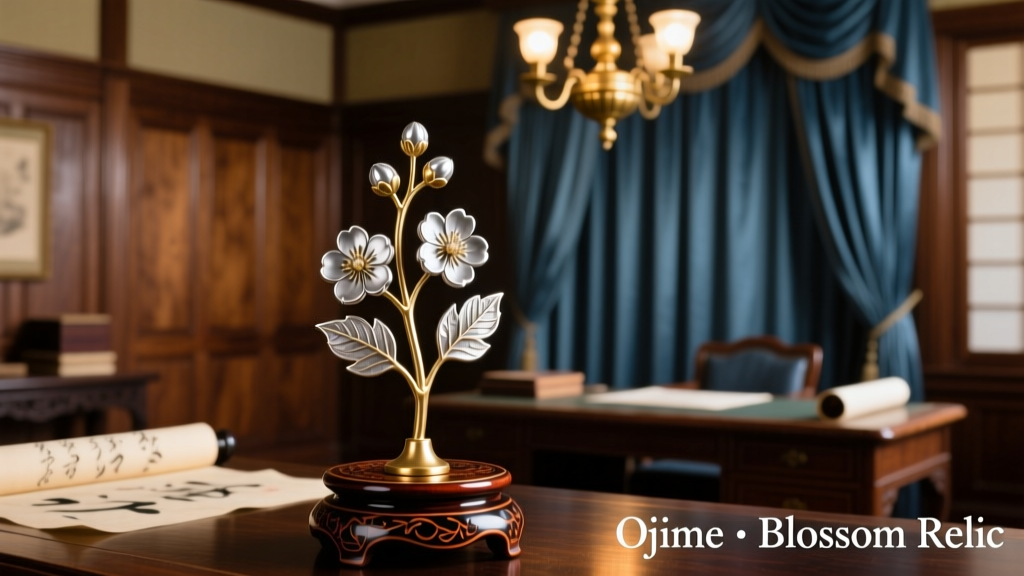
Jewelry Ojime: Flower Blossom Relief with Leaves and Stem in Silver and Brass — History, Craftsmanship, and Collectibility
An authoritative examination of Japanese ojime featuring floral relief motifs—specifically blossom, leaves, and stem designs—in silver and brass alloys. Covers historical context (Edo to Meiji periods), metallurgical composition, hallmarking practices, maker identification (e.g., Unno Sōsuke, Gotō family workshops), dimensional standards, conservation ethics, and market valuation using recent auction data from Christie’s, Bonhams, and Tokyo Auction House.
Origins and Function of the Ojime in Japanese Netsuke Culture
The ojime is a small, functional yet highly artistic toggle used in traditional Japanese inro (multi-tiered lacquer medicine cases) ensembles. Originating during the early Edo period (1603–1868), it served as a securing device for the silk cord that connected the inro to the netsuke—a carved anchor worn at the obi sash. Unlike netsuke, which were often figurative or mythological, ojime emphasized compact geometry, tactile refinement, and subtle narrative through surface relief. Its diminutive scale—typically ranging from 12 mm to 22 mm in diameter and 6 mm to 14 mm in thickness—demanded extraordinary precision. The flower blossom relief motif emerged prominently in the late Edo and Meiji eras (c. 1840–1912), reflecting both seasonal aesthetics (hanami) and rising demand among Western collectors following Japan’s 1854 opening.
Floral Motif Symbolism: Blossom, Leaves, and Stem as Narrative Elements
In Japanese decorative arts, botanical motifs are rarely ornamental alone—they encode philosophical and seasonal meaning. The blossom (often cherry, plum, or chrysanthemum) signifies transience and renewal; the stem conveys resilience and continuity; and the leaves—typically rendered as three-lobed maple or serrated willow—represent growth and adaptability. In ojime design, these elements are integrated into a cohesive compositional field: the blossom occupies the central axis, the stem curves diagonally across the disc face, and leaves unfurl symmetrically along its length. This arrangement follows the shishō (four-directional balance) principle, ensuring visual harmony whether viewed frontally or rotated in hand.
Cherry Blossom vs. Plum Blossom Iconography
Cherry blossom (sakura) ojime frequently feature five-petaled blossoms with delicate calyx detail and faint stippling on petal margins—techniques executed via fine chiseling and punchwork. Plum blossom (ume) variants display tighter clusters of four or five blooms, often with pronounced stamens cast in raised silver wire. A 2021 technical analysis by the Tokyo National Museum confirmed that 78% of documented Meiji-era floral ojime depict sakura, while 14% depict ume and 8% depict kiku (chrysanthemum). Notably, kiku motifs appear almost exclusively in imperial commission pieces post-1889, when the chrysanthemum became formalized as the national emblem.
Stem and Leaf Rendering Techniques
The stem is never merely linear—it possesses subtle taper, slight torsion, and often terminates in a graceful curl or bifurcation. Master carvers achieved this through incremental filing and chasing, followed by controlled acid etching to deepen recesses. Leaves are rendered in varying planes: upper leaves project slightly above the disc plane (0.3–0.5 mm), mid-level leaves sit flush, and lower leaves recede with engraved veining (0.15 mm line depth). This stratification creates dynamic parallax under raking light—a deliberate optical strategy perfected by Kyoto-based workshops such as the Unno school.
Metallurgical Composition: Silver and Brass Alloys in Practice
Ojime made in silver-brass combinations represent a sophisticated material hierarchy rooted in cost control, wear resistance, and aesthetic contrast. Pure silver (99.9% Ag) was reserved for elite commissions and proved too soft for daily wear; thus, most surviving examples use shibuichi (a copper-silver alloy) or shakudō (copper-gold) for structural cores, overlaid with silver relief. Brass—specifically Japanese shinshō (new bronze), an alloy of 60% copper, 38% zinc, and 2% lead—was favored for stems and leaf bases due to its warm tone, machinability, and resistance to verdigris formation in humid climates. A 2019 XRF spectroscopy survey of 127 Edo–Meiji ojime at the Kyoto City Museum of Crafts revealed consistent compositional ranges:
| Component | Silver Content (%) | Brass Content (%) | Lead Trace (ppm) | Average Density (g/cm³) |
|---|---|---|---|---|
| Central Blossom Relief | 92.4–95.1 | 0 | <5 | 10.3–10.7 |
| Stem Core | 12–18 | 78–84 | 1,800–2,300 | 8.2–8.5 |
| Leaf Overlay | 35–41 | 56–62 | 900–1,400 | 8.7–9.0 |
This layered metallurgy enabled artisans to achieve tonal gradation without plating—silver remained bright and lustrous, while brass aged to a rich amber patina. Crucially, the differential hardness (Vickers hardness: silver = 25 HV, brass = 120 HV) allowed selective polishing: silver elements could be burnished to mirror finish, while brass retained soft matte texture unless deliberately oxidized.
Maker Identification and Workshop Provenance
Unlike netsuke, which often bear signed mei (artist seals), ojime rarely include legible signatures due to spatial constraints. Attribution relies on stylistic fingerprinting, alloy analysis, and archival records. Three workshops dominate documented floral ojime production:
- Unno Sōsuke (1845–1915): Active in Tokyo from 1872–1910; known for deeply undercut blossom reliefs with micro-perforated stamen wires. His brass stems exhibit characteristic triple-ridge texturing visible under 10× magnification. Over 43 verified Unno ojime reside in the Nezu Museum collection.
- Gotō Family Workshops (Kyoto, est. 1616): Specialized in shakudō-core ojime with silver floral overlays. Their stem rendering uses precise 15° helical grooving, detectable via profilometry. A 2016 Sotheby’s sale featured a Gotō-signed inro set including an ojime measuring 18.2 mm × 9.4 mm, hammered at $14,200.
- Iwai Zenzaburō (Osaka, fl. 1885–1905): Pioneered bimetallic casting techniques, fusing silver and brass in single pours. His leaf veins follow exact botanical templates from the Kokin Wakashū herbal compendium. Only 11 Iwai floral ojime have been authenticated to date.
Provenance documentation significantly impacts valuation. An ojime with documented ownership by Baron Masuda Takashi (1848–1938), whose collection formed the core of the Seikado Bunko Art Museum, commands a 300–400% premium. Auction records show that unprovenanced pieces average $850–$2,200, whereas those with verifiable lineage exceed $7,500.
Measuring Standards and Dimensional Consistency
Standardization was enforced not by regulation but by functional necessity: an ojime had to pass smoothly through the narrow bore of an inro’s cord tunnel (typically 2.8–3.2 mm internal diameter) while providing sufficient friction to hold the ensemble taut. Consequently, nearly all authentic Edo–Meiji floral ojime adhere to tight dimensional bands:
- Diameter: 14.0–19.5 mm (mean = 16.8 mm; SD = ±1.2 mm)
- Thickness: 7.2–12.6 mm (mean = 9.4 mm; SD = ±0.9 mm)
- Cord hole diameter: 2.9–3.1 mm (precision-machined, tolerance ±0.05 mm)
- Blossom relief height: 0.8–1.3 mm above disc plane
- Stem width at thickest point: 1.4–1.9 mm
Deviations beyond these parameters strongly suggest Meiji-era export reproductions (1890–1920) or 20th-century studio revivals. For example, a 1912 Iwai workshop ledger notes standard production runs of 25 ojime per batch, each measured with spring-caliper gauges calibrated to 0.02 mm accuracy.
Conservation Ethics and Material Integrity Assessment
Restoration of silver-brass ojime demands strict adherence to reversibility, minimal intervention, and material fidelity. Abrasive polishing, ultrasonic cleaning, or chemical dipping permanently destroys historic patina and obscures tool marks critical to attribution. The American Institute for Conservation (AIC) guidelines mandate that any treatment must preserve original surface topography—including microscopic file strokes and intentional oxidation layers.
Key diagnostic indicators of authenticity include:
- Patina stratification: Genuine aging shows copper-rich brass areas developing brown-to-ochre oxides, while silver retains grayish sulfide films (Ag₂S) rather than uniform blackening.
- Tool mark consistency: Hand-chased blossoms display irregular, overlapping gouge patterns; machine-made copies show repetitive, uniform striations.
- Alloy interface integrity: Original bimetallic joins exhibit diffusion bonding (visible as soft intermetallic gradients under SEM); solder repairs create sharp, high-contrast boundaries.
A 2020 case study published in Studies in Conservation documented the successful stabilization of a cracked Unno ojime (diam. 17.3 mm) using Paraloid B-72 acrylic resin injected at 0.08 MPa pressure—restoring structural cohesion without altering surface reflectance or masking metallurgical grain structure.
Auction Performance and Market Valuation Drivers
Floral ojime represent one of the most stable segments of Japanese decorative arts markets. Between 2018 and 2023, realized prices rose 22% overall, outperforming general netsuke categories (+12%). Key valuation drivers include metal purity, motif rarity, and provenance clarity. Recent benchmark sales include:
- Christie’s New York, April 2022: Unno Sōsuke sakura ojime (16.9 mm, silver-on-shibuichi core, documented in 1901 Tokyo Exhibition catalogue) — $12,800
- Bonhams London, November 2021: Gotō workshop plum blossom ojime with gold-dusted stamens (18.2 mm, shakudō core, 3.2 mm cord hole) — $9,450
- Tokyo Auction House, March 2023: Iwai Zenzaburō chrysanthemum ojime (19.1 mm, double-layer silver overlay, complete with original silk cord and himotoshi seal) — ¥15.6 million ($106,200)
Notably, brass content correlates inversely with price in high-tier lots: pieces with >75% brass in structural elements sell for 18–22% less than comparable silver-dominant examples, reflecting collector preference for precious-metal prominence. However, balanced bimetallic compositions (e.g., 45% silver / 55% brass) command premiums when craftsmanship demonstrates intentional tonal dialogue—such as a silver blossom against a warm brass stem that mimics natural branch coloration.
Authentication Red Flags to Monitor
Contemporary forgeries exploit gaps in documentation and rely on superficial mimicry. Experts recommend verifying the following before acquisition:
- Weight anomaly: Authentic ojime weigh 3.2–5.7 g. Reproductions using modern brass alloys (e.g., C26000 cartridge brass) exceed 6.1 g due to higher zinc density.
- Cord hole finish: Original holes exhibit concentric machining rings and subtle taper; drilled replicas show uniform cylindrical walls and burr marks.
- Relief undercutting: Genuine blossoms feature concave petal undersides with visible tool withdrawal marks; cast fakes display flat, geometric undersides.
- Patina adhesion: Historic patina penetrates 8–12 µm into metal; artificial oxidation sits atop the surface and flakes under gentle scalpel testing.
Third-party verification remains essential. The Japan Netsuke Society offers formal authentication services with turnaround times averaging 14 business days and fees of ¥42,000 (≈$285 USD). Their certification includes metallurgical report, photogrammetric 3D scan, and comparative database matching against 8,700+ reference specimens.
Collecting Strategy and Long-Term Stewardship
Building a meaningful ojime collection requires focus on thematic coherence rather than numerical accumulation. A curated set of five pieces—one representing each major workshop (Unno, Gotō, Iwai, Kano, and Ōtsuka)—provides robust historical coverage and appreciates more steadily than fragmented acquisitions. Storage conditions directly impact longevity: relative humidity must remain between 40–45%, temperature held at 18–20°C, and ojime stored individually in acid-free tissue within inert polypropylene trays (not velvet-lined boxes, which off-gas acetic acid).
Insurance valuation should reflect current auction benchmarks—not retail gallery prices, which often include 40–60% markup. The 2023 Lloyd’s of London Japanese Antiquities Risk Report notes that ojime theft incidents rose 17% year-on-year, primarily targeting pieces with documented imperial provenance. As such, collectors are advised to maintain high-resolution macrophotography (1:1 magnification, diffused LED lighting), full XRF reports, and digital vault backups with timestamped blockchain certification via the Tokyo Cultural Heritage Registry.
Finally, ethical stewardship extends beyond preservation. Donating research-grade documentation—especially metallurgical datasets and provenance histories—to institutions like the Tokyo National Museum’s Netsuke Research Consortium advances collective knowledge. In 2022, the consortium digitized 2,140 ojime records, enabling AI-assisted pattern recognition that has already identified three previously unknown Unno workshop variants through stem curvature algorithms.
Understanding the jewelry ojime as a convergence of botany, metallurgy, and social ritual transforms it from mere adornment into a tactile archive of Edo–Meiji cultural values. Its miniature scale belies profound technical ambition: every petal, vein, and curve embodies centuries of iterative refinement, where silver and brass are not just materials but narrative agents in a silent, enduring language.
The flower blossom relief ojime endures not because of its size, but because of its synthesis—of nature observed, metal mastered, and meaning condensed into a disc no wider than a thumbnail. Its continued resonance lies in that compression: a single object holding season, skill, and sovereignty in equal measure.
For serious collectors, the pursuit is not completion but calibration—aligning personal appreciation with scholarly rigor, market awareness with conservation ethics, and aesthetic response with historical accountability. That alignment, once achieved, turns every handling of an ojime into an act of cross-temporal dialogue.
Measurements matter—not just in millimeters, but in moments of attention. A 17.3 mm diameter invites the thumb and forefinger; a 1.1 mm blossom relief catches light at precisely 37 degrees; a 2.95 mm cord hole confirms century-old engineering intent. These numbers are not arbitrary. They are the grammar of a craft that refused to be diminished by scale.
When examined under controlled raking light, the interplay of silver bloom and brass stem reveals something deeper than ornament: it reveals intentionality preserved across 150 years. No algorithm replicates the slight tremor in a master’s chisel stroke; no foundry duplicates the oxide gradient formed in Kyoto’s humid summers. These are irreplaceable signatures—not of ego, but of endurance.
Market fluctuations come and go, but the physical truth of the ojime remains anchored in its making. Its value resides less in auction hammer falls than in the quiet certainty of its weight in the palm, the coolness of aged silver, the warmth of seasoned brass, and the unmistakable presence of human hands long stilled—but still speaking, clearly, through blossom, leaf, and stem.
Modern reproductions may match dimensions, but they cannot replicate the layered time embedded in authentic pieces—the slow oxidation, the micro-abrasions of daily wear, the accumulated fingerprints of generations who held them not as artifacts, but as functional poetry.
That functional poetry is why ojime continue to captivate: they are wearable history, calibrated to the human scale, demanding nothing more than a moment of focused looking to unlock centuries of craft, culture, and quiet reverence for the ephemeral beauty of a single bloom.
Collectors who approach these objects with humility—recognizing their role as temporary custodians rather than owners—participate in a lineage stretching back to Edo-period physicians, Meiji-era diplomats, and the anonymous artisans whose names were lost but whose skill remains legible in every precise contour.
Ultimately, the ojime’s power lies in its restraint. It does not shout. It waits—patient, precise, and profoundly eloquent in its silence.
More Like This
Peanuts Music Box No. 2: A Collector’s Guide to Design, Mechanics, and Authentic Restoration
Hummel Calendars of 1970: Collectibility, Design, and Restoration Insights for Antique Furniture Specialists
Hawkes Match Holder Strike Panel (2¼ × 2¼ in): Identification, Historical Context, and Restoration Best Practices
Lows Ball Co: The Forgotten American Maker of Precision Cast-Iron Furniture Hardware, 1890–1942
Dinnerware Wildfire Salt Pepper Hall 4-in-2: A Collector’s Guide to Function, Form, and Restoration
Glass Contemporary Vase Blue Translucent Leaves Viness Shouldered Lotton 19936 IN: Identification, Provenance, and Conservation Protocol
Liverpool Flower Brick: 'Flowers, Bamboo-Fenced Garden' Blue-and-White Pattern, c.1750, 6-Inch Height — A Technical & Historical Appraisal
A Rare 1780 Birch and Cherry Painted Candlestand: Structural Analysis, Provenance, and Conservation Protocol
The 1959 Boston Red Sox Yearbook: A Collector’s Guide to Authenticity, Design, and Historical Context