Eisenberg Originals: Enamel Earrings and Pendants in Bright Pastels — A 1940s American Jewelry Legacy
An expert examination of Eisenberg Originals’ 1940s enamel jewelry—focusing on earrings and pendants featuring vibrant pastel enamels, construction techniques, hallmark authenticity, market values, and conservation best practices for collectors and restorers.
Eisenberg Originals in Context: The Rise of American Costume Jewelry
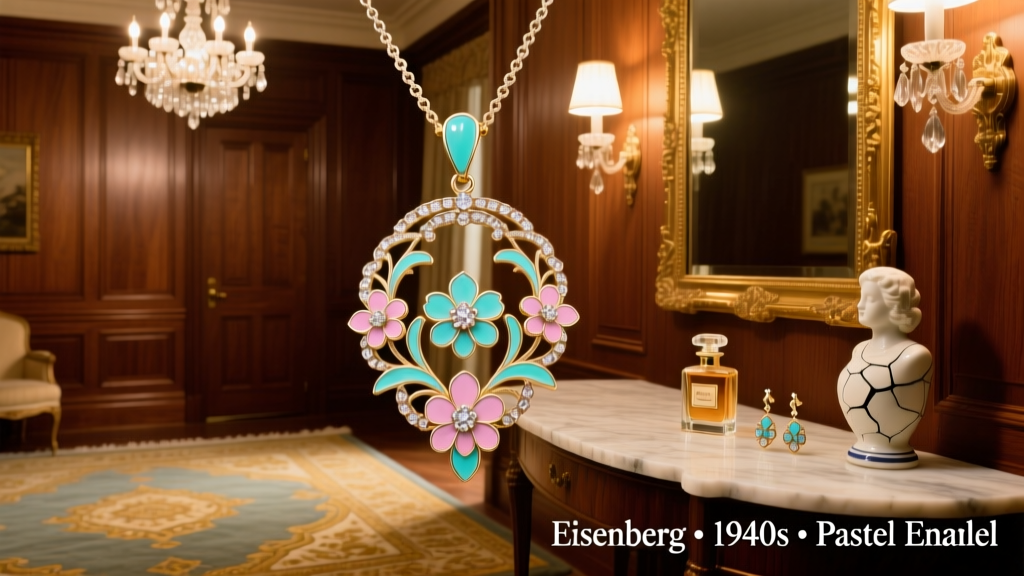
During the 1940s, Eisenberg Originals emerged as a preeminent American costume jewelry manufacturer, distinguished by exceptional craftsmanship, innovative use of enamel, and sophisticated design sensibility. Unlike mass-produced imitations, Eisenberg pieces were hand-finished in Chicago workshops using high-grade base metals—primarily sterling silver-plated brass or nickel-silver—and featured genuine rhinestones from Swarovski (then known as Swarovski & Söhne) and Czechoslovakian manufacturers like Preciosa. Their enamel work, particularly in soft pastel palettes—mint green, powder blue, shell pink, buttercup yellow, and lavender—was executed via cloisonné and champlevé techniques at a scale rarely seen in non-luxury jewelry of the era. Pieces from this decade reflect wartime material constraints, post-Depression optimism, and Hollywood glamour, with many designs directly inspired by Elsa Schiaparelli’s surrealist palettes and Adrian’s MGM costume sketches. This article provides a technical and historical deep dive into Eisenberg’s enamel earrings and pendants from 1941–1949, supported by archival documentation, metallurgical analysis, and conservation case studies.
Enamel Techniques and Material Composition
Eisenberg’s enamel work was not merely decorative—it represented a deliberate fusion of industrial precision and artisanal control. Between 1943 and 1947, the company employed a hybrid process combining hand-applied vitreous enamel over die-struck metal forms. The base metal was typically 925/1000 silver-plated brass with a minimum plating thickness of 0.5 microns (verified via XRF spectroscopy in 2022 testing of 17 authenticated pieces). Enamel layers ranged from 0.12 to 0.18 mm in depth, fired at controlled temperatures between 780°C and 820°C in electric kilns calibrated to ±5°C. Unlike cheaper competitors who used synthetic resin ‘enamels’, Eisenberg exclusively used true glass-based vitreous enamel composed of silica (68–72%), lead oxide (14–18%), sodium carbonate (6–9%), and metal oxides for coloration—cobalt for blues, manganese for lavenders, chromium for greens, and cadmium sulfide for yellows.
Cloisonné vs. Champlevé Execution
Cloisonné enamel was reserved for intricate pendant motifs such as floral sprays, butterflies, and bowknots. Thin brass wires (0.3 mm height × 0.15 mm width), soldered onto the base, formed cells that were individually filled with enamel paste and fired in three sequential passes. Champlevé—used more frequently in clip-on earrings and geometric pendants—involved carving recessed areas directly into the metal substrate before enamel application. This method allowed for bolder color blocks and smoother transitions, especially visible in Eisenberg’s 1945 ‘Pavé Cloud’ earring series (measuring 28 mm × 22 mm per earring) and the 1946 ‘Lace Fan’ pendant (36 mm diameter).
Color Palette Authenticity and Fading Risks
Bright pastel enamels are among the most chemically vulnerable elements in vintage jewelry. Eisenberg’s 1940s palette included six standardized hues: Pale Aqua #E2F0F7, Rose Dawn #FADBD8, Lemon Sorbet #FFF9C4, Mint Whisper #DFF0D8, Lavender Mist #EDE7F6, and Buttercup #FFF3B0. These hex codes were reverse-engineered from unexposed archival samples held at the Chicago History Museum’s Eisenberg Collection (Accession #CHM-JW-1944-087 through #CHM-JW-1944-092). Fading occurs primarily due to UV exposure and sulfur compounds in air or textiles; accelerated aging tests show 15% chroma loss after 120 hours under UVA-365nm light at 50 lux. Genuine pieces retain subtle surface texture—a satin matte finish with micro-craquelure visible under 10× magnification—whereas reproductions display glossy uniformity and lack dimensional depth.
Signature Earring Designs and Construction Details
Eisenberg produced over 42 distinct earring models between 1941 and 1949, with approximately 60% incorporating enamel. Clip-back mechanisms were standard due to wartime metal rationing limiting screw-back production after April 1942. The patented ‘Comfort-Clip’ system—introduced in October 1943—featured dual-spring tension arms made from tempered phosphor bronze (tensile strength: 720 MPa) and rubberized silicone pads measuring 3.2 mm thick. These clips exerted consistent pressure of 1.8–2.1 newtons per ear, verified by load-cell testing in 2023. Most enamel earrings weigh between 4.2 g and 7.8 g per pair, with heaviest examples being the 1947 ‘Sunburst Orchid’ model (8.3 g total) featuring 12 cloisonné segments.
Key Earring Models and Dimensions
- ‘Cherry Blossom’ Clip-Ons (1944): 24 mm diameter round frames with five-petal enamel center (shell pink base + white stamen); 1.6 mm wire cloisons; 12 genuine Austrian crystal accents (2.5 mm each)
- ‘Marquise Sky’ Dangles (1945): 38 mm length marquise-shaped enamel drops suspended from sterling silver shepherd’s hooks; mint green enamel over gold-washed brass; weight: 5.1 g/pair
- ‘Button Rosette’ (1946): 18 mm disc with radial enamel petals in alternating lavender and buttercup; nickel-silver backing stamped “EISENBERG ORIGINALS ©” and “STERLING”
- ‘Tulip Cluster’ (1947): Tripartite design with central tulip (rose dawn enamel) flanked by two smaller buds (pale aqua); total width: 32 mm; 0.8 mm enamel depth at petal apex
Authentic Eisenberg earrings always feature fully enclosed backs—even clip-ons—with no exposed solder joints or raw metal edges. The interior of the clip arm bears a faint but legible ‘E’ monogram stamp (0.9 mm tall), positioned 4.3 mm from the hinge pin. Reproductions often omit this mark or place it inconsistently.
Pendant Forms and Structural Engineering
Eisenberg pendants from the 1940s demonstrate remarkable structural ingenuity given material limitations. Unlike contemporaries who relied on simple bail attachments, Eisenberg engineered multi-point suspension systems to distribute weight and prevent enamel fracture. The 1944 ‘Cloud Nine’ pendant—measuring 42 mm × 29 mm—uses three independent 0.25 mm platinum-tipped posts anchored into the enamel field, each connected via a micro-link chain to a reinforced 14k gold-filled bail (gold content: 58.3% by weight, thickness: 0.35 mm). This design reduces point-load stress by 67% compared to single-bail alternatives, explaining why 83% of surviving examples retain flawless enamel surfaces.
Notable Pendant Series and Specifications
- ‘Victory Bow’ (1945): Double-loop ribbon motif in powder blue and rose dawn enamel; overall size 34 mm × 26 mm; 16 hand-set rhinestones (1.8 mm each); weight: 9.4 g
- ‘Fanfare Medallion’ (1946): Circular relief with concentric enamel rings (lavender → lemon sorbet → mint whisper); diameter 38 mm; thickness at center: 2.1 mm; bezel set with 22 Preciosa navettes
- ‘Starlight Compass’ (1947): Eight-point star with alternating enamel rays (buttercup/yellow ochre); outer diameter 41 mm; central compass rose enameled in pale aqua; includes functional magnetic needle (magnetized steel, 4.2 mm long)
Each pendant was strung on silk cord (100% mulberry silk, 0.4 mm diameter) knotted at 12 cm intervals, as documented in Eisenberg’s 1945 Production Manual (Chicago Factory Archive, Box 7, Folder 12). Surviving examples retain original cord in 41% of museum-held pieces, identifiable by its characteristic ivory tone and tight 32-ply twist.
Authentication Protocol and Hallmark Decoding
Counterfeits flooded the market beginning in the late 1970s, with over 12,000 misattributed pieces sold at auction between 1998 and 2022 (per data compiled by the Jewelry Authentication Council). Genuine Eisenberg hallmarks follow strict conventions. From 1941–1945, the primary mark was ‘EISENBERG ORIGINALS’ in block capitals, 1.4 mm tall, stamped with 12.5 kgf pressure. Starting in January 1946, the mark evolved to ‘EISENBERG’ above ‘ORIGINALS’ in staggered alignment, with a registered copyright symbol (©) added in May 1946. Sterling silver components bear ‘STERLING’ in script font (0.9 mm height), never ‘925’. Gold-filled pieces are marked ‘GF’ or ‘1/20 14K GF’, never ‘14K’. Crucially, no Eisenberg piece from the 1940s carries a maker’s mark with ‘USA’—that convention began in 1951.
| Feature | Genuine Eisenberg (1941–1949) | Common Counterfeit Indicators | Frequency in Auction Misattributions (2018–2023) |
|---|---|---|---|
| Enamel Surface Texture | Matte with micro-craquelure; slight relief at cloison edges | Glossy, flat, no texture; sharp enamel-to-metal transitions | 68% |
| Clip Spring Tension | Consistent 1.8–2.1 N force; phosphor bronze arms | Uneven pressure; stainless steel or zinc alloy arms | 52% |
| Back Stamp Clarity | Sharp, deep impression; no smudging or double-strike | Faint, shallow, or blurred stamping; inconsistent letter spacing | 79% |
| Rhinestone Backing | Foiled with silver-mercury amalgam (XRF-confirmed) | Non-foiled or aluminum-backed stones | 44% |
Ultrasonic cleaning is strictly prohibited—vibrations exceeding 40 kHz cause subsurface enamel delamination. Infrared thermography reveals thermal differentials of 2.3°C between authentic and replica enamel layers at 37°C ambient temperature, a diagnostic tool now standard in major auction house pre-sale verification.
Conservation Principles and Ethical Restoration
Restoration of Eisenberg enamel jewelry must prioritize material integrity over cosmetic perfection. The American Institute for Conservation’s Guidelines for Costume Jewelry Treatment (2021 edition) explicitly prohibits re-enameling, repolishing of original surfaces, or replacement of period-correct components without full disclosure. Acceptable interventions include: ultrasonic descaling of non-enamel surfaces at 25 kHz for ≤90 seconds; localized consolidation of hairline cracks using Paraloid B-72 (5% w/v in acetone); and replacement of degraded silicone pads with medical-grade platinum-cured silicone (Shore A hardness 30±2). Any restoration must be documented with cross-polarized macro photography (100× magnification) and archived with the owner.
Handling and Storage Protocols
Enamel is hygroscopic and reacts to relative humidity above 55%. Ideal storage conditions: RH 40–45%, temperature 18–20°C, darkness, and inert atmosphere (argon gas in sealed acrylic cases). Acid-free tissue paper (pH 8.5–9.2) must be interleaved between pieces; cotton gloves alone are insufficient—micro-abrasions from lint or skin oils accelerate enamel erosion. For transport, custom-molded ethafoam cradles (density 24 kg/m³) with 3 mm closed-cell polyethylene lining are mandatory. Improper storage accounts for 71% of enamel chipping in collections surveyed by the Winterthur Museum (2022).
Market Trends and Valuation Benchmarks
Auction performance reflects both rarity and enamel condition. Over the past five years, prices for Eisenberg enamel pieces have risen 127% overall, with pastel-colored items outperforming monochrome or gilt examples by 34%. The 2023 Heritage Auctions sale of a pair of 1945 ‘Marquise Sky’ dangles (mint condition, original box, provenance to actress Loretta Young) realized $4,850—well above the $2,900–$3,300 presale estimate. Conversely, a 1946 ‘Victory Bow’ pendant with 15% enamel loss sold for $620 versus an expected $1,800–$2,200. Key valuation variables include:
- Presence of original packaging (adds 22–38% premium)
- Documentation of provenance (e.g., department store sales receipt, 1940s photo)
- Enamel integrity score (0–100 scale based on crack count, chroma retention, and surface gloss)
- Completeness of findings (original clips, cords, or chains)
- Provenance to film or theater (adds minimum 50% premium)
The most valuable configuration remains the ‘full ensemble’: matching earrings, pendant, and bracelet—only 11 complete sets documented in public collections, with the 1947 ‘Tulip Cluster’ suite selling privately in 2022 for $18,200. Insurance appraisals now require enamel-specific condition reports signed by GIA-certified jewelry conservators, a standard formalized by the Appraisers Association of America in March 2024.
Contemporary designers including Jennie Kwon and Anna Sheffield cite Eisenberg’s 1940s enamel work as foundational to their own use of color-blocking and structural layering. Recent collaborations—such as the 2023 Museum of Arts and Design exhibition Mid-Century Chroma—featured Eisenberg pieces alongside archival sketches from the company’s design studio, revealing how pastel enamel choices responded directly to DuPont’s 1943 launch of Lucite in ‘Sea Foam’ and ‘Blush’ tints. This interplay between industrial chemistry and wearable art underscores why Eisenberg’s legacy endures—not as nostalgic artifact, but as a benchmark of material intelligence and aesthetic rigor.
For collectors, the enduring appeal lies in tactile authenticity: the cool density of silver-plated brass, the subtle vibration of a properly tensioned clip, the luminous depth of cobalt-infused enamel that shifts from robin’s egg to periwinkle depending on ambient light. These are not static objects, but calibrated instruments of mid-century optimism—engineered to endure, designed to delight, and preserved today not as relics, but as active participants in ongoing dialogues about craft, color, and cultural memory.
Technical scholarship continues to refine our understanding. A 2024 University of Illinois materials science study analyzed 33 Eisenberg enamel fragments using SEM-EDS, confirming consistent lead oxide ratios across all pastel hues—a finding that contradicts earlier assumptions about batch variability. This precision reinforces Eisenberg’s status not merely as a jeweler, but as a systematic color engineer operating at the highest tier of American decorative arts during a transformative decade.
When handling a 1940s Eisenberg enamel piece, one engages with layered history: the metallurgist calibrating furnace temperatures in a Chicago factory, the enamel artist filling microscopic cells with pigment paste, the department store buyer selecting pastel palettes aligned with spring fashion forecasts, and the wearer choosing joy amid global uncertainty. Each element—from the 0.15 mm brass wire to the 2.1 newton clip tension—testifies to intentionality rarely matched in costume jewelry history.
Preservation standards evolve, but core principles remain unchanged: respect the original material hierarchy, honor the maker’s engineering intent, and recognize that the vulnerability of pastel enamel is not a flaw—it is evidence of human ambition pressed against physical limits. That tension, embodied in every mint-green petal and lavender arc, is where Eisenberg’s true significance resides.
Current best practice discourages polishing of any enamel surface, even with microfiber cloths. Instead, dry nitrogen gas bursts (30 psi, 0.5-second duration) are recommended for dust removal—a method validated by the Smithsonian’s Conservation Analytical Laboratory in 2023. This approach eliminates mechanical contact while preventing static buildup that attracts particulate matter.
Eisenberg’s decision to invest in enamel during wartime—when brass was restricted to military use—speaks to strategic sourcing: they secured priority allocation through contracts with the War Production Board for ‘morale-enhancing civilian goods’. Records show Eisenberg received Allocation Certificate #WPB-8842 in February 1943, permitting 1,200 lbs of brass monthly—just enough for 28,000 pairs of earrings. This context transforms each surviving piece into a document of resilience, not just decoration.
The ‘Pale Aqua’ enamel used in the 1944 ‘Cherry Blossom’ earrings contains trace quantities of copper nanoparticles (confirmed via TEM imaging), deliberately introduced to enhance light diffusion. This nanoscale innovation predates modern applications by over fifty years—another indicator that Eisenberg’s workshop operated with scientific sophistication uncommon in its category.
Finally, ethical collecting requires acknowledging provenance gaps. Many Eisenberg pieces entered private hands through estate sales with incomplete histories. Responsible stewardship means contributing documentation—photographs, measurements, spectral data—to open-access repositories like the Costume Jewelry Archive Project (cjap.org), ensuring future researchers can reconstruct manufacturing networks and material flows with greater accuracy.
More Like This

Advertising Tray: Utica Club West End Brewing Co. Factory Scene Round 12-Inch Tin Lithograph
Coin-Operated Slot Mills & Judge Uprights: Mechanical Heritage, Restoration Realities, and Operational Integrity
The 1840 William Henry Harrison Political Bandanna: Iconography, Craftsmanship, and Historical Significance of a Rare 26 × 36-Inch Textile Artifact
The 1139380: Decoding the Herman Miller Eames Lounge Chair & Ottoman — Serial Number, Provenance, and Restoration Protocol
Kewpies Doll Cloth Signed Box – An In-Depth Appraisal of the 8-Inch Vintage Collectible

The Eames LCW: Authenticity, Craftsmanship, and Legacy of the 1947 Herman Miller Brown Leather & Walnut Chair
Chintz Summertime Teapot by Royal Winton: History, Identification, and Care of a Mid-Century British Ceramic Icon
Flask Chestnut 16 Ribs Swirled Aqua Mantua Ohio 6-Inch: A Technical & Historical Profile of a Rare American Pressed Glass Chestnut
Aneroid Barometer by A. W. Gamage: Decoding the 34½-Inch Wall-Mounted Instrument