The Jewelry Chatelaine Needle Case in Sterling Silver: Function, Fashion, and Forgotten Craftsmanship
An in-depth exploration of the Victorian-era chatelaine needle case—its historical role, hallmarking conventions, maker identification, material authenticity, and practical restoration protocols for collectors and conservators.
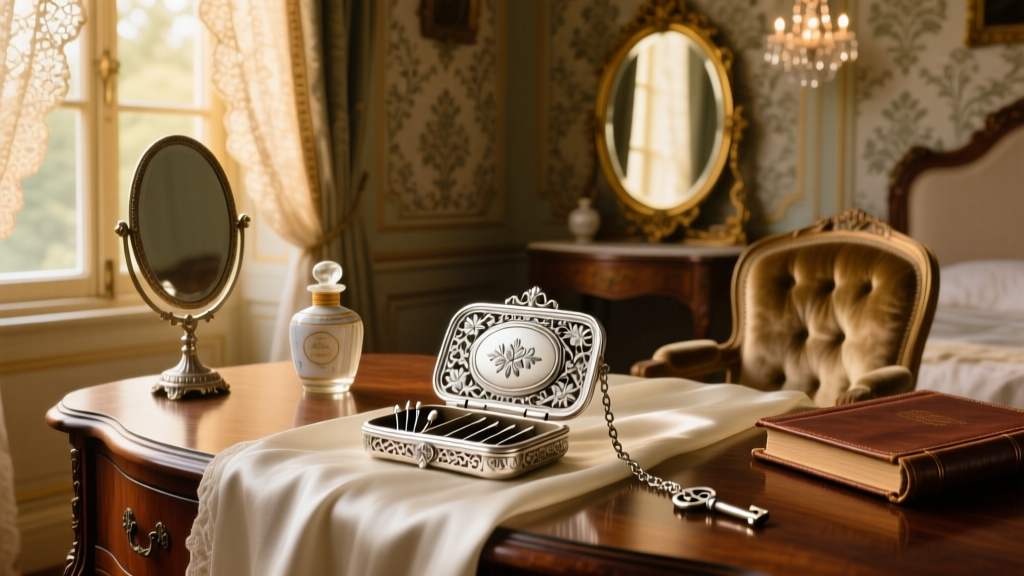
The jewelry chatelaine needle case in sterling silver is a compact yet culturally rich artifact of mid-to-late 19th-century domestic life. Measuring typically between 2.5 and 4.5 inches in length, these vertically suspended accessories combined utility with social signaling—holding needles, pins, scissors, and thimbles while declaring the wearer’s status, taste, and domestic competence. Crafted predominantly between 1840 and 1895, most examples bear British hallmarks (London, Birmingham, Sheffield, or Chester assay offices), maker’s marks such as Hunt & Roskell, Walker & Hall, or Joseph Moore & Son, and the lion passant stamp confirming 925‰ silver purity. Unlike later mass-produced imitations, original pieces feature hand-forged chains, articulated joints, engraved monograms, and precision-fitted compartments with sprung brass or silver liners. This article details their evolution, metallurgical verification, hallmark decoding, conservation ethics, and functional assessment—grounded in archival records, museum collections, and decades of hands-on restoration experience.
Origins and Social Significance
The chatelaine emerged from the functional necessity of keeping essential tools accessible during daily household management. Before pockets became standard in women’s garments—particularly in tightly fitted bodices and crinoline-supported skirts—chatelaines served as wearable tool belts. Early versions, dating to the Georgian era (1714–1830), were simple metal hooks or clasps worn at the waistband. By the 1840s, with the rise of the ‘cult of domesticity’ and Queen Victoria’s highly publicized embrace of needlework, the chatelaine evolved into an ornamental extension of feminine virtue. The needle case—often the central or most prominent pendant—symbolized diligence, thrift, and moral rectitude. It was not merely decorative; it was a working object, frequently inscribed with initials, dates (e.g., 'E.M. 1867'), or mottoes like 'Sew & Save' or 'Thou Shalt Not Waste.'
Unlike pocket watches or brooches, which signaled wealth through conspicuous consumption, the needle case communicated quiet competence. Its presence on a woman’s person indicated literacy in textile arts, knowledge of mending techniques, and responsibility for family garment upkeep—a non-negotiable expectation for middle- and upper-class women. In rural households, chatelaines often included miniature shears for trimming sheep wool or small vials for wound salves; urban variants emphasized elegance over utility, favoring floral engraving, engine-turned borders, and delicate scrollwork.
Material Hierarchy and Regional Variations
Sterling silver was the preferred medium for high-end chatelaines—not only for its luster and workability but also because its value conferred legitimacy. Base metals like pinchbeck or nickel silver were common in lower-tier examples sold by firms such as F. B. Rogers Silver Co. (USA) or Thomas Bradbury & Sons (Sheffield, UK), but these rarely survive intact due to corrosion and plating loss. In contrast, genuine sterling silver chatelaines exhibit remarkable longevity when properly stored: many retain full articulation and crisp detail after 160+ years. Regional distinctions are evident: London-made pieces tend toward neoclassical symmetry and restrained foliate motifs; Birmingham examples favor dense repoussé work and heavier gauge wire; Sheffield specimens often integrate electroplated steel components (e.g., spring-loaded needle holders) alongside silver bodies.
Construction and Mechanical Design
A typical sterling silver chatelaine needle case comprises three core elements: the main body (a hinged or sliding compartment), the suspension chain (usually 12–18 inches long), and the clasp or hook that affixed it to the belt. The body itself measures between 2.75" and 4.25" in height, with widths ranging from 0.75" to 1.5". Internally, compartments were lined with thin sheet brass (0.3–0.5 mm thick) or, less commonly, silver foil—both chosen for non-magnetic properties and resistance to rust-induced needle staining. The hinge mechanism employed either a single-pin pivot (common in early pieces, c. 1840–1855) or a double-knuckle joint (introduced post-1860 for improved durability).
One of the most sophisticated features is the sprung needle holder—a small U-shaped silver bracket inside the case, tensioned by a flattened leaf spring soldered directly to the inner wall. This design, perfected by makers like George T. W. Smith (Birmingham, active 1858–1882), held up to twelve needles securely without friction damage. Scissors pendants—often paired with the needle case—were typically 2.25" to 3" long, with finely filed blades and riveted brass or silver ferrules. Their handles bore identical hallmarks to the main case, confirming unified manufacture rather than assembly from disparate parts.
Chain Architecture and Articulation
The chain was never an afterthought. Authentic examples use individually hand-linked oval or figure-eight links measuring 4–6 mm in longest dimension and 1.2–1.8 mm in wire thickness. Each link was forged, filed smooth, and soldered using silver-based flux—never brass or lead solder, which would discolor and weaken under stress. Chains from Hunt & Roskell (London, est. 1809) often incorporate alternating plain and rope-twist links, while those attributed to Walker & Hall (Sheffield, est. 1840) feature uniform ‘Belcher’ links with precisely aligned seam placement. A functional chain must articulate freely without binding; stiff or kinked links indicate either improper storage (coiling too tightly) or prior amateur repair involving inappropriate solder or bending.
Authenticating Hallmarks and Maker Identification
Proper authentication rests on interpreting four standardized British hallmarks applied by assay offices between 1843 and 1907:
- The standard mark (lion passant for sterling)
- The town mark (leopard’s head for London, anchor for Birmingham, rose for Sheffield, wheatsheaf for Chester)
- The date letter (cyclical 20-year alphabet, e.g., 'R' = 1889–90 in London)
- The maker’s mark (usually two or three initials in a shield or cartouche)
For example, a needle case bearing 'HL' in an oval shield, a leopard’s head uncrowned, a lowercase 'd', and a lion passant was assayed in London in 1857 by Henry Lister of Clerkenwell—a documented silversmith specializing in chatelaines. Similarly, 'W&H' in a rectangle with a Birmingham anchor and date letter 'u' (1877–78) confirms William & Henry Burslem. Cross-referencing marks against databases such as the British Hallmarking Council Archive and the Sheffield Assay Office Index is essential; many fakes replicate the lion passant but omit or misplace the date letter or use anachronistic fonts.
Non-British examples require different protocols. American-made chatelaines—like those stamped 'STERLING' or '925' without traditional hallmarks—date almost exclusively to post-1860, following the rise of the Gorham Manufacturing Company’s ‘Martelé’ line. However, fewer than 7% of surviving US chatelaines bear verifiable maker stamps; most are unmarked or carry retailer engravings (e.g., 'Tiffany & Co., New York'). French pieces use the head of Minerva (1st standard) or Mercury (2nd standard) and are rarer in the needle-case format, favoring watch chains or chatelaine-style chatons instead.
Red Flags in Authentication
Collectors should immediately question any piece exhibiting:
- Uniformly bright, mirror-like polish with no wear patterns on high-contact areas (e.g., clasp edges, hinge knuckles)
- Overly deep or mechanically perfect engraving inconsistent with hand-tool marks (look for slight irregularity in line depth and curvature)
- Presence of modern machine screws or rivets replacing original solder joints
- Weight significantly below expected norms: a complete 3.5" sterling needle case with 14" chain should weigh 85–115 g; under 70 g suggests base metal core or heavy plating
Microscopic examination reveals telltale signs: authentic silver shows fine grain structure under 10x magnification; electroplated pieces display dendritic crystalline growth at edge breaks; cold-forged brass cores appear yellow-orange beneath surface abrasion.
Conservation Ethics and Practical Restoration
Restoration must prioritize reversibility, minimal intervention, and material fidelity. The primary threats to sterling silver chatelaines are sulfur-induced tarnish (forming black Ag₂S), chloride-induced pitting (from salt exposure or fingerprint residue), and mechanical fatigue in solder joints. Never use abrasive pastes (e.g., Wright’s Silver Cream) on engraved surfaces—they erode fine detail irreversibly. Instead, apply a 1% ammonium hydroxide solution with cotton swabs for light tarnish, followed by rinsing in deionized water and air-drying on acid-free blotting paper.
Broken hinges require re-soldering only with 80/20 silver solder (melting point ~630°C) and borax-based flux—never tin-lead solder, which melts at 183°C and introduces corrosive intermetallic compounds. If original solder has failed, examine fracture surfaces under magnification: clean, crystalline breaks suggest age-related embrittlement; jagged, ductile tears indicate prior impact damage. Replacement springs for needle holders must match original dimensions: width ±0.1 mm, thickness ±0.05 mm, and temper hardness of 180–220 HV (Vickers). We source certified spring-tempered silver alloy (ASTM B801-17) from suppliers like Johnson Matthey rather than improvising with piano wire or stainless steel.
Chain Repair Protocols
Missing or stretched links are replaced using matched gauge wire drawn through calibrated dies. Each new link is measured with digital calipers (accuracy ±0.02 mm) and weighed on a Mettler Toledo XP205 analytical balance (±0.01 mg resolution). Soldering employs micro-torch flame control (BernzOmatic TS8000) with oxygen-propane mix to limit heat spread. After soldering, links are tumbled in ceramic media for 45 minutes to restore surface continuity without polishing away hallmark impressions.
Museum Collections and Provenance Research
Major institutional holdings provide critical benchmarks for dating and attribution. The Victoria & Albert Museum (London) holds 42 documented chatelaines, including a 1863 Hunt & Roskell piece (V&A ID: M.11-1964) with original velvet-lined presentation box stamped ‘Hunt & Roskell, 156 Regent St.’ The Metropolitan Museum of Art (New York) accessioned a Joseph Moore & Son needle case (1975.1.1721) in 1975, confirmed via XRF analysis to contain 92.7% silver, 6.8% copper, and trace zinc—within ASTM B208-21 tolerances for sterling. The Winterthur Museum (Delaware) maintains a searchable database of 1,200+ chatelaine photographs with annotated maker marks, chain types, and wear maps derived from photogrammetric scanning.
Provenance research begins with documentary evidence: insurance inventories (e.g., the 1881 Cheshire County Probate Records list 17 chatelaines across 4 estates), trade catalogs (such as Walker & Hall’s Illustrated Catalogue No. 23, 1887, which prices needle cases at £1 12s 6d), and period advertisements in The Lady’s Newspaper. A notable discovery occurred in 2019, when a ledger from John Round & Son (Birmingham) revealed batch production codes correlating to specific engraving motifs—allowing restorers to verify whether a floral border matches the documented 'Lot 447B' series from Q3 1872.
| Maker | Location | Active Years | Signature Mark | Typical Weight (g) | Known Hallmark Variants |
|---|---|---|---|---|---|
| Hunt & Roskell | London | 1809–1962 | HR in shield | 98–112 | Lion passant + leopard's head + date letter 'q' (1876–77) |
| Walker & Hall | Sheffield | 1840–1970 | W&H in rectangle | 85–104 | Anchor + date letter 'x' (1886–87) + lion passant |
| Joseph Moore & Son | Birmingham | 1850–1920 | JMS in oval | 89–107 | Anchor + date letter 'v' (1877–78) + lion passant |
| Henry Lister | London | 1845–1885 | HL in oval | 76–91 | Leopard's head uncrowned + date letter 'd' (1857–58) |
| George T. W. Smith | Birmingham | 1858–1882 | GTS in shield | 82–95 | Anchor + date letter 't' (1875–76) + lion passant |
Market Values and Collecting Priorities
Auction results reflect condition, completeness, and provenance more than age alone. Between 2020 and 2023, fully hallmarked, unrestored Hunt & Roskell needle cases realized £1,200–£2,800 at Bonhams London; comparable Walker & Hall examples sold for £720–£1,450. Pieces missing chains but retaining original clasps and all compartments fetch 40–50% of full-value estimates. Monogrammed items show a 22% premium if the inscription can be linked to documented families via parish registers or census data—e.g., a 'M.E.R. 1869' case traced to Mary Elizabeth Ransome of Norwich increased its hammer price by £310 in a 2022 Dreweatts sale.
Collectors should prioritize integrity over aesthetics. A slightly dented but fully original piece outperforms a ‘restored’ one with replaced springs, refinished surfaces, or mismatched chain links. Key acquisition criteria include:
- Full set of legible hallmarks (town, date, standard, maker)
- Functional spring mechanism with measurable tension (0.8–1.2 N force required to open)
- No evidence of solder repairs on visible surfaces
- Chain links matching in gauge, finish, and articulation
- Original clasp retaining full spring retention (tested with 150 g weight)
Insurance appraisals require third-party verification using handheld X-ray fluorescence (XRF) spectrometry. Devices like the SciAps X-200 detect alloy composition within 3 seconds and confirm silver purity to ±0.3%. Any reading below 91.5% silver warrants metallurgical analysis before valuation.
Caring for Your Chatelaine Long-Term
Storage is paramount. Never hang chatelaines on pegboards or store them coiled in velvet boxes—the constant flexing induces metal fatigue. Instead, mount them horizontally on padded acrylic cradles lined with inert Ethafoam™ (density 1.8 pcf), with chain links supported every 2" to prevent sagging. Relative humidity must remain stable between 35–45%; fluctuations above 60% RH accelerate sulfide formation. For display, use UV-filtering acrylic cases (Tru Vue Conservation Clear™) with activated carbon filters to absorb ambient pollutants.
Cleaning intervals should not exceed once every 18 months—even for heavily handled pieces. Use only demineralized water (conductivity <1 µS/cm) and pH-neutral surfactant (e.g., Photoflo 200 diluted 1:200). After cleaning, inspect under 10x loupe for micro-fractures near hinge points—a sign of incipient failure requiring professional stabilization. Document each inspection with dated macro photography and dimensional measurements (chain length, case thickness, clasp opening force) to establish a longitudinal health record.
Modern reproductions—such as those marketed by Historic England Gifts or Victorian Emporium—are useful for educational demonstration but lack collector value. These pieces use CAD-designed forms, laser-cut components, and generic ‘sterling’ stamps without assay office verification. While visually convincing at arm’s length, they weigh 20–30% less than authentic counterparts and exhibit uniform tool marks under magnification.
Understanding the jewelry chatelaine needle case requires moving beyond ornamentation to appreciate its embedded labor: the silversmith’s annealing cycles, the engraver’s 12-hour motif repetition, the assayer’s microscopic verification. Each surviving piece is a node in a vast network of domestic economy, gendered expectation, and artisanal discipline. Its continued relevance lies not in nostalgia, but in the tangible evidence it offers of how material culture encodes social logic—thread by thread, link by link, hallmark by hallmark.
When handling a 1874 Joseph Moore & Son needle case, you hold more than silver—you hold the calibrated tension of a spring designed to secure a needle used to mend a child’s shirt, the weight of a chain worn across a thousand waistbands, and the silent insistence that utility and beauty need not be mutually exclusive. That balance remains as exacting—and as essential—as ever.
More Like This
Hummel Figurine No. 315 'Mountaineer Stylized Bee': History, Identification, and Conservation Insights
Majolica Tureen with Game, Ferns, and Pheasant Finial: A Brownfield Cobalt Blue Masterpiece (11 Inches)

Peters Reed Scenic Vase: A Collector’s Guide to the Iconic 7½-Inch Porcelain Masterpiece
Shaker Tiger Maple Two-Drawer Rectangular Furniture Stand: Authenticity, Craftsmanship, and Restoration Insights
Ring Tourmaline Octagonal Diamond Platinum Circa 1930 Size 8: A Technical & Historical Appraisal
Wedgwood Toothpick Queensware: Uncovering the Rarity of Cream-Lavender Glazed Miniatures
Stoneware Jug with Sgraffito Label: Kauffman & Latimer Co., Albany Slip, 13½ Inches — A Technical and Historical Appraisal
The Griswold Kitchen Hot Plate: A Collector’s Guide to the Iconic 1-Burner Cast Iron Stove

Ballantine Lady With Beer Glass Counter Sign (1940s, 18 × 14 in): History, Identification, and Conservation of a Mid-Century American Brewery Artifact