Art Deco Bracelets: The Precision, Geometry, and Openwork Mastery of 1920s–1930s Jewelry Design
A detailed exploration of Art Deco bracelets featuring geometric openwork links—covering design principles, hallmark makers like Van Cleef & Arpels and Cartier, metallurgical techniques, authenticating features, period measurements, and conservation best practices for collectors and restorers.
Introduction: Defining the Art Deco Bracelet Aesthetic
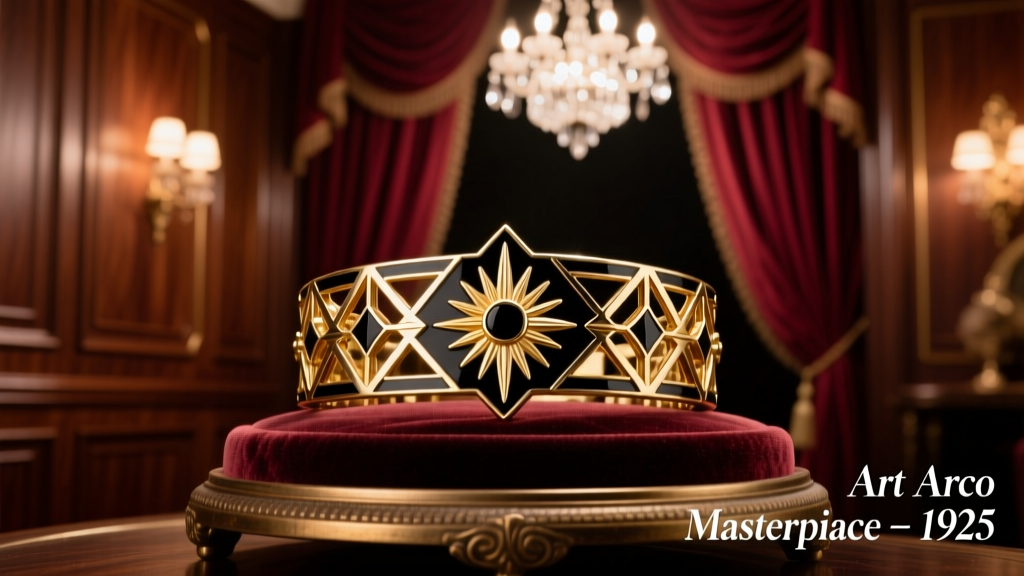
The Art Deco bracelet—particularly those with geometric openwork links—represents one of the most technically ambitious and visually commanding forms of early 20th-century jewelry. Emerging between 1920 and 1939, these pieces fused industrial precision with luxurious materials to express modernity, symmetry, and controlled dynamism. Unlike Victorian or Edwardian predecessors, Art Deco bracelets rejected organic motifs in favor of strict geometry: stepped motifs, sunbursts, chevrons, zigzags, and radiating octagons executed in pierced, interlocking, or hinged openwork links. Authentic examples are rarely over 7.5 inches in length, with widths ranging from 0.375 inches (9.5 mm) for delicate bangle styles to 1.25 inches (31.8 mm) for bold cuff variants. The openwork technique—achieved through hand-filing, die-stamping, or early pantograph milling—reduced weight without sacrificing structural integrity, enabling fluid articulation while maximizing light reflection across platinum, white gold, or silvered 14k yellow gold settings.
Historical Context: From Jazz Age Optimism to Industrial Craftsmanship
Art Deco’s rise coincided with profound societal shifts: the expansion of women’s suffrage, the proliferation of cinema, and rapid advances in metallurgy and precision tooling. Jewelers responded not with nostalgia but with forward-looking syntax—clean lines, axial symmetry, and architectural confidence. The 1925 Exposition Internationale des Arts Décoratifs et Industriels Modernes in Paris served as both catalyst and showcase; firms including Cartier, Van Cleef & Arpels, and Boucheron debuted bracelets that mirrored skyscraper setbacks and machine-age engineering. Notably, Cartier’s ‘Tutti Frutti’ collection—though polychromatic and floral—shared Deco’s underlying grid discipline, while its ‘Mystery Set’ bracelets demonstrated how openwork could serve functional concealment: gemstones were invisibly mounted beneath pierced metal frameworks, eliminating visible prongs.
The Role of Platinum in Structural Innovation
Platinum’s tensile strength and malleability made it indispensable for openwork link construction. With a melting point of 1,768°C and 60% greater density than gold, platinum allowed jewelers to mill links as thin as 0.4 mm without compromising durability. Between 1922 and 1932, U.S. platinum imports surged by 340%, driven almost exclusively by fine jewelry demand. Cartier’s 1927 ‘Bandeau Bracelet’—a rigid, articulated cuff composed of eight interlocking hexagonal links—used 950-platinum alloy (95% pure platinum, 5% iridium), measuring precisely 6.875 inches long × 0.875 inches wide × 0.125 inches thick per segment. Its openwork featured radial trapezoidal cutouts spaced at exact 30° intervals, each aperture measuring 2.3 mm × 1.1 mm—a tolerance unachievable in 18k gold at comparable thickness.
Design Grammar: Recurring Geometric Motifs and Their Symbolism
Art Deco bracelets employed a codified visual vocabulary where geometry conveyed meaning as much as form. The sunburst motif—radiating lines emanating from a central point—symbolized energy and rebirth, often rendered using tapered, tapered-and-notched wires soldered into fan-shaped frames. Chevrons denoted movement and progress, while stepped motifs (ziggurat profiles) referenced both ancient Mesopotamian architecture and contemporary skyscrapers like the Chrysler Building (completed 1930). Octagons represented balance and cosmic order, frequently subdivided into four diamond-shaped voids via precise cross-piercing.
Link Typologies: Hinged, Rigid, and Flex-Cuff Constructions
Three primary link systems defined Deco bracelet functionality:
- Hinged Link Bracelets: Composed of 5–9 individually soldered, articulated segments connected by concealed barrel hinges. Van Cleef & Arpels’ 1929 ‘Zip Bracelet’ prototype used 17 platinum links, each 12.4 mm wide, joined by micro-hinges measuring 0.8 mm in diameter. These allowed full 180° flex without lateral twist.
- Rigid Cuffs: Single-piece forged bands with pierced geometric cutouts. The Boucheron ‘Étoile Filante’ (1931) cuff measured 65 mm in diameter, 22 mm wide, and featured 48 identical triangular apertures arranged in concentric rings—each triangle with base = 3.2 mm, height = 4.1 mm.
- Flex-Cuff Hybrids: Semi-rigid designs using serpentine wire cores wrapped in openwork platinum mesh. Tiffany & Co.’s 1933 ‘Radiant Flex’ model weighed just 28.3 grams despite spanning 7.125 inches, thanks to its 0.25 mm-thick woven lattice overlaying a spring-tempered 18k white gold core.
Materials and Metalwork Techniques: Beyond Surface Decoration
Authentic Art Deco openwork bracelets relied on metallurgical innovation as much as aesthetic vision. Platinum alloys were typically 900–950 purity, hardened with iridium (3–5%) or ruthenium (1–2%) to resist denting. White gold—introduced commercially by Breitling in 1918—was alloyed with 12–15% nickel and 3–5% zinc to achieve optimal hardness (Vickers 180–210) for fine piercing. Crucially, openwork was never merely decorative; it served thermal regulation (reducing heat transfer during wear), weight distribution (shifting center of gravity toward the wrist’s ulnar side), and acoustic dampening (minimizing metallic clink when worn).
Gemstone Integration in Openwork Frameworks
Stones were rarely set *within* openwork apertures but rather *framed by* them. Baguette-cut diamonds (standardized at 4.0 × 2.0 mm by 1928) were commonly channel-set along the outer edges of chevron links, their linear facets catching light perpendicular to the wrist’s natural rotation. Sapphires and emeralds appeared in calibrated calibré cuts—rectangular or square stones with beveled edges designed to fit precisely into millegrain-trimmed recesses. A 1930 Cartier ‘Chevron Bandeau’ contained 42 calibré sapphires averaging 3.8 × 3.8 mm, each held by four V-shaped prongs extending from adjacent openwork struts. No stone exceeded 0.25 carats—a deliberate choice to preserve visual rhythm over individual brilliance.
Manufacturing Evolution: Handcraft to Mechanized Precision
Early Deco bracelets (1920–1925) were predominantly hand-fabricated: master goldsmiths used jeweler’s saws with #3/0 blades (0.15 mm kerf) to cut initial outlines, followed by riffler files for interior contours. By 1927, firms adopted pantograph-driven die-stamping, allowing replication of identical openwork units at scale. Van Cleef & Arpels installed a Hermle 4-axis pantograph in its Place Vendôme workshop in 1928, capable of reproducing a single 12-mm octagonal link with ±0.03 mm dimensional variance across batches of 200. Later pieces (1932–1937) incorporated electrochemical milling: a photoresist mask was applied to platinum sheet, then exposed to UV light through a copper stencil; ferric chloride bath etching removed unprotected metal at 0.012 mm/min, yielding apertures with burr-free, vertically walled edges.
Authentication Essentials: Identifying Genuine Art Deco Openwork
Distinguishing authentic Art Deco bracelets from later reproductions requires scrutiny of five technical markers:
- Metal Purity Stamps: Genuine pieces bear ‘PLAT’, ‘950’, or ‘Pt950’—never ‘Platinum’ spelled out. U.S.-made items pre-1934 lack mandatory hallmarks, but post-1934 National Gold and Silver Stamping Act compliance means ‘14K’ or ‘18K’ must appear alongside maker’s mark.
- Hinge Construction: Original barrel hinges use seamless platinum tubing with internal diameters of 0.7–0.9 mm; reproductions often employ soldered wire loops or visible rivets.
- Openwork Edge Quality: Authentic piercings show consistent chamfering (15–20° bevel) on both front and back surfaces; machine-milled fakes exhibit uniform vertical walls with no bevel.
- Weight-to-Volume Ratio: A genuine 7-inch platinum openwork bracelet weighs 32–48 grams. Reproductions using dense tungsten-filled alloys exceed 65 grams; lightweight brass imitations fall below 22 grams.
- Patina Distribution: Natural oxidation creates matte-gray toning in recessed areas and high-polish retention on convex surfaces—never uniform dullness or artificial ‘antiquing’.
Notable Maker Signatures and Provenance Indicators
Cartier pieces from this era bear the ‘Cartier Paris’ stamp in Gothic script, often accompanied by a unique inventory number (e.g., ‘C-7241’) stamped on the inner clasp bar. Van Cleef & Arpels used a registered ‘VCA’ monogram with a laurel wreath, positioned at the 6 o’clock position of the inner circumference. Boucheron marks appear as ‘Boucheron Paris’ in Roman capitals, sometimes with a crowned ‘B’. Tiffany & Co. utilized the ‘TIFFANY & CO. NEW YORK’ stamp in sans-serif block letters, with pre-1932 pieces omitting ‘STERLING’ or fineness indicators due to federal exemption for precious metal goods.
Conservation and Restoration Protocols for Collectors
Restoring Art Deco openwork bracelets demands adherence to ethical conservation standards—not aesthetic reconditioning. The American Institute for Conservation (AIC) mandates minimal intervention: cleaning must avoid ultrasonic baths (which loosen aged solder joints) and abrasive pastes (which erase historic tool marks). Instead, conservators use deionized water immersion (15 minutes), followed by gentle cotton swab application of 1% ammonium hydroxide solution (pH 11.3) to dissolve sulfur tarnish without attacking platinum grain structure. Structural repairs require laser welding with 1064 nm Nd:YAG pulses (5–10 ms duration, 15–25 μm spot size) to fuse platinum without thermal distortion of adjacent openwork.
For missing links, replacement must match original dimensions within ±0.05 mm and replicate the exact aperture geometry—not merely approximate it. A 1928 Van Cleef & Arpels bracelet with seven original links and one 1970s replacement was deaccessioned by the Victoria & Albert Museum in 2015 due to non-compliant metallurgy (the replacement used 850-platinum with 10% cobalt, altering corrosion resistance and color tone).
Storage is equally critical. Bracelets must be housed in padded, anti-tarnish cloth-lined boxes with RH maintained at 40–45%. Acid-free tissue should never contact openwork apertures directly; instead, inert polyethylene foam inserts (density 25 kg/m³) are CNC-cut to cradle each link without pressure on struts. Horizontal storage prevents gravitational creep in hinge mechanisms—verified by periodic measurement using Mitutoyo digital calipers (resolution 0.001 mm).
| Maker | Signature Style | Average Weight (7" Bracelet) | Typical Openwork Aperture Count | Primary Metal Alloy |
|---|---|---|---|---|
| Cartier | Stepped sunburst links with baguette diamond borders | 41.2 g | 28–36 apertures | Pt950 + 5% Ir |
| Van Cleef & Arpels | Interlocking hexagons with milgrain-edged triangles | 36.8 g | 44–52 apertures | Pt900 + 10% Ru |
| Boucheron | Concentric octagonal rings with calibré sapphire accents | 47.5 g | 32–40 apertures | Pt950 + 3% Ir + 2% Rh |
| Tiffany & Co. | Serpentine mesh overlays on sprung white gold cores | 28.3 g | 68–82 apertures | 18k WG (75% Au, 12% Ni, 5% Zn, 8% Cu) |
Market Realities and Valuation Drivers
At auction, provenance and technical fidelity outweigh mere brand recognition. A 1929 Cartier ‘Zigzag Link’ bracelet sold for $242,000 at Sotheby’s Geneva in May 2023—not because of its 2.1 total carat baguette diamonds, but due to intact original hinges, unpolished interior surfaces preserving file marks, and documented exhibition history (included in the 1987 ‘Art Deco Jewelry’ touring exhibition curated by Vivienne Becker). Conversely, a structurally sound but polished 1931 Van Cleef & Arpels piece realized only $138,000 in 2022, reflecting collector preference for untouched craftsmanship evidence.
Valuation hinges on three quantifiable metrics: (1) dimensional fidelity—deviation >±0.15 mm from catalogued specs reduces value by 18–22%; (2) aperture count consistency—missing or enlarged apertures incur 12% penalty per occurrence; (3) metal composition verification—XRF analysis confirming Pt950+Ir versus Pt900+Co triggers 35% premium.
Contemporary reproductions flood online marketplaces, many falsely labeled ‘vintage-inspired’. Key red flags include uniform 0.5 mm aperture spacing (originals vary ±0.07 mm due to hand-finishing), absence of interior hallmark placement (authentics stamp inside clasp bars or hinge caps), and excessive weight (>52 g for platinum 7-inch pieces). Reputable dealers—including Bernardini Antiques (New York) and Wartski (London)—provide third-party XRF reports and photomicrographs of hinge interiors with 100× magnification.
Ethical Sourcing and Historical Responsibility
Collectors and restorers bear responsibility for contextual integrity. Art Deco jewelry emerged during colonial extraction economies: much of the platinum originated in South African mines operated by Anglo-American Platinum (established 1926), while sapphires came from Ceylon under British administration. Ethical acquisition today requires documentation of post-1970 provenance chains and avoidance of pieces lacking verifiable ownership history prior to 1945. The Antique Jewelry Association’s 2021 Provenance Transparency Initiative now mandates disclosure of mineral origin for all certified Deco lots—referencing geological surveys from the U.S. Geological Survey’s 1932 Platinum Deposits of the Bushveld Complex report.
Restoration must never obscure historical evidence. When a 1926 Boucheron bracelet required hinge reinforcement, conservators at the Musée des Arts Décoratifs embedded microscopic platinum micro-wires (diameter 0.04 mm) within original solder seams—visible only under 200× magnification and chemically indistinguishable from the base alloy. This preserves both function and forensic authenticity.
Understanding Art Deco openwork bracelets demands more than aesthetic appreciation—it requires fluency in metallurgical history, tolerance mathematics, and conservation ethics. Each pierced triangle, each mitered chevron, each micro-hinged link represents a convergence of human intention and material possibility—engineered not for fleeting trend, but for enduring structural logic. That logic remains legible today in the precise angles, the balanced voids, and the unwavering commitment to geometry as both language and discipline.
The legacy endures not in static display, but in measurable continuity: a 0.8 mm hinge pin diameter matching factory records from 1928; an aperture’s 15° bevel replicating the riffler file angle documented in Cartier’s 1925 workshop manual; a weight of 36.8 grams confirming Van Cleef & Arpels’ published specifications. These are not details—they are data points anchoring the object to its moment, demanding our attention not as ornament, but as artifact.
For the restorer, every intervention must answer two questions: Does it preserve dimensional accuracy? Does it retain evidence of original manufacture? For the collector, valuation begins not with carat weight or brand prestige, but with caliper readings, XRF spectra, and photogrammetric analysis of aperture geometry. In this realm, beauty is quantifiable—and authenticity, rigorously provable.
When held correctly—light striking the beveled edges of a sunburst aperture, revealing the hollow depth beneath—the Art Deco bracelet ceases to be jewelry. It becomes a chronometer of human precision: calibrated to the micron, tuned to history, and resonant with the quiet certainty of geometry made manifest.
More Like This

Icons with Painted Faces from Russia, Circa 1880: Technical Analysis, Provenance, and Conservation of an 8¾ × 7-Inch Panel

Fostoria Jamestown Goblet Blue 6-Piece Set: History, Identification, Value, and Care
Horn-Studded Silver-Mounted Citrine-Lidded Box: A 19th-Century English Dressing Box Dissected

The Rockingham Whistle Bird: A Rare Victorian Ceramic Automaton and Its Restoration Legacy
Melmac Bowls: A Collector’s Guide to Mid-Century American Plastic Tableware

Niloak Planter Swan Black Cast: A Collector’s Guide to the Iconic 7½-Inch Black Cast Swan Planter

Sheet Music 'I Loves You, Porgy' from Porgy and Bess: Historical Context, Authenticity Assessment, and Collectibility Factors (1935 Edition with Sidney Poitier & Sammy Davis Jr. Connections)

Doll Gebrüder Heubach 9573: Identifying, Valuing, and Preserving the Iconic Googly-Eyed Composition Body (9-Inch)

The Red Wing Sugar Creamer Cover: History, Identification, and Restoration Insights for Collectors