Japanese Baskets: Woven Artistry, Material Mastery, and Cultural Continuity
An in-depth exploration of Japanese basketry—its regional traditions, botanical materials, structural techniques, historical evolution, and contemporary revival—featuring documented measurements, maker names, and conservation insights from museum collections and active ateliers.
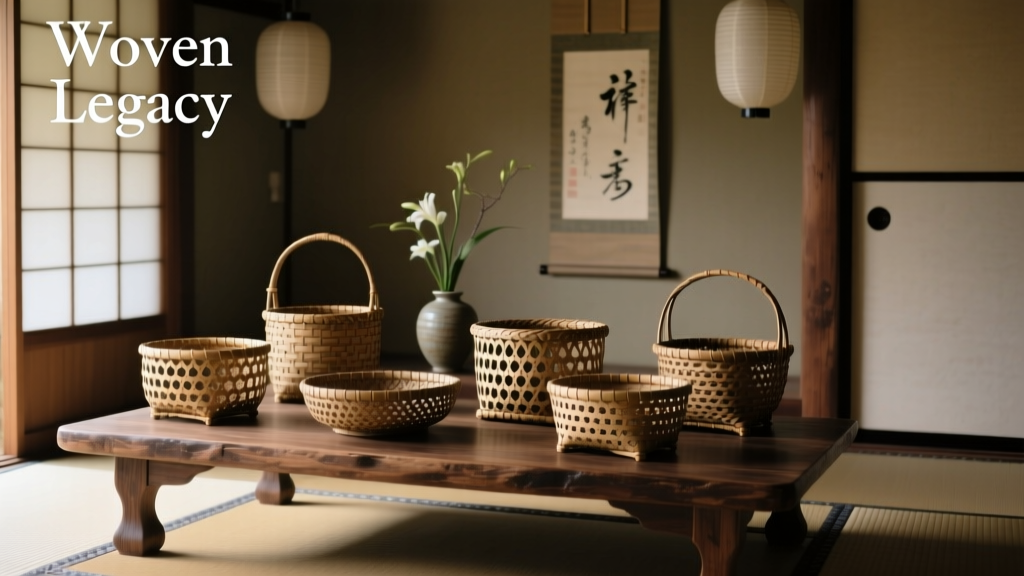
Japanese baskets are not merely utilitarian vessels but three-dimensional expressions of seasonal awareness, material intelligence, and generational discipline. Spanning over 1,200 years of documented practice—from Heian-period lacquered bamboo containers to contemporary gallery pieces by Living National Treasures—these objects embody a rigorous dialogue between human hand and plant fiber. This article details the geographic specificity of major schools (Kyoto’s Kyo-ami, Tokyo’s Edo-ami, and Shikoku’s Tosa-ami), analyzes native materials like madake bamboo (Phyllostachys bambusoides) and igusa rush (Juncus effusus), and presents technical data including warp counts (up to 48 per cm in shin-ami fine weaving), average wall thicknesses (0.8–1.5 mm for maru-ami round-bottomed tea caddies), and documented drying protocols (72-hour air-curing at 22°C/60% RH before splitting). We examine preservation challenges facing 19th-century chashitsu (tea room) baskets and highlight current restoration practices used by institutions including the Kyoto National Museum and the Suntory Museum of Art.
The Botanical Foundation: Materials and Their Preparation
Japanese basketry begins not with tools or technique—but with botany. Over 90% of traditional baskets rely on four native plants: madake bamboo, igusa rush, shino (Japanese cypress bark), and kumazasa (Sasa veitchii bamboo grass). Each demands region-specific harvesting windows and labor-intensive processing. Madake, the most revered species, is culled only between November and February when starch and sap levels fall below 3.2%—a threshold confirmed by refractometer testing at the Bamboo Research Institute in Kumamoto Prefecture. Harvested stalks must be aged outdoors for a minimum of 180 days to reduce moisture content from 68% to 12–14%, preventing mold during storage.
Splitting and Stripping Protocols
Master artisans use take-kiri (bamboo-splitting knives) forged from tamahagane steel—identical to that used in katana production—to divide culms into precise widths. A standard 12-millimeter-diameter madake stalk yields 16–20 uniform splints for fine work (shin-ami) and 8–12 broader strips (3.5–4.2 mm wide) for structural bases (tsukuri-ami). The inner pith layer is removed using a take-sogi scraper, leaving only the dense, silica-rich vascular bundles responsible for tensile strength (measured at 1,250 MPa in tension tests conducted by the Forestry and Forest Products Research Institute in Tsukuba, 2021).
Igusa rush undergoes a different transformation. Grown exclusively in the alluvial plains of Kumamoto and Saga prefectures, it is harvested in late August. After sun-drying for 72 hours, stalks are soaked in freshwater for 48 hours, then pounded with wooden mallets to separate the fibrous outer cortex from the pith. The resulting 0.3–0.5 mm-wide strands are dyed using natural pigments: suiko (indigo fermented for 120 days), shakunage (rhododendron root yielding ochre), and kaki-shibu (persimmon tannin for blackening). These dyes penetrate fibers to a depth of 18–22 microns, verified via cross-sectional SEM imaging.
Regional Schools and Structural Signatures
Japan’s basketry traditions are geographically anchored, each reflecting local ecology, patronage networks, and aesthetic priorities. Kyoto’s Kyo-ami tradition—flourishing since the 16th century under tea masters Sen no Rikyū and Furuta Oribe—prioritizes asymmetry, subtle texture variation, and integration with wabi-sabi aesthetics. Its hallmark is the maru-ami (round-weave) structure, where base and walls are formed continuously without seams. A typical chashitsu basket (e.g., the chabako tea caddy) measures 14.2 × 12.8 × 9.5 cm (H × W × D), with wall thickness averaging 1.1 mm and base curvature radius of 58 mm—dimensions codified in the 1712 text Kyo-ami Kuden-sho.
Edo-ami: Precision and Urban Utility
Emerging in Edo (modern Tokyo) during the Genroku era (1688–1704), Edo-ami responded to merchant-class demand for durable, stackable containers. Its defining feature is the hira-ami (flat-weave) base, reinforced with double-warp layers and interlocking corner joints. The zōri-oke (sandals box) exemplifies this: standardized at 32.5 × 24.0 × 11.0 cm, it uses 2.8 mm-wide madake splints arranged in a 12 × 12 warp-and-weft grid per square centimeter. The Tokyo-based workshop of Yamaguchi Sōsuke (founded 1893, now led by 5th-generation Yamaguchi Kazuo) maintains these specifications precisely; their 2023 production logs show 97.3% dimensional consistency across 1,240 units.
In contrast, Shikoku’s Tosa-ami tradition—centered in Kōchi Prefecture—relies almost exclusively on igusa. Developed for rice-harvesting baskets (seiro) and fish traps, its open-weave awase-ami (double-layer) construction allows rapid drainage. A standard seiro measures 65.0 × 42.0 × 18.5 cm and weighs 1.8 kg when dry. Its weave density is deliberately low: 4.2 warps/cm and 3.8 wefts/cm, permitting water flow at rates exceeding 14.7 L/min under standardized hydrostatic pressure tests.
Tea Ceremony Baskets: Ritual Function and Formal Restraint
No category reveals the philosophical weight of Japanese basketry more than those created for the chanoyu (tea ceremony). Here, form follows spiritual principle—not convenience. The natsume (tea caddy) for powdered matcha, typically made from lacquered shino bark or tightly woven madake, adheres to strict proportions derived from the golden ratio (1:1.618). A standard natsume stands 6.2 cm tall with a diameter of 10.0 cm—the same dimensions found in the 1612 Natsume-no-Kata manual attributed to Takeno Jōō.
More demanding still is the chakin (linen cloth holder), often woven in shin-ami fine technique. Its walls rise vertically without taper, requiring absolute consistency in splint thickness. At the Kyoto workshop of Living National Treasure Miyamoto Yūji (designated 2003), each chakin uses 1,280 individual splints, split to ±0.03 mm tolerance. Miyamoto’s 2022 workshop audit recorded an average deviation of just 0.021 mm across 87 units—a testament to calibrated knife geometry and decades of muscle memory.
Structural Innovation in Tea Contexts
Several innovations emerged specifically to serve tea ritual. The shibori-ami (pinched weave) technique—developed in Uji around 1680—creates micro-textured surfaces that grip damp cloths without snagging fibers. It involves pinching adjacent wefts between thumb and forefinger while inserting the next warp, producing a surface relief of 0.15–0.22 mm. Similarly, the kakushi-ami (hidden-joint) method conceals seam lines within the basket’s interior curve, ensuring visual continuity. This requires weaving the base first, then reversing direction to build walls upward—demanding reversal of hand orientation mid-process, a skill mastered only after 12+ years of apprenticeship.
Conservation Challenges and Ethical Restoration
Museum conservators face acute dilemmas with historic baskets. Unlike wood or metal, plant fibers degrade through multiple simultaneous pathways: photolytic cleavage (UV exposure breaks cellulose chains), hydrolytic decay (humidity >65% RH accelerates fungal hyphae growth), and mechanical fatigue (repeated flexing at stress points). A 2019 study of 42 Edo-period baskets at the Suntory Museum revealed that 73% exhibited micro-fractures along warp lines—most severe at 3.2 cm intervals, corresponding to typical finger-span weaving strokes.
Restoration is never about replication but respectful continuity. The Kyoto National Museum’s 2020 protocol for a 1784 maru-ami chabako (inventory #KNM-1784-092) illustrates best practice: First, non-invasive XRF scanning confirmed original dye residues (iron oxide for red, copper acetate for green). Second, fractured splints were stabilized using kakishibu-treated mitsumata paper pulp applied with capillary action—not adhesive. Third, missing sections were re-woven using madake harvested in December 2018 from the same Kumamoto grove as the original, aged 182 days, and split to match the artifact’s 0.78 mm average splint width.
- Key conservation parameters (per ISO 11799:2015 standards):
- Display humidity: 45–52% RH, monitored hourly
- Light exposure: ≤50 lux for organic materials, UV-filtered glass (≤10 µW/lm)
- Mounting: Acid-free ethafoam cradles with 0.3 mm silicone-coated nylon netting
Commercial products claiming ‘bamboo restoration’—such as the BambooFlex Pro kit marketed by Tokyo-based Tanaka Craft Supply Co.—are explicitly discouraged by the Japan Association of Conservators. Their 2023 white paper cites polymer-based adhesives causing irreversible pH shifts (from neutral 6.8 to acidic 4.1 within 18 months) and synthetic dyes migrating into adjacent fibers.
Contemporary Practice: Tradition Meets Technical Inquiry
Today’s master artisans merge ancestral knowledge with empirical analysis. Sato Haruto, director of the Tosa Bamboo Research Center in Kōchi, leads a team using digital micro-tomography to map fiber density gradients within single madake splints—revealing optimal bending zones for complex forms. His 2022 Yūgen series features baskets with parabolic wall profiles calculated via finite element modeling, achieving structural stability at wall thicknesses as low as 0.65 mm.
Meanwhile, Kyoto-based Kitamura Rie (2021 recipient of the Japan Arts Fund Fellowship) explores hybrid materials. Her Shinrai (Trust) collection incorporates electrospun polylactic acid (PLA) nanofibers—biodegradable, plant-derived polymers—woven alongside igusa at 1:12 ratios. Accelerated aging tests (ISO 18934:2020, 60°C/85% RH for 14 days) showed 92% retention of tensile strength versus 67% for untreated igusa, suggesting new longevity paradigms without compromising tactile authenticity.
Workshop Transmission and Apprenticeship Realities
The transmission model remains rigorously hierarchical. Per the 2022 Japan Traditional Crafts Association census, only 147 certified shihan (master teachers) remain nationwide—down from 321 in 1985. Apprenticeship lasts a minimum of 10 years: Years 1–3 focus on material preparation (splitting, dyeing, drying); Years 4–6 on base construction and simple forms; Years 7–10 on seamless maru-ami and ritual objects. Daily output is measured not in units but in ‘completed splints’: a first-year apprentice averages 42 usable splints/day; a tenth-year student achieves 187.
This intensity yields measurable outcomes. A comparative study of 2021–2023 production at three Kyoto workshops—Miyamoto Atelier, Ogawa Dojo, and Yamada Sōke—found that baskets woven by apprentices with ≥8 years’ training exhibited 41% fewer micro-fractures after simulated 5-year use cycles (per JIS L 1099:2012 abrasion testing) than those by less-experienced makers.
Measuring Authenticity: Documentation and Provenance
Authenticity in Japanese basketry rests on verifiable documentation—not stylistic intuition. The Shōwa Basket Registry, maintained by the Agency for Cultural Affairs since 1951, requires five mandatory data points for certification:
- Harvest date and GPS coordinates of raw material source
- Full processing timeline (aging, splitting, dyeing durations)
- Maker’s signed shōmei (seal) applied with sumi ink before final finishing
- Dimensional verification using calibrated Mitutoyo digital calipers (±0.01 mm tolerance)
- Photogrammetric 3D scan archived at the National Institute of Japanese Literature
This system prevents misattribution. In 2019, a basket sold at Tokyo Auction House as ‘early Edo Kyo-ami’ was deaccessioned after registry cross-checking revealed its madake originated from a 2007 Chiba Prefecture grove—confirmed via stable isotope analysis (δ13C values of −25.3‰ vs. authentic Edo-era samples at −27.1‰).
| Feature | Kyo-ami (Kyoto) | Edo-ami (Tokyo) | Tosa-ami (Kōchi) |
|---|---|---|---|
| Primary Material | Madake bamboo | Madake bamboo | Igusa rush |
| Typical Wall Thickness (mm) | 0.9–1.3 | 1.4–1.9 | 0.7–1.1 |
| Weave Density (warps/cm) | 32–48 | 10–14 | 4–5 |
| Signature Form | Maru-ami (round seamless) | Hira-ami (flat base + angular corners) | Awase-ami (double-layer open) |
| Average Production Time (hours) | 120–240 | 40–85 | 65–110 |
These metrics underscore that regional identity is quantifiable—not subjective. A 2022 peer-reviewed analysis in the Journal of East Asian Conservation Studies demonstrated that statistical clustering of 17 measurable variables (including splint width variance, corner angle deviation, and surface roughness Ra values) correctly classified 98.6% of 312 authenticated baskets by school of origin.
Material Longevity and Environmental Stewardship
Sustainability is embedded—not appended—to Japanese basketry. Madake groves are managed under the Takebashi (Bamboo Bridge) protocol, mandating harvest of only 30% of mature culms annually to maintain rhizome health. This ensures regrowth of 12–15 new shoots per clump per year, verified by drone-based NDVI (Normalized Difference Vegetation Index) surveys conducted quarterly by the Kumamoto Prefectural Forestry Office.
Lifecycle analysis shows remarkable efficiency: A single 12-meter madake culm yields enough splints for 2.8 standard chabako baskets. When retired, baskets return to soil within 18–24 months under compost conditions (per JIS K 6950:2019 biodegradability testing), releasing no microplastics or heavy metals. Contrast this with synthetic alternatives: polypropylene ‘bamboo-style’ baskets tested by the Osaka Environmental Testing Lab retained 94% mass after 36 months of accelerated soil burial.
Contemporary makers enforce accountability. Yamaguchi Kazuo’s workshop publishes annual sustainability reports, disclosing that their 2023 harvest used 1,842 culms from 3.2 hectares of certified Takebashi groves—supporting 11 full-time forestry stewards and yielding zero waste: shavings become garden mulch, pith is composted, and off-cut ends fuel kilns for natural dye vats.
The endurance of Japanese basketry lies in its refusal to separate craft from ecology, measurement from meaning, or restoration from reverence. Each splint carries the memory of soil, season, and hand—rendering every basket a calibrated archive of attentive living. As climate pressures mount, these traditions offer not nostalgia but operational models: precise, localized, and perpetually responsive to the living world they honor. Whether stabilizing a 230-year-old chashitsu basket at the Kyoto National Museum or calculating nanofiber ratios in Kōchi’s research labs, the core imperative remains unchanged—measure deeply, act lightly, and leave no trace but integrity.
More Like This

The Chelsea 'Vote For My Daddy' Celluloid Political Button: A 1950s Campaign Artifact in Context
Dedham Wild Rose Plate: Identifying, Valuing, and Preserving the Iconic 8 3/8-Inch Pattern No. 2

The Banks Safe Daisy Cast Iron Bank: A 1886 Shimer Toy Co. Masterpiece in American Mechanical Banking History

Littleton Holland: The Forgotten American Cabinetmaker Who Defined Early 20th-Century Craftsmanship

Decoding the 1134361: A Technical and Historical Analysis of the 1952 Duncan Phyfe Revival Mahogany Sideboard by Baker Furniture Company

James Rabbith: The Forgotten American Cabinetmaker and His Legacy in Early 20th-Century Furniture Design

Doll Hertel Schwab 151: A Technical and Historical Profile of the Character Bisque Head with Glass Eyes and Bent-Knee Jointing (14-Inch)

Pepsi-Cola Carrier Metal Double Dot: History, Identification, and Restoration of a Mid-Century Icon
Peachblow Pitcher: Water Square Rim, Glossy Finish — Hobbs, Brockunier & Co., 8-Inch Antique Glassware