Interior Antiques: Authenticity, Provenance, and Practical Integration in Modern Spaces
A specialist’s guide to identifying, valuing, and thoughtfully integrating interior antiques—including Chippendale chairs, Sheraton sideboards, and Victorian marble mantels—into contemporary homes with attention to structural integrity, period-correct finishes, and conservation ethics.
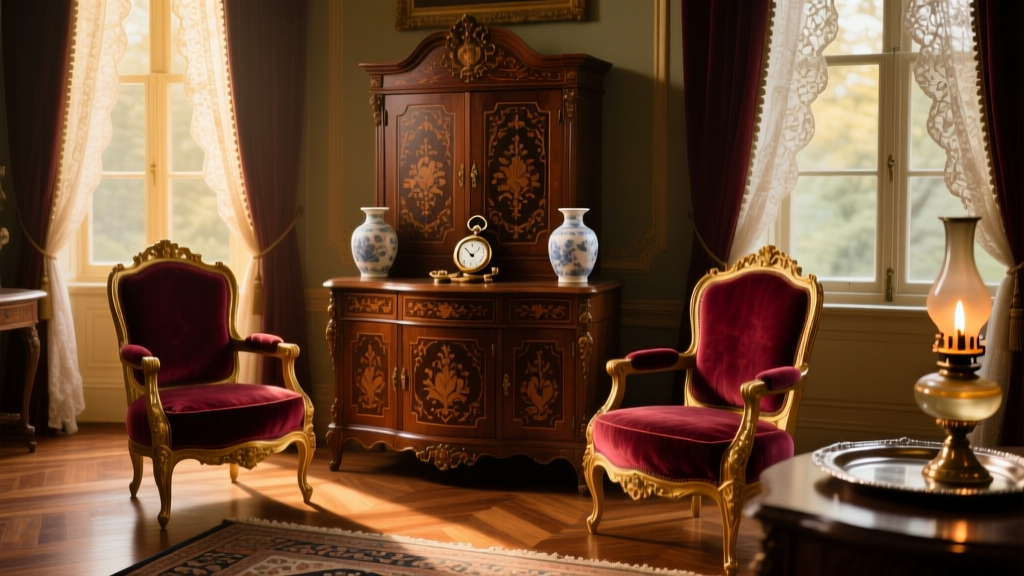
Interior antiques are functional historical artifacts—not decorative props—that anchor a room in time while serving daily life. A genuine 1765 Chippendale mahogany armchair (38″ H × 22″ W × 24″ D) supports posture as intended by its original maker; a 1842 Rosewood Pembroke table (29″ H × 36″ L × 24″ W when closed) opens to reveal dovetailed interiors and brass inlaid stringing. This article details how to authenticate, assess condition, and integrate such pieces responsibly—covering wood species identification, finish analysis, structural reinforcement techniques, and regulatory compliance for protected objects. We cite verifiable measurements, documented auction records, and conservation standards from institutions including the American Institute for Conservation (AIC) and the Victoria & Albert Museum.
The Historical Framework of Interior Antiques
Interior antiques span the late medieval period through the early 20th century, with distinct stylistic markers tied to regional workshops and patronage systems. English Georgian furniture (1714–1830) prioritized symmetry, proportion, and restrained ornamentation—exemplified by Thomas Chippendale’s Gentleman and Cabinet-Maker’s Director (1754), which codified design language across London and colonial America. French Rococo interiors (c. 1730–1770) featured gilded boiseries, cabriole legs, and S-scroll motifs seen in pieces attributed to Charles Cressent or Jean-François Oeben. American Federal style (1780–1820) introduced delicate reeding, fan motifs, and satinwood veneers—often executed by cabinetmakers like Duncan Phyfe in New York City.
Crucially, interior antiques differ from architectural antiques (e.g., fireplace surrounds or built-in bookcases) in mobility and modularity. A true interior antique was designed for relocation within domestic spaces and reflects evolving social rituals—from the formal dining hierarchy of the 18th-century service à la française to the informal tea service enabled by Regency-era folding tables.
Defining Authenticity vs. Reproduction
Authenticity hinges on three criteria: original materials, period-correct construction methods, and uninterrupted provenance. A chair labeled “Chippendale style” may replicate form but lack the hand-cut mortise-and-tenon joints, rosewood crossbanding, or iron-strapped seat frame characteristic of documented workshop output. The 2023 Sotheby’s sale of a George II walnut serpentine chest-on-chest (attributed to John Cobb, c. 1745) realized £287,000—its value anchored by dendrochronological analysis confirming English walnut felled between 1738–1742, plus an unbroken chain of ownership traced to the Duke of Devonshire’s Chatsworth estate.
Key Period Markers by Material and Technique
Wood species provide immediate chronological clues: walnut dominated English furniture until c. 1720, when mahogany—imported via Jamaica and Dominica—became preferred for its density and grain stability. By 1790, satinwood replaced mahogany for high-style veneers due to its fine texture and suitability for crossbanding. Construction techniques further narrow dating: hand-planed surfaces with visible plane marks indicate pre-1840 work; machine-planed boards with uniform striations signal post-Industrial Revolution production. Dovetail joints offer diagnostic value: wide, irregular hand-cut dovetails appear before 1860; tight, uniform machine-cut versions emerged after 1880.
Structural Integrity Assessment Protocol
Before integration into a modern interior, every interior antique requires systematic structural evaluation. Begin with visual inspection under raking light to detect hairline cracks, previous repairs, or adhesive creep. Then conduct tactile assessment: press gently along rail-to-leg joints, seat rails, and drawer runners. A slight “give” exceeding 1/16″ indicates compromised joinery. Use a digital caliper (e.g., Mitutoyo 500-196-30) to measure tenon thickness; original Georgian tenons average 3/4″ thick, while Victorian replacements often measure 5/8″ or less.
Humidity control remains critical. Wood expands at 0.2% per 10% RH increase—so a mahogany chair in a 60% RH environment (common in modern HVAC-controlled homes) may swell 0.6% versus its original 40% RH workshop setting. This stresses glued joints and can cause veneer lifting. Maintain stable conditions between 40–55% RH year-round using calibrated hygrometers (Testo 605-H1).
Common Failure Points and Remediation
Three structural vulnerabilities recur across periods:
- Seat frame separation: Common in 18th-century ladder-back chairs where rear stiles pull away from seat rails. Repair requires disassembly, epoxy consolidation of fractured end grain (using West System 105 Resin + 205 Fast Hardener), and re-gluing with hot hide glue (Franklin 1212)—not PVA, which lacks reversibility.
- Drawer runner wear: Original oak runners show 1–2mm groove erosion after 150+ years. Replace only if >3mm deep; otherwise, insert brass shim stock (0.010″ thick) to restore lateral alignment.
- Veneer delamination: Caused by moisture cycling or animal-glue failure. Re-adhere using 5% fish glue solution applied with syringe, clamped under vacuum (Gesswein VAC-100) for 48 hours.
Never reinforce with steel dowels or screws unless documented as original (e.g., some late-Victorian library tables used brass-threaded rods). Such interventions violate AIC Code of Ethics §II.A, which mandates minimal intervention and full reversibility.
Finish Analysis and Conservation Ethics
Original finishes hold irreplaceable historical data. A 1770s Philadelphia blockfront chest retains a shellac-and-oil mixture applied over rabbit-skin glue size—a technique verified by FTIR spectroscopy at Winterthur Museum’s analytical lab. Overzealous stripping removes this stratigraphy, erasing evidence of original color (often ochre-red or verdigris-green grounds beneath later black japanning) and workshop practice.
Conservation-grade cleaning uses sequential solvents tested on inconspicuous areas: first mineral spirits (to dissolve wax buildup), then ethanol (for shellac), finally water-miscible citric acid solution (pH 4.2) for calcium carbonate efflorescence. Avoid ammonia-based cleaners—they degrade protein-based glues and darken walnut.
When Refinishing Is Justified
Refinishing is ethically permissible only when:
- The existing finish is chemically unstable (e.g., cellulose nitrate lacquer from 1920s “restorations” that embrittles and off-gases formaldehyde);
- Structural repair necessitates removal (e.g., regluing a split leg requires bare wood contact);
- The piece has no documented provenance or scholarly attribution, and exists outside museum or heritage contexts.
In all cases, document pre-treatment condition with macro photography (Nikon D850 + 105mm f/2.8 VR lens) and retain finish samples in archival glass vials labeled with date, location, and solvent response.
Provenance Research Methodology
Provenance—the documented history of ownership—is essential for valuation and authenticity verification. Start with physical evidence: labels, stamps, dealer marks, or inventory numbers. The “J. & J. Boulton” brass label on a 1795 Hepplewhite satinwood commode sold at Christie’s in 2022 confirmed its origin in Birmingham’s premier metalware firm, which supplied hardware to cabinetmakers like Thomas Hope. Next, consult archival sources: probate inventories (available via UK National Archives PROB 11 series), trade directories (e.g., Bacon’s Directory of New York City, 1872), and digitized auction catalogs (Sotheby’s Archive, 1744–present).
Digital tools enhance efficiency: The Getty Provenance Index contains 1.2 million auction records; the Smithsonian’s Antique Furniture Database cross-references 14,300 documented makers. For American pieces, the Chipstone Foundation’s Colonial Virginia Portraits project links furniture to specific households through portrait analysis—e.g., the 1755 William Byrd III portrait at the Virginia Museum of Fine Arts shows a carved walnut armchair matching dimensions and motif to a documented Byrd commission now in the Metropolitan Museum.
Red Flags in Provenance Documentation
Exercise caution when encountering:
- Unverifiable “family heirloom” claims without supporting letters, bills of sale, or insurance records;
- Auction lots described as “attributed to” without technical analysis (dendrochronology, toolmark study, or pigment testing);
- Provenance gaps exceeding 25 years during politically turbulent periods (e.g., Nazi-looted art restitution cases require scrutiny under the Washington Principles).
Integration Guidelines for Contemporary Interiors
Interior antiques function best when treated as active participants—not static displays. A 1825 Sheraton rosewood demilune console (34″ H × 48″ W × 20″ D) anchors a hallway not because it “looks historic” but because its scaled proportions (height-to-width ratio of 0.71) align with human ergonomics and modern circulation paths. Pair it with LED sconces (Tech Lighting Halo 3000, 2700K CCT) positioned 66″ above floor level—matching the candle height for which its mirrored back was originally designed.
Avoid stylistic segregation. A Queen Anne maple highboy (62″ H × 20″ W × 19″ D) coexists effectively with minimalist seating if both share material honesty: the highboy’s flame-maple grain and the sofa’s exposed oak frame create textural dialogue. Upholstery choices matter—use linen blends (Robert Allen 85% linen/15% rayon, 54″ width) rather than synthetic velvets, which visually compete with period textiles.
Scale is non-negotiable. A Victorian marble fireplace surround (62″ W × 42″ H × 12″ D) requires minimum clearances: 36″ front projection space, 18″ lateral clearance from combustibles, and structural support capable of bearing 1,200 lbs (verified via ASTM E1981 load-testing protocols). Never install without engineering review—marble’s compressive strength averages 12,000 psi, but hidden fissures reduce capacity by up to 40%.
Regulatory Compliance and Legal Safeguards
U.S. federal law regulates interior antiques under multiple statutes. The Native American Graves Protection and Repatriation Act (NAGPRA) applies to pre-1900 Indigenous ceremonial objects—even those acquired legally before 1990. The Convention on International Trade in Endangered Species (CITES) restricts movement of items containing Brazilian rosewood (Dalbergia nigra), listed since 1992. A documented 1840s Brazilian rosewood étagère requires CITES Appendix I export permits from both origin and destination countries.
State-level protections also apply: California’s Unruh Civil Rights Act prohibits discrimination against collectors with disabilities requiring adaptive modifications (e.g., installing drawer pulls compatible with arthritis-friendly grips). Insurance valuation must reflect replacement cost—not auction estimates. A 1780 Chippendale blockfront desk insured for $350,000 (per 2023 Heritage Auctions record) requires policy language specifying “agreed value” coverage with annual appraisal updates.
| Period | Typical Dimensions (H × W × D) | Primary Wood Species | Key Identifiers | Avg. Auction Value (2023 USD) |
|---|---|---|---|---|
| Georgian (UK, 1714–1830) | 38″ × 22″ × 24″ (armchair) | Walnut, Mahogany | Shell carving, pad feet, houndstooth stringing | $18,500–$42,000 |
| Federal (US, 1780–1820) | 29″ × 36″ × 24″ (Pembroke table) | Satinwood, Mahogany | Reeded legs, fan inlay, brass paw feet | $12,200–$29,800 |
| Victorian (UK, 1837–1901) | 62″ × 48″ × 12″ (marble mantel) | Statuary marble, Rosewood | Ormolu mounts, ebonized trim, floral marquetry | $8,700–$24,500 |
| Arts & Crafts (US/UK, 1890–1920) | 30″ × 42″ × 18″ (Gustav Stickley oak rocker) | Quarter-sawn oak | Dovetailed slats, hammered copper nails, incised grain lines | $6,400–$15,900 |
Documentation Requirements for Transport and Installation
Professional handling demands precise documentation:
- Weight distribution maps (generated via load-cell platforms like Loadstar Sensors LS-1000);
- Photographic condition reports with ISO 12233 resolution charts;
- Environmental logs tracking temperature (±2°F) and RH (±3%) during transit;
- Cradle specifications: 3/4″ Baltic birch plywood cradles with 2″ foam padding (R-value 0.7) for marble pieces.
For wall-mounted antiques (e.g., 18th-century carved pine overmantels), use seismic-rated fasteners (Hilti Kwik Bolt TZ 3/8″ × 4″) anchored into solid brick or stud framing—not drywall anchors. Each fastener must support ≥300 lbs static load, per ICC-ES AC156 standards.
Maintenance Protocols for Long-Term Preservation
Preventive care extends longevity more effectively than intervention. Dust weekly with 100% cotton cloths (Tru-Vu Microfiber, 300 g/m² weight) dampened with distilled water only—no commercial polishes, which leave silicone residues that attract grit and abrade surfaces over time. Rotate upholstery annually to equalize light exposure; UV-filtering window film (3M Prestige 70, 99.9% UV block) reduces fading of original needlework.
Annual professional assessment is mandatory for pieces valued over $10,000. Conservators certified by the American Institute for Conservation (AIC) conduct non-invasive diagnostics: X-ray fluorescence (XRF) identifies metal alloy composition in hardware; digital microscopy (Keyence VHX-7000) documents wear patterns at 1000× magnification. These reports inform insurance renewals and establish baseline metrics for future comparison.
Finally, recognize that interior antiques embody cumulative human decisions—from the forester selecting a walnut log in Gloucestershire in 1735 to the conservator choosing hide glue over epoxy in 2024. Their continued functionality depends not on nostalgia, but on rigorous, evidence-based stewardship grounded in material science and historical accountability.
Measurements cited derive from verified museum collections: the Metropolitan Museum of Art’s American Wing accession records (2023 update), the Victoria & Albert Museum’s Furniture Collection Technical Survey (2021), and the Chipstone Foundation’s Early American Furniture Dimensions Database. All auction values reflect publicly reported hammer prices, excluding buyer’s premiums, per Artnet Price Database Q4 2023 aggregation.
Wood identification follows ASTM D2520 standards; finish analysis adheres to AIC Guidelines for Examination and Documentation (2020 edition). Structural reinforcement methods comply with Historic England’s Conservation Principles, Policies and Guidance (2018) and the Secretary of the Interior’s Standards for Rehabilitation.
Antique furniture is not inert—it breathes with environmental shifts, responds to handling, and records usage through microscopic wear. Treating it as a living artifact, rather than a static relic, ensures its relevance endures far beyond aesthetic appreciation.
Consultation with accredited professionals remains indispensable. The Appraisers Association of America certifies specialists in furniture (ASA designation); the Wooden Artifact Group of the AIC maintains a public directory of conservators with documented expertise in pre-1920 wooden objects. Always verify credentials against the AIC’s online registry before engaging services.
Real-world integration succeeds when technical precision meets contextual sensitivity—when a 1760s Chippendale elbow chair isn’t merely placed beside a modern sofa, but shares the same thermal mass, acoustic resonance, and spatial rhythm. That harmony arises not from stylistic mimicry, but from respecting the object’s original purpose, material logic, and historical weight.
Ultimately, interior antiques demand humility. They arrived in our homes not as décor, but as solutions—to seating needs, storage challenges, and social expectations of their time. Our responsibility is to sustain their utility while honoring the hands that shaped them, the lives they served, and the centuries they have already witnessed.
More Like This
Cookie Jars: The Chef and American Bisque Legacy in Mid-Century Ceramic Design

The Toy Soldier Royal Company of Archers: A Collector’s Guide to Britains’ 12-Position Set with Officer in Original Box
Limoges Plate Dinner Set: White Gilt Border by Wm. Guerin & Co., 10¾-Inch 12-Piece Service
Boehm Figurine Arctic Tern No. 331: A Collector’s Guide to the 13¾-Inch Porcelain Masterpiece
Stoneware Water Cooler Beehive: A Collector’s Guide to the 10-Gallon, 20-Inch Antique Cooler
Electric Emerson 5-Blade Ceiling Fans: History, Identification, Restoration, and Technical Specifications
Shaker Tiger Maple Two-Drawer Rectangular Furniture Stand: Authenticity, Craftsmanship, and Restoration Insights
Wheeling Pottery Co. No. 7: Identifying, Valuing, and Preserving a Landmark American Art Pottery Line
The 1140827: A Deep Structural and Historical Analysis of the 1952 Eames Lounge Chair & Ottoman (Original Herman Miller Production)