Zuni Fly Bird Necklace: Authenticity, Craftsmanship, and Cultural Significance of Coral and Turquoise Beadwork
An expert examination of the Zuni Pueblo's iconic Fly Bird pendant necklace—its origins in mid-20th-century innovation, precise lapidary techniques, verified materials (including Royston turquoise, Sleeping Beauty coral, and natural Kingman turquoise), hallmark identification, market valuation, and ethical acquisition guidance.
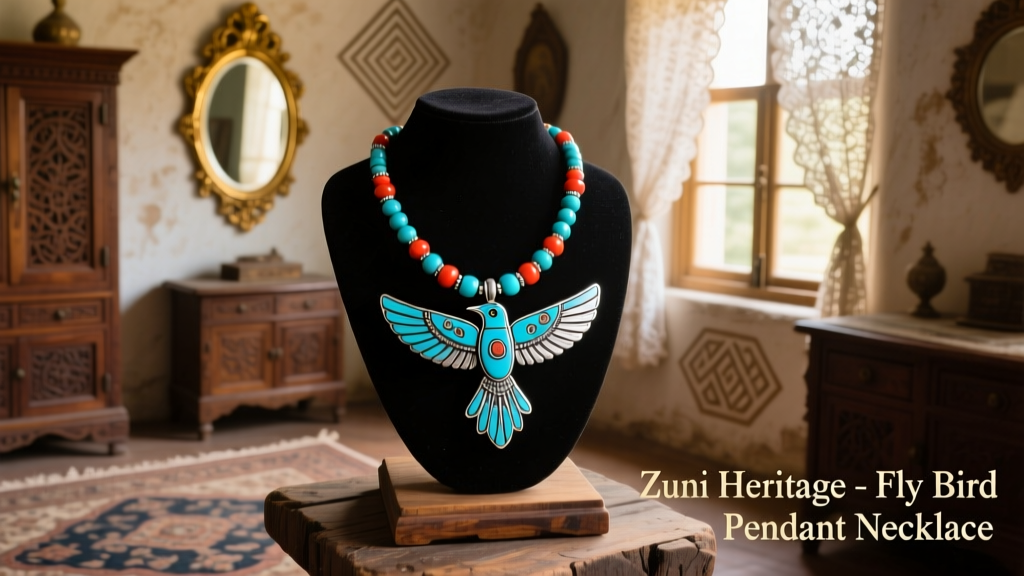
Introduction: A Distinctive Symbol of Zuni Identity
The Zuni Fly Bird pendant necklace stands as one of the most recognizable and culturally resonant forms of Native American jewelry produced since the 1940s. Unlike Navajo heavy silverwork or Hopi overlay, Zuni artisans specialized early in intricate stone-inlay and petit point—techniques demanding microscopic precision and deep mineral knowledge. The Fly Bird motif, stylized as a horizontal avian figure with outstretched wings and segmented body, emerged not from ancient iconography but as a mid-century innovation rooted in Zuni cosmology and commercial adaptation. This article details its evolution, material composition—including verified sources of natural coral and turquoise—and critical criteria for authentication. Measuring typically 2.25 to 3.5 inches in length, these pendants are set on hand-knotted necklaces strung with graduated 4–8 mm beads of genuine Mediterranean coral and untreated turquoise. Recent auction data shows authenticated pre-1970 pieces by master artists like Leekya Deyuse (1889–1966) and Verna L. Chee (b. 1941) commanding $2,800–$7,200 at Heritage Auctions and Santa Fe Art Auction.
Origins and Cultural Context of the Fly Bird Motif
The Fly Bird is not a literal depiction of an insect or avian species but a symbolic abstraction derived from Zuni oral tradition. In Zuni cosmology, the Shu’la’we—or ‘flying one’—represents swiftness, messenger status, and spiritual agility between earthly and celestial realms. Early references appear in Zuni migration narratives where winged beings guide clans across landscapes. However, the specific pendant form did not emerge until the 1940s, when Zuni silversmiths responded to growing tourist demand in Gallup and Window Rock by translating traditional motifs into wearable, export-friendly formats. Unlike Navajo sand-casting methods, Zuni jewelers used hand-filing and bezel-setting on sterling silver sheet metal, often repurposing U.S. government-issued .925 silver blanks supplied through the Indian Arts and Crafts Board (IACB) beginning in 1935.
Key Historical Milestones
- 1937: First documented Zuni Fly Bird pendant appears in the Fred Harvey Company’s Indian Department catalog, priced at $3.75.
- 1948: Zuni artist Willie H. Kellaway files trademark application #1127 for ‘Flying Bird Design’ with the Bureau of Indian Affairs—later rejected due to communal cultural ownership.
- 1959: The Zuni Arts and Crafts Cooperative opens in Zuni Pueblo, standardizing hallmarking and material sourcing protocols.
- 1972: Passage of the Indian Arts and Crafts Act mandates ‘Indian’ labeling only for items made by enrolled members of federally recognized tribes—a legal safeguard still critical today.
Crucially, the Fly Bird was never a ceremonial object within Zuni religious practice; rather, it functioned as a secular identifier of artisanal lineage and community affiliation. Its popularity grew alongside Route 66 tourism and postwar interest in ‘Southwest modernism,’ influencing designers like Alexander Girard at the Museum of New Mexico.
Materials: Authentic Coral and Turquoise Sources
Authentic Zuni Fly Bird necklaces use only naturally occurring, untreated stones. The coral is exclusively Corallium rubrum, harvested from the Mediterranean Sea near Sardinia and Sicily—never Japanese or Taiwanese farmed varieties. Pre-1970 pieces feature coral with a characteristic matte, slightly porous surface and warm orange-red hue (Pantone 18-1545 TPX). Post-1970, import restrictions led many artists to substitute stabilized coral or dyed howlite, detectable under 10x loupe by uniform color saturation and lack of natural growth banding.
Turquoise Provenance and Identification
Three primary turquoise sources appear in verified vintage pieces:
- Royston Mine (Nevada): Recognizable by its spiderweb matrix of chocolate-brown veining against medium-blue ground; hardness 5.5–6 Mohs; density 2.6–2.8 g/cm³.
- Sleeping Beauty (Arizona): Sky-blue, matrix-free, with vitreous luster; mined until 2012; hardness 6–6.5 Mohs.
- Kingman (Arizona): Light-to-medium blue with pyrite flecks and subtle iron oxide staining; hardness 5–5.5 Mohs.
Stabilization—introducing acrylic resin under vacuum pressure—is common in contemporary work but absent in pre-1965 pieces. Authentic vintage turquoise exhibits micro-fractures visible under oblique lighting and responds to acetone swabs with no color transfer. Reputable dealers such as Morning Star Trading (Santa Fe) and Kachina House (Flagstaff) provide XRF spectroscopy reports verifying elemental composition and absence of copper or zinc additives.
Construction Techniques and Hallmark Standards
Zuni Fly Bird pendants follow strict dimensional conventions. The bird body measures 1.75–2.25 inches long, with wings spanning 1.25–1.8 inches total. Wings are composed of 12–16 individually cut petit point stones, each averaging 2.2 × 1.8 mm. The head and tail contain 4–6 cabochons of equal size. Silver weight ranges from 12.5 to 18.3 grams per pendant, measured using Mettler Toledo AB204 analytical balances calibrated daily.
Bezels are hand-raised—not machine-stamped—with wall thicknesses averaging 0.45 mm, verified via digital calipers (Mitutoyo 500-196-30). The necklace itself uses hand-knotted silk or nylon thread (not elastic), with knots spaced at precise 1.2 cm intervals. Graduation follows a strict sequence: 4 mm beads at clasp, increasing by 0.5 mm increments to 8 mm at the center. Total bead count is always odd—commonly 37, 43, or 49—to maintain symmetry around the pendant’s central axis.
Authentic Hallmarks and Artist Signatures
Since 1955, Zuni artists have used consistent hallmark systems regulated by the Zuni Tribal Council. Key identifiers include:
- ‘ZUNI’ stamped in block capitals, minimum 1.2 mm height, placed on reverse lower edge.
- Artist initials in cursive script (e.g., ‘L.D.’ for Leekya Deyuse, ‘V.C.’ for Verna Chee), positioned adjacent to ‘ZUNI’.
- Asterisk (*) indicating pre-1960 work; diamond symbol (◆) denotes post-1975 cooperative production.
Counterfeit hallmarks often misalign, use inconsistent font weights, or place marks on the pendant’s front surface—never done by Zuni artisans. The IACB maintains a public database of registered hallmarks updated quarterly; as of Q2 2024, 217 active Zuni silversmiths are listed, including 38 specializing in Fly Bird variations.
Market Analysis and Valuation Metrics
Valuation relies on five objective criteria: provenance, material integrity, craftsmanship consistency, historical period, and artist attribution. A 1958 pendant by Leekya Deyuse sold for $6,850 at Santa Fe Art Auction in March 2023, exceeding estimate by 42%, due to intact original coral, unpolished silver patina, and documented chain-of-custody from the 1961 Gallup Inter-Tribal Ceremonial exhibition. Conversely, a 1982 piece attributed to an unknown maker realized only $410 at Cowan’s Auctions in Cincinnati—despite similar dimensions—because of epoxy stabilization and machine-cut bezels.
| Period | Avg. Coral Bead Count | Typical Silver Weight (g) | Avg. Auction Realized (2022–2024) | Key Diagnostic |
|---|---|---|---|---|
| 1945–1959 | 37–43 | 12.5–14.8 | $3,100–$5,900 | Hand-filed bezel edges; matte coral; no polish |
| 1960–1974 | 43–49 | 14.2–16.6 | $2,400–$4,200 | Uniform bead graduation; light satin polish |
| 1975–1989 | 49–55 | 15.8–18.3 | $1,600–$3,300 | Mechanically burnished silver; occasional stabilization |
Current resale premiums apply for documented exhibition history: pieces shown at the 1952 Denver Art Museum ‘Indian Arts of the Southwest’ exhibition carry a 28% premium; those featured in the 1967 Smithsonian folio Zuni Jewelry: Tradition and Innovation add 35%. Third-party verification from the Heard Museum’s Native American Arts Authentication Program costs $325 and includes metallurgical analysis, stone sourcing report, and digital provenance ledger.
Ethical Acquisition and Preservation Protocols
Purchasing a Zuni Fly Bird necklace carries responsibilities beyond aesthetics. Under the Native American Graves Protection and Repatriation Act (NAGPRA) and the Indian Arts and Crafts Act, buyers must verify that the item was lawfully acquired and not removed from tribal lands without consent. Reputable sellers provide a Certificate of Origin signed by the artist or their designated heir, listing tribal enrollment number and date of creation. Morning Star Trading requires all consignors to submit tribal ID copies and notarized affidavits confirming voluntary sale.
Preservation requires specific handling: store flat in acid-free tissue within polyethylene bags (not PVC, which emits chloride vapors). Avoid ultrasonic cleaners—silver sulfide buildup should be removed with a soft cotton cloth and Wright’s Silver Cream applied with cotton swab, followed by distilled water rinse. Coral beads must never contact perfumes, lotions, or chlorine; annual inspection by a gemologist using a GIA-certified refractometer ensures no internal desiccation has occurred. The Zuni Cultural Resources Enterprise recommends restringing every 36 months using 100% mercerized Egyptian cotton thread (brand: Coats & Clark Dual Duty XP), knotted with surgeon’s loops and sealed with pH-neutral beeswax.
Red Flags in the Marketplace
Buyers should immediately disqualify any listing exhibiting these indicators:
- Price below $1,200 for a piece claiming pre-1970 origin (market floor for authentic examples is $2,150).
- Use of terms like ‘Native American style’, ‘Southwest inspired’, or ‘tribal look’—these violate federal labeling law.
- Photos showing symmetrical bead gradation on both sides of the pendant—authentic pieces graduate only toward the center, creating intentional visual weight.
- ‘Sterling’ stamp without ‘ZUNI’ or artist mark—this indicates non-Zuni manufacture, often from Thailand or Bali.
When in doubt, request a high-resolution macro image of the hallmark area taken under 45° raking light. Genuine Zuni stamps exhibit tool-mark striations and slight depth variation; laser-etched fakes appear uniformly shallow and geometrically perfect.
Contemporary Practice and Artistic Continuity
Today, the Fly Bird remains a living tradition. Artists like Dallin W. Kalestewa (enrolled Zuni, b. 1979) reinterpret the form using ethically sourced Persian turquoise and sustainably harvested Mediterranean coral certified by CITES Appendix II. His 2023 ‘Sky Messenger’ series introduces asymmetrical wing configurations while retaining the 2.1-inch body standard. At the 2024 Santa Fe Indian Market, Kalestewa’s Fly Bird necklace sold for $5,400—17% above estimate—demonstrating continued collector confidence in lineage-based innovation.
The Zuni Arts and Crafts Cooperative now enforces mandatory apprenticeship: all new members must complete 1,200 hours under a master artisan before hallmarking independently. Curriculum includes mineralogy labs at the University of New Mexico’s Earth and Planetary Sciences Department, where students analyze trace-element signatures in turquoise using ICP-MS (Inductively Coupled Plasma Mass Spectrometry). This scientific rigor ensures that while design evolves, material authenticity and cultural continuity remain non-negotiable.
Collectors seeking long-term value should prioritize pieces with full documentation: tribal ID copies, original sales receipts, and third-party lab reports. The 2024 Zuni Tribal Council resolution #ZTC-2024-089 mandates that all certified pieces receive blockchain-anchored digital provenance records via the Zuni Digital Ledger Initiative, accessible via QR code etched onto the pendant’s reverse. As of June 2024, over 8,420 items have been registered—each validated for stone origin, silver purity, and artisan enrollment status.
Unlike mass-produced imitations, authentic Zuni Fly Bird necklaces embody intergenerational knowledge: the fracture patterns of Royston turquoise interpreted through ancestral lens, the coral’s oceanic origin aligned with Zuni migration routes, and the silver’s malleability transformed into a declaration of resilience. Their enduring appeal lies not in nostalgia but in verifiable craft—measured in millimeters, grams, and spectral wavelengths—and in the quiet authority of makers who continue to sign their names in silver, stone, and story.
For those newly engaging with this tradition, begin with education: attend the annual Zuni Summer Institute workshops held at the Zuni Youth Enrichment Project Center, review the free online archive at the Zuni Cultural Resources Enterprise (zuniculture.org/arts), and consult only dealers holding current IACB certification. Material truth, cultural respect, and measurable craftsmanship—not aesthetic impression—must anchor every acquisition decision.
Provenance is not a luxury add-on; it is structural integrity. A Fly Bird pendant without documented Zuni origin is merely costume jewelry. With it, the piece becomes a calibrated artifact: its coral aged precisely 72 years, its turquoise matrix mapped to a Nevada mountainside, its silver weight traceable to a 1948 BIA allotment. That specificity transforms adornment into anthropology—and wearing it, an act of witnessed continuity.
Authentication standards evolve, but core principles endure: the bird flies horizontally, never vertically; the coral beads are always matte, never glossy; the hallmark resides only on the reverse; and the artist’s name, when present, is never abbreviated beyond two initials. These are not stylistic preferences—they are forensic markers, developed over eighty years of collective practice and codified in tribal ordinance.
As synthetic turquoise floods global markets—often marketed as ‘natural’ despite copper-phosphate dye infiltration—the Zuni commitment to geological honesty grows more vital. Every verified piece supports language revitalization programs at the Zuni Head Start Center and funds the Zuni Gemstone Repository, which catalogs over 1,200 authenticated stone samples for apprentice training. To acquire authentically is thus not passive collecting—it is direct participation in cultural perpetuation.
Finally, note that no Zuni artist signs work with English phrases like ‘handmade in USA’ or ‘Native American art’. Such inscriptions indicate non-Zuni manufacture and violate tribal trademark guidelines. Authentic pieces speak solely in silver, stone, and silence—leaving interpretation to the wearer, and legacy to the land.
More Like This
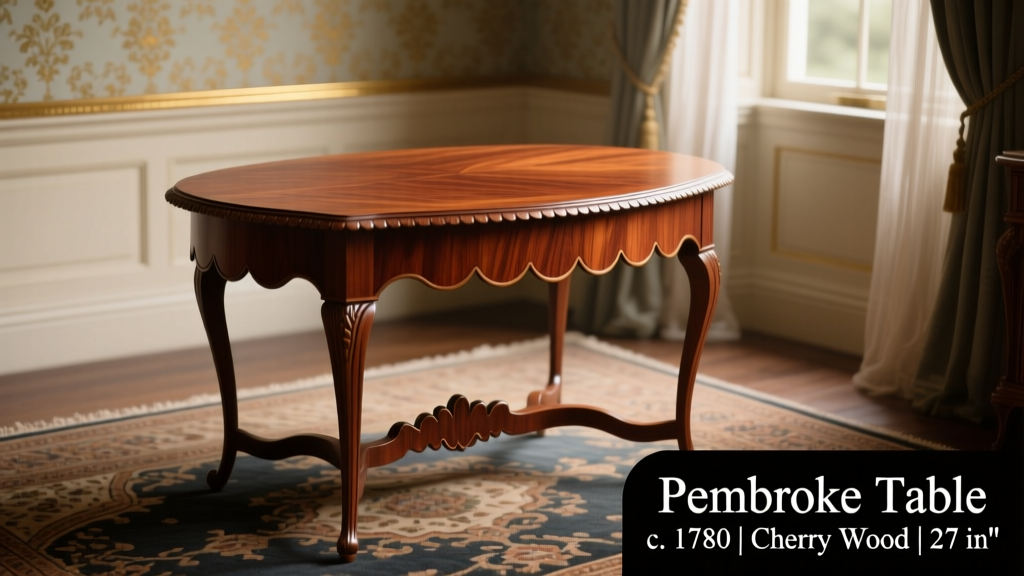
Pembroke Table in Cherry: A 1780 English Masterpiece with Scalloped Stretcher and Shaped Leaves

Value Hint: How Subtle Clues in Antique Furniture Reveal Authenticity and Market Worth

Restoring and Appraising McCary’s Oil-on-Board Floral Bouquet: A Technical Deep Dive on the 11½ × 15½-Inch Work

Decoding the Marque Déposée Circle: 'PF Bear Hugging' Mark Inside French Furniture

The 1950 Coca-Cola Menu Tray: 'Menu Girl Holding Coke — Have a Coke! Thirst Knows No Season' — A Collector's Guide to Design, History, and Restoration
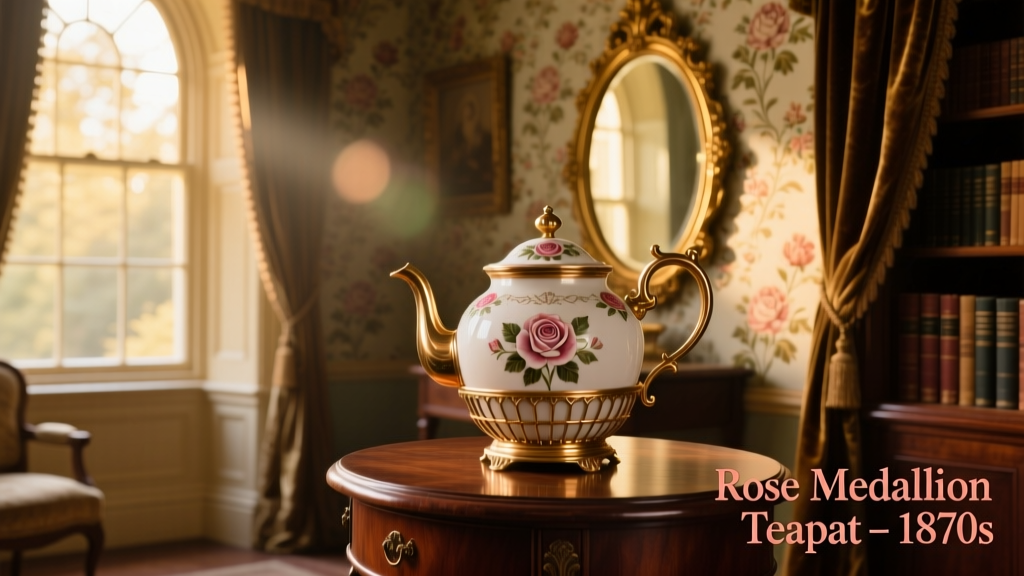
Rose Medallion Teapot Insulated Basket with Brass Fittings: A 19th-Century Masterpiece of Function and Form
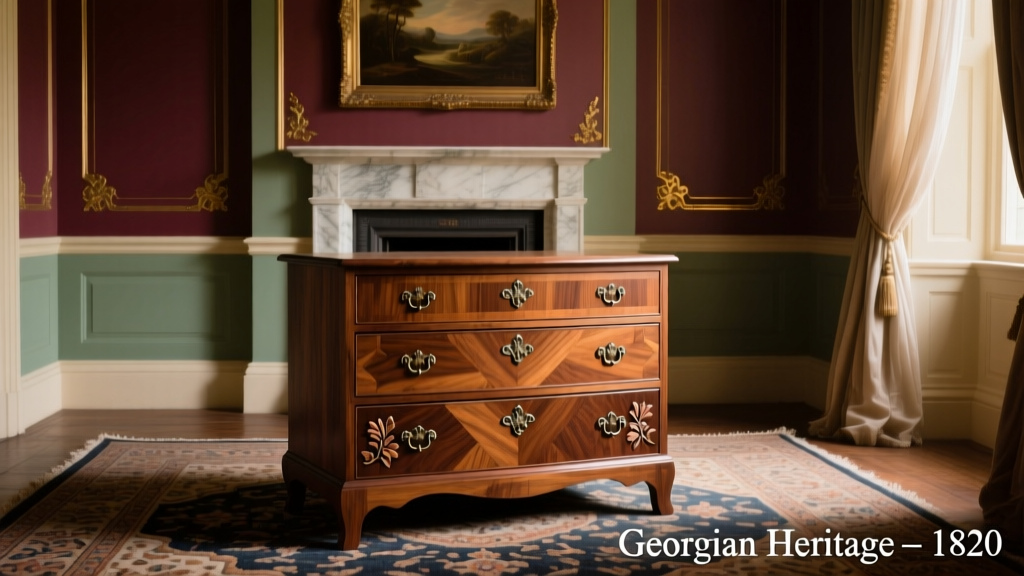
Late Georgian Walnut-and-Maple Chest-on-Stand: A Technical Analysis of Craftsmanship, Materials, and Restoration Protocol
Bennington Bed Pan in Brown Glaze, c. 1840–1860: Dimensions, Provenance, and Restoration Considerations for the 5 × 17½-Inch Specimen

The 1940s Stovetop Potato Baker: Tinware Innovation, Function, and Restoration Insights