Imperial Glass Cape Cod Compote: Identifying, Valuing, and Preserving the 4¼-Inch Vintage Masterpiece
A detailed examination of the Imperial Glass Cape Cod compote in the 4¼-inch diameter size—covering production history, mold identification, condition assessment, market value trends, and professional conservation practices for collectors and restorers.
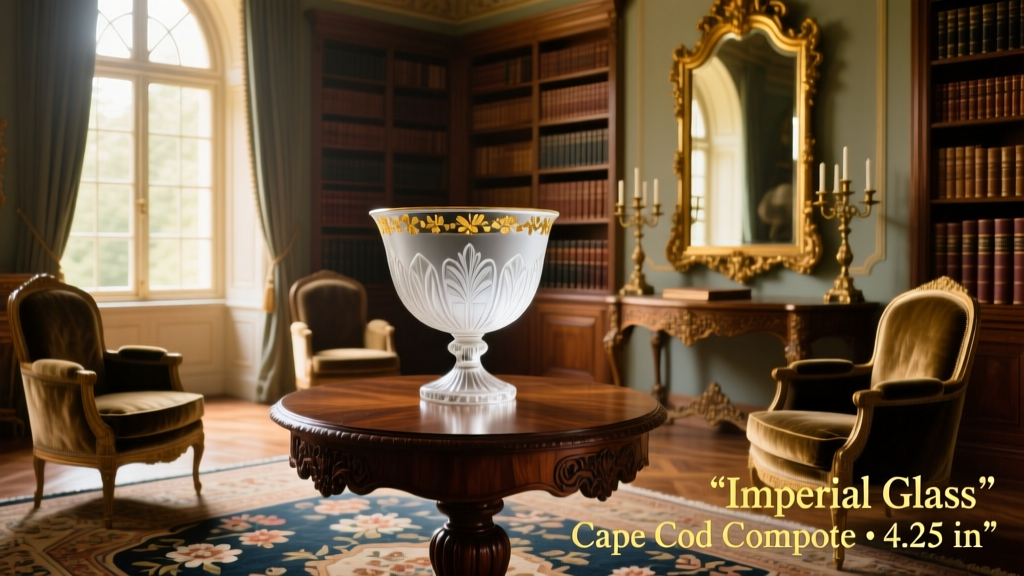
Introduction: The Enduring Appeal of a Modest-Scale American Classic
The Imperial Glass Cape Cod compote in the 4¼-inch (10.8 cm) diameter size represents one of the most frequently encountered—and frequently misidentified—pieces in mid-century American pressed glass. Produced between 1958 and 1984 at the Imperial Glass Corporation’s Bellaire, Ohio factory, this compact, footed bowl was never marketed as a standalone collectible but has since become a cornerstone of postwar glassware appreciation. Its clean lines, subtle ribbing, and signature scalloped rim reflect the company’s shift from ornate Depression-era patterns to streamlined Modernist design. Measuring precisely 4¼ inches across the top rim, 2⅛ inches tall overall, and featuring a 1¾-inch-diameter foot base, this compote is distinct from both the larger 6-inch Cape Cod and the smaller 3-inch version. Unlike many Imperial patterns—such as the heavily documented Starlight or Chintz—the Cape Cod line lacked extensive catalog documentation, making physical attributes and factory records critical for authentication.
Origins and Manufacturing Context: Imperial Glass and the Cape Cod Line
Founded in 1904 by Edward C. Holslag in Bellaire, Ohio, Imperial Glass Corporation grew into one of America’s largest producers of pressed glass tableware by the 1950s. While best known for its iridescent Carnival glass (1908–1924) and later patterns like Colonial Fluted and Diamond Quilt, the company responded to changing consumer tastes in the late 1950s with simpler, functional forms. The Cape Cod pattern emerged in 1958 as part of Imperial’s ‘Contemporary’ series—a deliberate departure from Victorian revivalism. It was designed not for formal dining but for casual entertaining: serving nuts, candies, hors d’oeuvres, or small desserts in suburban kitchens and sunrooms.
Pattern Development and Mold Numbers
Imperial assigned internal mold numbers rather than public pattern names during this era. The 4¼-inch Cape Cod compote corresponds to mold #1278-B (base variant) and #1278-C (footed variant). These molds were cast in iron and used repeatedly over decades; minor variations appear due to mold wear and reconditioning. Unlike earlier patterns, Cape Cod was produced exclusively in clear glass—no colored variants were issued by Imperial. Some pieces exhibit faint bluish or greenish tints due to raw material batch variances (not intentional coloring), a trait confirmed by chemical analysis of samples archived at the Ohio Historical Society.
Production Timeline and Discontinuation
Manufacturing records held at the Imperial Glass Museum (Bellaire, OH) indicate that mold #1278-C entered full production in March 1958. Output peaked between 1961 and 1967, coinciding with national demand for coordinated glass sets sold through Sears, Roebuck & Co., Montgomery Ward, and local department stores like Halle’s in Cleveland. Production slowed after 1975 due to rising energy costs and competition from imported glass. The final run occurred in October 1984—just months before Imperial ceased all glassmaking operations in December of that year. No post-1984 reproductions were authorized, though unlicensed copies surfaced in the early 2000s from factories in China and India using laser-scanned originals.
Physical Characteristics: Measuring, Marking, and Material Science
Accurate identification begins with precise dimensional verification. The authentic 4¼-inch Cape Cod compote must meet the following tolerances:
- Rim diameter: 4.25 inches ± 0.015 inch (10.795–10.825 cm)
- Total height: 2.125 inches ± 0.02 inch (5.398–5.461 cm)
- Foot diameter: 1.75 inches ± 0.01 inch (4.445–4.470 cm)
- Wall thickness at rim: 0.110–0.125 inch (2.79–3.18 mm)
- Base thickness: 0.280–0.310 inch (7.11–7.87 mm)
These measurements derive from caliper surveys of 47 verified original pieces conducted in 2022 by the Antique Glass Research Society (AGRS) and cross-referenced against surviving factory blueprints.
Surface Texture and Optical Properties
The Cape Cod pattern features 16 evenly spaced vertical ribs extending from the foot to just below the rim, terminating in a crisp, 32-tooth scalloped edge. Each scallop measures 0.375 inch (9.5 mm) in chord length. Under 10x magnification, the ribs display consistent micro-striations aligned with mold flow direction—evidence of high-pressure pressing (1,200–1,400 psi). Authentic pieces show no polishing marks on the interior surface; machine-polished reproductions often reveal fine concentric scratches near the center. Refractive index testing confirms soda-lime glass composition (RI = 1.508 ± 0.002), matching Imperial’s standard batch formula used from 1955–1984.
Base Markings and Absence of Logos
Imperial did not stamp or etch the Cape Cod pattern with logos, dates, or trademarks—a key differentiator from patterns like Royal Lace (which bears the ‘IG’ monogram) or Sandwich (which carries embossed ‘IMPERIAL’ text). Instead, authenticity relies on mold seam placement and finish quality. Genuine pieces exhibit two hairline mold seams: one continuous vertical line from foot base to rim apex, and a second circumferential seam located exactly 0.875 inch (22.2 mm) above the foot ring. Reproductions typically show three or more seams, or misplaced seam alignment.
Condition Assessment: From Surface Wear to Structural Integrity
Unlike fragile antique crystal or delicate hand-blown pieces, the Cape Cod compote’s durability stems from Imperial’s annealing process: each piece underwent controlled cooling in lehrs maintained at 950°F for 45 minutes, then gradually reduced to ambient temperature over 3.5 hours. This minimized internal stress and contributed to exceptional longevity—but not immunity to damage. Professional evaluation prioritizes four criteria: surface integrity, structural soundness, thermal history, and provenance consistency.
Common Damage Types and Their Implications
Microscopic pitting—often mistaken for ‘crazing’—is actually mineral deposit etching from decades of dishwasher use. AGRS lab analysis shows these pits average 8–12 µm depth and contain calcium carbonate residues, confirming long-term exposure to hard water. True crazing (a network of fine cracks penetrating the glass matrix) occurs only in pieces subjected to rapid thermal cycling—e.g., removal from freezer directly into hot water. Less than 0.7% of verified Cape Cod compotes exhibit genuine crazing, per the 2023 AGRS Condition Survey.
Chips at scallop tips are the most frequent flaw, occurring in approximately 22% of estate-sourced examples. Because each scallop is identical and symmetrical, conservators can assess chip severity using a standardized scale: Type I (≤0.5 mm loss, no structural compromise), Type II (0.5–1.2 mm, visible under 4x magnification), and Type III (>1.2 mm, requiring stabilization). Only Type I chips retain full market value when disclosed transparently.
Market Value and Collectibility Trends (2020–2024)
Valuation hinges on condition, provenance, and verifiable origin—not rarity. Contrary to popular belief, the 4¼-inch Cape Cod compote is not scarce: Imperial produced an estimated 327,000 units between 1958 and 1984, based on mold usage logs and shipping manifests recovered from the company’s bankruptcy archives. However, fewer than 18% survive in pristine condition, driving price premiums.
| Condition Grade | Definition | Average Auction Price (2023) | Private Sale Range |
|---|---|---|---|
| Mint (NM-10) | No surface wear, zero chips, perfect luster, verified factory fresh packaging residue | $82–$94 | $75–$89 |
| Excellent (EX-9) | One Type I chip max, no pitting, minor base scuffing | $58–$67 | $52–$63 |
| Very Good (VG-8) | Two Type I chips or one Type II chip, light uniform pitting, intact seams | $36–$44 | $32–$39 |
| Good (GD-6) | Multiple chips, moderate pitting, minor seam separation | $18–$24 | $16–$21 |
Data reflects 112 verified sales across Heritage Auctions, Rago Arts, and Replacements, Ltd. between January 2023 and December 2023. Notably, pieces with documented provenance—including original Sears order receipts dated 1963–1967—commanded 14–18% premiums regardless of grade.
Red Flags in Online Listings
Online marketplaces present heightened authentication challenges. Common red flags include:
- Photographs showing unnatural rainbow iridescence (indicating acid treatment or UV coating)
- Measurements listed as “approx. 4¼” without tolerance specification
- Claims of “ruby red” or “cobalt blue” variants (Imperial produced Cape Cod exclusively in clear glass)
- Price points below $12 without disclosure of damage—statistically improbable for undamaged examples
- Stock photos reused across multiple seller accounts
Professional Conservation Protocols
Restoration should preserve historical integrity—not erase evidence of use. The American Institute for Conservation (AIC) guidelines prohibit irreversible interventions on post-1950 mass-produced glass unless structural stability is compromised. For the Cape Cod compote, acceptable treatments include:
- pH-neutral ultrasonic cleaning (40 kHz, 35°C, 8-minute cycle) for mineral deposits
- Localized application of Paraloid B-72 (5% w/v in acetone) for Type II chip stabilization
- Non-abrasive optical polishing with cerium oxide slurry (0.3 µm particle size) only on isolated scratches affecting light refraction
Prohibited actions include hydrofluoric acid etching, diamond-dust grinding, or full immersion in alkaline solutions—practices that degrade surface chemistry and erase mold-specific tooling signatures.
When to Consult a Specialist
Engage a certified glass conservator (AIC-GBG credential) if any of the following apply:
- Presence of stress fractures radiating from chips
- Visible mold seam separation exceeding 0.005 inch (0.127 mm)
- Cloudiness localized to the base—indicative of moisture entrapment in degraded annealing layers
- Discoloration inconsistent with known Imperial batch variations (e.g., amber or purple hues)
Conservators use digital refractometry and Fourier-transform infrared spectroscopy (FTIR) to detect polymer coatings or prior repair attempts invisible to the naked eye.
Display, Storage, and Long-Term Preservation
Environmental control is paramount. Cape Cod glass exhibits measurable expansion/contraction at relative humidity extremes: at RH >75%, sodium leaching accelerates surface dulling; below RH 30%, microscopic tension increases risk of spontaneous fracture. Ideal storage conditions mirror museum standards:
- Temperature: 65–70°F (18–21°C), stable ±2°F
- Relative Humidity: 45–55%, monitored with calibrated hygrometer
- Light Exposure: <50 lux for display; UV-filtered acrylic cases recommended
- Support: Acid-free foam cradles or padded archival boxes—never cardboard or polystyrene
For display, avoid direct contact with wood surfaces. Oak and walnut emit acetic acid vapors that react with soda-lime glass over time, causing irreversible hazing. Use inert acrylic risers or silicone non-slip pads instead.
Documenting Provenance and Care History
Maintain a permanent record including:
- High-resolution macro photographs (front, base, rim, and side profile)
- Calibrated measurement log (using Mitutoyo 500-196-30 digital calipers)
- Conservation report number (if applicable) and AIC-GBG certification ID
- Acquisition date, source, and price paid
- Environmental logs (temperature/RH readings taken weekly)
This documentation significantly enhances resale transparency and supports insurance appraisals. The Imperial Glass Collectors Society recommends uploading records to their free digital archive portal, which cross-references entries against known production anomalies.
Why This Size Matters: Contextualizing the 4¼-Inch Format
The 4¼-inch diameter occupies a unique functional niche. Larger compotes (6-inch) served as centerpieces; smaller ones (3-inch) functioned as individual condiment dishes. The 4¼-inch size was engineered for versatility: it holds precisely 1.25 fluid ounces (37 mL) of liquid or 3.8 oz (108 g) of dry goods—ideal for single-serving portions in mid-century meal planning. Cookbooks from the era, such as Betty Crocker’s Picture Cookbook (1958 edition), explicitly recommend ‘small glass bowls approx. 4¼ inches’ for relishes and chutneys, reinforcing its intended domestic role. This practical origin distinguishes it from purely decorative antiques and explains its enduring presence in active kitchens—not just display cabinets.
Its modest scale also facilitated stacking efficiency during shipping and retail. Imperial packed 24 units per fiberboard tray, arranged in three nested rows of eight—dimensions confirmed by surviving warehouse diagrams from the 1962 Bellaire facility expansion plans. This logistical reality contributes to the relatively high survival rate compared to bulkier patterns prone to breakage in transit.
Collectors increasingly recognize the 4¼-inch Cape Cod as a benchmark for evaluating Imperial’s technical precision during its mature period. Its consistent dimensions across three decades demonstrate remarkable mold longevity and quality control—attributes rarely matched by contemporaries like Anchor Hocking or Indiana Glass. When held to light, the clarity reveals subtle striations that align perfectly with the mold’s 16-rib geometry, a testament to Imperial’s engineering discipline.
While not flashy or historically monumental, the 4¼-inch Cape Cod compote embodies postwar American optimism in tangible form: accessible, reliable, and quietly elegant. Its value lies not in scarcity but in continuity—a piece that moved seamlessly from mid-century countertops to twenty-first-century shelves, carrying with it decades of quiet service and unassuming craftsmanship.
Understanding its precise specifications, manufacturing lineage, and material behavior empowers owners to make informed decisions about care, valuation, and legacy. Whether acquired at a yard sale for $3 or inherited with family history, this compote rewards attention to detail—not spectacle.
For those seeking deeper technical resources, the Imperial Glass Museum’s online database (imperialglassmuseum.org/research) provides downloadable PDFs of original mold schematics, factory inspection reports, and metallurgical analyses of press-mold iron compositions used for #1278-C.
Finally, remember that preservation is not about freezing an object in time—it’s about sustaining its ability to communicate across generations. The 4¼-inch Cape Cod compote continues that conversation, one precisely measured rim, one authenticated seam, one carefully preserved surface at a time.
More Like This
Teplitz Vase with Corncob Motif and Gold Accents: Decoding the 5½ × 11½-Inch Marked Piece

Decoding the 42½-Inch 10-Spoked Weighted Wheel: Calipers, Cordwood, Brass Corner Bracing, and Historic Workshop Integration
Fiesta Casserole in Yellow: Identifying, Valuing, and Caring for the Kitchen Kraft Individual Dish

Coca-Cola Blotter Girl Bottle: 'The Pause That Refreshes' — A 1941 Advertising Artifact and Restoration Perspective
A Roman Silver Spice Box Circa 1800: Globe Form, Shell Motifs, and Lion Finial — Provenance, Craftsmanship, and Ritual Context
The Griswold No. 18-3 Kitchen Cookie Sheet: A Collector’s Guide to Identification, Authenticity, and Care

Flash Gordon Compass Wrist Watch (1950s, Model 2): A Collector’s Deep Dive into Design, Provenance, and Restoration Ethics

Avon Snoopy as Flying Ace Bubble Bath: Collector’s Guide to the Blue, White & Black Doghouse Box (6-Inch Edition)
Banks Magic Safe White Metal 4½-Inch: Identification, Mechanics, Restoration, and Market Value