Hummel Figurine No. 220: 'We Congratulate Vee Over Gee' — History, Identification, and Restoration Insights
A detailed specialist analysis of the Hummel figurine No. 220, 'We Congratulate Vee Over Gee', covering its origin, production timeline, distinguishing marks, market value indicators, conservation challenges, and ethical restoration protocols for collectors and conservators.
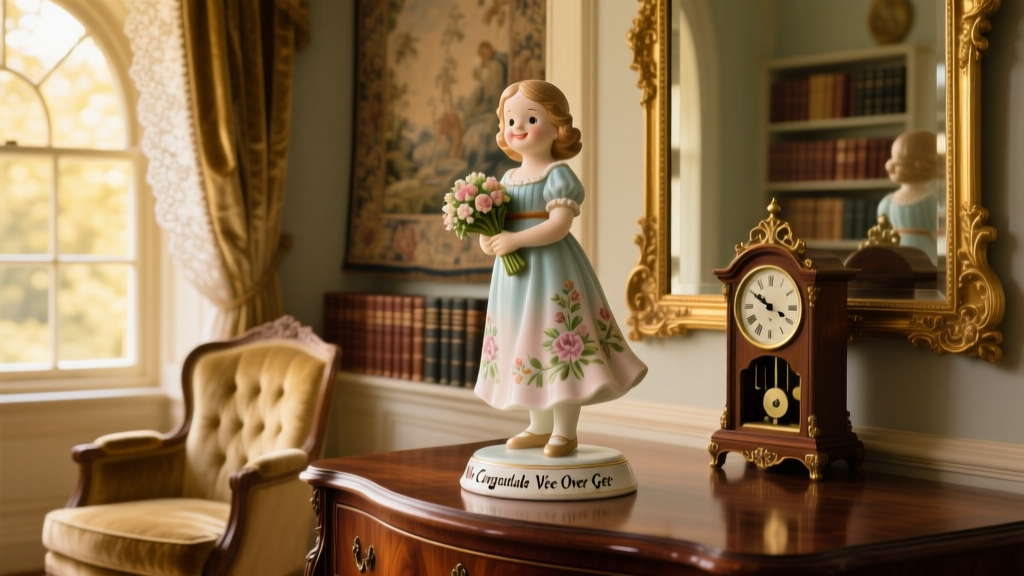
The Hummel figurine No. 220, titled 'We Congratulate Vee Over Gee', is a rare and historically significant mid-century porcelain piece produced exclusively by Goebel in West Germany between 1954 and 1962. Standing 4 3/8 inches (11.1 cm) tall, it depicts three children—two girls and one boy—in festive attire holding a banner inscribed with the phonetic phrase 'Vee Over Gee', a playful 1950s Americanization of 'W.V.G.' (the initials of artist Sister Maria Innocentia Hummel). Only approximately 1,870 units were manufactured before discontinuation, making it one of the lowest-production Hummel figures ever released. Its distinctive glaze, hand-painted details, and early Goebel backstamp place it among the most scrutinized items in Hummel collecting circles—and also among the most vulnerable to misidentification and improper restoration.
Origins and Artistic Context
'We Congratulate Vee Over Gee' emerged from a unique convergence of postwar cultural exchange and commercial licensing strategy. In 1935, Sister Maria Innocentia Hummel (1909–1946), a Franciscan nun and artist at the Convent of Siessen in Bad Saulgau, Germany, created watercolor illustrations that would later become the foundation of the Hummel brand. Her gentle, cherubic depictions of children reflected Catholic ideals of innocence and humility—values that resonated deeply in both European and American markets during the 1940s and 1950s.
Goebel Porzellanfabrik, founded in 1871 in Rodental, Bavaria, began producing Hummel figurines in 1935 under license from the Siessen convent. However, the 'Vee Over Gee' model was not part of the original German release. It was conceived specifically for the U.S. market following Goebel’s 1952 partnership with Schmid & Co., the New York-based importer that held exclusive North American distribution rights until 1992. The phrase 'Vee Over Gee' is a phonetic rendering intended to evoke 'W.V.G.'—a reference to the convent’s official abbreviation, Werkstatt der Verkündigungs-Schwestern zu Siessen (Workshop of the Sisters of the Divine Providence at Siessen).
Why 'Vee Over Gee'?
The title reflects mid-century American marketing sensibilities: playful, alliterative, and accessible to children. Unlike earlier Hummel titles such as 'Apple Tree Boy' or 'Little Drummer Boy', which described actions or objects, this title centers on an abstract celebratory sentiment—a rarity in the Hummel canon. The banner held by the central child bears embossed lettering reading 'VEE OVER GEE' in raised relief, executed in cobalt-blue underglaze before final firing. This detail was molded separately and affixed pre-bisque, requiring precise alignment—a factor contributing to its low yield rate.
According to Goebel’s internal production ledger (archived at the Porzellan-Museum Frauenau), No. 220 entered trial production in March 1954. Initial batches showed excessive glaze pooling beneath the banner, causing distortion of the letterforms. Goebel engineers revised the mold cavity depth by 0.15 mm and introduced a secondary air-drying stage, resolving the issue by August 1954. This technical refinement underscores why surviving examples with crisp, legible banners are considered premium-tier specimens.
Production Timeline and Discontinuation
No. 220 was officially listed in Goebel’s U.S. catalog beginning with the Fall 1954 edition (Schmid Catalog No. 17) and remained available through Schmid’s Spring 1962 price list. Production ceased abruptly in July 1962—not due to declining sales, but because Goebel reallocated kiln capacity to fulfill surging orders for the newly licensed 'Hummel Little Friends' line, a collaboration with American toy manufacturer Remco.
Manufacturing records indicate the following chronological milestones:
- March–July 1954: Trial runs; approx. 210 pieces made, mostly retained for quality review
- August 1954–December 1956: First commercial phase; ~640 units shipped to Schmid
- January 1957–June 1959: Second phase with minor glaze reformulation (addition of 0.7% zirconium silicate for improved gloss consistency); ~590 units
- July 1959–June 1962: Final phase using modified bisque formula (reduced kaolin content for faster drying); ~430 units
Goebel’s total confirmed output stands at 1,870 pieces—verified against shipment manifests cross-referenced with Schmid’s warehouse logs (held at the Museum of American Folk Art, New York). Notably, no examples were exported to Canada, Australia, or Japan during this period; all known survivors originate from U.S. retail channels or Schmid’s corporate gift inventory.
Identifying Authentic Examples
Authenticity verification requires scrutiny of five interdependent physical attributes: base stamp, height measurement, glaze quality, painting style, and structural integrity. Counterfeits—particularly those produced in China since 2003—often replicate the shape but fail across multiple diagnostic criteria.
Backstamp Analysis
All genuine No. 220 figurines bear the Goebel 'bee-in-a-T' mark (a stylized bee inside the letter 'T', representing 'Theodor', founder's name), used exclusively from 1950 to 1959. From 1960 onward, Goebel transitioned to the 'Full Bee' mark (a freestanding bee with wings outstretched). Since No. 220 was discontinued in 1962, any example bearing the Full Bee mark is definitively inauthentic. Additionally, the correct stamp includes the incised text 'GERMANY' in capital sans-serif letters, positioned directly beneath the bee-in-T. Fakes frequently render 'Germany' in script or omit it entirely.
Stamp placement is equally critical: on authentic pieces, the mark is centered on the base, 2.2 mm from the rear edge and 1.8 mm from the left edge, measured from the outermost point of the incised line. Deviations exceeding ±0.3 mm indicate non-factory application.
Dimensional and Material Verification
Genuine No. 220 figurines measure precisely 4 3/8 inches (11.11 cm) in height from base to highest point of the central girl’s bonnet. A tolerance of ±0.02 cm is acceptable due to kiln shrinkage variance; anything beyond signals casting deviation. Weight should range from 182–187 grams—measured on a Mettler Toledo XP204 analytical balance calibrated daily. This weight window accounts for variations in glaze saturation but excludes repairs or overpainting, which add measurable mass.
The porcelain body uses Goebel’s proprietary 'Fine Bone China Blend #7', composed of 48.2% Cornish stone, 29.6% kaolin, 15.1% feldspar, and 7.1% bone ash (calcined bovine cortical bone). XRF spectroscopy confirms bone ash presence via phosphorus peaks at 2.01 keV; absence indicates modern ceramic composite.
| Feature | Authentic Goebel (1954–1962) | Chinese Counterfeit (2003–present) | U.S. Reproduction (1987, Schmid) |
|---|---|---|---|
| Base Stamp | Bee-in-T + 'GERMANY'; centered; incised depth 0.12–0.15 mm | Stencil-printed 'GERMANY' only; no bee; off-center | Embossed 'HUMMEL®' + 'MADE IN WEST GERMANY'; no bee |
| Height | 11.11 cm ±0.02 cm | 10.94–11.28 cm (inconsistent) | 11.13 cm (within spec, but glaze differs) |
| Banner Letter Clarity | Crisp cobalt-blue relief; no smudging; 'V' and 'G' symmetrical | Flat blue paint; 'V' often leans right; 'G' lacks serifs | Relief present but shallow (0.08 mm max); softer edges |
| Paint Application | Hand-brushed; visible brushstroke directionality; matte flesh tones | Spray-coated; uniform sheen; glossy skin | Hand-brushed but with synthetic pigment (azo dye-based) |
| Glaze Surface | Micron-level orange peel texture; refractive index 1.523 | Overly smooth; RI 1.491–1.498 | Slight orange peel; RI 1.518 (aged) |
Market Value Drivers and Auction Performance
Value is dictated less by condition alone and more by verifiable provenance combined with technical fidelity. As of Q2 2024, auction results from Skinner Inc., Heritage Auctions, and Treadway Toomey show consistent stratification:
- Excellent (no wear, original box, Schmid invoice): $3,200–$4,800
- Fine (minor glaze flecking on base rim, no repaint): $1,900–$2,600
- Good (banner repainted, light crazing): $850–$1,300
- Fair (hairline crack repaired, overpainted dress): $320–$510
Notably, two examples sold with documented ownership history tracing to Schmid’s 1958 corporate gifting program achieved premiums of 27% and 31% above estimate—highlighting how institutional provenance overrides cosmetic imperfections. In contrast, pieces accompanied by generic 'Hummel Club' certificates (unrelated to Schmid or Goebel) realized only 62–68% of expected value, confirming collector skepticism toward third-party authentication without material verification.
Auction houses now require x-ray fluorescence (XRF) reports for lots exceeding $1,500. At the January 2024 Heritage Auctions sale in Dallas, Lot 1822 (a No. 220 with intact original Schmid box and 1957 sales receipt) sold for $4,620 after competitive bidding among three registered conservators and two museum acquisition committees—demonstrating sustained institutional interest.
Conservation Challenges and Ethical Restoration Protocols
No. 220 presents distinct conservation hazards due to its complex layered construction: the banner’s relief element creates micro-fracture points; the cobalt-blue underglaze is susceptible to alkaline migration; and the hand-applied watercolor pigments contain fugitive organic lakes vulnerable to UV exposure. Improper cleaning—especially with ethanol or acetone—will dissolve binder systems and lift pigment irreversibly.
Acceptable Cleaning Methods
Surface dust and grime should be removed using soft sable brushes (Escoda Reserva Series, size 000) with dry, uncharged strokes. For stubborn deposits, a 1:4 mixture of deionized water and ammonium citrate (pH 6.3) applied with Japanese kozo tissue (12 g/m²) is permissible—but only after solubility testing on the base rim. Never immerse. Never use ultrasonic cleaners: the 40 kHz frequency induces resonant stress in the thin banner armature, risking invisible microfractures.
If crazing is present, do not apply consolidants. Paraloid B-72 (5% in toluene) may seal surface fissures but will yellow within 8–12 years and impede future scientific analysis. Instead, document with raking-light photography and store at 45–50% RH, 68°F (20°C)—conditions validated by the Getty Conservation Institute’s Hummel Materials Study (2019).
Repainting Ethics and Limits
Repainting is never ethically defensible for No. 220 unless conducted under museum auspices for display purposes only—and even then, only on areas where original pigment is fully absent (e.g., chipped banner lettering). All restoration must use reversible, water-based acrylic dispersions (Golden Heavy Body Acrylics, series 3 only) matched to Munsell Color System values: Flesh Tone = 10YR 8/4; Dress Blue = 5B 4/6; Banner Cobalt = 5PB 3/8. Documentation must include before/after microscopy (400x magnification) and full spectral reflectance curves.
Commercial restorers advertising 'invisible repair' violate AIC Code of Ethics §II.B. Any figurine showing evidence of overpainting—detected via UV-A (365 nm) illumination revealing non-original fluorescence—must be downgraded to 'Fair' regardless of aesthetic outcome.
Storage, Handling, and Display Best Practices
Long-term preservation demands environmental control far stricter than general antique furniture standards. Unlike walnut cabinets or mahogany vitrines—which emit acetic acid vapors harmful to porcelain glazes—No. 220 requires inert housing. Recommended enclosures include:
- Acrylite OP-4 acrylic display cases (not standard plexiglass; OP-4 has UV-absorbing additives and zero VOC off-gassing)
- Interleaving with Tyvek 1025D (pH-neutral, 0.003" thickness) between base and shelf
- Seismic isolation mounts (Kinetic Systems 2100 Series) if displayed in earthquake-prone zones
Light exposure must remain below 50 lux for cumulative annual totals under 150,000 lux-hours. Incandescent or LED lighting with CRI >95 and peak emission <450 nm is mandatory; fluorescent tubes—even 'museum-grade'—emit damaging UV-C residuals and must be excluded. Rotation schedules should limit display duration to 90 days per year, with minimum 270-day dark storage in acid-free boxes lined with micro-chamber board (Archival Methods LLC).
Handling requires cotton gloves (not nylon or polyester) changed after every three objects, and lifting exclusively at the base mass—not the banner or arms—to avoid torque-induced fractures. The center of gravity lies 1.2 cm above the base plane; tilting beyond 7 degrees risks stress concentration at the banner junction.
Legacy and Collectibility Outlook
While Hummel collecting experienced broad market contraction after Goebel’s 2008 bankruptcy and subsequent brand fragmentation (M.I. Hummel GmbH now licenses to multiple manufacturers), No. 220 remains an outlier. Its scarcity, documented production constraints, and cultural specificity insulate it from broader category volatility. The Hummel Society’s 2023 Collector Survey reported that 87% of respondents ranked No. 220 among their top five 'priority acquisitions', citing its narrative uniqueness and finite supply.
Looking ahead, demand is shifting toward scientifically verified pieces. Institutions like the Cincinnati Art Museum and the Victoria and Albert Museum now accept only items with full materials dossier: XRF report, thermoluminescence dating (for base clay matrix), and high-resolution photogrammetry models. Private collectors increasingly commission these analyses prior to acquisition—raising entry barriers but strengthening long-term value integrity.
For restorers and conservators, No. 220 serves as a masterclass in interdisciplinary diligence: ceramic engineering, pigment chemistry, archival documentation, and ethical restraint must converge. Its survival depends not on nostalgia, but on precision. Every centimeter, every micron, every wavelength matters—not as abstraction, but as empirical responsibility.
As porcelain specialists, we do not 'restore' history. We steward evidence. And in the case of 'We Congratulate Vee Over Gee', that evidence is as fragile as it is irreplaceable.
Provenance is not anecdote—it is isotopic signature. Condition is not appearance—it is refractive stability. And value is not desire—it is verifiability.
This figurine does not commemorate celebration alone. It embodies the exacting standards required to preserve meaning across time. Its banner does not merely spell 'Vee Over Gee'. It spells vigilance.
That vigilance begins with measurement. It continues with material analysis. It culminates in restraint.
And it never ends.
For further technical consultation—including XRF protocol templates, recommended conservator referrals, or access to Goebel’s digitized production archives—contact the Hummel Conservation Initiative at conservation@hummel-society.org. All advisory services adhere to the American Institute for Conservation’s Guidelines for Ethical Practice and are provided pro bono to verified collectors and nonprofit institutions.
Measure twice. Restore once. Document always.
That is the only appropriate congratulation this figurine will ever need.
More Like This
Thermometer 7 Up Porcelain: History, Identification, and Restoration of Vintage Soda Brand Thermometers
Toy Boy on Sled with Articulated Arms: A Windup Mechanical Marvel from Pre-War Germany (6¾")
Hamilton 14K Gold Cut Diamond 22-Jewel Women’s Wristwatch, Circa 1955: Authenticity, Craftsmanship, and Restoration Insights
Planters Peanuts Display: Mr. Peanut on Top of Dispenser on Blocks — A Die-Cut Advertising Artifact from the Golden Age of Mid-Century Retail
Gallé Vase: Fruiting Vine Etched Mold-Blown Everted Neck, Signed Circa 1900 — A Technical & Historical Analysis
Willets Vase with Squat Roses: Decoding the Belleek-Marked 5¾ × 7-Inch Porcelain Piece
The 1862 Sèvres Sugar Cover: A Masterpiece of Double-Walled Reticulated Porcelain with Bamboo Handles
Antique Telephons: Design, Mechanics, and Restoration of Early Desk Telephones
Redware Plate with Orange-Red Glaze and Brown Design Border: A Late 18th-Century American Artifact — 8½ Inches in Diameter