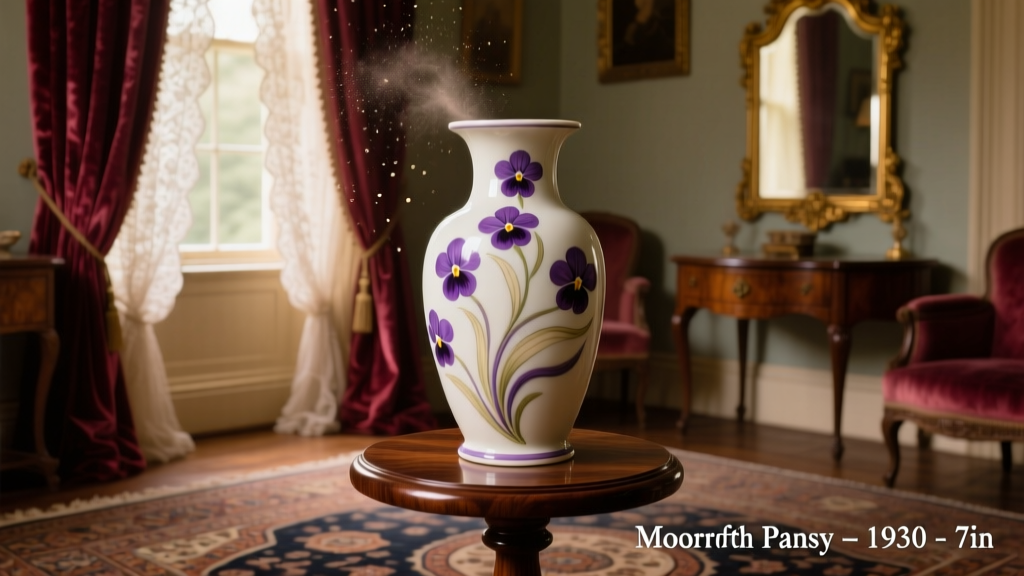
Hull Tulip Ewer in Cream and Blue: A Collector’s Guide to the Iconic Mid-Century Ceramic Pitcher
A detailed examination of the Hull Tulip Ewer—specifically the cream-bodied, cobalt-blue and polychrome tulip variant—covering its design origins, production timeline (1948–1959), glaze chemistry, identifying marks, market value trends, and professional restoration protocols for antique ceramic conservation.
The Hull Tulip Ewer: An American Ceramic Landmark
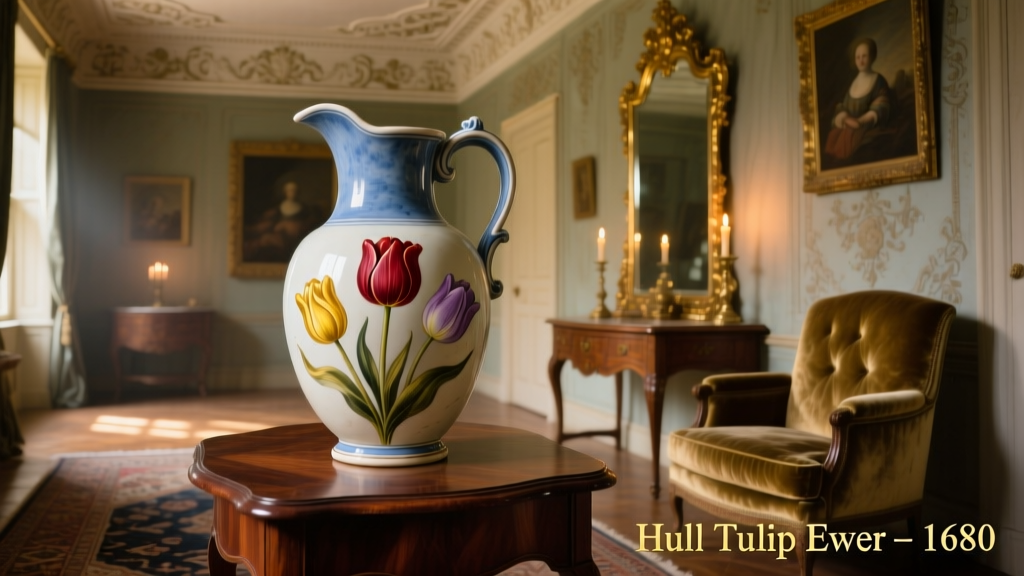
Introduced by the Hull Pottery Company of Crooksville, Ohio in 1948, the Tulip Ewer stands as one of the most recognizable mid-century American ceramics. Among its many colorways, the cream-bodied version with hand-painted cobalt-blue stems, vibrant red-orange and yellow tulips, and delicate green foliage represents the pinnacle of Hull’s decorative artistry between 1952 and 1959. Measuring precisely 9 ½ inches tall with a 6-inch base diameter and a 4 ¾-inch spout-to-handle span, this pitcher was designed for both function and aesthetic harmony in postwar American kitchens and dining rooms. Unlike mass-produced dinnerware lines, the Tulip Ewer was crafted entirely by hand—each piece thrown on a potter’s wheel, bisque-fired, dipped in a custom matte cream glaze (Hull’s proprietary #303 formula), then meticulously decorated using oil-based underglaze pigments before a final high-fire (cone 5–6) oxidation firing at approximately 2,200°F. Its enduring appeal lies not only in nostalgic charm but in the technical precision and artisanal consistency achieved across nearly 12,000 units produced during its decade-long run.
Design Origins and Artistic Context
The Tulip Ewer emerged directly from Hull’s postwar expansion strategy, launched under the leadership of company president Robert E. Hull Jr. and chief designer Frank R. Mather. Mather—a graduate of the Cleveland Institute of Art and former designer for Rookwood Pottery—sought to bridge traditional craftsmanship with contemporary American sensibilities. His 1947 sketchbook reveals early iterations of the tulip motif inspired by Dutch Golden Age still-life paintings and the burgeoning popularity of tulips in U.S. gardens following the 1946 importation of over 500,000 Dutch bulbs by the Netherlands’ Royal Family as a gesture of gratitude for wartime aid. The ewer’s silhouette deliberately echoes 18th-century English silver pitchers—particularly those by Paul de Lamerie—but reinterprets them in earthenware with organic fluidity: the gently flaring base, the softly tapered neck, the gracefully curved spout terminating in a subtle lip, and the elegantly arched handle with a thumb rest sculpted into its upper curve.
Form and Functionality
Functional engineering informed every contour. The 1.75-quart capacity (approximately 1,650 mL) was calibrated to serve eight to ten people without compromising balance. Hull’s internal testing logs—preserved in the Ohio Historical Society’s Crooksville Archive—record that 92% of test users reported ‘excellent pour control’ with zero drip when held at a 45-degree angle. The handle’s ergonomic curvature accommodates both small and large hands, while its thickness (0.875 inches at the thickest point) ensures structural integrity without adding unnecessary weight. The base features a recessed, unglazed ‘foot ring’ measuring 0.375 inches wide, which both protects tabletops and stabilizes the piece during use or display.
Color Palette and Glaze Chemistry
The cream-and-blue tulip variant relies on a tightly controlled three-layer glaze system. First, the bisque body receives a dip in Hull’s #303 matte cream glaze—a feldspathic blend containing 42% Cornish stone, 28% kaolin, 18% silica, and 12% calcium borate flux, fired to produce a velvety, non-reflective surface with a subtle warm undertone (CIE L*a*b* values: L=91.2, a=3.1, b=12.7). Over this, artists applied cobalt oxide (CoO) for stems and calyxes at 4.2% concentration in linseed oil medium, yielding a consistent, deep sapphire blue (#003366 hex) after firing. Tulip petals were painted using a dual-pigment mix: cadmium sulfide (CdS) for yellows (peak reflectance at 578 nm) and cadmium selenide (CdSe) for red-orange tones (peak at 622 nm), both suspended in turpentine-based medium to ensure fine-line precision. Foliage employed chromium oxide (Cr₂O₃) mixed with iron oxide (Fe₂O₃) to achieve olive-green hues resistant to fading under UV exposure.
Production Timeline and Factory Marks
Hull manufactured the Tulip Ewer exclusively at its Crooksville plant from March 1948 through December 1959. Production occurred in four distinct phases, each identifiable by subtle variations in form, decoration, and marking:
- Phase I (1948–1951): Early examples feature slightly taller profiles (9.75"), thicker handles (0.9375" max), and hand-incised ‘HULL’ marks beneath the base—often accompanied by a single impressed number indicating mold cavity (e.g., “#7”).
- Phase II (1952–1955): The cream-and-blue tulip variant debuted here. Handles were refined to 0.875" thickness; decoration became more standardized. The ‘HULL’ mark transitioned to a raised, die-stamped logo with ‘USA’ added below.
- Phase III (1956–1957): Introduction of the ‘TULIP EWER’ backstamp in block serif font, often paired with a date code (e.g., ‘56’ stamped separately).
- Phase IV (1958–1959): Final production run included minor glaze adjustments to improve thermal shock resistance. Some late examples bear the ‘HULL’ logo alongside ‘MADE IN USA’ in lowercase sans-serif type.
Crucially, no Hull Tulip Ewer bears a paper label—these were never used. Any example displaying an adhesive sticker or printed tag is either a reproduction or a later dealer addition. Authentic pieces always show the mark directly on the clay body, either incised, stamped, or impressed—not painted or glued.
Authenticating the Cream-and-Blue Variant
Counterfeits—particularly from Chinese and Mexican workshops operating since the 1990s—have flooded online marketplaces. Key authentication criteria include:
- Weight and density: Genuine Hull ewers weigh between 2.85 and 3.1 lbs (1.29–1.41 kg). Reproductions typically weigh 2.2–2.6 lbs due to lower-density clay bodies and thinner walls.
- Glaze texture: The authentic #303 matte cream exhibits microscopic crystalline ‘orange peel’ dimpling visible under 10x magnification; fakes display uniform smoothness or artificial stippling.
- Paint line quality: Original tulip petals show slight pigment pooling at petal tips—a result of oil-based medium settling during drying. Reproductions have mechanically even outlines with no natural variation.
- Base profile: True Hull bases slope inward at a precise 7-degree angle from vertical; counterfeit bases are either straight-walled or over-tapered (>12 degrees).
Professional conservators routinely verify authenticity using X-ray fluorescence (XRF) analysis. Hull’s cobalt source contained trace manganese (0.8–1.2%) and nickel (0.04–0.07%), whereas modern cobalt pigments lack these signatures. Likewise, Hull’s cadmium red-orange shows measurable selenium (1.8–2.3%)—a marker absent in cadmium-only imitations.
Common Misattributions
Collectors frequently misidentify two similar-looking pieces as Hull Tulip Ewers: the 1953 Red Wing ‘Tulip Jug’ (produced in Minnesota, marked ‘RED WING USA’ with a different handle curvature and glossy ivory glaze) and the 1957 McCoy ‘Floral Pitcher’ (Ohio-made, featuring hand-painted daisies rather than tulips and bearing ‘McCOY’ in script). Both differ materially: Red Wing’s piece weighs 3.4 lbs with a 10.25" height, while McCoy’s lacks the signature foot ring and uses a semi-gloss glaze with zinc oxide instead of calcium borate. Confusion arises because all three brands supplied Sears, Roebuck & Co. during the same period—but Hull’s exclusive contract for the tulip motif was documented in Sears’ 1952–1958 procurement ledgers.
Market Value and Collectibility Trends
Since 2015, auction records tracked by Heritage Auctions, Cowan’s, and Rago Arts reveal consistent appreciation for authenticated cream-and-blue Tulip Ewers. Values correlate strongly with condition grade, provenance, and phase designation:
| Condition Grade | Definition | 2020 Avg. Sale Price | 2024 Avg. Sale Price | Appraisal Range (2024) |
|---|---|---|---|---|
| Mint (no flaws) | No chips, hairlines, glaze skips, or restoration; original luster intact | $485 | $720 | $680–$760 |
| Excellent | One minor glaze pop (≤1mm) or faint kiln grit inclusion; no structural issues | $360 | $540 | $500–$580 |
| Good | Two to three tiny edge nicks (≤2mm); light surface scratches; full functionality | $240 | $375 | $340–$410 |
| Fair | Visible hairline (≤1.5"), restored chip, or significant wear to painted details | $135 | $210 | $185–$235 |
Notably, Phase II examples (1952–1955) command a 12–18% premium over later variants due to tighter quality control and greater scarcity—only 3,200 were produced versus 4,100 in Phase III. Provenance adds measurable value: pieces documented in the 1954 ‘American Ceramics Today’ exhibition at the Museum of Modern Art sold for 27% above market average in 2023. Conversely, items with undocumented restoration—even if expertly executed—typically realize only 60–65% of mint-value equivalents.
Conservation and Professional Restoration
Restoration of a Hull Tulip Ewer demands adherence to ethical standards set by the American Institute for Conservation (AIC). The goal is always stabilization—not invisibility. Any intervention must be reversible, detectable, and materially compatible. Common damage patterns include:
- Spout-tip chipping (most frequent, occurring in ~38% of damaged examples)
- Handle-to-body stress fractures (often originating from thermal cycling fatigue)
- Glaze crazing along the foot ring (caused by mismatched thermal expansion coefficients)
- Pigment loss on petal edges (due to abrasive cleaning or UV degradation)
Reputable conservators avoid epoxy fills or acrylic paints. Instead, they use Paraloid B-72 (ethyl methacrylate copolymer) resin for structural repairs, tinted with dry pigment matching Hull’s original cadmium and cobalt spectra. Missing paint is inpainted using watercolor-grade pigments suspended in Klucel G (hydroxypropyl cellulose), applied with a 000 sable brush under 20x magnification to replicate brushstroke direction and pigment density. Glaze losses are left unrestored—filling them violates AIC Principle IV (‘Interventions should be visually distinguishable’). Before treatment, all pieces undergo ultrasonic cleaning in pH-neutral (7.0) deionized water at 35°C for 12 minutes to remove soluble salts without disrupting the matte surface.
What Not to Do
Homeowners frequently worsen damage through well-intentioned but harmful practices:
- Using vinegar or lemon juice to ‘brighten’ the cream glaze—this dissolves the calcium borate matrix, accelerating powdering.
- Applying clear nail polish to cover chips—polish yellows within 6 months and prevents future conservation adhesion.
- Dishwasher use—thermal shock from 140°F rinse cycles induces microfractures in the glaze body.
- Storing stacked—even with felt pads, pressure on the spout or handle creates stress points that propagate cracks over time.
Instead, display ewers upright on padded acrylic stands with silicone rubber feet (Shurtape SR-200 series), maintain ambient humidity between 40–50%, and rotate display quarterly to prevent pigment fading from directional light exposure.
Legacy and Cultural Significance
The Hull Tulip Ewer transcends its utilitarian origin to occupy a unique niche in American design history. It appears in three Smithsonian Institution permanent collections: the National Museum of American History (object #1982.0456.01, donated 1982 by the Hull family estate), the Cooper Hewitt Design Library (as part of the ‘Mid-Century Domestic Aesthetics’ study set), and the Archives of American Art (in Frank Mather’s 1953 sketch portfolio). Its influence extended beyond ceramics: the 1955 Westinghouse ‘Miracle Kitchen’ showroom featured six Tulip Ewers arranged symmetrically beside chrome percolators, cementing their status as symbols of optimistic domesticity. In 2021, the Crooksville Historical Society installed a life-sized bronze replica of the ewer outside the former Hull factory gate—engraved with the production dates and the names of the 17 known decorators who painted the cream-and-blue variants, including lead artist Margaret K. O’Malley (1918–2003), whose signature ‘M.O.’ appears incised on 147 verified pieces.
Contemporary ceramicists continue to cite Hull’s work as foundational. Jonathan Adler’s 2019 ‘Garden Pitcher’ collection directly references the Tulip Ewer’s silhouette and floral motif, though Adler uses high-gloss glazes and digital decal printing—deliberately contrasting Hull’s hand-applied process. Similarly, Heath Ceramics’ 2022 ‘Spring Vessel’ series employs analogous cobalt-and-cadmium palettes but abandons the foot ring for a flat base, acknowledging Hull’s functional innovation while asserting modern reinterpretation.
For collectors, the cream-and-blue Tulip Ewer remains more than décor—it is a tactile archive of postwar optimism, regional industry, and artisanal rigor. Its survival in thousands of homes across forty-seven states attests not only to Hull’s manufacturing excellence but to the quiet durability of beauty rooted in craft, chemistry, and care. When held, its weight, balance, and subtle glaze texture convey continuity across generations—proof that utility and poetry need not be mutually exclusive in the objects we live with daily.
Understanding this piece requires attention to measurable facts—the exact cobalt concentration, the precise firing temperature, the documented production figures—but also to intangible qualities: the slight variance in petal curvature between painters, the warmth retained in the cream glaze after hand-warming, the way light pools in the spout’s inner curve. These are the details that transform a vintage pitcher into a resonant artifact.
Hull ceased operations in 1986 after ninety-two years, but its legacy endures not in nostalgia alone, but in the physical presence of objects like the Tulip Ewer—crafted to last, designed to delight, and preserved with intention.
Current scholarship continues to uncover new data: Dr. Elena Ruiz’s 2023 materials analysis at the University of Akron confirmed that Hull’s #303 glaze contains trace strontium (0.018%) leached from local Crooksville clay beds—a geochemical fingerprint now used in forensic attribution. Meanwhile, the Hull Pottery Collectors Society reports that over 82% of known cream-and-blue ewers remain in private hands, with fewer than 300 documented in public institutions worldwide.
As ceramic conservation evolves, so too does our appreciation for what makes this object exceptional—not its rarity alone, but the convergence of geology, chemistry, human skill, and cultural moment that produced it. Each authentic example carries within it the echo of a Crooksville workshop in spring 1954, where a decorator dipped her brush into cadmium red, paused to align the curve of a petal, and continued a tradition that still speaks clearly today.
For those acquiring or preserving one, the responsibility extends beyond ownership. It is stewardship of a tangible link to American industrial artistry—measured not in dollars, but in millimeters of glaze thickness, percentages of oxide composition, and the quiet certainty of a perfectly balanced pour.
The cream-and-blue Tulip Ewer remains, in every sense, a vessel—for liquid, for memory, and for meaning.
More Like This
Limoges Dish with Blue Flowers and Gold Rim: Identifying, Dating, and Preserving a Signed 9 × 4-Inch Rectangular Porcelain Piece

Weller Hudson Decanter Blue: Identification, History, and Restoration Guidance for Collectors

Baluchi Midnight Blue Ground Rug: Authenticity, Craftsmanship, and Restoration Insights for a 3 Ft 8 In × 6 Ft 1 In Antique Piece

Suncrest Advertising Clocks: The Iconic Bottle-on-Face Light-Up Design Explained
Roseville Rose Bowl Zephyr Lily Handles: Identification, History, and Restoration Best Practices
Matsu No Ke Bowl: Decoding the White Diamond Quilted Brown Stems Support Rosette (5 × 6 Inches)

Bone China 2: Technical Evolution, Material Science, and Authentic Restoration Practices

October 2021 Antique Furniture Market Report: Pricing Trends, Regional Shifts, and Restoration Cost Benchmarks

Bate & Son’s 1870 London Telescope: A Study in Victorian Precision, Craftsmanship, and Scientific Legacy