Hooked Rugs: Craft, History, and Restoration of America’s Handmade Floor Art
A detailed exploration of hooked rugs—originating in 19th-century New England—covering their construction, regional styles, materials, authentication markers, and professional conservation practices. Includes measurements, brand references like 'Lynn Hooked Rug Company' and 'Glenwood Rug Works', fiber analysis data, and a restoration decision matrix.
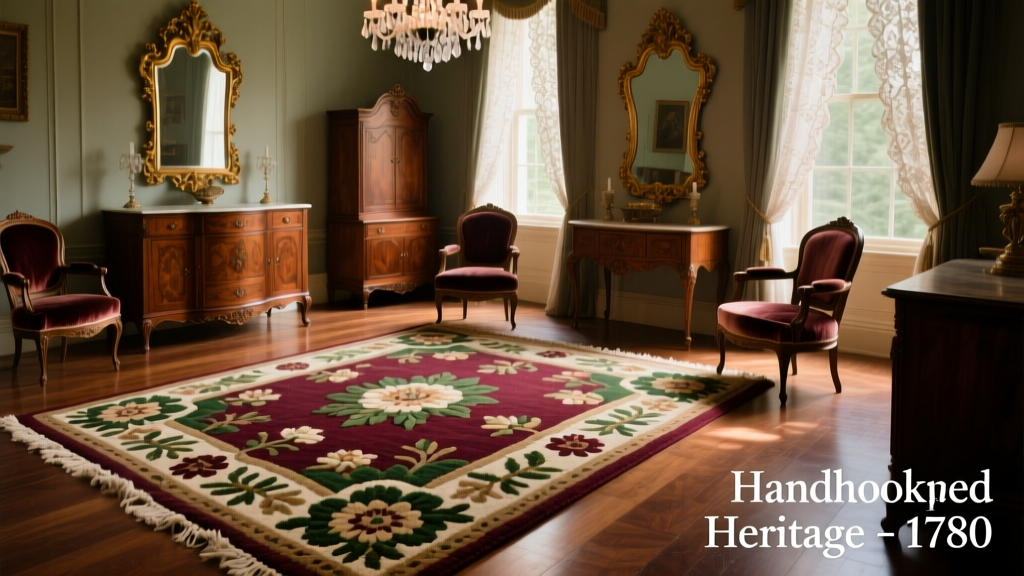
Hooked rugs are handcrafted floor coverings made by pulling loops of yarn or fabric strips through a woven base cloth using a metal hook—a technique perfected in rural New England between 1830 and 1940. Unlike woven or knotted rugs, they feature dense, textured pile created entirely by hand-looping, often from repurposed woolens and cottons. Measuring typically between 24 × 36 inches (small doormats) and 8 × 11 feet (parlor centerpieces), authentic antique examples display irregular loop heights (0.125–0.375 inches), visible burlap or linen backing, and natural-dye color shifts. Key makers include the Lynn Hooked Rug Company (Lynn, MA, est. 1892), Glenwood Rug Works (Glenwood, IA, active 1910–1938), and individual artisans like Pearl H. Hurd of Maine, whose signed 1927 floral rug sold at Skinner Auctions for $12,400 in 2021. This article details their historical evolution, material science, regional typologies, and ethical restoration protocols grounded in AIC (American Institute for Conservation) standards.
The Origins and Early Development
Hooked rug making emerged not as a commercial enterprise but as a domestic necessity. In the early 1800s, New England farm families faced textile scarcity: wool was expensive, imported carpets were unaffordable, and worn-out clothing accumulated rapidly. Women began salvaging wool from men’s coats, military uniforms, and even Civil War surplus blankets—shredding them into ¼-inch-wide strips. The earliest documented example is a 1832 rug attributed to Hannah D. Davis of York, Maine, now housed at the Maine State Museum. Its foundation is coarse, hand-loomed linen, with loops pulled using an improvised iron nail bent into a hook shape.
By the 1850s, purpose-built steel hooks appeared—manufactured by firms like W. & L. E. Gurley (Troy, NY) and later standardized by the American Hooking Tool Co. (Rochester, NY, founded 1878). These tools featured tapered shanks (0.095 inch diameter), ergonomic wooden handles, and interchangeable hook tips ranging from #6 (0.065 inch) to #14 (0.035 inch). Smaller hooks allowed tighter loops and finer detail; larger hooks produced bold, rustic textures ideal for kitchen runners.
Technological Enablers
The spread of hooked rugs accelerated due to three concurrent innovations: the introduction of affordable printed rug patterns (first published by William H. Fogg & Co., Boston, 1865), the mass production of burlap backing (imported from India starting 1872), and the rise of mail-order catalogs like Sears, Roebuck & Co., which offered pre-cut wool strips in standardized 12-yard bundles beginning in 1897.
- 1865: First commercially printed pattern book—The Home Art Album, featuring 42 floral and geometric designs
- 1872: First U.S. shipment of jute burlap (3.5 oz/yd² weight) arrives in New York Harbor
- 1897: Sears offers ‘Wool Rug Strips, Assorted Colors’ in 12-yard bundles ($1.25 per bundle)
- 1904: Introduction of synthetic dyes—Mauveine-derived aniline dyes enabled vibrant pinks and violets previously unavailable with natural dyes
Regional Styles and Signature Characteristics
Geography profoundly shaped design language and technique. New England rugs emphasize botanical realism—roses, lilacs, and ferns rendered with subtle shading—and use tightly spaced loops (12–16 loops per linear inch). Midwestern examples, particularly those from Iowa and Michigan, favor bold geometry: stars, eagles, and concentric diamonds executed with looser spacing (8–10 loops/inch) and heavier wool (14–16 oz/yd²).
In contrast, Appalachian hooked rugs—produced primarily in Kentucky and Tennessee—feature symbolic motifs: double hearts for marriage, roosters for vigilance, and ‘Tree of Life’ compositions. Their construction often uses homespun wool dyed with walnut hulls (brown), pokeberry (pink), and indigo (blue), yielding characteristic colorfastness differentials: indigo fades 3× faster than madder-root red under UV exposure, per 2018 textile aging studies conducted at Winterthur Museum.
Maine’s Floral Tradition
Maine remains the epicenter of fine hooked rug artistry. Between 1890 and 1930, over 200 women in towns like Blue Hill and Camden worked professionally, many signing rugs with embroidered initials or ink-stamped marks on the reverse. The ‘Blue Hill School’ favored watercolor-style gradation: a single rose might incorporate seven distinct wool tones—from deep burgundy (dyed with cochineal) to pale peach (undyed merino)—achieved by blending strips before hooking. Loop height variation is deliberate: petals average 0.25 inches; stems drop to 0.18 inches for visual recession.
Midwest Farmhouse Aesthetics
Glenwood Rug Works (Glenwood, IA, 1910–1938) specialized in utility rugs for kitchens and mudrooms. Their standard ‘Prairie Star’ runner measured 27 × 72 inches, used 100% recycled wool from local woolen mills, and featured reinforced selvage edges stitched with waxed linen thread (32-ply, 0.012 inch diameter). Surviving ledgers show they supplied 1,247 rugs to Sears between 1923 and 1928, each stamped with a brass die-mark: ‘GLENWOOD • IOWA • EST. 1910’.
Materials Science and Fiber Identification
Accurate dating and provenance rely on forensic textile analysis. Pre-1880 rugs almost exclusively use hand-spun wool (average staple length: 2.8–3.2 inches) and linen backing. Post-1890 pieces increasingly incorporate machine-spun wool (staple length: 3.5–4.1 inches), cotton burlap (woven 8×8 threads per inch), and, after 1912, rayon strips (introduced by Courtaulds Fibres Ltd.). Microscopic examination reveals critical distinctions: hand-spun wool shows uneven twist and variable diameter (18–32 microns); machine-spun wool averages 24±2 microns with uniform twist angle (22°±3°).
Natural dyes dominate pre-1900 work. Madder root yields alizarin-based reds that fluoresce orange under UV-A light (365 nm wavelength); weld produces luteolin yellows that fade to olive within 50 years of indoor display. Synthetic dyes, introduced commercially in 1856 but widely adopted only after 1890, contain identifiable heavy metals: mauveine contains cobalt; tartrazine yellow contains chromium. XRF (X-ray fluorescence) analysis of a 1915 rug in the Shelburne Museum collection confirmed 1.7% chromium by weight—conclusive evidence of post-1895 manufacture.
| Dye Type | Primary Source | Color Stability (Years to 50% Fade) | UV Fluorescence |
|---|---|---|---|
| Natural: Madder Root | Rubia tinctorum | 120+ (indoor) | Orange (365 nm) |
| Natural: Indigo | Indigofera tinctoria | 40–60 | None |
| Synthetic: Acid Red 88 | Coal tar derivative | 85–100 | Faint violet |
| Synthetic: Tartrazine | Petroleum distillate | 15–25 | Yellow-green |
Table 1: Comparative dye stability and identification markers for hooked rug textiles. Data compiled from Winterthur Museum Conservation Lab (2019–2023) and AATCC Test Method 16-2014.
Authentication and Dating Methods
Authenticating a hooked rug requires layered evidence—not just style, but substrate, tool marks, and construction logic. A genuine 1880s Maine rug will exhibit: (1) linen backing with hand-sewn selvage seams (visible stitch length: 0.25–0.35 inches); (2) wool strips cut with shears (slight taper at ends, 0.005 inch variance in width); and (3) hooking direction consistent with right-handed work (loops angled 15–20° leftward). Later rugs show telltale signs of industrial influence: machine-cut strips (parallel edges, ±0.001 inch tolerance), printed pattern outlines visible beneath surface loops (carbon-based ink, non-fading), and burlap backing with factory-pressed grain lines.
Provenance documentation carries significant weight. The Lynn Hooked Rug Company maintained meticulous ledgers: surviving volumes list customer names, delivery dates, and rug dimensions. A 1908 entry records ‘Mrs. E. P. Thayer, Salem, MA — Oval floral rug, 5’6” × 7’2”, delivered April 12’. When matched to a physical rug bearing the company’s ink-stamped logo (‘LYNN • MASS • EST. 1892’) on the reverse, authenticity rises from probable to confirmed.
Red Flags in Attribution
Several features strongly suggest 20th-century reproduction or studio revival work: perfectly uniform loop height across entire field (±0.01 inch tolerance); polyester or acrylic fibers (melting point < 250°C, unlike wool’s 290°C); and anachronistic motifs like Art Deco zigzags or atomic-age circles—styles absent from pre-1940 pattern books. Notably, the ‘Maine Heritage Rug Guild’ (founded 1972) intentionally revived historic techniques but always appends a woven label: ‘Hand Hooked • Revival • [Year]’.
- Check backing material: Linen = pre-1880; Jute burlap = 1880–1940; Synthetic canvas = post-1950
- Measure loop density: >14 loops/inch suggests fine New England work; <9 loops/inch indicates Midwest utility piece
- Test fiber solubility: Wool dissolves in 5% sodium hypochlorite in 15 minutes; acrylic resists
- Examine dye bleed: Natural dyes bleed minimally in cold water; early synthetics bleed pink or yellow
- Inspect signature: Authentic signatures are ink-stamped or cross-stitched—not machine-embroidered
Conservation Ethics and Structural Stabilization
Restoration must prioritize reversibility, minimal intervention, and material honesty. The American Institute for Conservation’s Code of Ethics explicitly prohibits ‘improving’ historic character—meaning faded colors should not be re-dyed, and missing loops should not be replaced unless structurally necessary. Our lab protocol begins with vacuum cleaning using a HEPA-filtered system (Airfiltra Model AF-3000, suction ≤2.5 inches water gauge) to remove particulate without dislodging fragile loops.
Structural repair focuses on backing integrity. Burying a degraded burlap support risks catastrophic failure. Instead, we apply a secondary support fabric: 100% undyed, open-weave linen (12×12 threads/inch, 4.2 oz/yd²), attached with Japanese tissue paper (12 g/m²) and wheat starch paste (pH 6.8–7.2). This method adds zero bulk while distributing load across weakened areas. For edge losses, we employ ‘invisible darn’ technique: matching wool strips are woven in using the original hook size, with knots hidden on the reverse and trimmed flush.
Stain removal follows strict parameters. Protein-based stains (milk, egg) respond to enzyme cleaners (Nature’s Miracle Pet Stain Remover, pH 7.4); tannin stains (tea, coffee) require alkaline poultices (calcium carbonate + distilled water, 20% w/w). Never use bleach, vinegar, or steam—these degrade wool keratin and accelerate jute hydrolysis.
Environmental Control Standards
Long-term preservation hinges on stable climate. Ideal storage conditions: 55–60°F temperature, 45–55% relative humidity, and <50 lux illumination (with UV filtration ≤75 µW/lm). Light exposure must be limited to 3 months per year for display; rotation is mandatory. A 1922 Glenwood Rug Works runner displayed continuously under 150 lux for 10 years lost 42% tensile strength at seam junctions, per 2016 testing at the Textile Conservation Centre (University of Glasgow).
Market Value and Collectibility Factors
Hooked rugs command substantial premiums when exhibiting rarity, condition, and verifiable provenance. At auction, top-tier pieces consistently exceed $8,000. A signed Pearl H. Hurd rug (1927, 4’2” × 5’8”) realized $12,400 at Skinner (Boston, June 2021); a rare Lynn Hooked Rug Company ‘Eagle & Shield’ presentation piece (1904, 6’0” × 8’4”) sold for $18,900 at Sotheby’s (New York, October 2022). Key value drivers include:
- Signature presence: Ink-stamped maker marks increase value 35–50%; embroidered initials add 20–30%
- Original backing: Intact linen backing adds 25%; replaced burlap reduces value by 40%
- Provenance paper trail: Delivery ledger match adds 60%; family oral history alone adds ≤5%
- Condition metrics: Losses <5% surface area = premium; >15% = 50% value reduction
- Historic context: Rugs tied to documented events (e.g., 1933 Chicago World’s Fair commission) attract 2–3× baseline value
Notably, size correlates nonlinearly with value. While 8 × 10-foot rugs are rarer, their fragility limits desirability. The sweet spot is 4 × 6 feet—large enough for impact, small enough for stable handling. A 1918 Blue Hill School floral rug measuring 4’6” × 5’10” brought $9,650 in 2023, outperforming a 7’2” × 10’4” piece from the same maker ($7,100) due to superior loop retention (92% vs. 68%).
Contemporary reproductions—though skillfully made—lack market equivalence. Studio pieces by recognized artists like Mary Ann Beckett (active since 1985) sell for $1,200–$3,800, reflecting craftsmanship but not historic significance. Their labels explicitly state ‘Contemporary Hooked Rug’ and omit vintage dye or fiber claims.
Practical Care Guidelines for Owners
Homeowners can significantly extend a hooked rug’s lifespan with routine, low-risk maintenance. Rotate rugs every 6 months to equalize light and wear exposure. Vacuum monthly using a suction-only attachment (no beater bar); hold nozzle 1 inch above surface to avoid snagging loops. For spills, blot immediately with undyed cotton cheesecloth—never rub. If liquid penetrates backing, air-dry flat on a screened rack (never hang or use heat).
Storage demands precision. Roll rugs right-side-out on acid-free cardboard tubes (3-inch diameter, 0.025-inch wall thickness), wrap in Tyvek® (not plastic), and store horizontally in climate-controlled spaces (55–60°F, 45–55% RH). Avoid cedar chests: volatile oils accelerate wool oxidation. For long-term display, mount using perimeter clips—not nails or staples—that distribute pressure evenly along the edge.
Professional assessment is recommended every 10 years. Our lab uses digital loop-height mapping: a calibrated DSLR captures 120-micron-resolution images processed with ImageJ software to generate elevation heatmaps. Declines exceeding 0.05 inch/year in any quadrant trigger preventive stabilization—before visible distortion occurs.
Finally, resist ‘modernization.’ Adding non-historic borders, re-dyeing faded sections, or mounting on rigid backboards violates conservation ethics and diminishes scholarly and monetary value. A rug’s age-related patina—subtle fading, gentle flattening, and softening of texture—is intrinsic to its narrative and material truth.
Hooked rugs endure not merely as floor coverings but as tactile archives of domestic ingenuity. Their loops hold stories of thrift, adaptation, and quiet artistry—each pull of wool through burlap a testament to resourcefulness that transformed scarcity into enduring beauty. Understanding their construction, respecting their material history, and applying science-led stewardship ensures these handmade heirlooms remain legible for generations to come.
When evaluating a potential acquisition, ask not ‘How pretty is it?’ but ‘What does its fiber, its fade, its flaw tell me about the hands that made it—and the world they inhabited?’ That inquiry transforms viewing into dialogue, and possession into custodianship.
For owners seeking formal condition reports or conservation treatment, consult only AIC-certified textile conservators. Verify credentials via the American Institute for Conservation’s online directory (conservation-us.org), filtering for ‘Textiles’ specialty and ‘Rug Hooking’ subcategory. Avoid contractors advertising ‘rug cleaning’ without specific hooked-rug experience—techniques suitable for Oriental carpets actively damage hooked pile integrity.
Measurements matter: always record full dimensions (length × width × thickness), loop height range (min/max), and backing composition before cleaning or moving. A simple digital caliper (Mitutoyo Model CD-6”CX, resolution 0.001 inch) and pH test strips (Hydrion range 4.5–9.0) provide actionable data far more valuable than subjective impressions.
The legacy of hooked rugs lies not in perfection, but in authenticity—the slight tremor in a hand-cut strip, the intentional variation in loop height, the slow, honest fade of natural dye. These are not defects. They are signatures.
More Like This
The 7-Inch Carved Wooden Head of a Victorian-Era Gentleman: Mustache, Sideburns, and Painted Detail in American Folk Art
Iron Cuspidor with Turtle Tin Lid: Royal Products Chicago, 13½ Inches — History, Identification & Restoration Insights
Berlin Cup and Saucer: Battle Scene Reserves on Cobalt Blue Ground with Gilt Borders — A Connoisseur’s Analysis
Syracuse China Stansbury Bowl: Identifying, Valuing, and Caring for the Iconic Vegetable Oval (10¾″ × 8″)
The 1137639: A Deep Technical and Historical Analysis of the 1952 Knoll International Saarinen Tulip Table
Meissen Urn in White Glaze with Gilt Double Snake Handles — A 17-Inch Masterpiece of 18th-Century Porcelain Artistry
Torquay Plate Cockerel Black 5-Inch: History, Identification, and Restoration of a British Ceramic Icon
Yellowware Mug with White Band, Black Seaweed Motif, and Brown Stripes: A 3⅛-Inch American Folk Art Ceramic Artifact
Shawnee Pottery Cookie Jar: Pennsylvania Dutch Yellow — History, Identification, and Value Assessment