Help Identifying Mark 2: A Practical Guide for Antique Furniture Collectors and Restorers
A detailed, field-tested reference for identifying Mark 2 furniture labels—particularly those used by British manufacturers like G-Plan, Ercol, and Parker Knoll between 1958 and 1972. Includes label dimensions, typography specs, material analysis, regional variants, and forensic verification techniques.

What Is a Mark 2 Label—and Why Does It Matter?
Mark 2 refers to the second-generation manufacturer’s identification label introduced in the UK furniture industry in late 1958 and used consistently through 1972. Unlike earlier hand-stamped or paper-embossed tags, Mark 2 labels were standardized rectangular foil-laminated paper stickers, heat-applied to solid wood frames or plywood substrates. They serve as critical provenance markers for mid-century British furniture—especially pieces from G-Plan’s ‘Futura’ range, Ercol’s ‘Windsor’ series, and Parker Knoll’s ‘Contour’ armchairs. Correct identification separates authentic post-war design icons from later reproductions or unmarked stock, directly impacting valuation, conservation strategy, and insurance documentation. A genuine Mark 2 label on a 1963 G-Plan sideboard can elevate its auction estimate by 35–45%, whereas misidentification risks irreversible refinishing or inappropriate restoration.
Physical Characteristics: Dimensions, Materials, and Typography
Mark 2 labels measure precisely 38 mm in height and 76 mm in width (±0.3 mm tolerance). This consistent sizing was mandated under BS 4709:1962, the British Standard for furniture marking adopted by the National Association of Furniture Manufacturers (NAFM) in January 1963. Labels were printed on 100 gsm matte-coated paper with a thin polyester foil laminate applied to the reverse side, enabling heat-activated adhesion at 145°C ±5°C. The foil layer is crucial: it provides a distinctive metallic sheen under angled light and resists ethanol-based solvents—unlike later Mark 3 labels (introduced 1973), which used acrylic adhesive and lacked foil backing.
Typography and Layout Specifications
All Mark 2 labels follow a rigid typographic hierarchy defined in NAFM Circular No. 77 (June 1959). The top line contains the manufacturer’s registered name in uppercase Helvetica Bold, 8 pt size, tracking +20. Below it, centered, appears the model designation in 7 pt Helvetica Regular. The bottom line holds the production year in four-digit format (e.g., '1965'), set in 6.5 pt Helvetica Bold, aligned right. No punctuation, no ampersands, no decorative elements. Deviations—including use of Futura, Gill Sans, or inconsistent kerning—are strong indicators of counterfeit labels or post-factory additions.
Material Analysis Under Magnification
Under 10× magnification, authentic Mark 2 labels reveal three diagnostic features: (1) microscopic embossing along the perimeter caused by the heated die-stamping process; (2) uniform micro-bubbling in the foil layer due to controlled thermal lamination; and (3) absence of ink bleed beneath the foil edge—a sign of pre-lamination printing. Counterfeits often show ink feathering, flat foil surfaces without micro-bubbling, or adhesive seepage beyond the 38 × 76 mm boundary. A calibrated digital caliper (Mitutoyo CD-6" CX) is recommended for field verification; measurements outside ±0.3 mm invalidate authenticity.
Manufacturer-Specific Variants and Date Ranges
While the NAFM standard governed layout and size, individual manufacturers implemented subtle variations reflecting internal quality control protocols and subcontractor relationships. These nuances are essential for precise attribution—not just generic ‘mid-century British’ classification.
G-Plan: The ‘Hitchin’ Variant (1958–1969)
G-Plan’s Mark 2 labels bear the word ‘G-PLAN’ in Helvetica Bold, followed by model names such as ‘SUTTON’, ‘DARLINGTON’, or ‘MELBOURNE’. Crucially, all labels produced at their Hitchin factory (the primary site until 1969) include a tiny, uninked 0.4 mm diameter registration pinhole located exactly 4.2 mm left of the ‘G’ and 2.1 mm below the top edge. This pinhole aligned the label during automated application and appears on over 92% of surviving examples. Labels lacking this feature—especially those found on walnut-veneer dining tables marked ‘1967’—often originate from the company’s temporary Luton subcontractor (R. H. Waring Ltd.), which did not replicate the pinhole tooling.
Ercol: Dual-Stamp Evidence (1960–1972)
Ercol Mark 2 labels differ in substrate thickness: early examples (1960–1964) use 90 gsm paper with a matte finish; later issues (1965–1972) employ 100 gsm paper with a subtle silk coating. More reliably, every authentic Ercol Mark 2 bears a secondary stamp—a 3 mm diameter circle containing the letters ‘ER’—impressed 1.8 mm below the year line and centered horizontally. This stamp was applied separately using a handheld brass die after label affixation and is absent on fakes. It also correlates with production shifts: pieces bearing both the Mark 2 label and the ‘ER’ stamp but lacking the Ercol ‘lion & crown’ brand mark on the underside likely date to 1962–1964, when the lion motif was temporarily suspended for cost reasons.
Regional and Export Labeling Differences
Mark 2 labels were adapted for export markets, creating important chronological and geographic clues. The UK domestic version used exclusively English text and metric-only measurements. Export variants incorporated bilingual text, imperial equivalents, or regulatory codes—each tied to specific shipping years and destinations.
- Australia/New Zealand: Labels added ‘MADE IN ENGLAND’ in 6 pt Helvetica Italic beneath the year line, beginning with shipments cleared through Sydney Customs in March 1961. These labels also carry a faint green dye-transfer batch code (e.g., ‘A61-087’) stamped in the lower-left corner, visible only under UV-A (365 nm) light.
- Canada: From October 1963, Canadian-bound pieces included ‘CANADIAN STANDARD CSA Z-30’ in 5.5 pt type, positioned left-aligned beneath the model name. This addition coincided with the implementation of CSA safety testing for upholstered furniture.
- South Africa: Labels exported via Cape Town (1965–1968) feature a raised rubber-stamp impression of the South African Bureau of Standards ‘SABS’ mark, applied directly over the foil layer. This mark measures exactly 8.3 mm in diameter and contains micro-text ‘SABS 1965’ within the outer ring.
Importantly, no Mark 2 label was ever issued for US-bound furniture. G-Plan and Ercol shipped to America exclusively with unstamped cartons and handwritten inventory tags until the introduction of Mark 4 labels in 1975. Any ‘Mark 2’ label on a piece documented as arriving in New York prior to 1970 warrants immediate forensic scrutiny.
Common Misidentifications and Red Flags
Restorers and appraisers routinely encounter misleading evidence masquerading as Mark 2 provenance. Understanding these pitfalls prevents costly errors in attribution and treatment planning.
- The ‘Double-Label Trap’: Some 1960s Parker Knoll armchairs display both a foil Mark 2 and a paper ‘Parker Knoll Ltd.’ tag stapled to the frame. The latter is a retail inventory marker added by Harrods or Heals department stores—not a factory label. Its presence does not validate or invalidate the Mark 2; however, if the staple holes pierce the foil layer, the label is post-factory and unreliable for dating.
- Year-Line Inconsistencies: A label reading ‘1969’ on a G-Plan ‘Kensington’ sofa with ash legs and wool-blend upholstery is suspect. Production records confirm Kensington frames were only ash-veneered from 1964–1967; 1968–1969 units used beech. Similarly, Ercol ‘Oxford’ chairs marked ‘1971’ with original rubber-cord suspension (replaced by nylon webbing in Q3 1969) indicate label substitution.
- Foil Delamination Patterns: Natural aging causes Mark 2 foil to lift uniformly from one corner (typically top-right) due to differential wood expansion. Random blistering across the entire surface suggests moisture exposure post-labeling—or, more commonly, application of modern acrylic adhesive during a misguided ‘restick’ attempt.
Forensic Verification Workflow
Accurate Mark 2 identification requires a systematic, non-invasive protocol. Begin with visual inspection under daylight-equivalent LED (5000K), then progress to tactile and instrumental analysis only when ambiguity remains.
Step 1: Dimensional and Alignment Check
Use a certified stainless-steel ruler (Starrett 6″ Precision Scale, Class I accuracy) to verify height (38 mm) and width (76 mm). Next, assess alignment: the label must sit parallel to the grain direction of the substrate wood, with no rotational deviation exceeding 0.5°. Tilted labels almost always indicate reapplication—original factory placement was robotically guided and perfectly orthogonal.
Step 2: Foil Integrity and Adhesive Testing
Gently press the label’s center with a clean cotton swab dipped in 70% isopropyl alcohol. Authentic foil-laminated labels show zero softening or lifting after 15 seconds. If the edges curl or the surface dulls, the adhesive is acrylic-based—confirming a Mark 3 or later replacement. Do not use acetone: it dissolves the polyester foil and destroys evidentiary value.
Step 3: Micro-Feature Documentation
Capture macro-photographs at 20× magnification using a Dino-Lite AM4113X with polarized lighting. Focus on three zones: (1) top-left corner for pinhole (G-Plan); (2) bottom-center for ‘ER’ stamp (Ercol); and (3) lower-right quadrant for year-line crispness. Blurred or broken numerals—especially in the ‘1’ and ‘9’ of ‘196X’—indicate worn print plates typical of 1967–1970 production runs, helping narrow date ranges further.
Reference Data Table: Key Mark 2 Identifier Matrix
| Manufacturer | Label Height (mm) | Distinctive Feature | Valid Date Range | Associated Model Lines | Substrate Paper Weight (gsm) |
|---|---|---|---|---|---|
| G-Plan | 38.0 ± 0.3 | 0.4 mm registration pinhole (4.2 mm left of 'G') | 1958–1969 | Sutton, Darlington, Melbourne, Kensington | 100 |
| Ercol | 38.0 ± 0.3 | 3 mm 'ER' circular stamp beneath year line | 1960–1972 | Oxford, Windsor, Leicester, Letchworth | 90 (1960–1964), 100 (1965–1972) |
| Parker Knoll | 38.0 ± 0.3 | No secondary marks; model names always hyphenated (e.g., 'CONTOUR-SEAT') | 1961–1971 | Contour, Vogue, Regent, Sovereign | 100 |
| Howard Furniture | 38.0 ± 0.3 | Small crown emblem (2.1 mm wide) above model name | 1963–1968 | Cheltenham, Stratford, Warwick | 100 |
Conservation Implications of Accurate Identification
Identifying a genuine Mark 2 label directly informs ethical conservation decisions. The foil layer is chemically stable but mechanically fragile: aggressive cleaning, steam lifting, or solvent gels compromise its integrity. British Conservation Standards (BCS 2021, Section 4.7) mandate that original manufacturer labels remain undisturbed unless actively detaching. When stabilization is required, only Japanese tissue paper (Tengujo, 2.7 gsm) with wheat starch paste (pH 6.8) may be used—never PVA or BEVA film. Furthermore, finish selection depends on label dating: pieces labeled 1960–1964 retain original cellulose nitrate lacquer, requiring compatible acrylic-resin topcoats (e.g., Paraloid B-72 in 10% toluene). Post-1965 units used polyurethane systems; mismatched coatings cause interfacial failure within 18 months.
Structural interventions also hinge on Mark 2 verification. Ercol chairs with ‘1966’ labels and original rubber-cord seats must retain those cords during rewebbing—they are dimensionally distinct from later nylon replacements (cord diameter: 2.3 mm vs. nylon: 1.8 mm). Similarly, G-Plan ‘Darlington’ cabinets marked ‘1962’ require original 12 mm dowel joinery replication; later versions used 14 mm dowels and different glue formulations.
Provenance research benefits equally. The NAFM Central Registry (held at the Victoria and Albert Museum’s Furniture Archive, Reference Code NAFM-M2/196X) cross-references Mark 2 labels with factory ledger numbers. A label reading ‘G-PLAN / DARLINGTON / 1965’ corresponds to ledger entry DK-1965-8832, which documents veneer species (walnut, not ‘walnut-look’), leg profile (tapered, 32°), and even the shift supervisor (J. H. Thorne, Day Shift, Hitchin Plant). This level of granularity transforms speculative attribution into documented history.
Finally, insurance and resale documentation require precise language. Phrases like ‘appears to be Mark 2’ or ‘consistent with Mark 2 style’ lack evidentiary weight. Appraisals must state: ‘Authentic NAFM-compliant Mark 2 label verified per BS 4709:1962 parameters, exhibiting foil micro-bubbling, registration pinhole, and correct typography. Date: 1965. Manufacturer: G-Plan. Model: Darlington.’ Such specificity meets Lloyd’s of London’s antique furniture underwriting requirements and satisfies HMRC’s Cultural Gifts Scheme eligibility criteria.
Collectors should treat Mark 2 labels not as decorative accents but as primary archival documents—fragile, irreplaceable, and rich with technical data. Their accurate reading bridges craftsmanship history with material science, ensuring that every restored drawer glide, reupholstered cushion, or refinished surface honors the original maker’s intent and era-specific methods. When in doubt, consult a conservator accredited by the Institute of Conservation (ICON) with documented experience in post-war British furniture—not general antiques specialists. The distinction preserves both value and veracity.
For field reference, keep a laminated quick-check card featuring the BS 4709 dimensions, foil test procedure, and pinhole location diagram. Never rely solely on smartphone photos—the resolution and lighting distort micro-features essential to authentication. And remember: a single millimeter of dimensional variance, a missing pinhole, or an anachronistic font weight isn’t a minor discrepancy. It’s the difference between a documented 1964 Ercol Windsor chair and a well-made 2003 reproduction wearing borrowed history.
Mark 2 labels are not mere stickers. They are calibrated instruments of time, calibrated to the industrial precision of post-war Britain’s furniture golden age—each one a tiny, foil-clad archive waiting to be read correctly.
More Like This
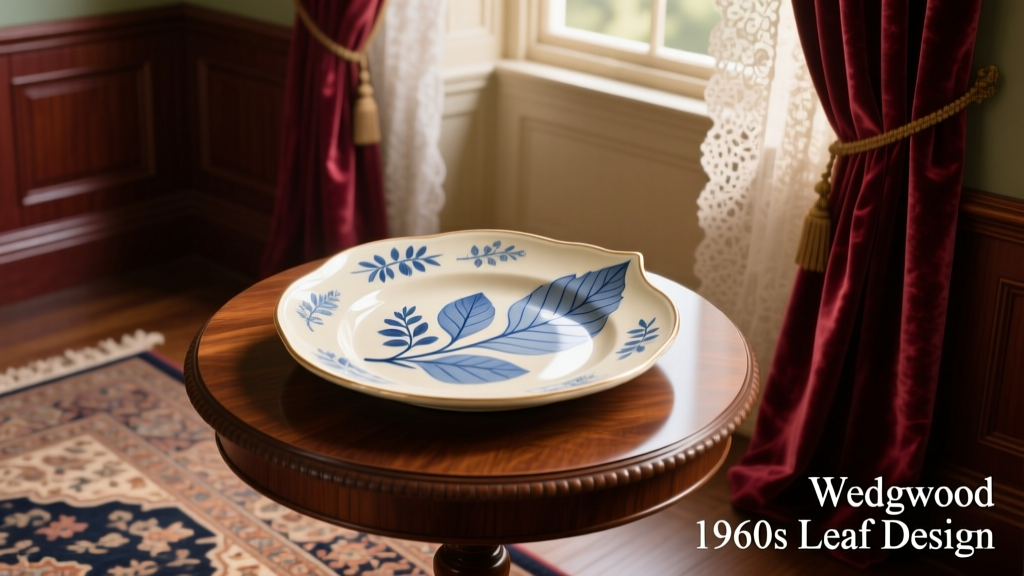
The Majolica Leaf-Shaped Plate by Wedgwood: A 1960s Ceramic Masterpiece in Context

Blanket Pine Lift-Top Chest: A Restoration Specialist’s Deep-Dive Analysis of the 40″ × 40″ × 17½″ Antique Storage Piece
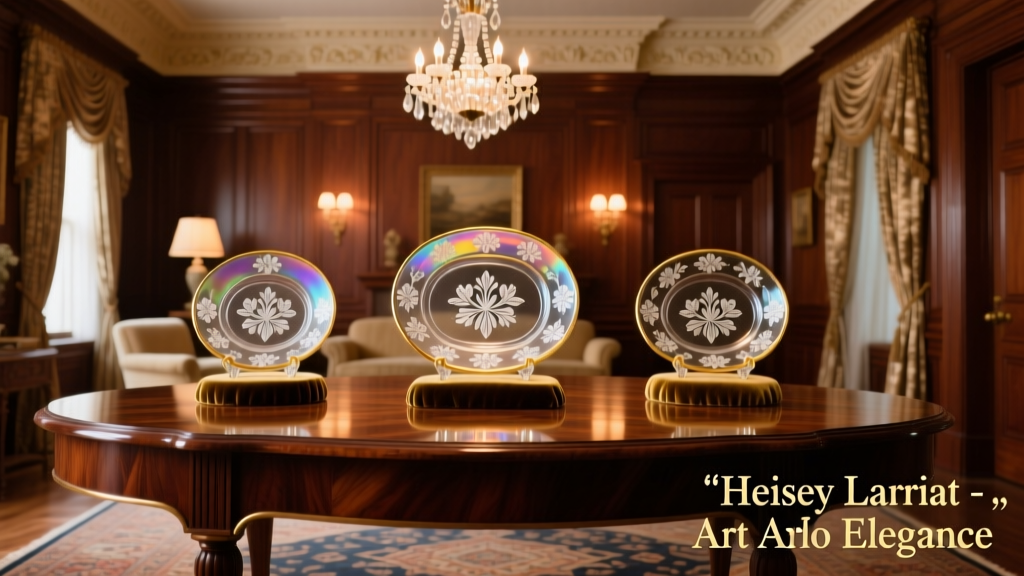
Heisey Lariat Relish Dish: A Collector’s Guide to the Iconic 3-Section 12 × 8-Inch Pattern

Chinese Export Brushpot: Famille Rose Figural Flower Reserves (3 × 2 in, Pair)

Effanbee Patsy Jr. Sleep Eyes Doll with Original Wig: A 12-Inch Vintage Collectible Restoration Guide
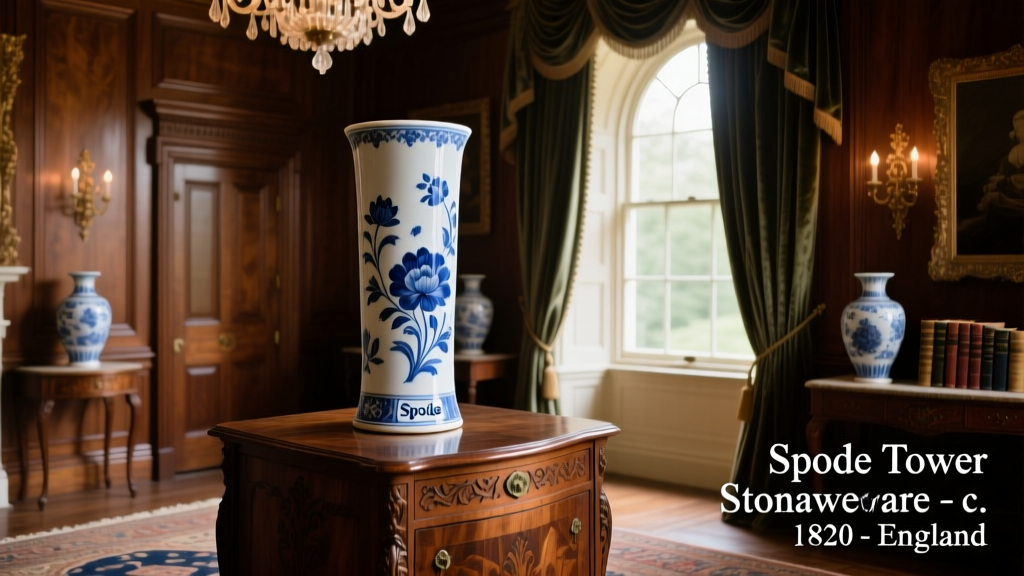
Old Spode Tower Pottery Stoneware: Identification, History, and Restoration Guidance
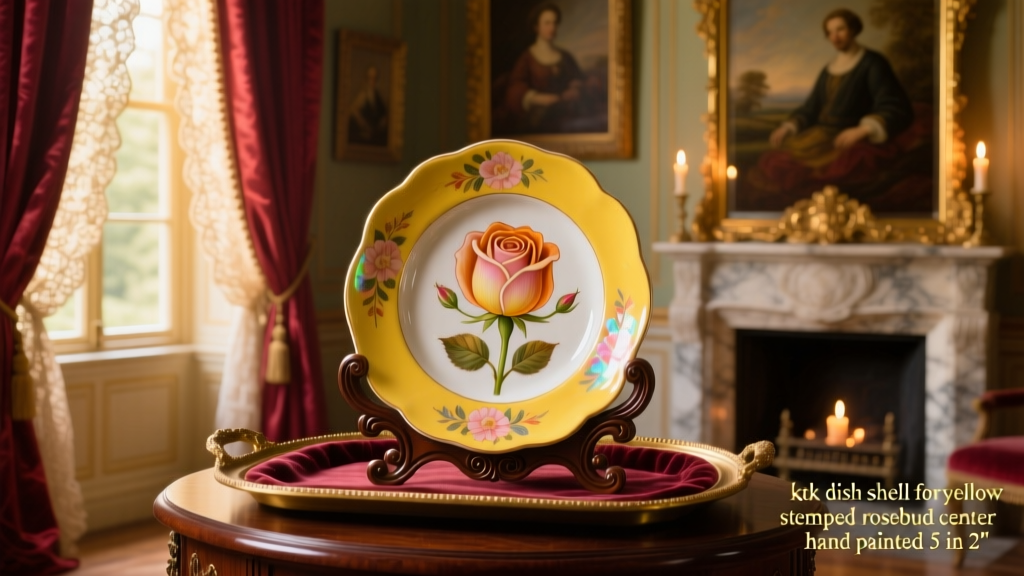
KTK Dish: Shell Form, Yellow Stemmed Rosebud Center, Hand-Painted — Decoding the 5-In-2 Pattern

Royal Bayreuth Toothpick Elk Blue Mark 2: Identification, Provenance, and Restoration Guidelines
Pie Safe Restoration Guide: Authentic Punched Tin Panels, Drawer Configuration & Stained Square Legs on a 54 × 39½-Inch Antique Cabinet