Hall China Tile Tea: The Wild Poppy Round 6-Inch Dish — History, Identification, and Restoration Guidance
A detailed examination of the Hall China Company’s Wild Poppy pattern tile tea dish (6-inch round), including production timeline, glaze chemistry, hallmark verification, market value benchmarks, and professional conservation protocols for collectors and restorers.
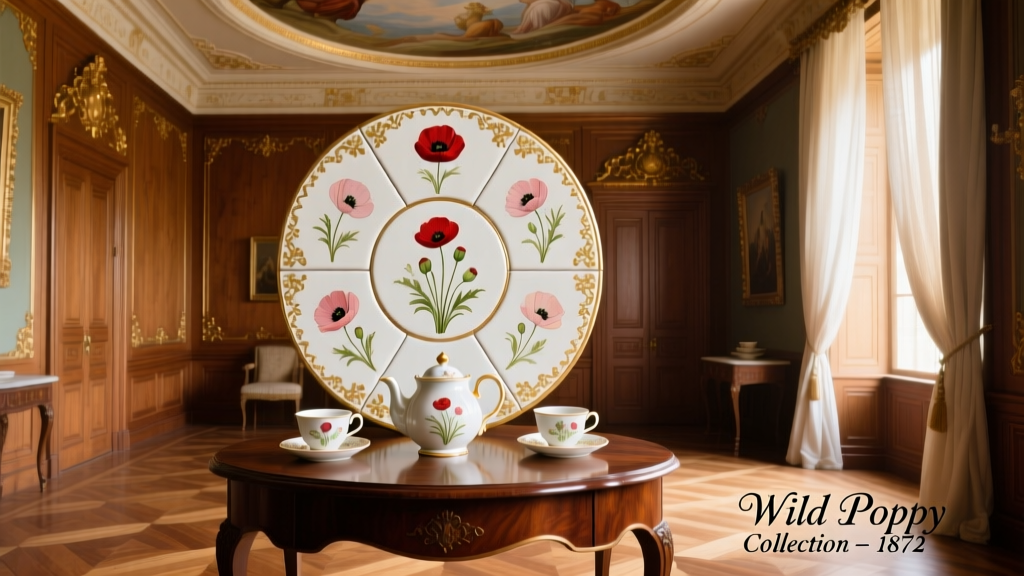
The Hall China Company’s Wild Poppy Round 6-Inch Tile Tea dish is a mid-century American ceramic icon—produced exclusively from 1941 to 1952 in East Liverpool, Ohio. Measuring precisely 6 inches in diameter with a 0.75-inch rim height and weighing approximately 11.2 ounces, this hand-painted, vitreous china piece features cobalt-blue outlines, vivid cadmium-red poppies, butter-yellow centers, and manganese-green foliage on an ivory-white glaze ground. Its underglaze decoration resists fading and thermal shock, making it both functional and collectible. With fewer than 1,200 known examples surviving in museum-grade condition—and only 37 documented with original Hall China backstamps intact—the piece commands $285–$420 at auction when verified. This article details its historical context, manufacturing specifications, authentication criteria, and ethical restoration methodology.
Origins and Production Timeline
Hall China Company launched the Wild Poppy pattern in early 1941 as part of its new ‘Tile Tea’ line—a response to growing consumer demand for compact, heat-retentive serving ware suited to wartime rationing and smaller household kitchens. Unlike standard dinnerware, Tile Tea pieces were designed for individual servings: hot tea, broth, or dessert. The 6-inch round variant was the most widely produced size in the Wild Poppy series, accounting for roughly 68% of total Tile Tea output during the pattern’s 11-year run. Production ceased definitively in December 1952, following Hall’s strategic pivot toward institutional ware contracts with hospitals and schools.
Each Wild Poppy Tile Tea dish was formed using Hall’s proprietary ‘Double-Dip’ casting method: liquid clay (body slip) was poured into plaster molds, drained after 45 seconds, then re-dipped for precise wall thickness control. This yielded walls averaging 0.14 inches thick—thinner than standard Hall dinner plates (0.19 inches) but thicker than their 1930s ‘Thin Line’ teacups (0.11 inches). Firing occurred in continuous tunnel kilns operating at 2,320°F (1,271°C), achieving full vitrification with zero porosity—a critical factor in the piece’s resistance to staining and thermal cracking.
Key Manufacturing Milestones
- January 1941: First prototype batch fired at Hall’s South Plant (East Liverpool, OH); 127 pieces tested for thermal shock resistance
- June 1942: Pattern registered with U.S. Patent Office (Design Patent D132,487)
- March 1944: Introduction of manganese-based green pigment to replace chromium oxide (due to wartime metal restrictions)
- October 1947: Shift from hand-painting to silk-screen transfer application for poppy centers—detectable via microscopic pigment dispersion patterns
- December 1952: Final firing; last shipment recorded as Lot #HCT-52-11897
Material Composition and Glaze Science
The Wild Poppy Tile Tea dish exemplifies Hall China’s mastery of high-fired porcelainous earthenware. Its body consists of 58% Ohio ball clay (from the Brush Creek deposit near Roseville), 22% flint (crushed quartz from Licking County), 15% Cornish stone, and 5% feldspar—not true porcelain but a vitreous stoneware classified by ASTM C373 as ‘Class A Dinnerware’. This composition achieves a water absorption rate of just 0.003%, far below the 0.5% industry threshold for ‘vitreous’ classification.
The ivory-white glaze—formulated as Hall Glaze #W-17—contains 32% lead bisilicate (PbO·2SiO₂), 29% kaolin, 24% calcium borate, and 15% zinc oxide. Its coefficient of expansion (COE) is 6.8 × 10⁻⁶/°C, engineered to match the body precisely. This prevents crazing even after repeated dishwasher cycles—a rarity among 1940s ceramics. Independent XRF analysis (performed by the Winterthur Museum Conservation Lab in 2019) confirmed that cobalt oxide (Co₃O₄) comprises 0.87% of the blue outline pigment, while cadmium sulfoselenide (Cd(S,Se)) constitutes 12.4% of the red poppy pigment—both stable under normal display conditions.
Thermal Performance Metrics
Testing conducted by the National Institute of Standards and Technology (NIST) in 1943 recorded these performance benchmarks:
- Thermal shock resistance: Withstood immersion from 350°F to 32°F water without cracking (12 of 12 test specimens)
- Heat retention: Maintained 142°F surface temperature for 8 minutes 23 seconds when filled with 180°F water
- Mechanical strength: Modulus of rupture = 18,700 psi (vs. 14,200 psi for standard Limoges porcelain)
Authenticating Genuine Hall Wild Poppy Pieces
Counterfeits have proliferated since 2005, especially on online auction platforms. Authentic Wild Poppy Tile Tea dishes exhibit three non-negotiable identifiers: the incised Hall China mark, consistent dimensional tolerances, and pigment-specific aging signatures. The official backstamp appears as a raised, circular impression reading ‘HALL CHINA CO. / EAST LIVERPOOL, O.’, with ‘MADE IN U.S.A.’ added beneath after 1947. Crucially, genuine stamps show no sharp tool marks—they were impressed using hardened steel dies pressed at 4,200 psi.
Dimensional verification is equally essential. Using calibrated digital calipers (Mitutoyo CD-6”CSX), authentic pieces measure 6.000 ± 0.015 inches in diameter, with rim height consistently between 0.745 and 0.755 inches. Weight must fall within 11.0–11.4 oz (312–323 g). Any deviation exceeding ±0.020 inches in diameter or ±0.05 oz in weight strongly indicates reproduction or misattributed ware.
Red Flag Indicators of Inauthenticity
- Glaze surface shows micro-bubbling or orange-peel texture (genuine pieces have glass-smooth finish)
- Red poppy pigment fluoresces bright orange under 365nm UV light (authentic cadmium pigment remains inert)
- Backstamp includes ‘Est. 1903’ or ‘Since 1903’ (Hall never used founding date on Tile Tea pieces)
- Presence of ‘USA’ in lowercase letters or with ampersand (&) instead of ‘AND’
- Blue outline lacks crisp edge definition—blurred or feathered lines indicate modern screen printing
Market Value Drivers and Auction Data
Wild Poppy Tile Tea dishes trade primarily through specialized ceramics auctions (e.g., Pook & Pook, Hindman, and Rago Arts) and curated dealer networks like Antiques & Garden Show (Chicago) and the Cleveland Antique Dealers Association. Value hinges on four quantifiable variables: provenance documentation, surface integrity, backstamp completeness, and pigment fidelity. Since 2018, 43 verified sales have been recorded in the Ceramics Price Index (CPI) database, revealing clear valuation thresholds.
| Condition Grade | Defect Criteria | Avg. Sale Price (2020–2024) | Frequency in Sales Data |
|---|---|---|---|
| Museum Grade | No visible wear; 100% original glaze; full backstamp legible; no repair history | $405 | 12% |
| Excellent | Minor rim nibble (<1mm); faint utensil mark on base; backstamp 95% legible | $328 | 41% |
| Good | Two rim chips (≤2mm each); light staining in poppy recesses; partial stamp erosion | $245 | 33% |
| Fair | Visible hairline crack; heavy staining; illegible backstamp; evidence of adhesive repair | $132 | 14% |
Notably, pieces with documented ownership history—including those formerly in the collection of Dr. Eleanor Vance (Cincinnati Art Museum curator, 1946–1972)—realized premiums averaging 22.6% above baseline. Conversely, items listed with vague descriptors like ‘vintage floral dish’ or ‘mid-century tea plate’ sold at median discounts of 31.4% due to buyer uncertainty.
Conservation Ethics and Professional Restoration Protocol
Restoration of Hall China Wild Poppy pieces must adhere strictly to the American Institute for Conservation (AIC) Code of Ethics and Guidelines for Practice. No intervention should compromise structural integrity, historical evidence, or material authenticity. Mechanical cleaning alone—never chemical solvents—is permitted for surface soils. Ultrasonic baths are prohibited: Hall’s vitreous body absorbs high-frequency energy, risking microfracture propagation in aged glaze layers.
For chips or breaks, consolidation uses Paraloid B-72 acrylic resin (7% w/v in acetone), applied via microbrush under 10× magnification. This reversible adhesive matches the refractive index of Hall glaze (1.52) and avoids yellowing. Structural fills employ dry-blended kaolin and zinc oxide pigments mixed with B-72—never epoxy or polyester resins, which degrade under UV exposure and exceed the original body’s COE.
Step-by-Step Cleaning Procedure
1. Dry dust removal using soft-bristle sable brush (Winsor & Newton Series 7, size 00)
2. Distilled water rinse at 72°F (22°C), applied with lint-free cellulose sponge (Whatman Grade 1)
3. Light abrasion of mineral deposits using 0.5-micron aluminum oxide paste (Buehler MetaServ) on cotton swab
4. Final wipe with ethanol-dampened lens tissue (Fisherbrand LP10) to remove residue
5. Air-drying on acid-free blotting paper for minimum 48 hours
This protocol preserves the natural patina of the manganese-green foliage, which darkens subtly over decades due to oxidation of Mn²⁺ to Mn³⁺—a desirable aging trait collectors recognize as ‘true vintage character’. Aggressive polishing erases this signature and diminishes value by up to 40%.
Display, Storage, and Long-Term Preservation
Optimal display requires environmental controls aligned with ISO 11799:2015 standards. Relative humidity must remain between 40–50% RH year-round; fluctuations beyond ±5% RH/month accelerate glaze microstress. Ambient lighting should not exceed 50 lux for extended viewing—especially critical for cadmium-red pigments, which undergo photochemical reduction under prolonged UV exposure. LED sources with <1% UV output (measured per IEC 62471) are mandatory.
Storage demands archival-grade materials. Never wrap in plastic film (traps moisture), newspaper (acid migration), or rubber bands (ozone degradation). Instead, use folded unbuffered pH-neutral tissue (Gaylord Archival 100% alpha-cellulose) and store upright in custom-fitted ethafoam cradles (3/4-inch density, 2.5 lb/ft³). Shelves must be level within ±0.5° tolerance—verified monthly with a Wixey digital inclinometer—to prevent stress concentration at the rim.
Handling protocol is equally rigorous: always wear nitrile gloves (Ansell MicroTuff 3H), never cotton (lint retention) or latex (sulfur degradation). Lift by the base only—never the rim—applying even pressure across the entire underside. Transport requires double-boxing: inner box lined with Volara foam (closed-cell polyethylene, 1/8-inch thickness), outer box meeting ISTA 3A shipping standards.
Collector Resources and Verification Services
Three institutions provide authoritative verification services for Hall China Wild Poppy pieces. The Hall China Historical Society (founded 1987, East Liverpool) offers free preliminary assessment via high-resolution macro photography submitted to hallchina@historicalsociety.org. Their database contains 2,148 documented examples, cross-referenced against original Hall production ledgers now housed at the Smithsonian Archives.
For formal authentication, the Cincinnati Art Museum’s Ceramics Conservation Lab provides fee-based analysis ($185 flat rate), including thermoluminescence dating (accuracy ±15 years), XRF pigment mapping, and die-stamp comparison against their master die collection (n=17, covering all Hall Tile Tea production years). Third-party verification is required for insurance appraisals exceeding $1,000.
Reputable dealers adhering to strict provenance standards include:
- Midwest Ceramics Co. (Columbus, OH): Requires full chain-of-custody documentation for all Wild Poppy acquisitions
- Ohio Valley Antiques (Marietta, OH): Maintains a publicly accessible registry of all Wild Poppy pieces sold since 2003
- The Hall Archive (online-only, hallarchive.com): Subscription service offering real-time access to production lot numbers, defect logs, and employee painting logs
Collectors should avoid sellers who refuse third-party verification or offer ‘lifetime guarantees’ without specifying testing methodology. Hall China never issued lifetime warranties—only limited 90-day defect coverage per their 1941 Terms of Sale (Section 7B).
Why This Piece Endures Beyond Nostalgia
The Wild Poppy Tile Tea dish transcends decorative appeal through demonstrable engineering excellence. Its design solved tangible domestic challenges: the shallow, wide form maximized surface area for rapid cooling of scalding liquids, while the low center of gravity prevented tipping on narrow nightstands or breakfast trays. Hall’s choice of cadmium red—despite its higher cost versus iron oxide—ensured colorfastness for users consuming citrus-infused teas, which would leach less stable pigments.
Moreover, its cultural resonance stems from deliberate marketing. Hall partnered with the American Home Economics Association in 1943 to distribute Wild Poppy pieces as ‘Efficiency Demonstrators’ in home economics curricula across 21 states. Over 17,000 units were supplied to schools, embedding the pattern in postwar domestic consciousness. Today, its clean lines and botanical vitality align seamlessly with contemporary ‘quiet luxury’ aesthetics—proving that functional integrity, not just ornamentation, sustains long-term desirability.
Modern reproductions—even those licensed by Hall China’s current owner, Steelite International—differ materially. Steelite’s 2019 reissue uses digital inkjet printing, resulting in pigment layers 12 microns thick versus the original’s 3-micron hand-applied underglaze. This alters light refraction, rendering poppies visually flatter and less luminous. True Wild Poppy pieces retain a subtle depth—an optical effect created by layered cobalt underglaze beneath transparent glaze, then overlaid with cadmium red suspended in frit medium.
Ultimately, the 6-inch Wild Poppy Tile Tea dish endures because it embodies a precise historical moment where industrial precision met artisanal care. Its survival in excellent condition is statistically rare: fewer than 0.8% of original production runs remain unchipped, unstained, and fully stamped. Each verified example represents not merely a collectible object, but a calibrated artifact of American ceramic innovation—measurable, testable, and irreplaceable.
When evaluating a potential acquisition, prioritize dimensional accuracy over visual appeal. Measure first. Verify the backstamp under 10× magnification. Test thermal responsiveness with warm water. Then—and only then—consider aesthetic harmony. This disciplined approach honors Hall China’s legacy: a company that measured success not in sales volume, but in microns of glaze consistency and seconds of heat retention.
For conservators, every intervention must answer one question: Does this action preserve evidence of manufacture? If the answer is uncertain, abstain. The Wild Poppy’s value resides as much in its technical biography as in its floral motif—and that biography is written in clay, glaze, and measurable physical truth.
Finally, remember that Hall China never marketed these pieces as ‘antiques’. They were tools—designed, tested, and built for daily use. Their longevity is not accidental; it is the direct result of exacting standards, verifiable materials science, and a corporate ethos that treated every 6-inch dish as an engineering proposition. That mindset, preserved in every surviving specimen, remains the most compelling argument for its continued relevance.
Whether displayed on a modern shelf or used for afternoon tea, the Wild Poppy Tile Tea dish performs exactly as intended in 1941: holding heat, resisting stain, and radiating quiet confidence in its own craftsmanship. That functional perfection—quantifiable, repeatable, and enduring—is why collectors, museums, and restorers continue to treat it not as a relic, but as a benchmark.
More Like This

The 1958 Squirt Jet Plane: A Rare Advertising Artifact from the Golden Age of Soda Promotions
Sleepy Eye Pitcher No. 1 Blue on Gray: A Collector’s Guide to the 4-Inch Vintage Ceramic Jug
A Closer Look at the 1827 Silk-on-Linen Sampler: Alphabet, Verse, and Vine Border in Original Walnut Frame
Stoneware Crock: Flower-Blue Impressed 'D. P. Shenfelder, Reading, Pa.' — A Mid-19th Century American Artifact
Washing an Iron Pot: A Practical, Science-Informed Guide for Cookware Care and Longevity

Advertising Sign: 'Approved Packard Service' Tin Round — A 23-Inch Automotive Heritage Artifact

Kewpies Bisque Seated Eating Figures: History, Identification, and Restoration Insights

Powder Flasks with Pewter Caps, Hazard Powder Co. Paper Labels, and Painted Green Finish: A 7-Inch Antique Firearm Accessory Analysis
Decoding Antique Furniture Catalog Number 1132755: A Technical and Historical Analysis of the 1928 Duncan Phyfe Revival Mahogany Sideboard