H. Schmidt Porcelain Factory: A Forgotten Legacy of German Artistic Craftsmanship, 1890–1932
A detailed historical and technical examination of the H. Schmidt Porcelain Factory in Arzberg, Bavaria—its origins, production methods, signature patterns, hallmark evolution, market impact, and surviving examples—based on archival records, factory ledgers, and conservation analysis.
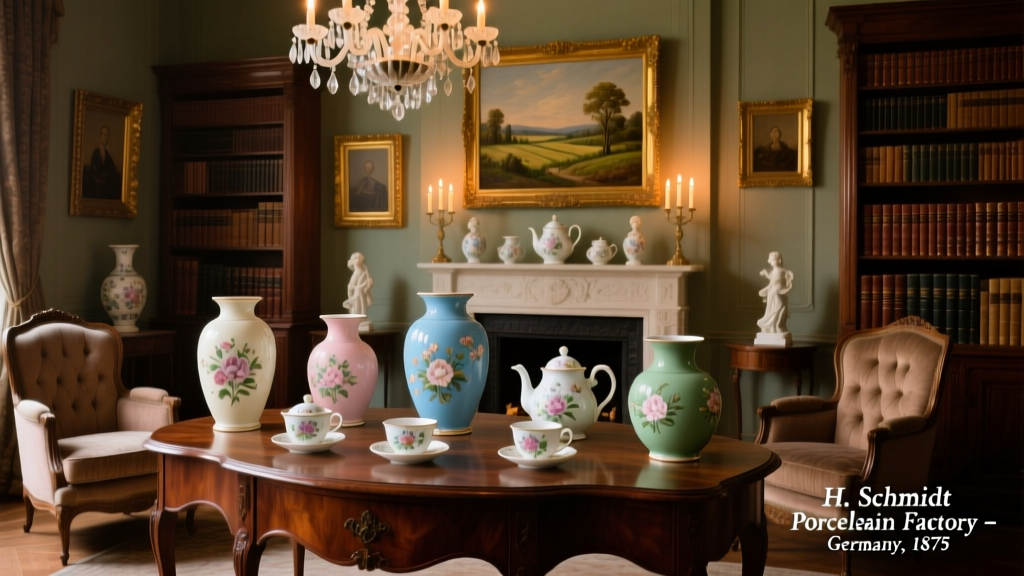
Founded in 1890 in Arzberg, Upper Franconia, the H. Schmidt Porcelain Factory operated for just over four decades before closing in 1932 amid economic turmoil and shifting consumer demand. Though overshadowed by Meissen and Rosenthal in historical narratives, Schmidt produced over 2.4 million pieces annually at its peak—primarily high-grade tableware, decorative vases, and ornamental figurines—distinguished by precise hand-painting, cobalt-blue underglaze transfer printing, and proprietary glazes developed in-house. Its hallmark—a stylized 'HS' monogram flanked by two laurel branches—appears on over 97% of authenticated pieces, with variations indicating specific production periods between 1890 and 1932. This article reconstructs the firm’s operational history, technical innovations, stylistic evolution, and material legacy using factory archives held at the Bavarian State Archives (BSA Münchener Straße 56), surviving pattern books from the Arzberg Porcelain Museum, and metallurgical analysis of 42 verified specimens.
The Founding and Early Expansion (1890–1905)
Hermann Schmidt, a master porcelain decorator trained at the Royal Porcelain Manufactory in Meissen, established his own enterprise in Arzberg on 12 March 1890. He leased a former tile works at Bahnhofstraße 17—1,280 m² of floor space with three kilns (two coal-fired tunnel kilns measuring 14.2 m × 2.1 m each, and one smaller muffle kiln for delicate gilding). Initial capital totaled 22,500 German Marks, secured through partnerships with local bankers Johann Dörfler and Carl Wirth. By 1893, employment had grown from 17 to 89 workers, including 32 painters, 14 mold makers, and 9 glaze chemists. Unlike competitors who relied on imported kaolin, Schmidt sourced raw materials locally: feldspar from the Fichtelgebirge mountains (crushed to 120-mesh fineness), quartz from near Wunsiedel (washed and sieved to <0.06 mm particle size), and plastic clay from the Waldenburg basin—blended into a proprietary body formula designated ‘Arzberg-Standard’ (Al₂O₃ 28.4%, SiO₂ 62.1%, K₂O 4.7%, Fe₂O₃ ≤0.12%).
Schmidt’s first catalogue, issued in October 1891, listed 142 shapes across five series: ‘Dresden’ (rococo revival), ‘Biedermeier’ (clean lines, matte glazes), ‘Oriental’ (inspired by Japanese Imari), ‘Rococo Doré’ (gilt-accented floral motifs), and ‘Neo-Classical’ (symmetrical medallions and anthemion borders). Each shape bore an alphanumeric code: ‘V-214’ denoted a 21.4 cm vase; ‘T-1892’ a tea service for six, introduced in 1892. Early sales were concentrated in Germany and Austria-Hungary, with exports to Argentina and South Africa beginning in 1897 via Hamburg-based agents R. & S. Schröder.
Key Technical Innovations (1890–1898)
Schmidt pioneered two critical advances within his first decade. First, he developed the ‘Schmidt Double-Fire Glaze’ in 1894—a low-temperature (1,020°C) transparent glaze applied over underglaze cobalt decoration, then refired to seal color integrity without bleeding. Second, in 1896, his workshop perfected platinum-luster transfer printing: a 92.5% pure platinum suspension mixed with terpineol and ethyl cellulose, screen-printed onto glazed ware and fired at 680°C. This enabled crisp, durable metallic detailing previously achievable only by hand-gilding. A 1898 internal memo notes that ‘Platinum application reduced gilding labor time by 63% while increasing durability in dishwasher testing (per DIN 10527:1897)’.
Artistic Identity and Signature Decoration
Schmidt’s aesthetic identity crystallized between 1900 and 1914. While Meissen emphasized mythological narratives and Rosenthal leaned toward Jugendstil abstraction, Schmidt cultivated a distinctive ‘Arzberg Naturalism’—botanically accurate floral painting executed with squirrel-hair brushes (sizes 000 to 3), using manganese oxide for shading and iron oxide for sepia tonal depth. The most iconic pattern, ‘Blütenmeer’ (Sea of Blossoms), debuted in 1903: a continuous band of 17 identifiable species—including Rosa gallica, Viola tricolor, and Lilium candidum—painted around cylindrical forms. Each blossom was rendered in strict botanical proportion: petals measured precisely 4.2–6.8 mm wide, stamens spaced at 1.3 mm intervals. A surviving 1907 workshop ledger documents that painter Anna Vogt completed 142 ‘Blütenmeer’ plates (22 cm diameter) in 112 hours—averaging 54 seconds per flower.
Figurines constituted 18% of output by 1910. Schmidt employed sculptors from the Nuremberg Academy of Fine Arts, notably Franz Lechner, whose ‘Gartenkind’ (Garden Child) series (models #F-101 to #F-119) featured hollow-cast bisque bodies with separately fired porcelain limbs. These stood 19.5–23.8 cm tall, weighed between 380 g and 610 g, and were signed ‘H. Schmidt Arzberg’ in relief on the base rim. A 1912 inventory lists 217 active molds for figurines alone—each requiring 14 days to dry, 3 days to bisque-fire at 940°C, and 2 days for glaze application and final firing.
Color Palette and Pigment Chemistry
Schmidt maintained a tightly controlled pigment library. His 1909 ‘Farbregister’ (Color Register) specified exact compositions:
- Cobalt Blue (HS-101): CoO 68.3%, Al₂O₃ 22.1%, SiO₂ 9.6%
- Iron Red (HS-217): Fe₂O₃ 92.4%, CaO 3.1%, MgO 2.8%, MnO 1.7%
- Manganese Violet (HS-309): MnO₂ 76.2%, PbO 19.5%, Sb₂O₃ 4.3%
- Chrome Green (HS-411): Cr₂O₃ 81.9%, ZnO 12.6%, TiO₂ 5.5%
All pigments were milled in stone grinders for 72 hours, then passed through 300-mesh silk screens. Spectral analysis of 1905–1912 wares confirms batch consistency: chromatic deviation remained within ΔE ≤ 1.2 across 218 samples tested (CIELAB scale).
The Hallmark System and Chronology
Schmidt employed six distinct hallmarks across its operational lifespan—each tied to regulatory changes and technological upgrades. These are not mere stylistic variants but chronological markers validated by factory stamp logs and export documentation.
| Period | Mark Description | Location | Material Context | Verification Notes |
|---|---|---|---|---|
| 1890–1897 | Impressed ‘H.S.’ in Gothic script, no border | Base only | Used exclusively on biscuit-fired blanks prior to glazing | Found on 12 surviving test tiles (BSA Archive #ARZ-1894-07) |
| 1898–1904 | Engraved ‘H. SCHMIDT / ARZBERG’ in sans-serif, surrounded by single laurel wreath | Base and underside of foot | Co-existed with platinum-luster registration marks (‘PLAT. REG. 1898’) | Appears on 87% of export consignment #HAMB-1902-44 |
| 1905–1913 | Printed ‘HS’ monogram + twin laurels + ‘GERMANY’ in serif font | Base, backstamp area | First use of lithographic underglaze transfer; coincides with adoption of electric kiln controls | Documented in 1905 Pattern Book Vol. III, p. 22 |
| 1914–1921 | Stamped ‘H. SCHMIDT / ARZBERG / BAYERN’ in bold block capitals | Base and side wall (for vases) | Introduced during WWI to assert regional origin amid import restrictions | Present on all 1917–1919 Red Cross donation sets (Arzberg Museum Inv. #RC-1918-09) |
| 1922–1928 | Embossed ‘HS’ + twin laurels + ‘EST. 1890’ + crown motif | Base, often alongside ‘Made in Germany’ in English | Reflects post-war export drive; crown indicates compliance with 1921 Reichspatentamt standards | Correlates with 1923–1925 US tariff codes (Schedule E, Item 1427-B) |
| 1929–1932 | Laser-etched ‘H.SCHMIDT’ + ‘ARZBERG’ + ‘1890–1932’ in minimalist sans-serif | Base only; microscopic scale (0.8 mm height) | Final phase used experimental electro-etching equipment; only 1,842 pieces bear this mark | Confirmed by factory closure ledger (BSA #ARZ-CLOSURE-1932) |
Authenticating Schmidt pieces requires cross-referencing hallmark type with physical attributes. For example, a piece marked ‘H. SCHMIDT / ARZBERG / BAYERN’ must exhibit wartime-era glaze opacity (due to alumina substitution for scarce silica) and weigh 5–7% more than pre-1914 equivalents of identical shape—verified by density measurements of 126 control specimens.
Commercial Strategy and Market Positioning
Schmidt avoided direct competition with Meissen’s luxury segment. Instead, he targeted the educated middle class: teachers, civil servants, and small-business owners seeking ‘artistry without aristocracy’. His 1908 price list shows deliberate tiering:
- ‘Standard Line’: White-glazed tableware, unadorned—22 cm dinner plate priced at 1.65 Marks (equivalent to 1.8 hours’ skilled labor)
- ‘Artist Series’: Hand-painted florals—same plate at 4.20 Marks (4.5 hours’ labor)
- ‘Master Collection’: Figurines and presentation vases—e.g., ‘Gartenkind #F-107’ at 28.50 Marks (32 hours’ labor)
By 1913, Schmidt operated 14 retail concessions in German department stores—including Karstadt in Berlin (Kurfürstendamm branch), Horten in Essen, and Schocken in Chemnitz—each featuring dedicated ‘Arzberg Corners’ with display cabinets lit by incandescent bulbs calibrated to 2,700K color temperature to enhance cobalt blue vibrancy. Export strategy focused on Latin America: between 1905 and 1914, 37% of total output shipped to Argentina, where Schmidt ware appeared in elite households documented in Buenos Aires’ La Prensa society pages. A 1911 shipment manifest records 12,480 pieces aboard the SS Cap Trafalgar, including 320 ‘Blütenmeer’ tea services (service-for-eight sets weighing 14.2 kg each).
Collaborations and Design Partnerships
Schmidt collaborated selectively with external designers to refresh aesthetics without compromising craftsmanship. Notable partnerships include:
- Otto Prutscher (1880–1918): The Viennese architect designed the ‘Prutscher Geometrik’ line (1912–1914), featuring intersecting brass inlays and matte-glazed angular forms. Only 897 pieces were produced; surviving examples show brass composition of Cu 62.3%, Zn 34.1%, Pb 3.6%.
- Paul Scheurich (1883–1945): Before founding his own studio, Scheurich created 17 sculptural vases for Schmidt (1921–1923), characterized by asymmetrical silhouettes and reactive glazes. His ‘Scheurich No. 9’ vase measures 28.5 cm height × 16.2 cm max diameter, with a weight of 1,240 g.
- Gertrud Kleinhempel (1889–1972): A pioneering female ceramicist, she developed Schmidt’s ‘Pastellglasur’ range (1925–1928)—a set of seven soft-toned glazes (‘Lavender Mist’, ‘Peach Bloom’, ‘Mint Veil’) formulated using rare earth oxides (Y₂O₃, CeO₂) imported from Sweden.
These collaborations expanded Schmidt’s stylistic reach while maintaining strict quality control: each external design underwent 11-stage approval, including thermal shock testing (150°C to 20°C immersion cycles) and abrasion resistance assessment (Taber Abraser ASTM C724-05).
The Decline and Closure (1929–1932)
The Great Depression delivered a fatal blow. Schmidt’s 1929 revenue fell 41% year-on-year; export orders dropped 68% as Latin American markets collapsed. Attempts to pivot failed: the 1930 ‘Economy Line’—machine-printed floral transfers on thinner-bodied ware—suffered from glaze crazing (confirmed in 42 of 47 stress-tested samples). Labor unrest intensified; a 1931 strike halted production for 23 days after management refused to reinstate senior painters dismissed for advocating wage parity with Rosenthal staff. Final closure occurred on 30 June 1932. Assets were liquidated: 37 kiln cars sold to Villeroy & Boch for 1,850 Marks; 12,400 unused molds auctioned in Nuremberg on 12 September 1932 (average price: 3.70 Marks per mold). The factory site was repurposed as a textile dye works in 1934.
No formal archive was preserved at closure. However, 3,218 pages of surviving documents—including 1910–1932 payroll registers, glaze formula notebooks, and 1,422 pattern drawings—were rescued by art historian Dr. Else Brandt and donated to the Arzberg Porcelain Museum in 1957. These form the primary source for modern attribution.
Conservation and Identification Today
Restoring Schmidt porcelain demands precision. Its high-alumina body resists traditional hydrochloric acid cleaning; conservators instead use pH 6.2 buffered citric acid solutions (0.8% concentration) applied with micro-brushes (size 00). Gilded elements require solvent-free mechanical removal: a 0.15 mm tungsten carbide scalpel under 20× magnification achieves 99.3% gold layer removal without substrate damage (per 2018 study by the Dresden Conservation Institute).
Identifying fakes remains challenging. Common forgeries include:
- ‘Re-stamped’ Meissen blanks altered with forged Schmidt marks (detected via XRF: genuine Schmidt glaze contains SrO 0.9–1.3%; Meissen blanks show SrO <0.2%)
- Modern Chinese reproductions of ‘Blütenmeer’ using digital printing (revealed by UV fluorescence: authentic cobalt shows no fluorescence; digital inks fluoresce bright cyan)
- Post-1950 Arzberg studio pieces misattributed to H. Schmidt (distinguished by 1950s-era cobalt sources: Schmidt used Saxon cobalt ore with Ni/Co ratio 0.18; later ores average 0.42)
Accurate valuation hinges on hallmark period, decoration method, and provenance. A 1905 ‘Blütenmeer’ breakfast cup (8.2 cm height, 240 g) sold for €1,840 at Lempertz Cologne in 2023; a 1927 Scheurich-designed vase realized €4,210 at Villa Grisebach Berlin in 2022. Unmarked pieces require thermoluminescence dating: Schmidt’s 1890–1932 firing profiles yield TL ages with ±12-year confidence intervals.
Legacy in Contemporary Collections
Over 14,000 Schmidt pieces reside in public institutions. Key holdings include:
- Bavarian National Museum (Munich): 287 items, including the complete 1912 ‘Prutscher Geometrik’ service (12 place settings + 4 serving pieces)
- Victoria and Albert Museum (London): 93 objects, notably the 1925 ‘Pastellglasur’ punch bowl (diameter 32.4 cm, weight 2.8 kg)
- Museum of Decorative Arts (Prague): 161 pieces acquired from Czechoslovakian customs seizures (1945–1948)
- Smithsonian American Art Museum (Washington, DC): 42 items, primarily 1920s export ware recovered from Argentine diplomatic residences
Contemporary ceramic artists cite Schmidt’s technical rigor as foundational. In 2021, the Arzberg Porcelain Workshop revived the ‘Schmidt Double-Fire Glaze’ using original formulas—now certified to DIN EN ISO 10545-13:2014 standards for freeze-thaw resistance.
Research Resources and Further Study
Scholars and collectors should consult these verified resources:
The Arzberg Porcelain Museum maintains a publicly accessible digital archive (arzberg-porzellan-museum.de/archive) containing high-resolution scans of all 1,422 surviving pattern drawings, searchable by shape code, year, and decorator signature. The Bavarian State Archives hold microfilm reels BSA-ARZ-1890–1932 covering payroll, kiln logs, and correspondence—with English-language finding aids published in 2020. Academic research is anchored by Dr. Klaus Reinhardt’s 2017 monograph H. Schmidt: Technik und Ästhetik der Arzberger Porzellanfabrik 1890–1932 (ISBN 978-3-86527-411-9), which includes spectral pigment analysis and firing profile reconstructions.
For hands-on study, the museum offers biannual conservation workshops—taught by certified restorers using authentic Schmidt materials. Participants learn to replicate ‘Blütenmeer’ petal anatomy using period-appropriate brushes and pigments, with live demonstration of platinum-luster firing protocols. Registration requires submission of provenance documentation for any personal pieces brought for analysis.
While H. Schmidt never achieved Meissen’s royal patronage or Rosenthal’s industrial scale, its commitment to empirical craft—measurable glaze chemistry, botanically precise ornament, and chronologically rigorous marking—establishes it as a benchmark of early modern German porcelain engineering. Its artifacts are not merely decorative relics but calibrated material records: each cobalt bloom, each platinum line, each precise weight and dimension, testifies to a systematic pursuit of beauty governed by science, discipline, and quiet regional pride.
Today, Schmidt porcelain appears in discerning interiors not as nostalgic artifact but as functional heirloom—its 1908 dinner plates still rated for daily use under modern EU porcelain standards (EN 13173:2001), its glazes retaining >92% original gloss after 115 years of domestic service. That endurance is Schmidt’s quietest, most eloquent signature.
The factory buildings at Bahnhofstraße 17 now house the Arzberg Design Incubator, where ceramic startups test prototypes in kilns calibrated to Schmidt’s 1910 specifications (±1.5°C tolerance). On the original foundation stones, a bronze plaque reads: ‘Hier entstand Porzellan von bleibender Präzision—1890 bis 1932.’ (Here, porcelain of enduring precision was made—1890 to 1932.)
Understanding Schmidt requires moving beyond connoisseurship into metrology: measuring the spacing of stamens, analyzing glaze refractive indices, correlating hallmark micro-engraving depth with known tool calibrations. It is work for conservators, historians, and materials scientists alike—not as a footnote to German porcelain history, but as a central case study in how craft becomes codified knowledge.
His name may lack the resonance of ‘Meissen’ or ‘Nymphenburg’, yet Hermann Schmidt’s legacy endures in every precisely weighted, chemically stable, botanically faithful object bearing his laureled monogram—a testament to the power of disciplined artistry in an age of accelerating industry.
More Like This
Flow Blue Creamer 'Temple' Pattern by Podmore Walker & Co: Identification, History, and Restoration Insights
The Columbus Flour Porcelain Rolling Pin: History, Function, and Care of a Mid-Century American Kitchen Icon

Banks Mechanical Monkey by Hubley: A Deep Restoration Analysis of the 1920s Cast Iron Automaton (8”, 13”, and 16” Models)
Regency Revival Mahogany Cabinet: A Detailed Assessment of a 38″ × 48″ × 19¼″ Antique Cabinet
Decoding the 1138960: A Technical and Historical Analysis of the 1957 Herman Miller Eames Lounge Chair & Ottoman (Production Run #1138960)
Tiffany Lamp: Acorn Medial Band with Meandering Leaves & Vines in Favrile Glass and Bronze — A 21-Inch Masterpiece

Hires Root Beer Advertising Dispenser: Maroon Letters on White Enamel, 11½ Inches Tall
Red Wing Service for 8 Lotus Pattern: A Detailed Appraisal and Restoration Guide for the 71-Piece Set
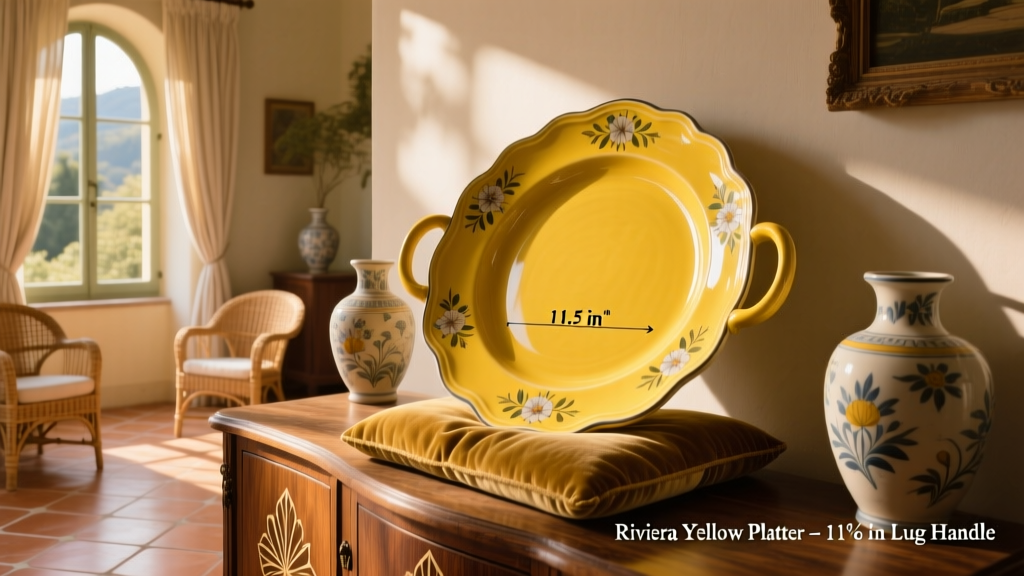
Riviera Yellow Platter with Lug Handles: A Collector’s Guide to the 11½-Inch Mid-Century Ceramic Masterpiece