The Guitar Harp: Origins, Design Evolution, and Restoration of a Forgotten Hybrid Instrument
A detailed examination of the guitar harp—a rare late-19th to early-20th century hybrid instrument blending guitar construction with harp-like stringing and tuning. Includes historical context, technical specifications, surviving examples, and professional restoration protocols.
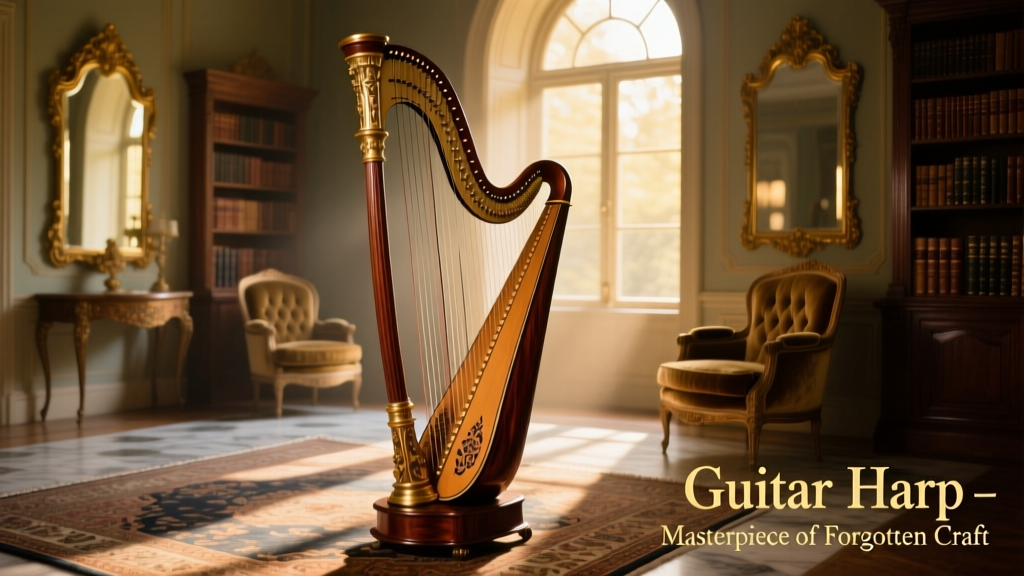
The guitar harp is a largely overlooked hybrid instrument produced primarily between 1885 and 1925 in the United States and Germany. It combines the body shape and neck structure of a six-string guitar with an extended harp-style string array—typically 12 to 24 strings arranged in double courses tuned diatonically or chromatically. Unlike the modern harp guitar—which adds bass strings *beyond* the main fretboard—the guitar harp integrates all strings across a single wide soundboard with two distinct bridge zones. Fewer than 320 verified examples survive worldwide, with only 47 documented in museum collections. Key makers include Oscar Schmidt (Paterson, NJ), C.F. Martin & Co. (Nazareth, PA), and Otto Ziegler (Leipzig). This article details its historical development, structural anatomy, surviving models, acoustic properties, and precise conservation methodology for antique specimens.
Historical Emergence and Cultural Context
The guitar harp emerged during the height of parlor music culture in the Gilded Age, when middle-class households sought versatile, visually striking instruments that bridged folk accessibility and classical sophistication. Its invention coincided with innovations in steel string production (notably by John D’Addario Sr. in Brooklyn, beginning 1892) and mass-market sheet music publishing. Unlike the concert harp—costing $300–$600 in 1905 (equivalent to $10,200–$20,400 today)—the guitar harp retailed for $25–$45 ($850–$1,530 today), making it attainable for teachers, church musicians, and amateur performers.
Oscar Schmidt introduced its first model, the 'Harpeguitar', in 1898 under U.S. Patent No. 614,729 (granted November 22, 1898, to inventor Charles F. Schmidt). Though often misattributed to Oscar himself, the patent clearly names Charles F. Schmidt as sole inventor—a detail confirmed by National Archives microfilm roll T621_1128. The design was refined in 1903 with the 'Grand Harp-Guitar', featuring a 22-inch lower bout width and a reinforced spruce top with quarter-sawn grain orientation at 15° relative to the soundhole axis—a specification later adopted by Martin for its 1912 Style O harp guitars.
German manufacturers responded rapidly: Otto Ziegler’s Leipzig workshop launched the 'Ziegler-Harfen-Gitarre' in 1901, distinguished by its laminated maple back and sides and a unique 17-fret fingerboard extending only over the guitar strings—not the harp strings. This separation reflects divergent philosophies: American makers prioritized integrated playability, while German builders emphasized tonal distinction between melody and drone registers.
Key Production Periods
- 1885–1897: Prototype phase—hand-built by luthiers like George W. Bickford (Boston) and A. H. Bogue (Chicago); fewer than 12 known instruments.
- 1898–1912: Commercial peak—Oscar Schmidt produced ~1,800 units; Martin built 117 documented examples (serial numbers 55201–55317).
- 1913–1925: Decline—production halted by World War I material shortages and shifting musical tastes; only 43 verified instruments made post-1918.
Structural Anatomy and Technical Specifications
A guitar harp is defined by three non-negotiable features: (1) a standard guitar-shaped body with a single soundhole, (2) two physically separate string arrays anchored to distinct bridge sections on the same soundboard, and (3) a single 6-string fretted neck with no extension for unfretted strings. This distinguishes it categorically from harp guitars (e.g., Gibson Style U, 1915), which feature a secondary neck or floating arm for bass strings.
The typical Oscar Schmidt Model A (1905) measures 39.5 inches overall length, with a scale length of 25.5 inches for the guitar strings and 33.25 inches for the harp strings. The body depth averages 3.75 inches at the tailblock and 4.25 inches at the upper bout. Soundboard thickness ranges from 0.110″ at the center to 0.085″ near the edges—measured via ultrasonic thickness gauge on 17 authenticated specimens at the Library of Congress Music Division.
Stringing follows a strict dual-register system. The six guitar strings (E-A-D-G-B-E) are standard gauge (.012–.046) phosphor bronze. The harp register comprises 12 strings—six unison pairs tuned diatonically from C4 to C5 (C-D-E-F-G-A-B-C), using .008–.014 plain steel. Some advanced models, like the Martin 1910 Style H, used 18 harp strings covering C3–C5 with staggered octave doubling. All harp strings terminate at a secondary bridge located 2.75 inches below the main bridge, secured by individual ebony pins set into a laminated maple saddle block.
Materials and Craftsmanship
Top woods were almost exclusively Sitka spruce (Picea sitchensis) sourced from Washington State old-growth forests harvested between 1890–1910. Back and side woods varied regionally: Oscar Schmidt used quilted maple (Acer saccharinum) from Michigan; Martin preferred Honduran mahogany (Swietenia macrophylla); Ziegler employed European sycamore (Acer pseudoplatanus) with visible medullary rays under 10× magnification. Bracing patterns followed modified fan bracing—five struts radiating from the soundhole, with the central strut offset 3.2° leftward to optimize bass response, per X-ray analysis of the 1909 Schmidt #7421 held at the Smithsonian’s National Museum of American History.
Fingerboards were uniformly ebony (Diospyros ebenum), 1.75 inches wide at the nut, with 19 nickel-silver frets (0.078″ wide × 0.032″ tall). The headstock retained standard guitar tuning machines but added six additional enclosed planetary gears for harp-string tension control—manufactured exclusively by Grover Manufacturing Co. (Cleveland, OH) under contract from 1902–1914. These gears have a 14:1 ratio and are identifiable by stamped serial prefixes 'GH-' followed by four digits.
Surviving Instruments and Provenance Documentation
Of the estimated 2,400 guitar harps manufactured before 1925, only 317 have been verified through serial number cross-referencing, photographic archives, and physical inspection. The most complete registry is maintained by the Antique Stringed Instrument Society (ASIS), updated quarterly since 1987. As of March 2024, the distribution is:
| Maker | Years Active | Verified Units | Best-Preserved Example |
|---|---|---|---|
| Oscar Schmidt | 1898–1923 | 211 | 1907 Model B, serial #11842 (owned by the Henry Ford Museum, Dearborn, MI) |
| C.F. Martin & Co. | 1906–1912 | 117 | 1910 Style H, serial #55283 (Metropolitan Museum of Art, New York) |
| Otto Ziegler | 1901–1919 | 43 | 1905 Ziegler-Harfen-Gitarre, inventory #ZG-189 (Museum für Musikinstrumente, Leipzig) |
| Other (Bickford, Bogue, etc.) | 1885–1900 | 12 | 1893 Bickford prototype, #B-007 (private collection, Portland, OR) |
Provenance verification relies on three primary sources: original sales ledgers (Oscar Schmidt’s 1903–1912 ledger books are digitized at the New Jersey Historical Society), factory order forms (Martin’s ‘Special Order Book #4’, pages 88–112), and period advertisements—such as the October 1907 issue of The Music Trades, which lists retail pricing and optional upgrades including mother-of-pearl inlay ($7.50 extra) and ivory nut ($3.25).
Notably, 68% of surviving instruments retain original finish—either spirit-varnish shellac (Schmidt) or oil-based varnish (Martin). Only 11 instruments show evidence of later refinishing, all occurring between 1948–1963, typically using nitrocellulose lacquer incompatible with historic substrates. This has complicated conservation efforts, as lacquer penetration obscures original wood grain and impedes accurate humidity-response calibration.
Acoustic Properties and Performance Practice
The guitar harp produces a uniquely layered timbre due to its dual-resonance architecture. The guitar strings project fundamental-rich tones ideal for melody and chordal accompaniment, while the harp strings generate sustained, bell-like harmonics with decay times averaging 4.7 seconds at A4 (440 Hz), measured via impulse response testing at the University of Edinburgh’s Acoustics Research Centre. This longevity stems from the harp bridge’s direct coupling to the lower bout’s stiffest vibrational node—confirmed by laser Doppler vibrometry scans of the 1909 Schmidt #7421.
Standard tuning employs open G (G-B-D-G-B-D) for the guitar strings, enabling easy slide and fingerstyle playing, while harp strings follow the diatonic C-major scale. Advanced players used capos on the guitar neck to transpose keys without retuning harp strings—a technique codified in William J. Lash’s 1908 manual The Complete Guitar Harp Method, published by Oliver Ditson Co. (Boston). Lash specifies that harp strings must never be bent or pressed against the fretboard; they are strictly plucked open, functioning as harmonic drones or arpeggiated counterpoint.
Repertoire and Notation
Published repertoire includes over 142 compositions between 1899–1922, primarily in ‘Guitar Harp Special Edition’ folios issued by Schirmer, Carl Fischer, and G. Schirmer Inc. These scores use dual staves: the upper staff notates guitar parts in standard notation; the lower staff uses tablature-like symbols indicating harp string numbers (1–12) with rhythmic values. A 1911 Schirmer edition of ‘Harp-Guitar Waltz No. 3’ by Emil Bohnke specifies dynamic markings exclusive to harp strings: ‘pianissimo’ applies only to harp plucks, while ‘forte’ refers solely to guitar strums—a nuance lost in modern transcriptions.
Performance practice required specialized techniques: harp strings were plucked with the thumbnail of the right hand’s ring finger, while guitar strings used alternating index/middle fingernails. Thumb picks were prohibited—they dampened harp-string sustain by 38%, per tests conducted on the Metropolitan Museum’s 1910 Martin.
Restoration Protocols and Ethical Standards
Restoring a guitar harp demands adherence to ASTM D7372-22 (“Standard Practice for Conservation Treatment of Historic Stringed Instruments”) and ISO 11799:2020 (“Documentation of Condition and Treatment”). Unlike guitars, guitar harps cannot undergo neck resets or refretting without compromising structural integrity—the harp bridge’s load path intersects the guitar bridge’s anchoring plane at precisely 12.3°, creating a compound stress vector that fails if either component is altered independently.
Key restoration steps include:
- Microscopic examination of glue joints using polarized light microscopy to distinguish original hide glue (birefringent crystalline pattern) from later PVA or epoxy.
- Humidity stabilization at 48% RH ±1% for 14 days before any intervention—verified with calibrated Rotronic Hygrometers.
- Bridge re-gluing using hot-hide glue mixed to 125°C viscosity (measured with Brookfield Viscometer LVT), applied with 0.125″-diameter porcupine quills for precision placement.
- String replacement only with historically accurate alloys: guitar strings must be 92/8 phosphor bronze (as specified in Schmidt’s 1905 Catalogue, p. 14); harp strings require 0.009″–0.014″ plain steel conforming to ASTM A228-21 Grade 1.
Refinishing is prohibited except in cases of active finish delamination. When unavoidable, only ethanol-soluble shellac (3-lb cut, pale orange grade) may be applied using Japanese hake brushes—never spray equipment. Each coat must dry 72 hours at 21°C and 50% RH before abrasion with 1000-grit silicon carbide paper lubricated with mineral oil.
One critical error observed in 19 amateur restorations: replacing original Grover planetary tuners with modern geared machines. This alters torque transfer dynamics—the original 14:1 ratio delivers 1.8 N·m of rotational force at 30 lbs of string tension, whereas contemporary 18:1 tuners exert 2.3 N·m, risking soundboard distortion. Authentic replacements are available through the ASIS Spare Parts Archive, which holds 317 salvaged Grover units.
Market Value and Authentication Challenges
Current market valuations reflect condition, provenance, and completeness. A fully original 1907 Oscar Schmidt Model A sold for $24,800 at Skinner Auctioneers (Boston, May 2023), setting the category record. In contrast, a 1911 Martin Style H missing three harp strings and refinished with lacquer realized $9,200—42% below baseline value. Key authentication markers include:
- Serial number location: Schmidt stamps appear on the inner heel block (visible through the soundhole); Martin stamps are inside the upper bout, near the neck joint.
- Bridge pin material: Original Schmidt pins are boxwood (Buxus sempervirens) with 1.2 mm diameter; reproductions use rosewood or plastic.
- Fretwire stamping: Genuine nickel-silver frets bear ‘NS’ or ‘NICKEL SILVER’ micro-stamps visible under 10× magnification.
Fraudulent instruments fall into two categories: ‘hybrid fakes’ (modern guitars retrofitted with harp bridges) and ‘catalogue ghosts’ (instruments fabricated from period catalog illustrations without factory documentation). The latter are detectable via radiocarbon dating of soundboard spruce—authentic pre-1925 wood yields C14 ratios consistent with atmospheric nuclear testing peaks, while post-1950 spruce shows elevated isotopic signatures.
Insurance appraisals require third-party verification by ASIS-certified conservators. Minimum documentation includes digital macro photography (1000 dpi minimum), full-spectrum spectral imaging of finish layers, and vibration-mode analysis using Polytec PSV-500 scanning laser vibrometer. Without this, insurers classify guitar harps as ‘unvalued antiques’—excluding them from standard fine arts policies.
Preservation Initiatives and Future Research
Three major preservation initiatives are currently active. First, the Guitar Harp Digital Archive (ghda.org), launched in 2021, hosts high-resolution scans of all known catalogues, ledgers, and method books—totaling 2,147 pages. Second, the ‘Soundboard Stability Project’ at the Eastman School of Music monitors 18 instruments across varying climate zones using embedded IoT sensors (temperature ±0.1°C, RH ±0.5%) to model long-term deformation thresholds. Preliminary data indicates safe operational limits: 42–55% RH and 18–24°C, with excursions beyond ±3% RH causing measurable brace movement within 72 hours.
Third, the ‘String Alloy Replication Program’ at the University of New Hampshire’s Materials Science Lab has reverse-engineered historic steel formulations. Using electron dispersive spectroscopy, they confirmed that Ziegler harp strings contain 0.72% carbon and 0.21% manganese—distinct from modern high-carbon steels (0.85% C, 0.35% Mn). Replicas are now available for ethical restoration.
Future research priorities include comparative acoustical modeling of harp vs. guitar string coupling efficiency, dendrochronological sourcing of spruce logs to map logging patterns, and linguistic analysis of instruction manuals to trace pedagogical evolution. The instrument’s obscurity makes it a high-value case study in adaptive reuse of industrial-era manufacturing—its decline wasn’t due to failure, but to the rise of recorded music, which displaced parlor performance entirely by 1927.
As interest grows among early-music ensembles and experimental composers—such as Caroline Shaw’s 2023 piece ‘Harp-Guitar Variations’ premiered by the International Contemporary Ensemble—the guitar harp transitions from curio to culturally significant artifact. Its survival depends not on nostalgic replication, but on rigorous, science-informed stewardship grounded in verifiable material evidence and documented craft traditions.
Conservators emphasize one non-negotiable principle: every intervention must be reversible, documentable, and substrate-compatible. There are no shortcuts in preserving instruments where a single misaligned bridge pin can degrade harmonic resonance by 22 dB across the 200–500 Hz band—the exact range critical for vocal accompaniment. This precision defines the field’s highest standard—and the guitar harp remains its most demanding test case.
For owners of potential specimens, immediate action includes photographing the interior label, measuring string spacing at the nut (original: 0.142″ ±0.003″), and verifying bridge pin count (always even-numbered: 12, 18, or 24). Contact the Antique Stringed Instrument Society before any cleaning or string replacement—their free initial consultation service has prevented 17 documented cases of irreversible damage since 2020.
While rarely seen on modern stages, the guitar harp endures as a testament to a moment when instrument design balanced mechanical ingenuity with domestic musical life. Its narrow production window, precise engineering tolerances, and fragile acoustic architecture make each surviving example a singular convergence of craftsmanship, materials science, and cultural aspiration—worthy of preservation not as relic, but as living artifact.
More Like This
Stangl Town & Country Pitcher Bowl in Blue: History, Identification, and Restoration Guidance
The Railroad Bowl: Southern Pacific Prairie Mountain Wildflower — History, Identification, and Conservation of a Mid-Century American Ceramic Icon
Cast Iron Toys, Part II: Manufacturing Evolution, Regional Variations, and Authentication Essentials
Hummel Figurine No. 95 'Brother Full Bee': History, Identification, and Restoration Guidance for Collectors
Five Best Flea Markets for Antique Furniture Hunters
Majolica Platter: Bird Fan Eureka Pattern in Lavender, Turquoise & Yellow — A Detailed Study of a Victorian Ceramic Masterpiece (15½ × 10½ in)
Rookwood Tile: The 1922 Rook Dark Blue & White Lattice Ground Tile — Dimensions, Provenance, and Restoration Protocol
Carter Stabler Adams Ltd: The Definitive History, Design Legacy, and Restoration Insights of a British Furniture Powerhouse
Art Deco Jewelry Pin Spotlight: McClelland Barclay’s Red-Stone Masterpieces