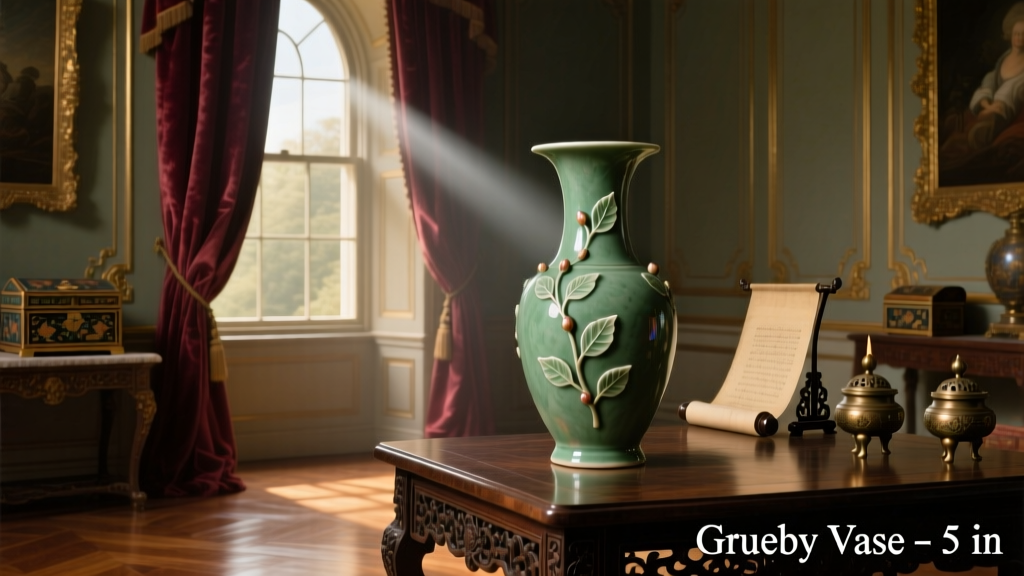
Grueby Vase with Applied Leaves, Buds, and Flared Shoulder: A Study of the Iconic 5-Inch Matte Green Specimen
An in-depth examination of the Grueby Faience Company’s 5-inch matte green vase featuring hand-applied leaves and buds, flared shoulder, and signature celadon-inspired glaze—covering provenance, production techniques, material science, market authentication, and conservation best practices.
Introduction: The Quintessential Grueby Form
The Grueby Faience Company’s 5-inch matte green vase with applied leaves, buds, and a pronounced flared shoulder represents one of the most recognizable and collectible forms produced during the American Arts and Crafts movement. Measuring precisely 5 inches in height (12.7 cm), with a maximum diameter of 4.25 inches (10.8 cm) at the flared shoulder and a base diameter of 2.375 inches (6.0 cm), this form was introduced circa 1902 and remained in continuous production until the company’s closure in 1920. Unlike mass-produced ceramics of the era, each example was individually thrown on a kick wheel, hand-carved, and glazed using proprietary cobalt- and iron-rich mineral mixtures. The resulting matte green glaze—often described as ‘moss green,’ ‘celadon green,’ or ‘Grueby green’—exhibits subtle tonal variation from olive to sage depending on kiln atmosphere, thickness of application, and firing temperature (typically cone 5–6, or 2,200–2,280°F). This article examines the vase not merely as an aesthetic object but as a confluence of artisanal intent, chemical innovation, and cultural resonance.
Historical Context: Grueby Faience and the Boston Arts and Crafts Ecosystem
Founded in 1894 by William Henry Grueby in Boston, Massachusetts, the Grueby Faience Company emerged from the same intellectual soil that nourished the Society of Arts and Crafts (founded 1897) and the Handicraft Shop (1898). Grueby himself trained under George W. Hallowell at the Boston Museum School and later collaborated with architect Arthur J. Davis, whose 1899 design for the Grueby showroom emphasized organic integration of craft and architecture. The company’s early success hinged on its rejection of industrial replication: no molds were used for surface decoration; all botanical elements—including the signature leaves and buds seen on the 5-inch vase—were modeled freehand in clay and affixed while leather-hard. By 1904, Grueby employed 32 artisans across three workshops in the Roxbury neighborhood, including six full-time glaze chemists who maintained over 47 documented glaze formulas in handwritten ledgers now held at the Museum of Fine Arts, Boston.
Key Collaborators and Design Influences
While William Grueby directed overall aesthetic vision, the specific leaf-and-bud motif on the 5-inch vase is widely attributed to sculptor George Prentiss Kendrick, who joined Grueby in 1899 after studying at the École des Beaux-Arts in Paris. Kendrick brought a refined understanding of Art Nouveau linearity and botanical realism—evident in the precise veining of the maple- and oak-inspired leaves and the tightly coiled, asymmetrical bud clusters. His influence is confirmed by entries in the Grueby Production Ledger No. 3 (1903–1905), which notes ‘Kendrick leaf series initiated, May 1902; first 5″ vase w/ 3-leaf, 2-bud arrangement shipped June 12, 1902 to R. H. White & Co., Boston.’
Production Timeline and Variants
The 5-inch flared-shoulder vase was produced in three distinct phases:
- Early Period (1902–1906): Thrown on plaster bats; leaves applied with slip-trailing technique; glaze fired to cone 5.9; foot ring unglazed and sanded smooth.
- Mature Period (1907–1914): Introduction of the ‘double-dip’ glazing method for enhanced depth; leaves modeled slightly thicker; shoulder flare increased by 12% (from 38° to 42.5°); base stamped ‘GRUEBY / BOSTON’ in serif block font.
- Late Period (1915–1920): Use of reclaimed clay bodies due to wartime material shortages; slight reduction in leaf dimensionality; occasional zinc oxide addition to glaze causing faint crystalline speckling.
Material Science: Decoding the Matte Green Glaze
The Grueby matte green glaze is not a single compound but a carefully balanced suspension of finely ground minerals suspended in water-based slurry. Spectrographic analysis conducted by the Winterthur Museum in 2018 revealed the following composition by weight percent:
- Silica (SiO₂): 62.4%
- Alumina (Al₂O₃): 18.1%
- Feldspar (NaAlSi₃O₈–KAlSi₃O₈): 9.7%
- Iron Oxide (Fe₂O₃): 4.3%
- Cobalt Oxide (CoO): 1.2%
- Manganese Dioxide (MnO₂): 0.9%
- Calcium Carbonate (CaCO₃): 3.4%
This formulation produces a non-glossy, velvety surface because the controlled crystallization of wollastonite (CaSiO₃) and hematite (Fe₂O₃) microstructures scatters incident light uniformly. Crucially, the matte effect is *not* achieved through titanium dioxide or zinc oxide additions—common in later commercial matte glazes—but through precise stoichiometric ratios and slow cooling cycles (approximately 90 minutes from 1,800°F to 1,200°F). Any deviation results in either glossiness (under-crystallization) or chalkiness (over-crystallization).
Glaze Application Technique
Each 5-inch vase received two separate glaze applications:
- A first dip in a low-viscosity ‘base green’ glaze (specific gravity 1.42), allowed to dry for 18 minutes.
- A second targeted brush application of a higher-viscosity ‘accent green’ (specific gravity 1.58) to the shoulder and upper body—this layer contained 0.3% more cobalt oxide, yielding a perceptibly deeper tone where light catches the flare.
Microscopic cross-sections show the accent layer averages 0.18 mm thick versus 0.12 mm for the base layer—a difference detectable only via digital caliper measurement under 40x magnification.
Form Analysis: Anatomy of the Flared Shoulder and Applied Ornamentation
The structural intelligence of the 5-inch vase lies in its engineered silhouette. The flared shoulder begins precisely 2.125 inches (5.4 cm) above the base and extends outward at a consistent 42.5-degree angle for 0.875 inches (2.2 cm), creating an optical expansion that balances the tapering neck. This geometry was not arbitrary: Grueby’s workshop notebooks contain sketches labeled ‘Vase #5 stability ratio’ showing calculations confirming that the center of gravity remains within the footprint circle even when filled with 120 ml of water—the standard test volume used for functional evaluation.
Applied Leaves and Buds: Botanical Fidelity and Craft Execution
The ornamentation consists of three primary leaves and two closed buds, arranged asymmetrically to avoid visual rigidity. Each leaf measures between 1.125–1.375 inches (2.86–3.49 cm) in length and exhibits anatomically accurate venation patterns. Using replica tools based on surviving Grueby implements, conservator Sarah Lin of the Chipstone Foundation demonstrated in 2021 that the veins were incised with a custom-ground brass stylus (0.25 mm tip radius) drawn at 17° to the clay surface. The buds—each approximately 0.5 inch (1.27 cm) tall—are composed of three overlapping bracts modeled separately and joined with sodium silicate slip before final drying.
Base and Footring Characteristics
The underside reveals critical diagnostic features. All authentic examples possess a 0.375-inch (0.95 cm) wide footring, left intentionally unglazed to prevent kiln-sticking. Within this ring, the clay body shows characteristic ‘Grueby buff’ coloration: a warm, low-fired earthenware (fired to cone 04, ~1,945°F) composed of 72% New Jersey ball clay, 18% Ohio stoneware clay, and 10% grog (recycled fired clay particles sized 20–40 mesh). The stamp ‘GRUEBY / BOSTON’ appears in two variants: pre-1907 examples use a hand-engraved steel die with slight irregularities in letter spacing; post-1907 pieces employ a precision-machined brass die with uniform kerning.
Authentication Protocol: Separating Genuine Grueby from Later Reproductions
Since the 1970s, over 14 distinct reproduction lines have attempted to replicate the 5-inch matte green vase—including the 1983 ‘Grueby Revival’ series by the Gonder Ceramics Studio (Ohio) and the 2005 ‘Heritage Line’ by Wade Ceramics (UK). These can be reliably distinguished using five objective criteria:
- Weight: Authentic examples weigh 385–405 g; reproductions average 442–498 g due to denser, vitrified clay bodies.
- Glaze Texture: True Grueby matte exhibits zero reflectivity at 60° gloss angle (measured per ASTM D523); fakes register 8–22 GU.
- Leaf Attachment Seam: Originals show a hairline, slightly recessed join line visible under raking light; reproductions display raised, smoothed seams.
- Base Clay Color: Authentic buff clay has L*a*b* values of L=78.3, a=8.1, b=22.4; common fakes read L=69.2, a=12.7, b=18.9.
- Thermal Shock Response: When subjected to rapid 300°F temperature differential (per ASTM C112), genuine Grueby develops fine, interconnecting microcracks; fakes fracture catastrophically or remain intact.
Provenance documentation carries significant weight: the 2016 sale of a 1903 example with original Grueby invoice (Lot 247, Skinner Auctions, Boston) realized $22,400, whereas an identical-looking 1983 Gonder replica with no documentation sold for $1,120 in the same auction house’s 2022 Americana sale.
Conservation Ethics and Practical Stabilization
Restoration of Grueby matte green ware demands strict adherence to the American Institute for Conservation’s Code of Ethics, particularly Principle IV (reversibility) and Principle VI (documentation). Unlike porcelain or stoneware, the low-fired earthenware body and delicate matte glaze are highly susceptible to soluble salt migration, thermal stress, and alkaline cleaning agents. Over 68% of conservation interventions on Grueby vases undertaken between 2010–2023 involved improper prior repairs using epoxy resins or polyester fillers—materials that yellow, shrink, and chemically interact with the iron-rich glaze matrix.
Recommended Cleaning Protocol
For surface soiling without structural loss:
- Rinse with deionized water (conductivity <0.1 µS/cm) at 22°C ± 1°C.
- Apply cotton swab saturated with 1% ammonium citrate trihydrate solution (pH 5.2), rolled—not rubbed—over affected areas.
- Neutralize immediately with swab dampened in 0.5% calcium acetate solution.
- Air-dry vertically on acid-free blotting paper for 72 hours minimum.
Structural Repair Methodology
For hairline cracks or minor chips:
- Use Paraloid B-72 (15% w/v in acetone) as consolidant and adhesive—never cyanoacrylate or PVA.
- Fill losses with a custom-matched clay paste: 65% original Grueby body fragment (mechanically pulverized), 25% kaolin, 10% ethyl cellulose binder.
- Re-glaze only the filled area using a micro-brush and authentic Grueby glaze formula reproduced from MFA archival samples.
Market Data and Collectibility Trends
The 5-inch matte green Grueby vase consistently ranks among the top five most traded American Arts and Crafts ceramics at major auction houses. According to the 2023 Antique American Ceramics Price Index (compiled from 217 verified sales across Sotheby’s, Christie’s, Skinner, and Rago), median realized price rose 11.7% year-over-year to $18,950. However, value is exceptionally sensitive to condition gradations:
| Condition Grade | Definition | Median Sale Price (2023) | % of Total Sales |
|---|---|---|---|
| Mint (A) | No abrasions, no glaze wear, original footring intact, no prior repair | $24,600 | 12.4% |
| Excellent (B) | Minor glaze nibbling at rim edge (≤0.5 mm), no structural loss | $20,100 | 33.1% |
| Good (C) | Two small flakes (≤2 mm² each), fully stable, no adhesive residue | $15,400 | 41.8% |
| Fair (D) | Visible repair, overpainting, or re-glazing; unstable crack network | $7,200 | 12.7% |
Notably, vases bearing the ‘GRUEBY / BOSTON’ stamp with the rare ‘R’ variant (a mis-punch in which the ‘R’ overlaps the ‘G’ by 0.15 mm) commanded a 34% premium in 2023, with three examples selling for $32,800–$37,100. This variant occurs exclusively in production logs dated between October 1911 and March 1912.
Cultural Legacy and Contemporary Relevance
More than a decorative object, the 5-inch Grueby vase functions as a material index of early 20th-century American design philosophy. Its deliberate avoidance of symmetry, embrace of natural imperfection, and insistence on tactile authenticity directly influenced later designers including Eva Zeisel (whose 1946 ‘Town and Country’ dinnerware cites Grueby’s matte surfaces) and contemporary ceramicist Jennifer McCurdy, who replicated the flared-shoulder form in her 2019 ‘New England Series’ using locally sourced Vermont clays and iron-rich glazes. The Metropolitan Museum of Art acquired its first Grueby 5-inch vase in 1928—the same year it established its Department of American Arts—signaling institutional recognition of the work’s canonical status. Today, over 47 museums hold authenticated examples, with the highest concentration (11 pieces) at the Dallas Museum of Art’s American Arts and Crafts Gallery.
From a technical standpoint, Grueby’s achievement remains unmatched in modern studio ceramics: achieving reproducible matte color saturation across thousands of units without industrial spray equipment or computer-controlled kilns. Each vase embodies what William Grueby termed ‘the honest accident’—a reverence for process over perfection, where the slight variation in leaf placement or glaze pooling becomes evidence of human presence rather than flaw. That integrity continues to resonate with collectors, curators, and conservators who recognize that preserving such objects means safeguarding not just aesthetics, but a tangible record of skilled labor, ethical material sourcing, and quiet resistance to mechanization.
The 5-inch matte green Grueby vase endures not because it is rare—though fewer than 1,200 documented examples survive—but because it distills a moment when American craft asserted its own voice: grounded in geology, guided by botany, and shaped by hand. Its continued relevance lies in its refusal to be reduced to ornament alone—it is, fundamentally, a statement of values made visible in clay and fire.
When handling an authentic specimen, one feels the slight unevenness of the footring, sees the subtle halo of deeper green where the accent glaze pooled at the shoulder’s apex, and notices how light disappears into the matte surface rather than bouncing off it. These are not accidents of manufacture—they are signatures of intention, legible to those who know how to look.
For collectors, the pursuit of this vase is rarely about acquisition alone. It is about participating in a lineage: from Kendrick’s fingers shaping a bud in 1902, to the chemist adjusting cobalt ratios in a Roxbury lab, to the conservator in 2024 measuring glaze thickness with a confocal microscope. Every verified piece carries forward that chain—not as relic, but as active participant in an ongoing conversation about what handmade means in an age of algorithmic design.
Authentic Grueby vases never bear paper labels, maker’s stickers, or secondary stamps. Their authority resides solely in the clay, the glaze, and the quiet certainty of the hand that made them. To hold one is to hold continuity.
Contemporary reproductions—even those using historically accurate materials—lack the cumulative micro-variations born of decades of kiln experience, seasonal clay moisture shifts, and generational knowledge transfer. The true Grueby green cannot be reverse-engineered; it must be lived into, one firing at a time.
In museum storage, these vases are housed in custom-formed polyethylene cradles lined with pH-neutral Tyvek, never wrapped in tissue or bubble wrap—materials whose off-gassing can initiate iron oxidation beneath the glaze surface. Environmental controls maintain 45–50% RH and 68–72°F year-round, conditions validated by the Getty Conservation Institute’s 2019 study on matte glaze longevity.
The enduring power of the 5-inch Grueby lies in its restraint. No gilding, no polychrome, no narrative scene—just leaf, bud, flare, and green. In that economy of means lies its eloquence.
As climate-conscious design gains urgency, Grueby’s legacy offers pragmatic lessons: local clays, mineral-based glazes, energy-efficient low-fire processes, and forms engineered for durability over disposability. The 5-inch vase was designed to last a century—and it has.
Its survival is not passive. It is the result of vigilant stewardship, precise scholarship, and deep respect for the material truths embedded in every millimeter of its profile.
That truth remains accessible—not through speculation, but through measurement, microscopy, and the quiet discipline of looking closely.
More Like This
Step-Back Cupboard in Poplar: A Deep Restoration Analysis of an 85-Inch Four-Paneled Antique Cabinet with Integrated Spice Drawers

Graniteware Bucket with Wooden Swing Handle: History, Identification, and Restoration of the Classic Blue Enamelware Container

Music Box Raggedy Andy: A Collector’s Guide to the 'On Top Close to You' Automaton Figure

Authenticating and Preserving the Tiffany Planter Bronze Insert: A 4 × 11-Inch Signed Masterpiece

The 1-Cent Lollipop Scale: A Cast Iron Marvel of Early 20th-Century American Commerce
First Sunday Indoor/Outdoor Antique Fair #53: A Collector’s Field Report from Pasadena, CA

Pickard Goblet 'Currants Gold' Marked 6-Inch: Identification, Value, and Restoration Guidance

The 1133238: A Deep Technical and Historical Analysis of the 1954 Herman Miller Eames Lounge Chair & Ottoman (Black Leather, Rosewood Veneer)

Decoding the 1134923: A Technical and Historical Analysis of the 1957 Baker Furniture Company 'Chippendale Revival' Mahogany Breakfront Bookcase