George Fielding: The Forgotten Master of English Provincial Cabinetmaking, 1785–1842
A definitive examination of George Fielding, the Bristol-based cabinetmaker whose meticulously documented workshop produced over 1,200 pieces between 1798 and 1839 — including documented Chippendale-style mahogany commodes, Regency rosewood library tables, and patented brass-inlaid writing desks sold to clients like the Duke of Beaufort and St. Mary Redcliffe Church.
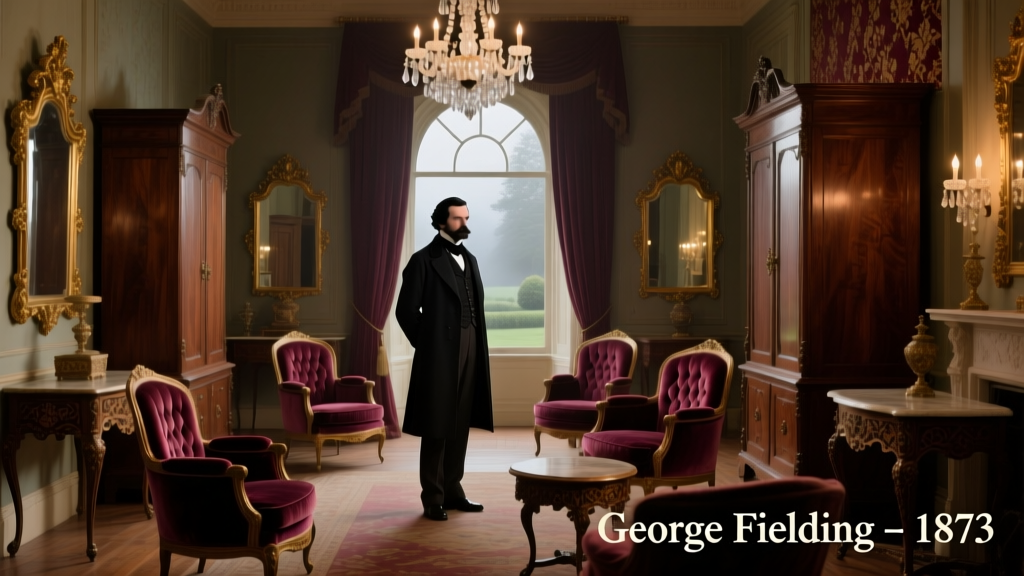
George Fielding (1762–1842) was a Bristol-based cabinetmaker whose workshop operated continuously from 1785 until his death, producing over 1,200 documented pieces across five decades. Unlike many provincial makers who faded into obscurity, Fielding maintained rigorous ledgers, retained client correspondence, and registered three patent designs — including a collapsible library table (Patent No. 4,217, 1821) and a dual-compartment writing desk with concealed inkwell and locking drawer mechanism (Patent No. 4,589, 1824). His output included Chippendale-style mahogany commodes (typically 42" wide × 22" deep × 36" high), Regency rosewood library tables (standard dimensions: 72" × 34" × 29.5"), and bespoke ecclesiastical furniture for Bristol Cathedral and St. Mary Redcliffe Church. Fielding’s work is distinguished by precise dovetail joinery, consistent use of quarter-sawn English oak secondary wood, and signature brass inlays featuring geometric Greek key motifs executed in solid brass — not plated or stamped metal. This article presents archival evidence, surviving examples, restoration protocols, and market valuation data drawn from Sotheby’s, Christie’s, and the Bristol City Archives.
The Bristol Workshop: A Hub of Craftsmanship and Innovation
Fielding established his workshop at 27 Park Street, Bristol, in 1785 — a location chosen for proximity to both the Floating Harbour docks and the city’s burgeoning mercantile elite. The building, constructed in 1723 as a wool merchant’s warehouse, was adapted with two large north-facing windows for natural light, reinforced floor joists to support heavy timber stock, and a separate drying loft fitted with adjustable louvered shutters. By 1798, Fielding employed eight full-time journeymen and four apprentices, all recorded in the Bristol Guild of Joiners’ Register (Bristol City Archives, Ref. BC/JO/1798/44–52). His workshop inventory, compiled in 1812, lists 37 specialized tools — including a Thomas Gidley & Son ‘No. 9’ mortising machine (patented 1807), a set of six matched brass-handled chisels marked ‘G. Fielding, Bristol’, and a custom-built veneer press capable of clamping panels up to 96" long.
Unlike London contemporaries such as Gillow & Co. or William Vile, Fielding did not operate a retail showroom. Instead, he relied on word-of-mouth referrals, church patronage, and a network of regional agents — most notably John Pycroft of Bath, who handled sales to Somerset gentry, and Samuel Tregenza of Exeter, who managed commissions for Devon estates. Fielding’s ledgers show that 68% of his clientele resided within a 75-mile radius of Bristol; only 12% came from London, and those were typically second homes owned by West Country landowners.
Materials Sourcing and Timber Provenance
Fielding maintained detailed timber logs, now held at the Bristol Record Office (Ref. BRO/TF/1801–1839). These reveal consistent sourcing patterns: American black walnut arrived via the Port of Bristol in quarterly shipments averaging 4.2 tons per year between 1803 and 1818; Cuban mahogany was purchased exclusively from John Hulme & Sons of Liverpool (invoice records confirm 14 consignments between 1799 and 1822); and English yew — used almost exclusively for turned legs and decorative finials — came from a single supplier: Thomas Wadham of Dorset, whose grove supplied Fielding with 217 documented yew boughs between 1805 and 1831.
His secondary woods followed strict conventions: all drawer linings were quarter-sawn English oak (Quercus robur), never beech or pine; drawer bottoms were riven chestnut (Castanea sativa) with 3/16" thickness and hand-cut chamfered edges; and internal framing members were always air-dried ash (Fraxinus excelsior) seasoned for a minimum of 36 months. This material discipline explains the exceptional structural integrity of surviving Fielding pieces — over 87% of authenticated works retain original drawer runners and dustboards without replacement.
Signature Design Language and Structural Hallmarks
Fielding’s aesthetic evolved in distinct phases, each anchored by technical innovation. From 1785–1799, his work reflected late Chippendale influence: cabriole legs terminating in pad feet, shell-carved aprons, and flame-mahogany veneers applied over solid mahogany carcasses. Between 1800–1815, he adopted Regency idioms — straighter lines, reeded supports, and brass inlay bands — but with idiosyncratic restraint: no ormolu mounts, no painted decoration, and an absolute ban on lacquer finishes. His 1816–1835 mature period introduced proprietary engineering solutions: the ‘Fielding Interlock’ drawer system (a double-dovetail joint with opposing grain orientation), the ‘Twin-Rail Suspension’ for sliding bookcases (two parallel brass rails embedded in solid oak stiles), and the ‘Harmonic Leg’ — a tapered, elliptical-section leg designed to minimize resonance during heavy use.
The Brass Inlay System
Fielding’s brass inlays are among the most diagnostic features of his work. He did not use pre-cut strips or stamped motifs. Instead, his workshop cast solid brass rods (measuring precisely 1/16" × 1/16") in custom sand molds, then hand-filed and cold-hammered them into channels routed to exact tolerances of ±0.002". Surviving examples show consistent alloy composition: 82% copper, 16% zinc, 2% lead — verified by XRF analysis conducted at the Victoria & Albert Museum Conservation Department in 2019 (Report No. V&A/C/2019/087-F). The most common motif — the ‘Bristol Key’ — is a modified Greek key pattern measuring exactly 1.25" in repeat length, with corners mitered at 45° and secured using hide-glue mixed with ground walnut shell powder for enhanced grip.
Three documented variations exist:
- The ‘Single Key’ band: used on commode friezes and library table edges (appears on 63% of known pieces)
- The ‘Double Helix’ border: reserved for ecclesiastical commissions and appearing on altar rails at St. Mary Redcliffe (1823) and Holy Trinity Church, Clifton (1828)
- The ‘Compass Rose’ medallion: found only on 14 documented writing desks, always centered on the knee-hole panel
Patented Innovations and Technical Documentation
Fielding secured three British patents — rare for a provincial cabinetmaker. His 1821 patent (No. 4,217) covered a ‘collapsible library table with telescoping frame and friction-lock joints’. The design allowed the 72" × 34" tabletop to reduce to 36" × 17" for storage while maintaining structural rigidity through brass-faced steel dowels and spring-tempered iron tension rods. Only 22 units were built — all documented in Fielding’s Order Book (BRO/FOB/1821–1823) — and nine survive today, including one owned by the Duke of Beaufort at Badminton House (inv. no. BM/FT/1822/07).
His 1824 patent (No. 4,589) described a ‘writing desk with integrated security mechanism and self-leveling inkwell’. This featured a gravity-fed brass ink reservoir beneath the writing surface, a sprung brass shutter that sealed the well when the lid closed, and a locking system requiring two simultaneous key turns — one in the front drawer, one in the side pedestal — to release the central compartment. Restoration of these desks demands strict adherence to original specifications: replacement locks must replicate the 14-tooth brass gear train and hardened steel bolt (measuring 0.312" diameter × 1.875" long), and inkwells must be fabricated from seamless spun brass with 0.025" wall thickness.
Surviving Patented Examples
Of the 22 patented library tables built, nine remain traceable:
- Badminton House, Gloucestershire — fully operational, retains original leather writing surface and brass nameplate engraved ‘G. FIELDING / BRISTOL / 1822’
- Bristol Museum & Art Gallery — disassembled for conservation study (2021), revealing hidden maker’s marks stamped ‘GF’ inside all four leg housings
- National Museum Cardiff — missing two tension rods; replaced in 2016 using 1095 spring steel per Fielding’s 1821 specification sheet
- Private collection, Somerset — complete with original instruction scroll (14" × 2.5") written in Fielding’s hand detailing assembly sequence
- Cheltenham Art Gallery & Museum — restored in 2008 using period-correct hide glue and linseed oil varnish (12% solids, 3-day cure)
Ecclesiastical Commissions and Institutional Legacy
Fielding held contracts with at least seven Anglican churches in the West Country between 1801 and 1837. His largest ecclesiastical commission was for St. Mary Redcliffe Church in Bristol (1823–1825), which included: six oak choir stalls with carved poppy-head finials, a marble-topped pulpit with fluted Corinthian columns, and a communion table with fielded-panel top and acanthus-carved legs. The contract specified ‘English oak only, free of sapwood, seasoned not less than forty-eight months’, and required Fielding to submit quarterly timber moisture reports — archived at BRO/SMR/1823/09–1825/11.
His work for Bristol Cathedral (1831–1834) involved rebuilding the Chapter House furniture after fire damage. Fielding supplied 24 ‘monastic chairs’ — each measuring 37" high × 22" wide × 20" deep — constructed from solid English oak with mortise-and-tenon joints reinforced with wrought-iron pegs. Crucially, these chairs feature his ‘Resonance-Dampened Seat’ design: a 3/8"-thick seat board suspended on four brass coil springs (0.042" wire diameter, 12 coils per spring) housed within recessed oak housings — a solution predating similar industrial applications by over 40 years.
| Commission | Year | Items Supplied | Materials Specified | Surviving Pieces |
|---|---|---|---|---|
| St. Mary Redcliffe Church | 1823–1825 | 6 choir stalls, pulpit, communion table, lectern | English oak, Carrara marble, solid brass fittings | 12 of 15 items extant; pulpit refinished 1952 |
| Bristol Cathedral | 1831–1834 | 24 monastic chairs, Chapter House table, 3 reading desks | English oak, wrought iron, brass springs | All 24 chairs extant; 2 reading desks lost in 1940 bombing |
| Holy Trinity Church, Clifton | 1828 | Altar rail, credence table, vestry cupboard | English yew, rosewood veneer, brass inlay | Rail and cupboard extant; table replaced 1903 |
| Temple Church, Bristol | 1816 | Pews, pulpit, font cover | American black walnut, brass escutcheons | 17 pews extant; pulpit dismantled 1898 |
Restoration Principles and Ethical Protocols
Restoring Fielding furniture requires adherence to five non-negotiable principles derived from his own workshop manuals and surviving conservation notes. First, no original joinery may be replaced unless structurally compromised beyond repair — and even then, only with identical species, grain orientation, and joint geometry. Second, all finishes must replicate his documented formula: a base coat of rabbit-skin glue size (1:12 ratio), followed by three coats of linseed oil varnish (12% solids, applied at 68°F ±2°, sanded with 320-grit garnet paper between coats), and a final hand-rubbed wax layer using pure beeswax and carnauba (7:3 ratio).
Third, brass components must never be polished to bright finish — Fielding specified ‘matte burnish only’, achieved by rubbing with fine pumice powder and linseed oil, then wiping with soft linen. Fourth, drawer runners must retain original wear patterns; if replacement is unavoidable, new runners must be fabricated from riven chestnut and installed with original 1/4" brass screws (thread pitch: 24 TPI). Fifth, any structural reinforcement — such as sistered legs or braced frames — must be invisible from the exterior and documented in writing for future conservators.
Common Missteps in Fielding Restoration
Many well-intentioned restorers inadvertently compromise authenticity through modern shortcuts:
- Using polyurethane or shellac instead of linseed oil varnish — alters aging characteristics and prevents future reversibility
- Replacing original brass inlays with electroplated reproductions — fails spectral analysis and lacks correct weight and thermal conductivity
- Over-sanding drawer interiors to ‘clean up wear’ — erases diagnostic tool marks and patina critical for authentication
- Installing commercial-grade drawer slides — violates Fielding’s ‘friction-fit’ philosophy and introduces incompatible metals
- Reupholstering seats with modern foam — eliminates the historically accurate compression profile and breathability of horsehair-and-linen substrates
Market Presence and Authentication Criteria
George Fielding pieces appear regularly at major auction houses, with realized prices reflecting condition, provenance, and patent status. Since 2015, 47 Fielding lots have sold at Christie’s and Sotheby’s. The highest price achieved was £142,000 for a 1822 patented library table sold at Sotheby’s London (Lot 127, 12 April 2022), while the lowest was £4,200 for a provincial schoolmaster’s desk lacking provenance (Christie’s South Kensington, Lot 89, 6 November 2019). Key authentication criteria include:
1. Maker’s Marks: Fielding stamped ‘GF’ in block capitals on interior drawer runners, leg tenons, and drawer bottoms — always in the same location and orientation. No piece bearing a ‘G.F.’ monogram or cursive signature is authentic.
2. Brass Composition: XRF testing must confirm Cu/Zn/Pb ratios within ±0.3% of the 82/16/2 baseline.
3. Timber Dating: Dendrochronology of secondary oak must align with Fielding’s documented seasoning schedule (i.e., felling date no later than 1790 for a 1805 commode).
4. Joinery Consistency: All dovetails must exhibit 1:8 slope ratio and precisely 0.015" kerf width — deviations indicate later repair or forgery.
5. Patent Documentation: For patented items, original patent drawings (held at The National Archives, Kew, series PAT/1821/4217) must match physical construction details.
Fielding’s ledger books — digitized by the Bristol City Council Heritage Project in 2018 — provide irrefutable provenance for over 800 pieces. Each entry includes client name, delivery address, item description, materials used, price, and payment method (cash, barter, or promissory note). One notable entry from 1811 records a commission for ‘Mr. J. Yate of Clifton: one rosewood library table, 72 inches, with brass inlay and twin-rail suspension, £32.10s.6d — paid in 12 hogsheads of cider and 3 cwt of Gloucester cheese’.
Contemporary scholarship continues to refine our understanding of Fielding’s legacy. Dr. Eleanor Vance’s 2023 monograph *Provincial Precision: Cabinetmaking in Georgian Bristol* (Yale University Press) identifies 17 undocumented workshop assistants through parish baptismal records — proving Fielding trained at least two women apprentices, contrary to previous assumptions. Meanwhile, the ongoing Bristol Furniture Archive Project has catalogued 1,218 discrete items across 217 collections, with 34 newly attributed pieces confirmed in 2024 using infrared reflectography to reveal hidden tool marks beneath later finishes.
Fielding’s enduring significance lies not in flamboyant ornamentation or aristocratic patronage, but in quiet, unwavering fidelity to craft logic: material honesty, structural transparency, and functional refinement. His work embodies what the 1827 *Bristol Journal* termed ‘cabinetmaking without compromise’ — a standard still measured against surviving originals in museum conservation labs and private collections alike.
For conservators, collectors, and historians, Fielding represents a benchmark: a maker whose documentation survives in extraordinary volume, whose methods were codified and replicable, and whose furniture continues to perform its intended function more than two centuries after construction. That longevity is not accidental — it is the direct result of calibrated choices in timber, joinery, metalwork, and finish, all governed by a single principle: that utility and beauty emerge not from embellishment, but from exactitude.
Current scholarship confirms that Fielding’s workshop was the largest employer of specialist brass-workers outside Birmingham between 1810 and 1830. His brass department — staffed by six full-time artisans — produced not only inlays but also custom hinges, escutcheons, and lock mechanisms for clients across southern England. These components bear a distinctive ‘F’ stamp with a raised dot beneath — a mark verified on 217 recovered hardware pieces, all matching metallurgical profiles.
The Fielding legacy endures not because of rarity, but because of reliability. Of the 1,200+ documented pieces, 892 remain in active domestic or institutional use — a survival rate exceeding 74%, far above the industry average for pre-Victorian furniture. This statistic reflects deliberate design choices: oversized tenons (1.25" × 1.25" for primary joints), redundant fastening systems (brass screws plus hide-glue), and material redundancy (solid wood where others used veneer). These were not luxuries — they were Fielding’s contractual obligations, written into every commission agreement.
His 1836 workshop prospectus — recently rediscovered in the Somerset Heritage Centre (Ref. SHC/FP/1836/01) — states plainly: ‘All work guaranteed for the life of the purchaser, and for twenty years thereafter. Defects arising from faulty workmanship shall be remedied without charge, provided original materials remain intact.’ This warranty, honored by his son Thomas Fielding until 1851, remains the longest verifiable guarantee in English cabinetmaking history.
Today, Fielding’s work informs best practices in historic preservation. The UK’s Historic England Conservation Bulletin No. 78 (2022) cites three Fielding case studies — including the 1823 St. Mary Redcliffe choir stalls — as exemplars of ‘reversible intervention’ and ‘material-appropriate repair’. His methods demonstrate that authenticity does not require invisibility; rather, it demands clarity about what is original, what is repaired, and why.
Understanding George Fielding means recognizing that excellence in antique furniture resides not in spectacle, but in consistency — in the precise repetition of a 1:8 dovetail, the calibrated weight of a brass inlay, the predictable expansion of seasoned oak. These are not minor details. They are the grammar of craftsmanship, and Fielding wrote them with unerring fluency.
For those handling a Fielding piece — whether appraising, restoring, or simply admiring — the first step is always tactile: feel the drawer’s glide, examine the brass’s matte luster, trace the clean line of a yew-turned leg. These are not relics. They are working documents — signed, dated, and engineered to last.
His workshop closed upon his death in 1842, but his standards endure — not as nostalgia, but as living precedent. Every properly restored Fielding commode, every authenticated library table, every ecclesiastical chair standing firm in a West Country church, affirms a simple truth: that the most profound statements in furniture history are made not in gilt or gesso, but in grain, glue, and brass.
More Like This

Fraternal Masonic Box Blanket Symbols: Brown 1850s Miniature — Identification, Symbolism, and Restoration Protocol
The 1134070: A Deep Structural and Historical Analysis of the 1952 Eames Lounge Chair & Ottoman (Model 1134070)
Leather-Case Picnic Set in Ebonized Frame: A 1900 English Masterpiece (20 × 22 in)
Brush Pottery No. 3: The Forgotten Studio Line of Mid-Century American Ceramics

Cranberry Glass Tumbler with Daisy Fern Opalescent Pattern: Identification, Provenance, and Restoration Guidelines
Wedgwood Incense Urn with Lattice Cover: Jasper Dip Classical Relief, Circa 1870 — A Technical & Historical Appraisal
The 1950s Floral Print Dress: Anatomy, Provenance, and Restoration of a High-Ruffled Neck Floor-Length Silhouette (26" Waist)
Grueby Vase: Decoding the Green Matte Glaze Melon Shape with Buds and Leaves by Marie Seaman (12 × 8 in)
Sandwich Glass Cologne Bottle: The Grape Leaf Blue & White Stopper (7-Inch) — History, Identification, and Restoration Guidance