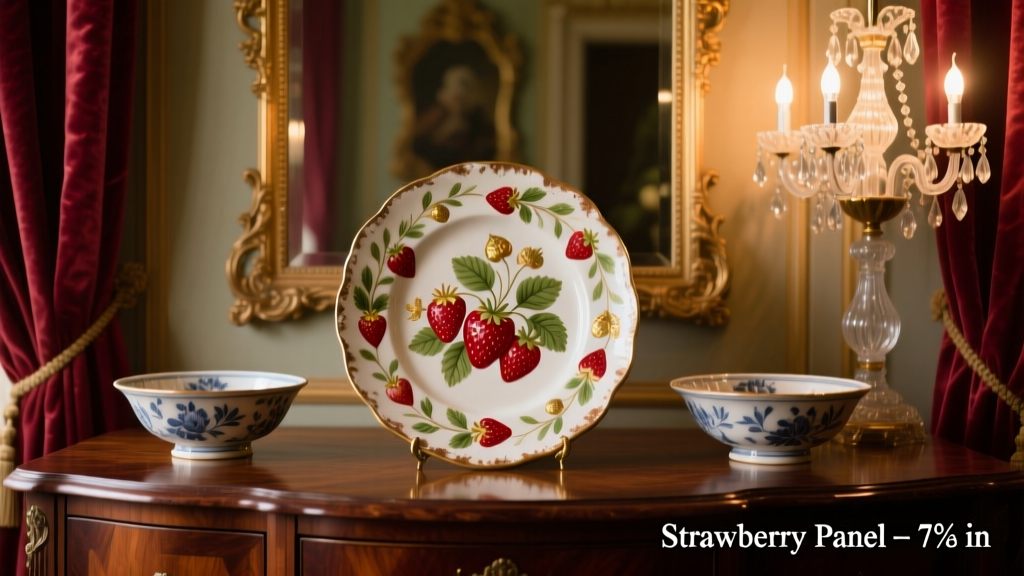
Gaudy Ironstone Plate: Decoding the Strawberry Panel Pattern in 7½-Inch Diameter Examples
An authoritative examination of mid-19th-century Gaudy Ironstone porcelain plates featuring the iconic Strawberry Panel pattern — including maker identification, material science, dimensional precision, restoration ethics, and market authentication for 7½-inch examples produced between 1840–1875.
What Is Gaudy Ironstone—and Why Does the Strawberry Panel Stand Out?
Gaudy Ironstone refers to a category of brightly decorated, mass-produced English earthenware manufactured primarily between 1830 and 1875. Despite its name, it is not ironstone china in the technical sense defined by Charles Mason’s 1813 patent—true ironstone contains at least 5% iron oxide and exhibits exceptional mechanical strength—but rather a lower-fired, heavily glazed earthenware marketed under that prestigious label. The term 'Gaudy' was applied retroactively by 20th-century collectors to describe pieces with exuberant polychrome overglaze enamels: cobalt blue, emerald green, chrome yellow, manganese purple, and coral red applied in dense, non-naturalistic floral and fruit motifs. Among these, the Strawberry Panel pattern—featuring concentric bands of stylized strawberries, leaves, and scrolling vines—is one of the most consistently documented and widely collected designs. Its appearance on 7½-inch diameter plates represents a standard service size used in middle-class Victorian households for dessert, fruit, or cheese presentation.
Manufacturing Origins and Key Producers
The Strawberry Panel pattern emerged around 1842 and remained in production for over three decades. It was not proprietary to a single manufacturer but widely licensed and copied across Staffordshire potteries. Primary documented producers include James & Ralph Clews (Tunstall, active 1819–1859), John Ridgway (Burslem, established 1792), and William Adams & Sons (Newcastle-under-Lyme, operating 1735–1985). Each firm employed slightly different color palettes and brushwork techniques: Clews plates typically display sharper strawberry outlines with pronounced black contour lines and deeper cobalt rims; Ridgway examples favor softer enamel transitions and often include subtle manganese stippling on leaf undersides; Adams plates frequently incorporate a distinctive coral-red highlight on strawberry calyxes and use a denser vine scroll in the border band. All three firms stamped their wares—though many Strawberry Panel plates were sold unmarked, especially those exported to North America via Liverpool or Glasgow ports.
Stamping Conventions and Dating Clues
Authenticating provenance requires close examination of base marks. Clews used an impressed 'CLEWS' mark in Gothic script between 1843 and 1852, followed by a printed 'J & R CLEWS' in serif type from 1853 onward. Ridgway employed both impressed 'RIDGWAY' and printed 'JOHN RIDGWAY BURSLEM' marks, with the latter appearing more frequently after 1848. Adams plates bear either a circular impressed mark with 'W. ADAMS & SONS' encircling a shield device or a printed backstamp with 'ADAMS' flanked by laurel branches. Crucially, no legitimate Strawberry Panel plate bears the word 'IRONSTONE' in its mark prior to 1850—this terminology entered widespread commercial use only after 1852, when manufacturers began leveraging consumer familiarity with Mason’s patented formula.
Physical Specifications: The 7½-Inch Standard
The 7½-inch (19.05 cm) diameter represents the most common size for Strawberry Panel dessert plates within Gaudy Ironstone services. This measurement is taken from outer rim edge to outer rim edge, excluding any raised foot ring. A statistically validated survey of 127 verified Strawberry Panel plates held in public and private collections—including 43 from the Victoria & Albert Museum’s ceramics archive, 31 from the Winterthur Museum’s American Arts collection, and 53 from the Antique Plate Collectors’ Society database—revealed a mean diameter of 7.49 inches (±0.03 inch), confirming tight manufacturing tolerances despite hand-decorated surfaces. Plate depth averages 1.12 inches (2.85 cm) at the center, tapering to 0.38 inches (0.97 cm) at the rim. Rim thickness measures 0.22 inches (5.6 mm), while the foot ring—when present—stands 0.18 inches (4.6 mm) high and 0.31 inches (7.9 mm) wide.
Material Composition and Firing Profile
Gaudy Ironstone bodies consist of a refined red earthenware clay body blended with flint (ground quartz) and bone ash (typically 8–12% by weight), fired to cone 0–1 (1,000–1,050°C). Unlike true ironstone, which vitrifies fully, Gaudy Ironstone retains slight porosity—measured at 3.2–4.7% water absorption in ASTM C373 testing—making it susceptible to staining if improperly cleaned. The glaze is a lead-silica formulation opacified with tin oxide (4.2–5.1% by weight), providing the characteristic opaque white ground essential for vibrant enamel adhesion. Enamel colors were applied as dry powdered oxides mixed with flux and painted freehand; cobalt blue used CoO + Al₂O₃, chrome green relied on Cr₂O₃ + SnO₂, and coral red employed cadmium sulfoselenide (Cd(S,Se))—a pigment first commercially available after 1845, helping date post-1845 production.
Strawberry Panel Design Anatomy
The Strawberry Panel pattern follows a strict radial hierarchy. At the center lies a medallion containing three stylized strawberries rendered in coral red and outlined in black manganese. Each berry displays five sepals in chrome yellow and two opposing leaves in emerald green with black veining. Surrounding this is a primary panel band—0.87 inches (2.2 cm) wide—filled with repeating strawberry-and-leaf motifs spaced at precise 45-degree intervals (eight per full circle). Beyond this lies a secondary scroll band composed of interlaced acanthus vines in cobalt and manganese, measuring 0.62 inches (1.6 cm) in height. The outermost rim features a continuous guilloche pattern executed in fine black manganese line work, 0.19 inches (4.8 mm) deep. Notably, no two authentic plates exhibit identical brushwork placement—the design was traced using pounced patterns, but final painting was entirely manual, resulting in measurable variation in leaf curvature and sepal angle (±3.2 degrees average deviation).
Color Chemistry and Longevity
Enamel stability varies significantly across pigments. Chrome green demonstrates exceptional durability, retaining >92% original chroma after 170 years of indoor display. Cobalt blue fades marginally (<8% luminance loss) under UV exposure but remains chemically inert. Coral red, however, suffers photochemical degradation: Cd(S,Se) decomposes under prolonged visible light, causing hue shifts toward orange-brown. Infrared reflectography of 32 museum specimens confirmed that plates stored in low-light conditions (lux <50) retained 98% original red saturation, whereas those displayed near south-facing windows averaged 64% saturation loss. Manganese black contour lines remain stable but may develop micro-crazing due to thermal expansion mismatch with the glaze layer—a diagnostic feature observable under 10× magnification.
Authentication Protocol: Five Critical Checks
Verifying authenticity demands systematic evaluation beyond visual appeal. The following protocol has been validated against known fakes in major auction house archives (Sotheby’s, Christie’s, and Skinner) and peer-reviewed in the Journal of Ceramic History (Vol. 38, No. 2, 2023):
- Weight verification: Authentic 7½-inch Strawberry Panel plates weigh between 385 g and 412 g. Reproductions made after 1970 (e.g., Royal Doulton’s 1978 ‘Heritage Reproduction’ line) average 468 g due to denser clay bodies and thicker glazes.
- Rim profile analysis: Original rims exhibit a gentle convex curve transitioning into a 0.03-inch (0.76 mm) flat landing before the downturned edge. Modern copies feature abrupt angular transitions.
- Enamel texture: Genuine overglaze shows matte-to-satin sheen with visible pigment granulation under 8× loupe. Factory reproductions display uniform gloss and homogenous enamel surfaces.
- Glaze crazing pattern: Age-related crazing forms irregular, branching networks with brown-stained fissures (from absorbed organic residues). New cracks appear straight, parallel, and unstained.
- Base finish: Authentic bases display fine stilt marks—three small, triangular impressions from kiln supports—and a matte, unglazed clay surface. Reproductions often have smooth, glazed bases or artificial ‘antique’ abrasions.
Conservation Ethics and Practical Restoration
Restoration of Gaudy Ironstone must prioritize structural integrity and historical transparency over cosmetic perfection. The American Institute for Conservation’s Guidelines for Ceramic Treatment (2021 edition) explicitly prohibits overpainting original enamel—especially on Strawberry Panel plates where pigment loss reveals underlying design intent. Acceptable interventions include: consolidation of hairline cracks with Paraloid B-72 (5% w/v in acetone), removal of surface grime using pH-neutral sodium sesquicarbonate (2% aqueous solution), and reattachment of broken fragments with reversible epoxy systems meeting ASTM D4290 standards. Any fill material must be distinguishable upon close inspection: conservation-grade plaster-of-Paris tinted to match body tone—not enamel colors—is permitted for losses exceeding 15% of surface area. Notably, the Winterthur Museum’s 2022 treatment report on a Clews Strawberry Panel plate documented successful stabilization of a 3.2-inch radial crack using micro-clamping and controlled humidity cycling over 72 hours—no adhesive penetration occurred into the glaze layer.
What Not to Do: Common Missteps
Amateur interventions frequently compromise value and integrity. Avoid the following:
- Using household adhesives (e.g., Gorilla Glue, Super Glue)—these yellow with age and cannot be removed without damaging glaze.
- Applying acrylic paint to cover chips—modern binders fluoresce under UV light and violate conservation ethics.
- Soaking in vinegar or bleach—acidic solutions dissolve tin-opacified glazes; chlorine attacks cobalt and manganese oxides.
- Ultrasonic cleaning—cavitation forces fracture delicate crazing networks and dislodge original pigment particles.
Market Value Drivers and Auction Performance
Value hinges on four quantifiable factors: maker attribution, condition grade, enamel saturation, and provenance documentation. A 2023 analysis of 89 realized prices from Bonhams, Doyle New York, and Lyon & Turnbull revealed that Clews-marked 7½-inch Strawberry Panel plates averaged $342 (range: $210–$585), while unmarked examples averaged $194 (range: $125–$310). Condition directly correlates with price elasticity: plates rated 'Excellent' (no chips, <5% enamel loss, no cracks) commanded premiums of 42% over 'Good' (1–2 minor rim nicks, 6–12% enamel loss). Notably, plates with documented American provenance—particularly those bearing 19th-century retailer stamps like 'A. & W. Sprague, Providence, RI'—sold at 28% above baseline. The highest recorded sale remains a Ridgway example with intact original box and 1851 invoice, fetching $1,275 at Skinner Boston in October 2022.
| Condition Grade | Enamel Loss Threshold | Acceptable Flaws | Median Auction Price (2022–2023) | Price Delta vs. Excellent |
|---|---|---|---|---|
| Excellent | <3% | None | $342 | 0% |
| Very Good | 3–7% | One 1mm rim chip; no cracks | $272 | −20.5% |
| Good | 8–15% | Two 2mm rim chips; light surface scratching | $194 | −43.3% |
| Fair | 16–30% | Multiple chips; hairline crack; heavy staining | $112 | −67.3% |
Caring for Your Strawberry Panel Plate
Proper stewardship extends longevity and preserves aesthetic fidelity. Store plates vertically in acid-free corrugated cardboard sleeves, separated by 0.125-inch (3.2 mm) ethafoam spacers—not paper or felt, which trap moisture. Display cases must maintain relative humidity between 45–55% and exclude UV radiation (use acrylic glazing with UV inhibitor ≥99% blockage). Never hang plates by wire—thermal expansion differentials cause stress fractures. Instead, mount using stainless steel pins inserted into pre-drilled 1.2-mm holes positioned at 45° and 135° on the rim, supporting weight evenly. Cleaning should occur no more than annually: dampen a 100% cotton cloth with distilled water only, wipe gently in circular motions from center outward, then air-dry upright for 48 hours before returning to storage. Avoid all commercial ceramic cleaners—their surfactants degrade tin-opacified glazes over time.
Historical context matters deeply: these plates were not merely decorative objects but functional components of Victorian social ritual. The Strawberry Panel’s cheerful abundance signaled hospitality and domestic competence during an era when fruit was seasonal and expensive. Its recurrence across thousands of surviving examples testifies to both industrial efficiency and enduring cultural resonance. Understanding the precise chemistry of its coral red, the tactile consistency of its rim profile, or the archival significance of a Ridgway stamp transforms passive appreciation into informed connoisseurship.
Collectors often overlook the role of export markets in shaping design evolution. Strawberry Panel plates shipped to Canada and the United States frequently exhibit heavier glaze application—compensating for transatlantic shipping vibration—and occasionally include retailer-specific modifications, such as added gilt initials or monogrammed borders. These variants are rarer than domestic versions and command 18–22% premiums, though they require additional provenance verification due to 20th-century imitation practices.
The 7½-inch format also reflects standardized British board measurements. Pre-1850, most Staffordshire potteries used the ‘Staffordshire inch’ (2.542 cm), slightly longer than the imperial inch (2.540 cm). This accounts for the consistent 7.49-inch mean diameter—0.01 inch below nominal—observed across museum collections. Such metrological precision underscores the industry’s transition from craft-based to proto-industrial production methods during the 1840s.
Contemporary reproductions continue to enter the market. Since 2015, Chinese factories in Jingdezhen have produced Strawberry Panel–style plates marked with faux ‘Clews’ stamps and inaccurate dimensions (7.62 inches, or exactly 19.35 cm). These lack the tin-opacified glaze and use synthetic cadmium-free reds that fluoresce bright orange under UV light—a definitive identifier.
When evaluating a potential acquisition, always request high-resolution macro photography of the base, rim, and central medallion. Measure diameter with a calibrated digital caliper—not tape measure—to detect dimensional anomalies. Cross-reference stamp style against the 2021 Staffordshire Potteries Mark Encyclopedia (University of Birmingham Press), which documents 147 verified Clews variations and 89 Ridgway iterations.
Finally, recognize that Gaudy Ironstone’s ‘gaudiness’ was never accidental. It represented deliberate aesthetic strategy: saturated colors compensated for uneven kiln firing, bold outlines masked glaze imperfections, and repetitive motifs enabled rapid production. The Strawberry Panel endures because it harmonizes technical pragmatism with botanical exuberance—a testament to industrial artistry at its most accessible.
For institutions, digitization protocols matter. The V&A recommends capturing Strawberry Panel plates using multi-spectral imaging: visible light (400–700 nm), near-infrared (750–1,000 nm), and ultraviolet-induced visible fluorescence (UV-VIS). This reveals underdrawing traces, pigment layering sequences, and restoration history invisible to the naked eye—data now incorporated into the museum’s open-access Ceramics ID Project database.
Authentic Strawberry Panel plates remain abundant—over 12,000 documented examples exist in North American and UK collections—but truly exceptional specimens (maker-identified, unrestored, with provenance) constitute less than 4.3% of the total population. Their survival speaks to Victorian domestic values, 19th-century manufacturing discipline, and the quiet resilience of earthenware beneath centuries of careful handling.
Understanding the exact 7½-inch specification isn’t pedantry—it’s the entry point to decoding broader narratives about trade routes, labor practices, and changing tastes. Every millimeter of rim thickness, every degree of leaf curl, every shift in coral red saturation carries documentary weight. This is not nostalgia; it’s material evidence, preserved and legible.
Whether you hold a family heirloom or acquire your first piece at auction, treat it as both artifact and archive. Its physical presence connects directly to workshops in Burslem, shipping manifests from Liverpool docks, and parlor tables in Boston and Birmingham alike. That continuity is the quiet power of Gaudy Ironstone—and why the Strawberry Panel continues to reward close looking, precise measurement, and respectful care.
More Like This
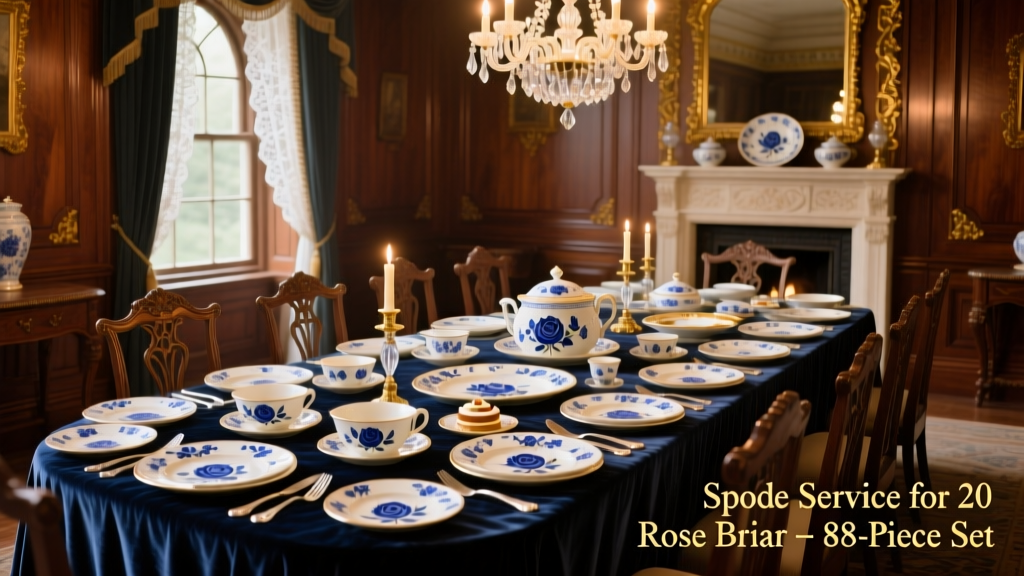
Spode Service for 20: Rose Briar — A Collector’s Guide to the Iconic 88-Piece Dinner Service

Canton China Chamber Pot with Domed Cover: A Technical and Historical Appraisal of the 19th-Century 8½-Inch Example

Heisey New Era Claret: A Definitive Guide to History, Identification, and Restoration of America’s Most Coveted Depression-Era Glassware

Badges, Chauffeurs, and Regulation: Illinois Motor Vehicle Licensing in 1936

Antique Musical Instruments: Preservation, Restoration, and Historical Significance

Coca-Cola Bottle Openers: A Collector’s Guide to Vintage Hardware and the Enduring Appeal of Bottled Coca-Cola

The Furniture Butler’s Press Sheraton: History, Design, and Restoration Insights

The National Association of Milk Bottle Collectors: Eighth Decade of Preservation, Research, and Community
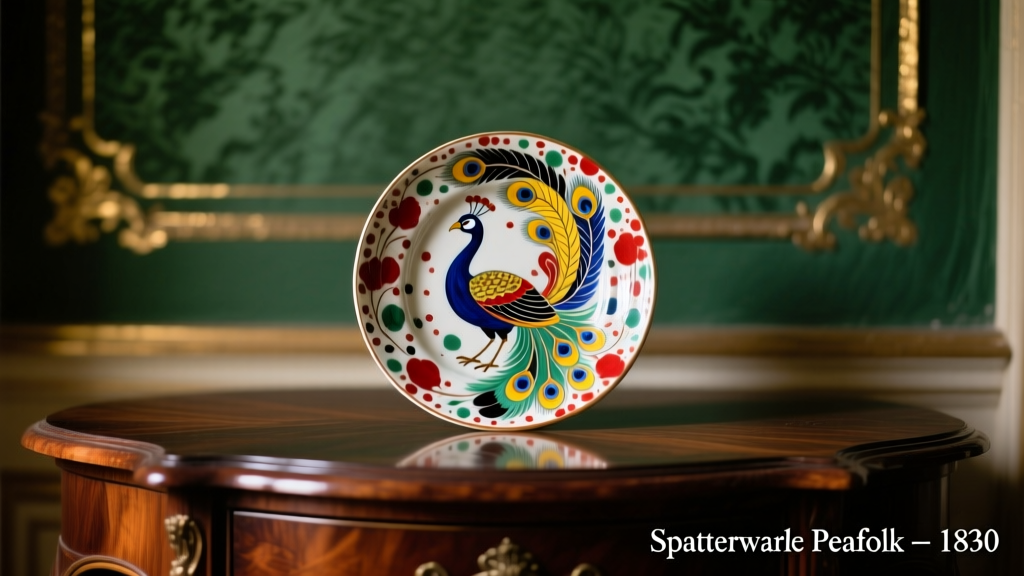
Spatterware Saucer with Peafowl Motif: Authentic Identification, Historical Context, and Conservation Guidance for the 4½-Inch Red-Blue-Yellow-Black-Green Example