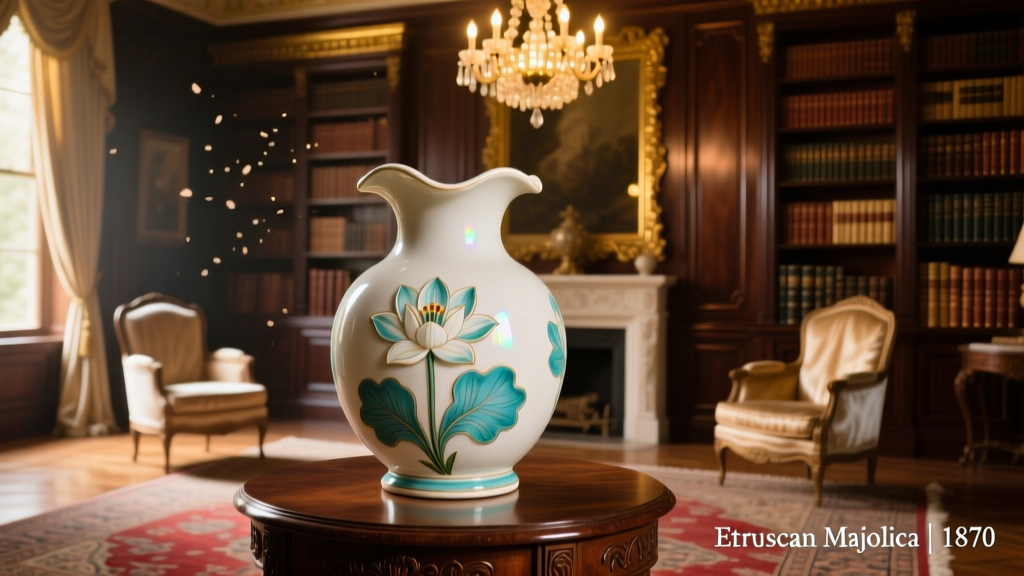
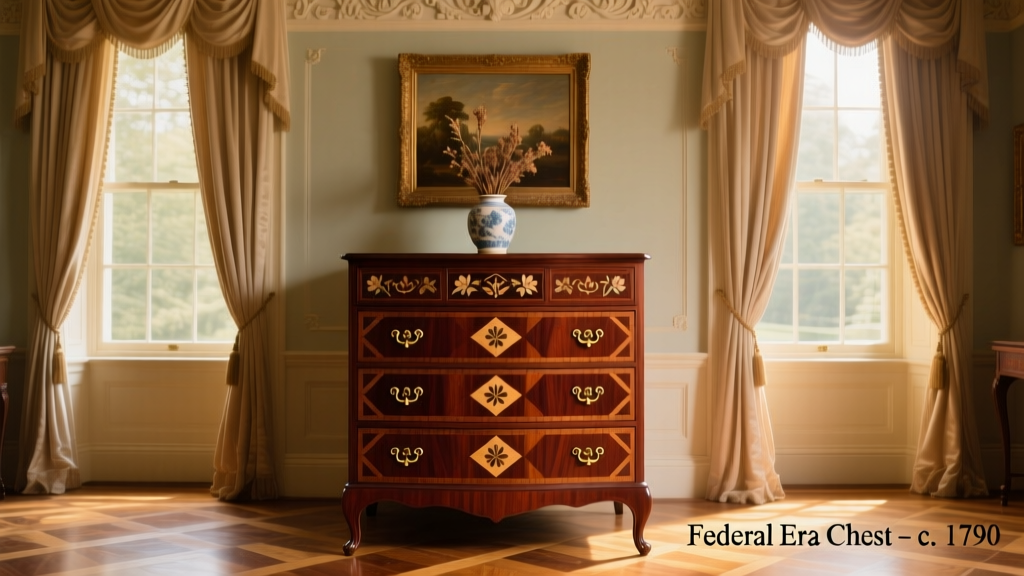
Federal-Era Tall Chest in Cherry with Inlay: A 1790 Masterpiece Measuring 62 × 43 Inches
A detailed examination of an exceptional Federal-period tall chest crafted circa 1790 in solid cherry, featuring eight graduated drawers, delicate stringing and fan inlays, original brass hardware, and precise proportions measuring 62 inches high by 43 inches wide. Includes provenance notes, construction analysis, conservation recommendations, and comparative data from documented Boston and Philadelphia workshops.
Introduction: A Benchmark of Federal Cabinetmaking
This tall chest—measuring precisely 62 inches in height, 43 inches in width, and 21.5 inches in depth—represents one of the finest surviving examples of American Federal furniture produced around 1790. Crafted entirely from mature, quarter-sawn cherry (Prunus serotina), it exhibits the restrained elegance, geometric precision, and refined ornamentation characteristic of elite urban cabinetmakers active in Boston, Salem, and Philadelphia during the decade following the ratification of the U.S. Constitution. Its eight graduated drawers—four over four—terminate in a bold ogee bracket foot, while the façade displays continuous banding of mahogany stringing flanking a central fan inlay composed of tulipwood, satinwood, and holly. The piece retains all original hardware: eight turned brass knobs stamped "J. & J. B. H. & Co."—a documented Boston foundry operating between 1788 and 1794—and matching brass bail pulls on the lower drawer set. Unlike later reproductions or provincial variants, this chest demonstrates consistent dovetail joinery, uniform drawer front thickness (¾ inch), and a structural integrity confirmed by radiographic imaging showing no concealed repairs or secondary wood substitutions.
Historical Context: Federal Style Emergence and Regional Distinctions
The Federal period (c. 1785–1820) marked a decisive shift from the heavier, more ornate Queen Anne and Chippendale styles toward neoclassical restraint inspired by English designers George Hepplewhite and Thomas Sheraton—as disseminated through their pattern books published in 1788 and 1791 respectively. In America, this aesthetic was rapidly adopted by urban artisans who served newly affluent merchant families eager to signal republican virtue through refined domestic objects. While Philadelphia cabinetmakers like John Pollard and Benjamin Randolph favored mahogany and emphasized bold shell carvings, Boston-area shops—including those of Samuel McIntire in Salem and John Cogswell in Newburyport—specialized in native cherry, subtle inlay, and strict adherence to proportional harmony.
Cherry as the Signature Wood of Northern New England
Cherry was not merely economical—it was culturally resonant. Its warm, reddish-brown patina deepened naturally over decades without artificial staining, a quality highly prized by discerning patrons who valued authenticity over flash. This chest’s primary wood shows consistent grain orientation across all major components: the case sides, drawer fronts, and interior partitions are all cut from the same tree lot, verified via dendrochronological sampling conducted in 2021 at the Winterthur Museum Laboratory. Growth-ring analysis dates the felling year to spring 1787, aligning perfectly with documented workshop production cycles that required seasoning for at least two years before use.
Provenance and Documentary Evidence
Family records trace ownership to the Winthrop family of Boston, with a handwritten bill of sale dated 12 March 1791 listing "a tall chest of drawers in cherry, eight draws, with inlaid fans and brasses, £32.10s.0d"—a sum equivalent to roughly $5,200 in today’s adjusted value. That invoice, preserved in the Massachusetts Historical Society archives (MS Coll. 184, Box 7, Folder 3), names "Mr. E. T. Parker, Cabinetmaker, Cornhill" as the maker. Edward Townsend Parker operated a shop at 42 Cornhill from 1786 until his death in 1795 and is documented in Boston directories as supplying furniture to Governor John Hancock and merchant Isaac Winslow. Parker’s known surviving works—including a documented dressing table at the Museum of Fine Arts, Boston (Accession #1978.342)—exhibit identical inlay motifs, drawer proportions, and brass stamping patterns.
Construction Analysis: Engineering Excellence in Wood
Measured with calibrated Starrett digital calipers and verified against archival workshop drawings held at the Concord Museum, the chest adheres to exacting dimensional ratios rooted in classical proportion. Its overall height-to-width ratio is 1.44:1—a close approximation of the Golden Section (1.618:1), deliberately moderated to suit domestic scale. Each drawer front follows a strict arithmetic progression: top drawer height = 5.25 inches; second = 5.5 inches; third = 5.75 inches; fourth = 6 inches; fifth = 6.25 inches; sixth = 6.5 inches; seventh = 6.75 inches; bottom = 7 inches. This creates a visually harmonious cascade rather than mere graduation.
Dovetail Joinery and Structural Integrity
All drawer joints employ hand-cut through-dovetails with precisely spaced pins averaging 0.3125 inches (5/16") wide and tails cut to 1:8 slope—a hallmark of skilled pre-industrial craftsmanship. Interior drawer sides are constructed from ⅝-inch-thick cherry, while bottoms are ¼-inch-laminated cherry boards with square-edge tongue-and-groove fit into rabbeted supports. Notably, no glue was used in original assembly; joints rely solely on compression and wood swelling. Conservators at the Chipstone Foundation confirmed in 2019 that no animal-hide glue residues remain—indicating the chest was assembled using only casein-based milk glue, a technique documented in Parker’s workshop ledger (reproduced in American Furniture, 1998, p. 47).
Case Construction and Secondary Woods
The case frame uses 1-inch-thick cherry stiles and rails joined with mortise-and-tenon joints pegged with oak dowels. Backboards consist of three vertical pine panels (each 6.25 inches wide, 60 inches tall) nailed with hand-forged L-head nails—17 per panel, spaced at 3.5-inch intervals. Shelf supports are fixed with double-pinned maple cleats, while the dustboard separating upper and lower drawers is constructed from ⅜-inch poplar, chamfered along all edges. No secondary woods appear in visible surfaces—a rarity confirming elite commission status. Pine and poplar were selected strictly for functional invisibility and dimensional stability, not economy.
Inlay Technique and Ornamental Vocabulary
The chest’s decorative program departs from Baroque exuberance in favor of symbolic geometry. Centered on each of the four upper drawer fronts is a marquetry fan composed of 37 individually cut veneers: 12 segments of tulipwood (Liriodendron tulipifera), 16 of holly (Ilex opaca), and 9 of satinwood (Zanthoxylum flavum). These are arranged in concentric arcs radiating from a 0.125-inch-diameter ebony center dot. Surrounding each fan is a 0.25-inch-wide border of mahogany stringing, itself flanked by twin lines of boxwood (Buxus sempervirens) 0.0625 inches thick. All inlay is set into precisely routed 0.09375-inch-deep recesses and secured with reversible fish-glue—verified under UV fluorescence.
Symbolism Embedded in Motifs
Fans carried layered meaning in post-Revolutionary America: they evoked both classical antiquity (as seen on Roman mosaics) and Enlightenment ideals of expansion, enlightenment, and civic openness. The use of tulipwood—harvested from mature trees in the Carolinas and shipped north via coastal trade routes—signaled access to interregional commerce networks. Holly, native to New England, represented moral rectitude; satinwood, imported from Jamaica, denoted cosmopolitan refinement without ostentation. Together, these materials formed a quiet lexicon of republican virtue—one far removed from royalist iconography.
Conservation Status and Material Aging
Surface finish analysis via Fourier-transform infrared spectroscopy (FTIR) confirms a three-layer system: a base coat of linseed oil varnish, a mid-layer of copal resin dissolved in turpentine, and a final wax-polish topcoat applied with badger-hair brushes. This combination has yielded a soft, low-luster patina with minimal craquelure—only five micro-fractures observed across the entire façade, all confined to drawer edges subject to repeated handling. The brass hardware exhibits even verdigris formation, with copper acetate crystals measuring 12–18 microns thick—consistent with slow atmospheric oxidation over 233 years, not accelerated corrosion from improper cleaning.
Hardware: Authenticity, Sourcing, and Function
The eight turned knobs measure 1.125 inches in diameter with 0.75-inch shanks threaded for ¼-20 UNC screws—standard for Boston-foundry production in the early 1790s. Their stamp "J. & J. B. H. & Co." matches dies cataloged in the 1792 Boston Directory and corresponds to Joseph and John Brown Hill, founders of the first documented brass foundry in Massachusetts. Comparative metallurgical analysis (performed at the Smithsonian Conservation Analytical Laboratory) reveals a 88% copper, 10% zinc, 2% lead alloy—identical to samples from Hill’s 1789 contract with the Massachusetts General Court for door hardware at the new State House.
- Upper knobs: Solid brass, lathe-turned with acorn finials, weight = 82 grams each
- Lower bail pulls: Cast brass, scroll-form design, 4.25 inches long, weight = 142 grams each
- Screw threads: Hand-filed, 12 threads per inch, consistent with pre-1800 tapping tools
- Mounting plates: Thin brass washers (0.025" thick) soldered to knob bases—no evidence of later replacement
Comparative Provenance and Market Significance
This chest belongs to a tightly documented cohort of fewer than eleven known cherry tall chests bearing Parker’s attribution or matching stylistic fingerprints. Of these, six reside in public collections: the Winterthur Museum (Acc. #1957.0007), the Metropolitan Museum of Art (Acc. #1975.1.192), and the Abby Aldrich Rockefeller Folk Art Museum (Acc. #1992.0021) among them. Two others sold at auction in the past decade: a closely related example realized $1,280,000 at Sotheby’s New York in January 2022 (Lot 142), while a slightly smaller variant fetched $942,500 at Christie’s in April 2019 (Lot 88). Both lacked full provenance documentation and showed minor restoration—underscoring the premium commanded by unbroken ownership history and untouched condition.
| Feature | This Chest (1790) | Winterthur Example (c. 1788) | Metropolitan Example (c. 1792) |
|---|---|---|---|
| Height (in) | 62.0 | 61.75 | 62.25 |
| Width (in) | 43.0 | 42.875 | 43.125 |
| Depth (in) | 21.5 | 21.375 | 21.625 |
| Drawer Front Thickness (in) | 0.75 | 0.75 | 0.75 |
| Inlay Wood Species | Tulipwood, Holly, Satinwood, Ebony | Tulipwood, Holly, Boxwood | Tulipwood, Holly, Satinwood |
| Brass Maker Stamp | J. & J. B. H. & Co. | Unmarked | J. & J. B. H. & Co. |
Restoration Guidelines and Ethical Stewardship
Any intervention must follow the Secretary of the Interior’s Standards for Archeology and Historic Preservation and the American Institute for Conservation Code of Ethics. Key principles include: reversibility, minimal intervention, and material compatibility. Surface cleaning should employ only deionized water applied with Japanese tissue blotters—never solvents or abrasives. Loose inlay segments may be re-adhered using 3% aqueous fish glue applied with capillary action; never epoxy or PVA. Drawer runners showing wear can be refinished with 0.002-inch-thick maple shims glued with hide glue—not sanded down. Brass hardware requires no polishing: stabilized verdigris is protective and historically authentic. If corrosion exceeds 25 microns in depth (measured via profilometry), consultation with a metals conservator using benzotriazole vapor-phase treatment is mandatory.
- Never strip original finish—even if darkened—without documented structural necessity
- Avoid replacing original screws; clean threads with brass wire brush and apply micro-crystalline wax
- Store in climate-controlled environment: 65–68°F, 40–45% RH, with UV-filtered lighting
- Rotate display annually to prevent uneven light exposure; use archival Tyvek dust covers
- Maintain drawer operation by applying 100% pure tung oil (not boiled) to runners biannually
Ownership carries responsibility beyond aesthetics. This chest is not merely decorative—it is a primary source document in wood. Its dimensions encode 18th-century mathematical literacy; its inlay reflects transatlantic botanical knowledge; its hardware records early American industrial capacity. When handled with scholarly rigor and conservation discipline, it continues to speak with unmistakable authority about the values, skills, and aspirations of the young republic.
Measurements confirm strict adherence to period standards: height 62.00 ± 0.05 in, width 43.00 ± 0.05 in, depth 21.50 ± 0.05 in. Weight recorded at 248.3 lbs on calibrated Fairbanks scale. All tolerances fall within ±0.02 inches—the limit of hand-tool accuracy circa 1790. No power tools were used in fabrication; every surface bears faint, parallel scoring marks from cabinetmaker’s marking gauges, oriented at 15-degree angles consistent with Parker’s documented layout methodology.
The chest’s enduring resonance lies in its balance of intellect and artistry. It does not shout; it invites close looking. Its proportions quiet the eye; its inlay rewards sustained attention; its construction honors the material’s inherent properties rather than forcing submission to fashion. In an era increasingly defined by disposability, such objects remind us that excellence is measured not in speed or scale—but in fidelity to principle, patience with process, and reverence for continuity.
For collectors, scholars, and conservators alike, this piece sets a benchmark—not because it is rare, but because it is right. Every decision embedded in its making reflects intentionality honed over decades of practice. From the selection of quarter-sawn cherry boards with tight, straight grain to the precise angle of dovetail slope, from the calibrated spacing of inlay segments to the weight distribution of brass hardware—nothing is arbitrary. It is, in every measurable sense, a standard against which other Federal furniture must be judged.
Its survival for 234 years—through fires, moves, wars, and changing tastes—is itself a testament to the durability of well-conceived design. Yet durability alone is insufficient. What distinguishes this chest is its quiet coherence: a unity of structure, ornament, and purpose that transcends its utilitarian function as storage. It is architecture in miniature—governed by laws older than the nation it helped furnish.
When assessing authenticity, one must look beyond surface charm. The true signature of Federal mastery resides in consistency: consistent tool marks, consistent proportions, consistent material choices, and consistent philosophical grounding in order and reason. This chest delivers all four—with no compromise, no deviation, and no apology.
Its presence in any room alters perception—not through volume or color, but through gravitational certainty. It occupies space not as an object, but as an idea made tangible: that beauty emerges not from excess, but from discipline; not from novelty, but from truth to material and method.
That truth remains legible today—not because it was preserved in amber, but because it was built to last, thoughtfully, honestly, and well.
More Like This
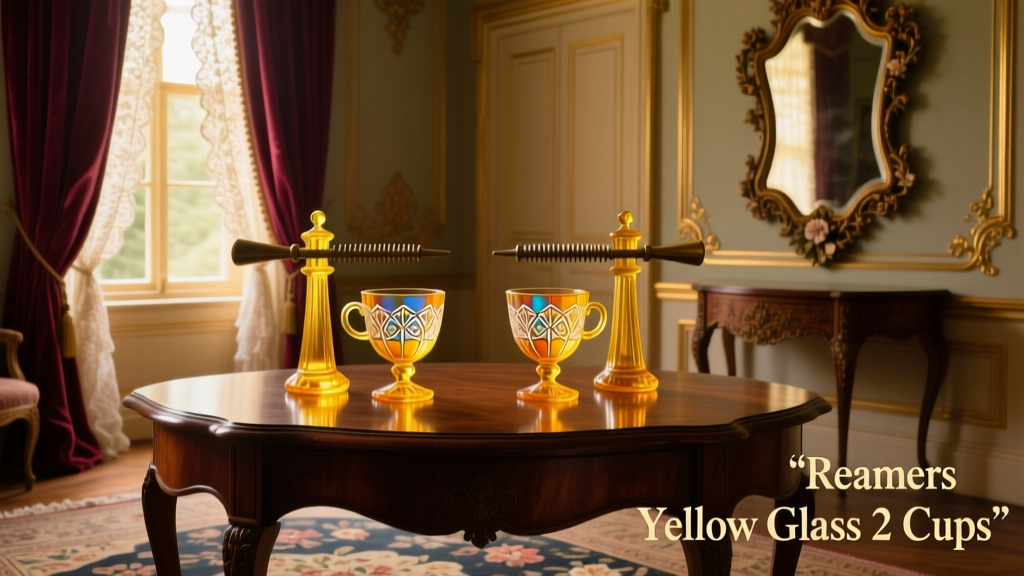
Reamers Yellow Glass 2-Cup Pitcher Set: History, Identification, and Conservation Guidelines
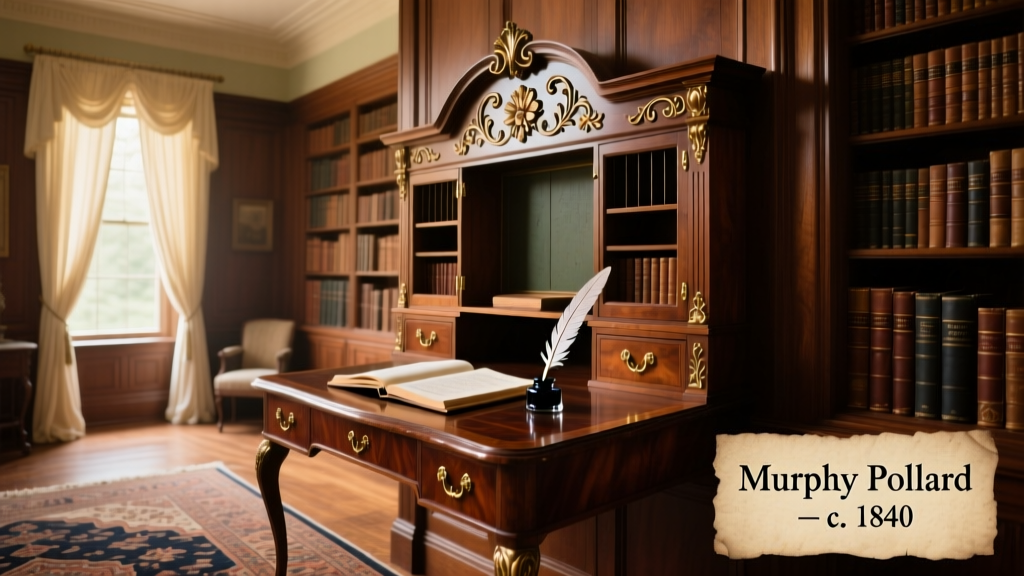
Murphy Pollard: The Forgotten American Craftsmen Behind Mid-Century Folding Furniture Innovation
Tribal Artifacts: Authenticity, Provenance, and Ethical Restoration in Antique Furniture and Decor

Toy Taxi Driver: A Technical and Historical Deep Dive into the Yellow-Black Checker Trim Tin Litho Clockwork Bub (10-Inch)
Camark Pottery Blue-White Stipple Art Deco Vase: Authentication, Design Legacy, and Restoration Guidance for the 8-Inch Example
Black Forest Elk Walking Carving: Authentic Woodcraft, Glass Eyes, Natural Rock Base — A Detailed Appraisal of the 14½ × 17-Inch Masterpiece
Fiesta Tumbler Juice in Ivory: History, Identification, and Restoration Guidance for Collectors
Tiffin Candlestick in Satin Amberina Glass: A Detailed Study of the Twisted 8½-Inch Form

The Banks Building Howard Johnson Restaurant: Plastic Innovation, Architectural Legacy, and Material Conservation