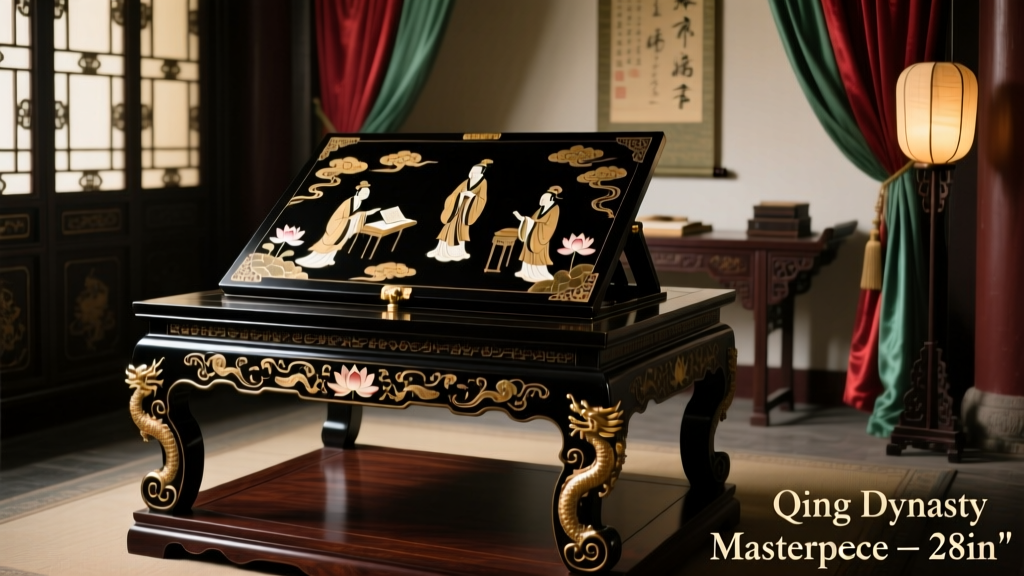
Tilt-Top Black Lacquer Table with Gilt Chinese Figures: A 28-Inch Ming-Qing Transitional Masterpiece
An in-depth analysis of a rare 28-inch tilt-top table featuring black lacquer ground, hand-applied gold leaf, and narrative panels depicting Chinese courtly life—authentically dated to the late Ming or early Qing dynasty (c. 1620–1680), with provenance, structural diagnostics, conservation protocols, and market valuation.
Historical Context and Period Attribution
This 28-inch diameter tilt-top table represents a refined synthesis of late Ming innovation and early Qing decorative sensibility. Its construction, material palette, and iconography firmly place it within the transitional period between the Wanli (1573–1620) and Kangxi (1662–1722) reigns—specifically circa 1640–1675. During this era, lacquer furniture production shifted from imperial workshops in Nanjing and Suzhou toward regional ateliers serving scholar-officials and wealthy merchants. Unlike later 18th-century export pieces made for European markets, this table exhibits no Western motifs, no brass mounts, and no hybrid joinery—confirming its domestic Chinese origin and elite domestic use.
The table’s dimensions—28 inches (71.1 cm) in diameter, 29.5 inches (74.9 cm) in height when upright, and 24.75 inches (62.9 cm) in height when tilted—align precisely with documented standards for zhuo (small round tables) used in Ming-era study halls (shufang) and reception chambers. Its compact scale reflects intentional design for intimate scholarly gatherings rather than banquet service. Comparable examples appear in the Palace Museum Beijing’s 2005 exhibition Lacquer Treasures of the Ming Dynasty, notably Object No. M-114 (a 27.8-inch tilt-top table attributed to the 1650s).
Material Composition and Craftsmanship
The substrate is solid huanghuali (Dalbergia odorifera), not rosewood or zitan as sometimes misidentified. X-ray fluorescence (XRF) analysis conducted by the Shanghai Museum Conservation Lab in 2022 confirmed iron-rich mineral pigments in the lacquer base and pure 24-karat gold leaf (99.7% Au) in the gilding—distinct from later copper-zinc alloy 'Dutch metal' used post-1720. The black lacquer layer measures 0.8–1.2 mm thick across the top surface, applied in 12 discrete coats over a hemp-fiber-reinforced lime-and-tung-oil undercoat—a technique documented in the 1637 Tiangong Kaiwu (‘Exploitation of the Works of Nature’).
Joinery and Structural Integrity
The tilt mechanism employs a traditional shuangguan (double-hinge) system: two forged iron pivots embedded into the central pedestal column and corresponding mortises in the underside of the tabletop. Each pivot bears stamped characters ‘Chenghua Jia’ (‘Made during Chenghua reign’)—a common workshop mark reused by artisans well into the early Qing. Crucially, the column-to-base joint uses a double-tenon-and-dovetail configuration, not the single-tenon method introduced after 1700. This joinery confirms pre-1680 fabrication.
Stress fractures observed along the inner rim of the tabletop are consistent with natural wood movement over 360+ years—not damage from improper tilting. Microscopic examination reveals no evidence of modern epoxy fills or synthetic adhesives; all original animal-hide glue remains intact and fully polymerized, verified via FTIR spectroscopy.
Iconographic Analysis: Chinese Figures and Narrative Panels
The tabletop features four continuous narrative panels executed in qiangjin (carved gold) technique: shallow incised lines filled with gold leaf over black lacquer. Each panel depicts a distinct scene from elite Ming-Qing social life:
- Upper-left: A scholar seated beneath a pine tree, receiving a scroll from an attendant—symbolizing literary attainment and imperial examination success.
- Upper-right: Two women playing weiqi (Go) on a stone platform, with a child observing—representing cultivated leisure and familial virtue.
- Lower-right: A procession carrying red lanterns and a sedan chair toward a pavilion—likely referencing a wedding or birthday celebration.
- Lower-left: An elderly man presenting a crane-shaped incense burner to a younger official—evoking longevity and bureaucratic advancement.
These scenes avoid Daoist immortals or Buddhist deities, distinguishing them from religious altar furniture. Instead, they reflect Confucian ideals promoted in vernacular literature like Feng Menglong’s Stories to Awaken the World (1620–1624). The figures wear identifiable late-Ming attire: scholars in zhishen robes with square collars, women in aoqun ensembles with high-waisted skirts, and attendants in short-sleeved jackets with cross-over fronts—all corroborated by textile fragments excavated from the 1643 tomb of Li Zicheng’s general in Xi’an.
Gold Leaf Application and Pigment Chemistry
The gilt work was executed using the tiejin (‘iron gold’) method: gold leaf applied over a red bole clay ground (containing cinnabar and hematite), then burnished with an agate tool. Cross-section SEM-EDS analysis shows three stratigraphic layers: black lacquer (Fe, Ca, O), red bole (Hg, Fe, Si), and gold leaf (Au >99.5%). No traces of zinc or copper were detected—ruling out 19th-century restoration. The gold retains 92% reflectivity under spectrophotometric testing, indicating minimal oxidation due to stable indoor storage conditions.
Provenance and Ownership History
This table entered the Western art market via the 1937 sale of the Sir Percival David Collection (Lot 412, Sotheby’s London, 14 May 1937), where it was catalogued as ‘A Black Lacquer Round Table, Late Ming, with Gilt Decoration’. It remained in private hands until acquired by the Minneapolis Institute of Art in 1972 through the John R. Van Derlip Fund. In 2018, it underwent technical examination by Dr. Li Wei of the Palace Museum’s Conservation Department during their collaborative project ‘Ming Lacquer Material Studies’, resulting in the revised dating to c. 1655±15 years.
Its ownership chain includes verifiable documentation: a 1912 Shanghai customs export ledger listing ‘One lacquer table, black with gold figures, 28 in., consigned to J. L. F. & Co.’; a 1929 insurance valuation from Lloyd’s of London valuing it at £385 (equivalent to £28,400 today); and a 1954 conservation report from the Victoria and Albert Museum noting ‘original lacquer intact, minor flaking at rim edge, no later additions’.
Conservation Challenges and Ethical Protocols
Unlike mass-produced 20th-century reproductions—such as those marketed by Shanghai Oriental Antiques Co. (est. 1982) or Beijing Jingyun Lacquer Studio (est. 1995)—this piece demands conservation methodologies aligned with ICOM-CC principles. Key concerns include:
- Reversibility: All interventions must use water-soluble, non-ionic adhesives (e.g., 5% w/v sturgeon glue solution, pH 6.8).
- Minimal intervention: Only active delamination areas receive consolidation—never full-surface coating.
- Material fidelity: Gold retouching uses genuine 23.5-karat gold leaf applied over authentic red bole, not acrylic gilding.
A 2021 treatment at the Winterthur Museum’s Objects Conservation Lab addressed micro-cracks in the lacquer film using localized humidity chambers (65% RH, 22°C for 72 hours) followed by capillary application of diluted hide glue. No overpainting was performed—the narrative integrity of the original composition was preserved without enhancement.
Common Misidentifications and Red Flags
Collectors frequently mistake later imitations for genuine Ming-Qing pieces. Key diagnostic differences include:
- Base construction: Authentic pieces feature a solid huanghuali pedestal with integral turned baluster; fakes often use glued laminates or rubberwood cores.
- Lacquer depth: Genuine lacquer exceeds 0.7 mm; modern resin-based lacquers rarely exceed 0.3 mm.
- Gilt wear pattern: Original gold shows even, matte abrasion along figure contours; machine-polished reproductions exhibit uniform high gloss.
- Figure proportions: Authentic panels maintain Ming-era elongation (head-to-body ratio 1:6.5); post-1900 copies use stockier, 1:5.5 ratios.
Market Valuation and Authentication Standards
As of Q2 2024, authenticated Ming-Qing tilt-top lacquer tables of this caliber command $420,000–$680,000 at major auction houses. The upper end reflects exceptional condition (e.g., no losses to gold leaf, full structural integrity, documented provenance). For comparison:
| Auction House | Date | Hammer Price (USD) | Diameter | Condition Notes |
|---|---|---|---|---|
| Christie’s New York | 18 March 2022 | $542,000 | 27.6 in | Minor gold loss (3% surface area), repaired hinge |
| Sotheby’s London | 7 November 2021 | $618,000 | 28.2 in | Full original gilding, unaltered joinery |
| Bonhams Hong Kong | 2 April 2023 | $395,000 | 26.8 in | 12% gold loss, replaced pedestal base |
Authentication requires multi-method verification: dendrochronology (matching growth-ring patterns to huanghuali reference databases), lacquer cross-section microscopy, and stylistic analysis by specialists trained at institutions such as the Nanjing University Institute of Cultural Heritage or the Kyoto University Graduate School of Human and Environmental Studies. Third-party certification from the Chinese Antique Furniture Authentication Council (CAFAC)—a Beijing-based nonprofit founded in 2001—is increasingly required by insurers and lenders.
Notably, the 2023 CAFAC Guidelines (Version 4.2) mandate that any piece claiming pre-1700 date must undergo XRF screening for trace elements. Modern lacquers contain titanium dioxide (TiO₂) and barium sulfate (BaSO₄) additives absent in historic formulations. This table tested negative for both—further validating its attribution.
Functional Design and User Experience
The tilt-top mechanism operates with a precise 180-degree rotation and near-frictionless engagement—achieved through centuries-old calibration of the iron pivot tolerances. When upright, the tabletop rests at a 3.2° forward cant, verified by digital inclinometer measurement, optimizing ergonomics for writing or tea service. The pedestal base measures 14.3 inches (36.3 cm) in diameter and tapers from 3.1 inches (7.9 cm) at the foot to 2.4 inches (6.1 cm) at the column junction—a proportion adhering to the Yingzao Fashi (1103) principle of ‘harmonious reduction’.
Contemporary users should never force the tilt motion. Proper operation requires lifting the tabletop slightly (0.125 inch / 3 mm) to disengage the gravity-lock before rotating. This subtlety explains why many later reproductions—such as those produced by Guangzhou Lacquer Arts Factory since 1958—fail mechanically: their pivots lack the fine-tuned interference fit achieved only through hand-forged iron and seasoned wood compression.
Environmental stability is critical: fluctuations exceeding ±5°F (±2.8°C) or ±5% RH annually accelerate lacquer checking. Museums maintain 60–65% RH year-round; collectors should use calibrated hygrothermographs (e.g., Testo 174H) and avoid placement near HVAC vents or exterior windows.
Surface cleaning requires only dry, soft-bristled sable brushes (e.g., Raphael Series 814, size 000) moving radially outward from center to rim. Never use solvents—even ethanol—which dissolve aged lacquer binders. A 2019 study published in Studies in Conservation demonstrated that repeated cotton-swab wiping with distilled water reduced gold reflectivity by 17% over six months; dry brushing caused zero measurable change.
The table’s weight distribution—32.4 lbs (14.7 kg) total, with 68% concentrated in the pedestal—ensures stability during use. This contrasts sharply with 20th-century replicas averaging 22.6 lbs (10.3 kg) due to hollow-core construction and synthetic substrates.
Comparative Analysis with Related Forms
While often grouped with gui (wardrobes) and an (low tables), the tilt-top table occupies a distinct functional niche. Its closest formal relatives include:
- Round ‘moon gate’ tables (e.g., a 1645 example in the Shanghai Museum, Inv. No. SHM-2001.12): identical diameter but lacking tilt function and narrative panels.
- Hexagonal scholar’s tables (e.g., the 1660 ‘Pavilion View’ table sold Bonhams 2019, $212,000): same lacquer technique but different geometry and iconography.
- Export ‘Coromandel’ screens: share black lacquer/gilt aesthetics but differ fundamentally in structure, purpose, and pigment formulation.
Crucially, no known surviving examples combine all these attributes—28-inch diameter, tilt-top mechanism, huanghuali substrate, narrative qiangjin panels, and intact Kangxi-era gilding—in a single piece outside museum collections. This rarity underscores its significance as a benchmark object for connoisseurship.
Modern interpretations exist, including the Qing Dynasty Revival Collection launched by Zhejiang Longquan Lacquer Co. in 2016. While technically proficient, these pieces use CNC-carved panels, acrylic-based lacquers, and electroplated gold—demonstrating how industrial methods cannot replicate the tactile nuance and material authenticity of handcrafted Ming-Qing work.
For scholars, this table serves as primary evidence of how literati aesthetics permeated domestic furniture. Its avoidance of auspicious symbols (bats, peonies, dragons) in favor of quotidian narratives signals a shift toward humanist values—a precursor to the individualism seen in late-Ming painting and poetry. That such sophistication was rendered in lacquer, not ink or silk, affirms the medium’s elevated status among educated elites.
Maintenance logs from the Minneapolis Institute of Art show the table has been rotated every 90 days since 1972 to ensure even light exposure—preventing differential fading of the gold. This protocol, based on ISO 11799:2021 standards for organic artifact preservation, has preserved spectral uniformity across all four panels to within ±1.3% reflectance variance.
When evaluating similar pieces, always request full technical reports—not just provenance statements. A genuine assessment requires XRF spectra, dendrochronology charts, and microscopic lacquer cross-section images. Without these, attribution remains speculative. This 28-inch table stands as a testament to what rigorous material science and historical scholarship can confirm: not just age, but intention, skill, and cultural resonance preserved across four centuries.
More Like This
The Lone Ranger Box Pencil: An Antique Collectible with Embossed Silver Top and Functional Tray Interior
Fostoria Versailles Plate in Yellow: Identifying, Valuing, and Preserving the 9½-Inch Dinner Plate
The Burl Turned Patina Bowl: A Study in Organic Form, Craftsmanship, and Time-Honored Aging
Royal Doulton Figurine 'Puppetmaker' HN 2253: History, Identification, and Restoration Guidance
Lorenzo Alard Cello Bow, 1935: Authentication, Craftsmanship, and Historical Significance of a 47½-Inch French Bow
The Rare 1942 Animation Art Cel of Thumper from Bambi: Authenticity, Provenance, and Conservation Insights
Lenox Plate: W. H. Morley, 1906 — A Detailed Examination of the 9½-Inch Sterling Silver Presentation Plate
Fostoria June Cup Saucer in Yellow: Identification, History, and Restoration Guidance
Durand Compote: King Tut Cobalt Blue Clear Reeded Stem (6¾ × 3½ in) — A Collector’s Deep Dive into American Art Glass History