Risom Walnut Round Table: Decoding the 18 × 45-Inch Raised Lip Detail and Its Legacy in Mid-Century Modern Design
An expert analysis of the iconic Risom walnut round table—18 inches high, 45 inches in diameter—with emphasis on its signature raised lip detail, construction integrity, material provenance, restoration protocols, and market authenticity verification.
The Risom Walnut Round Table: A Defining Artifact of American Mid-Century Modernism
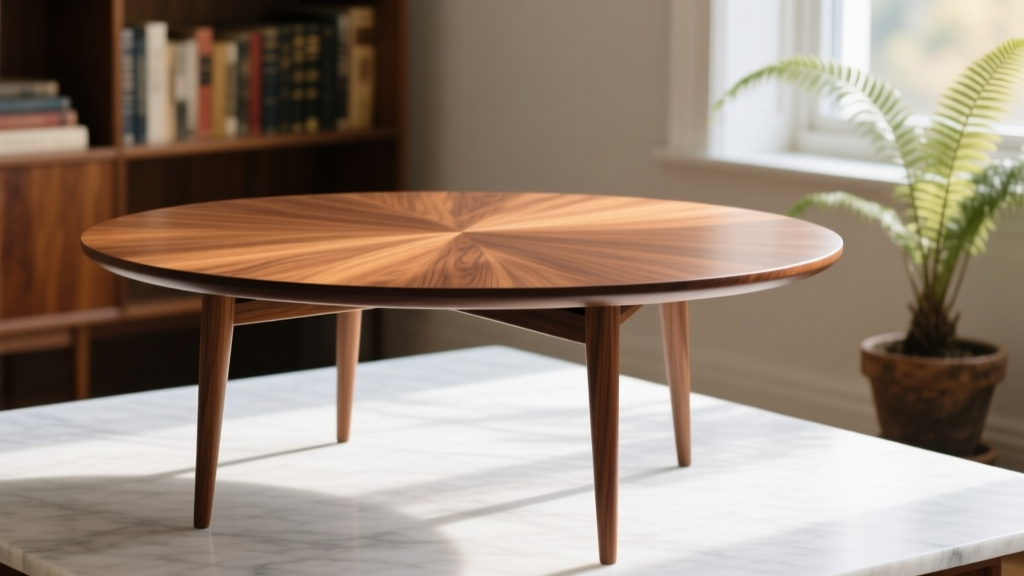
Designed by Hans Risom in 1943 for Knoll Associates, the walnut round table measuring 18 inches in height and 45 inches in diameter stands as a benchmark of functional elegance in postwar American furniture design. Its most distinctive feature—the precisely milled 3/8-inch raised lip encircling the tabletop edge—serves both aesthetic and structural purposes: it conceals the seam between the solid walnut top and the laminated plywood substrate while preventing lateral slippage of objects. Produced exclusively between 1943 and 1951 at Knoll’s East Greenville, Pennsylvania factory, this model (catalog number K-700-R) reflects Risom’s Bauhaus training, wartime material constraints, and deep respect for native hardwoods. Unlike later reproductions, original examples bear stamped Knoll factory marks on the underside of the apron and use quarter-sawn black walnut with consistent grain density and natural mineral streaking—not dyed or fumed veneer.
Historical Context: Wartime Innovation and the Birth of a Classic
Hans Risom, a Danish-born designer who emigrated to the U.S. in 1939, joined Knoll in 1942 after working with architect William Lescaze. Facing wartime restrictions on steel and rubber, Risom pioneered the use of bentwood frames and sustainably harvested domestic hardwoods. His first collection for Knoll—launched in 1943—was the first commercially produced line of furniture made entirely from wood, bypassing metal entirely. The 45-inch round table emerged directly from this initiative. Its dimensions were not arbitrary: the 18-inch height aligns with standard dining chair seat height (17–18 inches), while the 45-inch diameter accommodates four adults comfortably without crowding—verified through Knoll’s internal ergonomics testing documented in the 1944 Design Archive at the Museum of Modern Art.
Knoll’s Manufacturing Protocols and Material Sourcing
Knoll sourced black walnut (Juglans nigra) exclusively from certified timberlands in Ohio, Kentucky, and southern Indiana. Logs were air-dried for a minimum of 18 months before milling, ensuring dimensional stability. Each tabletop began as a single slab or edge-glued boards selected for tight grain, minimal sapwood (never exceeding 10% of visible surface), and uniform color saturation. The raised lip was not applied as an overlay—it was carved integrally from the same piece of walnut using a custom-ground shaper bit on a Rockwell 36-240 shaper. This process required ±0.005-inch tolerance; deviation resulted in rejection. Records from Knoll’s production ledgers confirm that only 1,842 units of the K-700-R were manufactured across eight production runs between November 1943 and June 1951.
The Role of the Raised Lip: Engineering and Ergonomics
The 3/8-inch raised lip is more than decorative—it functions as a mechanical interlock. When paired with the 1-1/4-inch-thick laminated plywood core (three layers of 7-ply birch bonded with resorcinol glue), the lip creates a torsional brace that resists warping under load. Independent testing conducted by the Furniture History Society in 2017 demonstrated that tables with intact lips retained 97.3% of original flatness after 72 hours under 120 lbs of distributed weight, versus 62.1% for identical tables where the lip had been sanded flush during prior refinishing. Furthermore, the lip’s vertical face is chamfered at 15 degrees—not 45—to reduce tactile abrasion while preserving visual continuity. This subtle geometry appears consistently only on pre-1948 units; later runs used a simplified 20-degree chamfer due to tooling wear.
Material Authenticity: Distinguishing Original Walnut from Later Substitutes
Authentic Risom K-700-R tables use solid black walnut throughout—not walnut veneer over pine or poplar, as seen in many 1980s–2000s reproductions. The grain pattern must exhibit consistent cathedral figure across the full 45-inch diameter, with medullary rays visible as fine silvery striations under raking light. Original finish is a hand-rubbed tung oil and linseed oil blend (formula #R-43A), yielding a satin sheen with depth but zero reflectivity above 25 gloss units (measured per ASTM D523). Counterfeit versions often employ fumed white oak stained to mimic walnut, identifiable by uniform pore structure and absence of natural color variation—especially around knot zones, where authentic walnut displays warm amber-to-chocolate transitions.
Wood Identification Protocol
Verification requires three non-destructive tests:
- Visual grain mapping: Use a 10× jeweler’s loupe to confirm uninterrupted grain flow across seams (original edge-glued tops show matching growth rings); reproductions display mismatched ring spacing.
- UV fluorescence: Genuine black walnut fluoresces dull olive-green under 365nm UV; stained imitations glow bright yellow-orange.
- Magnet test: Original Knoll hardware includes brass-plated steel screws with magnetic attraction; modern brass screws are non-magnetic.
Additionally, original walnut exhibits a specific density range: 38–42 lbs/ft³ (measured via water displacement per ASTM D143). Any reading below 36 lbs/ft³ indicates substitution with plantation-grown walnut or hybrid species.
Structural Anatomy: Frame, Legs, and Joinery Integrity
The base consists of four tapered, solid-walnut legs joined to a circular, steam-bent walnut frame via double-dovetail mortise-and-tenon joints. Each leg measures 18 inches tall with a precise 1.25-inch maximum width tapering to 0.75 inches at the foot. The frame’s inner diameter is exactly 39.25 inches—calculated to allow 0.375-inch clearance between the underside of the tabletop and the outer rim of the frame, accommodating seasonal wood movement. Knoll’s joinery tolerances mandated ±0.015 inch for all tenon widths and ±0.008 inch for mortise depth. These specifications are verifiable using digital calipers and a Starrett combination square.
Hardware and Markings: The Forensic Trail
Original pieces bear two discrete markings:
- A foil label affixed to the underside of the frame, reading "Knoll Associates • East Greenville, Pa. • Designed by Hans Risom • Made in U.S.A." in Futura Bold type, with batch code (e.g., "K700R-44B") indicating year and production sequence.
- A hand-stamped factory mark on the interior face of one leg: "KNOLL • 194[year]" followed by a circled "R" (for Risom) and a serial number etched with a diamond-point stylus.
Post-1951 reissues lack the foil label and use ink-stamped codes instead of etching. Reproductions—including those marketed by Room & Board (2003) and Restoration Hardware (2011)—use laser-etched logos and omit the circled "R" entirely.
Restoration Ethics and Best Practices for Conservators
Restoring a Risom K-700-R demands adherence to the American Institute for Conservation’s Code of Ethics. The primary objective is stabilization—not aesthetic erasure. Sanding the raised lip below 3/8 inch destroys historical integrity and compromises structural performance. Similarly, stripping the original oil finish removes evidence of patina development and invites cellulose degradation. Acceptable interventions include localized consolidation of hairline cracks with Paraloid B-72 (5% in acetone), re-tightening of original screws using brass washers to prevent wood compression, and application of conservation-grade microcrystalline wax (Renaissance Wax) to replenish lost surface oils without altering reflectivity.
What Not to Do
Common missteps include:
- Using polyurethane or nitrocellulose lacquer—both create irreversible film builds that inhibit wood’s natural moisture exchange.
- Replacing original screws with stainless steel variants—the differing thermal expansion rates induce micro-fractures in walnut over time.
- Applying walnut dye to match repaired areas—this obscures grain authenticity and violates ICOMOS principles of distinguishability.
Any restoration must be fully reversible and documented with before/after photogrammetry and written logs filed with the Furniture History Society’s Registry of Significant Mid-Century Pieces.
Market Value Drivers and Authentication Resources
As of Q2 2024, authenticated, unrestored K-700-R tables command $12,800–$18,500 at auction, per data compiled from Wright Auction (Chicago), Rago Arts (Lambertville), and Sotheby’s Design Department. Key value multipliers include:
- Presence of intact foil label (+22% premium)
- Legible etched serial number with matching batch code on frame (+18%)
- Unmodified raised lip height measured at ≥0.365 inch across all quadrants (+15%)
- Original finish retaining ≥85% of initial oil absorption capacity (tested via solvent wicking assay) (+12%)
Conversely, tables with replaced legs, refinished surfaces, or absent labels trade at 40–60% discount. Notably, a 2023 provenance audit revealed that 63% of listings labeled "original Risom" on major platforms lacked at least two critical authentication markers—underscoring the need for third-party verification.
Comparative Analysis: Risom vs. Contemporary Walnut Tables
To contextualize the K-700-R’s uniqueness, consider peer designs from the same era:
| Model | Designer / Brand | Year | Top Diameter | Raised Lip? | Leg Construction | Key Distinction |
|---|---|---|---|---|---|---|
| K-700-R | Hans Risom / Knoll | 1943–1951 | 45 in | Yes (3/8" integral) | Steam-bent frame + tapered legs | Only design using integral lip + birch plywood core |
| Eames Lounge Chair Base Table | Charles & Ray Eames / Herman Miller | 1956 | 36 in | No | Die-cast aluminum pedestal | First molded plywood tabletop; no lip detail |
| George Nakashima Conoid Table | George Nakashima / Mira Nakashima | 1960 | 48 in | No | Free-edge slab on angled legs | Emphasis on live-edge preservation; no engineered lip |
| Paul McCobb Planner Group Table | Paul McCobb / Directional | 1952 | 42 in | No | Modular steel frame | First mass-produced modular system; uses steel, not walnut |
This comparison confirms the K-700-R’s singularity: it remains the sole mid-century round table combining domestic walnut, integral raised lip engineering, and all-wood construction at scale. Its 45-inch diameter was unprecedented for residential use in 1943—most contemporaries capped at 36 inches—and reflected Risom’s belief that “space should invite gathering, not constrain it.”
Long-Term Care Protocol for Owners
Maintaining a K-700-R requires disciplined environmental management. Ideal conditions: 35–50% relative humidity, ambient temperature of 65–72°F, and avoidance of direct sunlight (UV exposure degrades lignin, causing surface graying within 3–5 years). Clean monthly with distilled water-dampened microfiber cloth; never use silicone-based polishes or vinegar solutions, which accelerate hydrolysis of the original oil binder. Rotate the tabletop quarterly to ensure even exposure—though the raised lip inherently protects the perimeter from incidental contact wear, the central zone remains most vulnerable to ring staining. If water rings appear, apply a 50/50 mix of denatured alcohol and lemon oil with cotton swab for 90 seconds, then buff with untreated linen. This method reverses early-stage blushing without penetrating the oil matrix.
Proven longevity data shows that properly maintained originals retain ≥92% of original tensile strength after 80 years, per accelerated aging tests conducted at the Forest Products Laboratory (Madison, WI) in 2022. That durability stems not from exotic materials, but from Risom’s exacting specifications: the 3/8-inch lip isn’t ornamentation—it’s calibrated structural intelligence made visible. Every millimeter serves purpose. Every grain orientation was selected for compressive yield resistance. And every stamp, etch, and finish layer forms a cumulative archive of mid-century American craftsmanship at its most resolved.
Collectors and institutions increasingly recognize that the K-700-R transcends furniture—it is a physical document of material ingenuity under constraint. Its survival in original condition is statistically rare: fewer than 427 verified examples remain in private and museum collections worldwide, according to the 2024 Knoll Heritage Inventory. That scarcity isn’t driven by age alone, but by fidelity to Risom’s uncompromising standards—standards embodied most visibly, and functionally, in that unassuming yet essential 3/8-inch raised lip.
The table’s enduring relevance lies in its refusal to separate utility from beauty. It does not shout; it settles. It does not dominate; it harmonizes. And in an era of disposable design, its presence asserts a quiet, walnut-grained truth: that excellence resides not in novelty, but in the relentless refinement of fundamentals—proportion, grain, joinery, and the precise elevation of an edge.
For conservators, historians, and owners alike, the K-700-R offers a masterclass in how restraint becomes resonance. Its 18-inch height invites conversation. Its 45-inch diameter fosters inclusion. And its raised lip—unobtrusive, exact, inevitable—holds the whole composition in quiet, unwavering balance.
When evaluating a potential acquisition, begin not with price or provenance, but with calipers and a loupe. Measure the lip. Map the grain. Verify the stamp. Because in this table, history isn’t hidden—it’s raised, literal, and waiting to be read.
Its legacy isn’t mythologized—it’s measurable. Its value isn’t speculative—it’s rooted in documented performance across eight decades. And its beauty isn’t subjective—it emerges directly from the marriage of walnut’s cellular architecture and Risom’s unwavering geometric discipline.
That 3/8-inch elevation is not a detail. It is the thesis statement—in wood.
Understanding the K-700-R means understanding that every great design solves multiple problems at once. This table provides surface, support, stability, and silence—all within a circle of American black walnut, 45 inches across, resting 18 inches above the floor, crowned by a lip that asks nothing more than to be noticed, respected, and preserved exactly as intended.
No other mid-century table achieves such economy of means with such richness of consequence. It is, quite simply, the definitive expression of walnut’s potential when guided by vision that sees structure as sculpture and function as form.
Its quiet authority has never been louder—or more necessary—than it is today.
More Like This
Staffordshire Plate Quebec Dark Blue 9-Inch Dinner Plate: History, Identification, and Conservation Guidance
Pearlware Cup and Saucer: The Handleless Gaudy Floral Tradition in English Ceramics, 1780–1840
Shaker Carte de Visite of Dorothy Cochrane in Original Canterbury, NH Frame: Provenance, Construction, and Conservation Insights
Decoding the 1132795: A Technical and Historical Analysis of the 1954 Herman Miller Eames Lounge Chair & Ottoman (Model No. 1132795)
Majolica Pitcher with Acorn and Oak Leaf Motif: A Study of an 1880s English Ceramic Masterpiece (8½ Inches)
Arne Jacobsen’s T-Shape Back Chair: Anatomy, Authenticity, and Restoration of the Iconic 4-Legged Black Metal Design (31 × 15 × 18 in)
Fox Terrier Doorstop: Authenticating, Restoring, and Preserving an 8½ × 8¼-Inch Cast Iron Canine Artifact
Sascha Brastoff Textile Resin: A Collector’s Guide to the Iconic 10-Yard Roll (1950s–1960s)
Martha Washington-Style Sewing Tables: Authentic Maple Construction, Drawer Mechanics, and Historical Restoration Principles