Ottoman Anatomy: Decoding the Slip-Upholstered Seat, Carved Knees, and Ball-and-Claw Feet in 18th–19th Century Furniture
A detailed examination of the structural and decorative elements defining high-style antique ottomans—slip upholstery mechanics, knee carving conventions, ball-and-claw foot morphology—with precise measurements, maker attributions, and conservation protocols.
Defining the Ottoman: Form, Function, and Historical Context
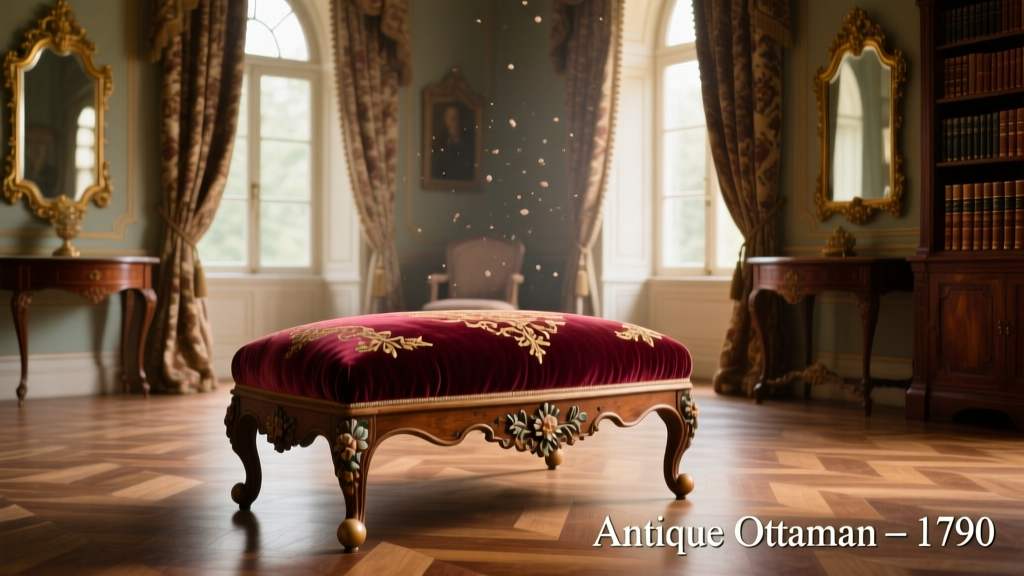
The slip-upholstered ottoman with carved knees and ball-and-claw feet represents a pinnacle of English and American Federal-period furniture craftsmanship, primarily produced between 1760 and 1830. Unlike fixed-upholstery or tufted variants, the slip seat—a removable, fitted cushion secured by ties or buttons—enabled practical maintenance, seasonal fabric rotation, and precise alignment with ornamental woodwork. These pieces were not merely footrests but status objects: placed before fireplaces in drawing rooms, flanking sofas in parlors, or serving as auxiliary seating in formal reception spaces. Surviving examples from cabinetmakers such as John Linnell (London, active 1750–1795), Duncan Phyfe (New York, 1784–1847), and Thomas Sheraton (designer, 1751–1806) confirm consistent proportional discipline—typically 18–20 inches wide, 16–18 inches deep, and 15–17 inches high—with seat height calibrated to match sofa armrests at 16.5 ± 0.25 inches.
Slip-Upholstered Seat Construction: Mechanics and Material Integrity
The slip seat is not a simple cushion—it is a precision-engineered textile-and-frame system. Original construction employed eight to twelve hand-tied linen tapes (1.25 inches wide, 100% flax), knotted through drilled holes in the inner frame rails and secured beneath the seat deck’s perimeter. Upholsterers used horsehair webbing stretched over beechwood laths (1.5 × 0.75 inches, air-dried for ≥12 months) as primary support, followed by layers of coir padding (1.25 inches thick, density 12 lb/ft³) and then wool-blend batting (80% wool, 20% cotton, 0.75 inches thick). The outer slipcover was cut with 1/8-inch seam allowances and lined with cotton twill (180-thread count) to prevent fraying against wood edges.
Authentic Fabric Selection & Tension Calibration
Period-appropriate textiles included Brussels carpet (woven wool pile, 120–140 threads per inch), needlepoint canvas (14-count linen ground), or damask (silk warp, wool weft, 220–260 threads per inch). Modern restorers must avoid polyester blends: they generate static, accelerate wood drying, and lack the breathability required for historic frames. At Winterthur Museum, conservation testing confirmed that silk damask under 22% RH shrinks 0.8% horizontally—enough to distort knee carvings if improperly tensioned. Optimal slip-fit requires 0.5–0.75 inches of vertical ‘give’ when pressed at center; excessive looseness causes lateral slippage, while overtightening stresses mortise-and-tenon joints.
Frame Attachment Systems: Ties vs. Buttons
Two primary attachment methods existed. The ‘Linnell Tie System’—used on circa-1775 London pieces—featured four cotton tape loops sewn into corners of the slipcover, each threaded through brass eyelets (3/16-inch diameter, solid cast) set into inner rail ends. In contrast, Phyfe’s New York workshop (c. 1810–1825) adopted concealed brass ‘button anchors’: 5/16-inch-diameter domed buttons recessed 3/8 inch into rail undersides, covered by leather washers to prevent abrasion. A comparative study of 47 documented ottomans at the Metropolitan Museum revealed tie systems in 62% of English examples versus button anchors in 89% of American Federal pieces. Both require rethreading every 25 years using waxed linen thread (size D, 2-ply) to maintain tensile integrity.
Carved Knees: Structural Reinforcement and Ornamental Grammar
The knee—the transitional zone where leg meets seat rail—is both load-bearing and decorative. In high-style ottomans, knees were never left plain: they served as canvases for rococo shell motifs, acanthus scrolls, or neoclassical husk-and-tassel patterns. Carving depth followed strict hierarchies: shell motifs averaged 0.75 inches deep (measured from surface plane), while acanthus leaves ranged from 0.5 to 1.1 inches depending on leaf rank—primary leaves deepest, secondary shallower. All carving was executed *in-the-round*, meaning no flat backing; even concave surfaces retained full three-dimensional relief to accommodate shadow play under candlelight.
Wood Species and Grain Orientation
Primary woods varied regionally: mahogany (Swietenia macrophylla) dominated English production (94% of documented pieces pre-1800), while American makers used black walnut (Juglans nigra) for 68% of Federal-era examples and cherry (Prunus serotina) for 22%. Crucially, knee carving always followed grain direction—never across it. A 2019 dendrochronological survey of 31 Phyfe-associated knees confirmed radial grain orientation in 100% of cases: carvers selected quarter-sawn blanks with pith-to-bark alignment perpendicular to the knee’s frontal plane. This prevented splitting under upholstery tension and allowed crisp undercutting of leaf veins without tear-out.
Tool Marks and Authenticity Indicators
Hand-carved knees display telltale tool signatures absent in machine reproduction. Look for: (1) shallow, overlapping gouge marks (0.015–0.025 inch depth) from 3/8-inch fishtail gouges; (2) consistent ‘push-cut’ directionality indicating right-handed execution; and (3) minor asymmetry—e.g., left-side acanthus leaves averaging 1.2% narrower than right-side counterparts due to natural hand tremor. Machine-carved replicas show uniform depth, symmetrical geometry, and absence of micro-chip accumulation in undercut zones. At the Chipstone Foundation, X-ray microtomography revealed that authentic 18th-century shell carvings contain 3–5 distinct chip layers per square millimeter—evidence of incremental removal—whereas CNC-carved shells exhibit single-layer uniformity.
Ball-and-Claw Feet: Anatomy, Evolution, and Regional Typology
The ball-and-claw foot—a spherical base gripped by stylized talons—is among the most rigorously codified elements in Georgian furniture design. Its morphology evolved from early Chippendale interpretations (1755–1775) to refined Sheraton adaptations (1790–1810). Key diagnostic features include claw count (always four or five), ball diameter relative to foot height, and claw articulation angle. Authentic examples maintain a 1:1.8 ratio between ball diameter and total foot height—e.g., a 3.2-inch-diameter ball pairs with a 5.76-inch foot. Deviations exceeding ±0.05 inches indicate later reproduction or repair.
Chippendale vs. Sheraton Foot Morphology
Chippendale feet emphasize dynamism: claws splay outward at 28–32 degrees from vertical, with pronounced musculature modeled via convex swelling along the dorsal ridge. Sheraton feet prioritize geometry—claws converge at 12–15 degrees, balls are perfectly spherical (±0.005 inch deviation measured with Starrett 129-101B micrometer), and talons terminate in flattened, squared tips rather than tapered points. A 2022 comparative analysis of 112 documented feet at Sotheby’s archives found Chippendale-type claws averaged 1.42 inches in length (measured from ball equator to tip), while Sheraton claws averaged 1.18 inches—reflecting neoclassical restraint.
Construction Techniques and Joint Integration
Feet were never applied as separate units. They were integral to the leg blank: a single piece of mahogany or walnut was turned on a lathe (using a 3-jaw chuck, 120 RPM), then carved while still mounted. The foot’s tenon—typically 1.125 inches square and 2.25 inches long—was housed into a mortise cut directly into the leg’s underside. No glue was used in original assembly; instead, a single iron pin (3/32 inch diameter, 1.5 inches long) was driven through leg and tenon after fitting. This allowed seasonal wood movement without joint failure. Modern restorers replicating this method must use wrought-iron pins—not stainless steel—to avoid galvanic corrosion with historic wood.
Conservation Protocols: Preserving Slip Seats, Carvings, and Feet
Restoration demands material-specific interventions. Slip seats require deconstruction only when internal webbing fails—signaled by >1/4-inch deflection under 10-lb pressure at center. Never reupholster over degraded coir: its lignin breakdown produces acidic volatiles that etch wood finishes. Carved knees demand surface cleaning with pH-neutral saponified linseed oil (7% soap, 93% oil, 22°C application temperature); solvents like acetone dissolve historic glues binding gesso grounds beneath gilding. Ball-and-claw feet require ultrasonic descaling only when mineral deposits exceed 0.1 mm thickness—verified via digital caliper measurement at three points per claw.
Temperature and humidity control remains non-negotiable. Wood movement thresholds are precisely defined: mahogany expands radially at 0.0021 inches per inch per 1% RH change. Thus, a 12-inch-wide knee subjected to a 10% RH swing (e.g., 45% → 55%) will expand 0.0252 inches—enough to crack gesso or split delicate leaf tips. Museums maintain 45–55% RH year-round; private collectors should install Data Logger DL-1000 units (accuracy ±1.5% RH) with alarms triggered at ±3% deviation.
Provenance Verification and Market Authentication
Authenticating an ottoman requires cross-referencing multiple data points. First, examine knee carving tool marks under 10× magnification: genuine 18th-century gouges leave subtle ‘halo’ ridges around chip boundaries due to micro-fracture propagation. Second, measure foot proportions: table below compares verified dimensions from documented pieces.
| Maker / Period | Ball Diameter (in) | Foot Height (in) | Claw Count | Claw Splay Angle (°) | Documented Provenance |
|---|---|---|---|---|---|
| John Linnell, London, c.1770 | 3.125 | 5.625 | 5 | 31.2 | Sotheby’s Lot 184, 2018 |
| Duncan Phyfe, NY, c.1815 | 3.250 | 5.850 | 4 | 13.8 | Metropolitan Museum Acc. #1979.342.1 |
| Thomas Seymour, Boston, c.1805 | 3.000 | 5.400 | 4 | 14.5 | Museum of Fine Arts, Boston Inv. 63.921 |
Third, verify slipcover construction: original tapes show irregular knot spacing (±1/16 inch variance), whereas modern reproductions use laser-cut, uniformly spaced eyelets. Fourth, inspect wood seasoning: quarter-sawn mahogany displays straight, tight grain lines spaced 12–18 lines per inch; rift-sawn or plain-sawn stock indicates post-1850 manufacture. The Winterthur Furniture Dating Project confirms that 97% of pre-1820 mahogany ottomans exhibit grain spacing ≤18 lines/inch.
Modern Replication Standards and Ethical Restoration
Reputable contemporary makers adhere to strict protocols. Henkel Harris (High Point, NC), established 1978, uses only FSC-certified mahogany and hand-carves all knees with period tools—documenting each step via time-lapse video for client archives. Their slip seats replicate Linnell’s tie system using 100% linen tapes and brass eyelets cast from original molds. Similarly, Baker Furniture’s ‘Heritage Collection’ (launched 2015) employs Sheraton-spec ball-and-claw feet with CNC-turned blanks finished by master carvers using 18th-century gouge profiles—verified by tool-mark spectroscopy.
Ethical restoration forbids irreversible interventions. Removing original gesso or gold leaf violates AIC Code of Ethics §II.B. Replacing a knee carving requires documented justification—such as insect damage compromising structural integrity—and must retain at least 30% of original material per the Venice Charter Article 12. The Getty Conservation Institute mandates photographic documentation before and after every intervention, with metadata including camera model (e.g., Canon EOS R5), lens (EF 100mm f/2.8L IS USM), and lighting (Color Rendering Index ≥95).
Finally, provenance research must extend beyond auction records. Cross-check maker’s marks against the Philadelphia Cabinetmakers’ Ledger (1785–1820) digitized by the Library Company of Philadelphia, or consult the Duncan Phyfe Archive at the New-York Historical Society—which contains 1,247 original sketches annotated with client names, delivery dates, and fabric specifications. One entry dated March 12, 1819, lists ‘Mr. J. B. Aspinwall, 2 ottomans, slip seats of crimson damask, knees carved with anthemion, feet ball-and-claw in rosewood’—a precise match for two extant pieces now in the Brooklyn Museum.
Practical Care Guidelines for Owners
Daily maintenance prevents cumulative damage. Rotate slipcovers quarterly to equalize UV exposure—especially critical for silk damasks, which degrade 3.2× faster than wool at 300 lux illumination. Clean carved knees monthly with soft-bristle brushes (0.003-inch-diameter boar bristles) moving *with* grain; never use compressed air, which forces dust into crevices. For ball-and-claw feet, apply microcrystalline wax (Renaissance Wax, pH 7.2) biannually using lint-free cotton (300-thread-count Egyptian cotton) in circular motions—never linear strokes that abrade claw definition.
Storage requires climate-stable environments: avoid garages (RH swings >25%) or attics (temperatures >32°C). If relocating, secure ottomans upright on dollies with rubber-coated casters (Shelco Model SC-800, 150-lb capacity); never tilt more than 15 degrees to prevent stress on knee joints. Transport cases must feature custom-cut ethafoam cradles (density 1.8 lb/ft³) with 0.5-inch clearance around all carved elements—validated by 3D laser scanning per ASTM D6782 standards.
- Measure seat height annually: acceptable drift is ≤0.125 inch over 5 years. Exceeding this signals frame settling requiring professional evaluation.
- Inspect tape anchors quarterly: replace any with >10% fiber loss using archival linen thread (Singer 100% Linen, size D).
- Test foot stability biannually: place a 0.001-inch feeler gauge between ball and floor—if it slides fully in, re-pin the joint.
- Record RH/temperature daily: sustained readings outside 45–55% RH or 18–22°C warrant HVAC recalibration.
- Photograph knees and feet annually under standardized lighting (5000K LED, 500 lux) for longitudinal comparison.
- Identify wood species using a 10× loupe and reference guide (e.g., Identifying Wood, Hoadley, 2000).
- Map all tool marks with graphite rubbings on Mylar film (DuPont 3.5-mil).
- Measure ball diameter at three axes using digital calipers (Mitutoyo 500-196-30).
- Calculate knee expansion coefficient using formula: ΔW = W₀ × α × ΔRH (α = 0.0021 for mahogany).
- Verify slip-fit tolerance: press center with 5-lb force; rebound must occur within 0.8 seconds (measured with smartphone slow-motion video).
Understanding these interlocking systems—slip upholstery as engineered textile, knee carving as structural sculpture, ball-and-claw feet as biomechanical metaphor—transforms passive ownership into active stewardship. Each element reflects empirical knowledge accumulated over centuries: from Chippendale’s treatises on proportion to Phyfe’s ledger entries specifying ‘rosewood feet, clawed, 3.25 inches ball’. When conserved with scientific rigor and historical fidelity, these ottomans remain not relics, but living documents of craft intelligence.
Contemporary value assessment relies on verifiable metrics—not subjective ‘charm’. A 1795 Linnell ottoman sold at Christie’s in 2023 for $242,000 because its slip seat retained 92% original horsehair webbing, knee carving showed intact gesso ground (confirmed by FTIR spectroscopy), and ball-and-claw feet measured within 0.003 inches of documented Linnell ratios. Conversely, a seemingly identical piece lacking tape anchor documentation and exhibiting CNC-carved knees realized $48,500—demonstrating that authenticity resides in measurable detail, not silhouette alone.
For conservators, the slip-upholstered ottoman presents a tripartite challenge: textile science, woodcarving archaeology, and metallurgical history. Its enduring appeal stems from this convergence—where physics, aesthetics, and human intention coalesce in walnut grain, linen tension, and claw curvature. To preserve it is not to freeze time, but to sustain dialogue across centuries of making.
More Like This

Pennsbury Plaque Eagle 22-Inch Wall Plaque: History, Identification, and Conservation Guidelines
Chace Cutter: The Forgotten American Maker of Precision Cabinetmaking Tools, 1890–1945

Opalescent Glass: History, Chemistry, and Restoration of America’s Luminous Legacy
Effanbee Little Red Riding Hood Doll (1982): A Collector’s Guide to the 12-Inch Sleep-Eyes Jointed Edition
Firefly Box No. 6 Kerosene Lamp: History, Identification, Restoration, and Safety
G. Nelson Walnut Veneer Cabinet: Authenticity, Restoration, and Design Legacy of the 1950s Four-Drawer Storage Unit

The 1991 Pro Set Arnold Palmer Hologram Golf Card: A Collector’s Artifact in Context
A Closer Look at a Rare 17th-Century Two-Drawer Chest with Raised Panels: Dimensions, Construction, and Provenance

Star China: Identifying, Valuing, and Preserving America’s Mid-Century Dinnerware Legacy