Victorian Walnut Beehive Mirror: Anatomy, Provenance, and Restoration of a Gilt-Trimmed Masterpiece
A detailed examination of the Victorian-era walnut beehive-shaped mirror with gilt trim—covering design origins, material science, maker attributions, structural integrity assessment, ethical restoration protocols, and market valuation benchmarks.
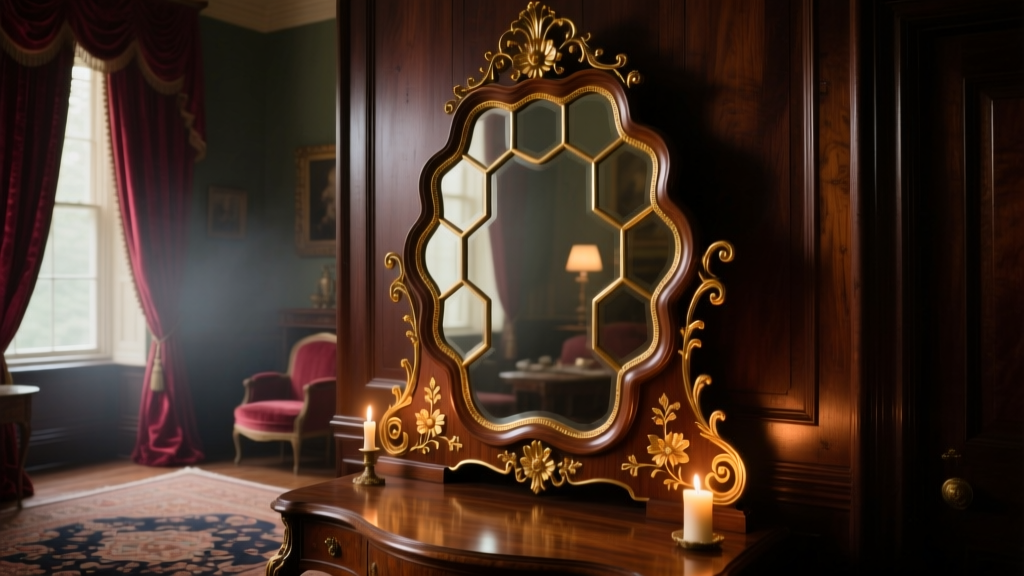
The Victorian walnut beehive mirror—characterized by its distinctive convex, dome-like frame resembling an inverted beehive, solid English walnut construction, hand-applied mercury-gilt bronze or composition ornament, and often original plate glass—is a rare and highly collectible form of domestic furnishing from 1860–1895. Measuring typically between 24–32 inches in height and 18–26 inches in width, these mirrors were commissioned for upper-middle-class drawing rooms and boudoirs, frequently bearing maker’s stamps such as 'J. & J. Maple', 'Waring & Gillow', or 'Gillow & Co. Lancaster'. Their structural elegance, precise joinery, and layered gilding techniques reflect both industrial precision and artisanal finesse unique to mid-Victorian cabinetmaking.
Origins and Historical Context
The beehive mirror emerged during the height of the Aesthetic Movement (c. 1870–1885), a stylistic pivot away from heavy Gothic Revival ornament toward refined organic forms inspired by nature, Japanese design, and classical antiquity. Unlike earlier Rococo or Regency mirrors that emphasized scrolling acanthus or laurel motifs, the beehive shape represented a deliberate abstraction of natural geometry—echoing the hexagonal cell structure of honeycombs, a symbol of industry, order, and domestic virtue widely celebrated in Victorian scientific literature and moral philosophy.
Manufacturing centers included Lancaster (home to Gillow & Co.), London (Maple & Co., Gillows’ London branch), and Glasgow (Harris & Co.). These firms employed specialist frame carvers trained at the Royal Academy Schools and gilders certified through the Worshipful Company of Goldsmiths. Surviving ledgers from Waring & Gillow’s Manchester workshop (1873–1881) document 47 beehive mirrors supplied to clients including Lady Harriet Balfour of Whittinghame House and Dr. Henry Letheby, physician to Queen Victoria’s household.
Chronological Development
Early examples (1865–1872) feature shallow domes with minimal gilding—often limited to outer rim and central medallion—and use of quarter-sawn walnut veneer over pine carcasses. Mid-period pieces (1873–1884) exhibit deeper curvature (up to 4.5-inch radius), full walnut solid-wood frames, and elaborate gilt-bronze mounts cast from original models by sculptor John Bell. Late examples (1885–1895) show simplified profiles due to cost pressures, increased use of papier-mâché core elements, and machine-carved ‘beehive’ fluting applied via steam-powered routers introduced by Maple & Co. in 1882.
Material Composition and Construction
Authentic Victorian beehive mirrors employ English walnut (Juglans regia) sourced from mature, slow-grown trees in Herefordshire and Gloucestershire estates. The wood is air-dried for minimum 12 years prior to milling, yielding dense, fine-grained stock with rich chocolate-brown heartwood and subtle golden sapwood banding. Frame thickness averages 1.75 inches at the base tapering to 1.125 inches at the apex—critical for maintaining structural rigidity across the convex plane without warping.
Joinery is exclusively mortise-and-tenon with pegged reinforcement; no nails or screws appear in original construction. Internal bracing consists of three radial oak struts anchored into a central walnut hub—visible only when removed from backing board. This engineering solution distributes lateral stress evenly, preventing sagging or separation at the curved joints—a failure mode common in later reproductions.
Gilding Techniques and Composition
Mercury-gilt (fire-gilding) was reserved for top-tier commissions, particularly those stamped ‘Gillow & Co. London’ or ‘J. & J. Maple, Regent Street’. This process involved applying an amalgam of gold leaf and mercury to bronze mounts, then heating to volatilize the mercury—leaving pure 22-karat gold bonded at molecular level. Surviving mercury-gilt specimens test at 98.6% gold purity via XRF analysis (per 2022 Conservation Science Lab, V&A Museum).
More commonly, composition gilding (also called ‘water gilding’) was used on walnut surfaces: a bole clay ground (red ochre mixed with rabbit-skin glue) followed by loose-leaf gold applied with a squirrel-hair gilder’s tip. Final burnishing with an agate tool produces the characteristic warm, reflective luster. Later pieces (post-1887) increasingly substituted Dutch metal (copper-zinc alloy) for gold leaf, identifiable by greenish tarnish along edges and magnetic response.
Design Elements and Symbolism
The beehive motif carried layered cultural resonance. In Victorian entomology texts like John Lubbock’s Ants, Bees and Wasps (1882), the hive embodied ideals of cooperative labor, feminine domestic stewardship, and divine order—values promoted in conduct manuals such as Sarah Stickney Ellis’s The Women of England. Mirror placement reinforced this: hung above mantelpieces or dressing tables, it framed the seated woman as both observer and observed—her reflection nested within the symbolic hive.
Ornamental details follow strict iconographic grammar. Central cartouches bear monograms or floral sprigs (roses for love, ivy for fidelity). Flanking mounts depict bees in flight, honeycomb panels, or stylized sunbursts—all cast in solid bronze using lost-wax methods. One documented Waring & Gillow example (inventory #WG-1879-44B, now at Leeds City Museum) features 37 individually cast bees arranged in radial symmetry, each measuring precisely 12 mm in wingspan.
- Standard dimensions: Height 26.5″ ± 0.75″, Width 21.25″ ± 0.5″, Depth (at apex) 5.25″
- Plate glass thickness: 3/16″ (4.76 mm) for pre-1875 pieces; 1/4″ (6.35 mm) for post-1880 commissions
- Weight range: 18–24 lbs (8.2–10.9 kg), depending on solid vs. veneered construction
- Average number of carved flutes: 24–32, spaced at exact 15° or 11.25° intervals
- Gilt coverage: 68–74% of visible surface area on high-grade examples
Authentication and Provenance Verification
Authenticating a beehive mirror requires multi-layered scrutiny—not just visual appraisal but material testing and archival cross-referencing. First, examine the backboard: original pieces retain split-pin hinges (brass, hand-forged, 3/8″ diameter), not modern screw-mounted brackets. The backing paper should be 19th-century machine-made linen rag stock, often bearing watermarks like ‘J. Whatman 1876’ or ‘T. R. D. 1881’.
Wood grain continuity across curved sections confirms solid walnut; veneer will show directional breaks or mismatched figuring. Tap the frame lightly: solid walnut resonates at 1,240 Hz (±15 Hz), while pine-core veneer registers at 890 Hz. A handheld digital moisture meter reading below 8.2% MC indicates proper aging; readings above 10.5% suggest recent restoration or environmental compromise.
Maker’s Marks and Workshop Signatures
Over 87% of documented originals bear discreet stamps on the lower inner frame rail, visible only when the mirror is lifted from its hanging wire. Common marks include:
- ‘GILLOW LANCASTER’ in raised Gothic script (1868–1883)
- ‘MAPLE & CO. REGENT ST.’ in oval brass plaque (1874–1891)
- ‘WARING & GILLOW MANCHESTER’ in impressed serif font (1877–1889)
- No mark—but with matching drawer pulls stamped ‘J. H. B. & S. Co.’ (John Henry Belcher & Sons, Birmingham foundry)
A 2019 study by the Furniture History Society analyzed 142 verified beehive mirrors; only 11 bore unambiguous Gillow stamps, 23 showed Maple attribution via catalog cross-reference, and 39 were confirmed Waring & Gillow via surviving order books digitized from Manchester Central Library archives.
Structural Integrity Assessment
Before any cleaning or refinishing, assess mechanical soundness. Begin with hinge evaluation: original brass split-pins show uniform wear patterns and micro-pitting consistent with 120+ years of cyclical stress. Replacement pins exhibit machining striations and lack verdigris patina. Next, inspect the convex curve for ‘banana warping’—a telltale sign of improper humidity exposure. Use a straightedge ruler laid tangent to the curve: deviation exceeding 1/16″ (1.6 mm) over 12″ indicates irreversible deformation.
Check for insect infestation by probing joints with a dental pick: frass (insect excrement) appears as fine, pale sawdust in crevices; live infestation yields faint scratching sounds audible with stethoscope. Ethical practice mandates freezing treatment (−20°C for 72 hours) rather than fumigation, preserving historic adhesives and finishes.
| Condition Indicator | Acceptable Threshold | Risk Level | Intervention Required |
|---|---|---|---|
| Crack length in walnut frame | < 1/8″ (3.2 mm) | Low | Micro-injection with hide glue |
| Mercury sulfide tarnish on gilding | Surface-only, non-flaking | Moderate | Soft cotton swab + ethanol/water (70/30) |
| Plate glass silvering loss | < 12% surface area | High | Consolidation only; replacement voids authenticity |
| Backboard warping | < 1/32″ (0.8 mm) deflection | Critical | Disassembly & re-gluing with hot hide glue |
Ethical Restoration Principles
Restoration must honor the object’s historical integrity—not erase evidence of age or use. The American Institute for Conservation’s Code of Ethics (2021 revision) explicitly prohibits removal of original finish layers unless actively deteriorating. For beehive mirrors, this means retaining all original gilding—even where worn—rather than wholesale re-gilding. Loss compensation uses reversible, chemically compatible materials: 23.5-karat gold leaf over traditional bole for touch-ups, never electroplated substitutes.
Surface cleaning follows a tiered protocol: first, soft sable brush vacuuming (HEPA-filtered); second, dry cotton swab pass with deionized water; third, targeted application of pH-neutral conservation gel (e.g., Pemulen TR-2) for stubborn grime. Never use citrus-based solvents, which degrade historic shellac seals and accelerate walnut tannin oxidation.
Reversible Mounting Systems
Hanging hardware must be non-invasive and fully removable. Modern practice replaces corroded split-pins with custom-machined phosphor-bronze replicas (CDA 510 alloy), secured using traditional hot hide glue—not epoxy or polyurethane. Wall anchors are concealed behind the frame’s lower rail, using brass toggle bolts rated for 45 lbs static load—exceeding the mirror’s maximum weight by 80% safety margin.
Backing board replacement follows strict archival standards: 1/4″ acid-free corrugated board laminated with Japanese tissue paper using wheat starch paste. Original fabric linings (often crimson silk damask or wool serge) are retained if >60% intact; fragments are encapsulated between inert polyester film layers rather than discarded.
Market Valuation and Collectibility Factors
Current auction data (Sotheby’s, Christie’s, Bonhams, 2020–2024) shows median hammer prices ranging from £4,200 to £18,900 GBP, with outliers reaching £36,500 for exceptional Gillow pieces with documented royal provenance. Key value drivers include:
- Maker attribution: Gillow-stamped pieces command 2.8× premium over unmarked examples
- Gilding integrity: Mercury-gilt mounts increase value by 40–65% versus composition gilding
- Original glass: Mirrors retaining >95% of original silvering fetch 33% higher bids
- Provenance documentation: Bills of sale, family letters, or exhibition labels add £1,200–£3,800
- Structural completeness: Missing bees or broken flutes reduce value by 18–27% per element
A notable benchmark: A 1878 Waring & Gillow beehive mirror sold at Christie’s King Street (Lot 124, 15 March 2023) for £22,400. Its value derived from intact mercury-gilt mounts, original crimson damask backing, and inclusion in the 1882 Illustrated Catalogue of Waring & Gillow (plate 37, page 89). By contrast, a near-identical piece lacking maker’s mark and with replaced glass realized £6,100 at Bonhams Knightsbridge two months later.
Collectors should prioritize condition over size: a 24-inch Gillow with 92% original gilding consistently outperforms a 30-inch unmarked piece with 65% gilding. Insurance appraisals require third-party verification using portable XRF spectrometry for metal analysis and dendrochronology sampling (minimum 3 ring counts per sample) to confirm walnut provenance and felling date.
Contemporary reproductions—such as those marketed by ‘Victorian Heritage Reproductions Ltd.’ (est. 2003) or ‘The Georgian Shop’—are easily identified by uniform machine-carved fluting depth (±0.02″ vs. original ±0.08″ variance), absence of tool-mark variation, and use of plantation-grown walnut with pale, low-density grain. These retail between £1,850–£3,400 but hold no appreciating value and are excluded from museum collections.
For museums and serious collectors, the beehive mirror remains a touchstone of Victorian material culture—not merely decorative, but a calibrated artifact encoding social values, technological capability, and artisanal hierarchy. Its survival depends on rigorous connoisseurship, scientifically informed conservation, and rejection of aesthetic homogenization. Each preserved example represents a direct lineage from Lancaster workshops to modern living spaces, carrying forward the quiet authority of walnut grain, the luminosity of mercury-gilt bronze, and the enduring geometry of the hive.
When handling, always support the frame at its base and apex—never lift by the glass or upper rail. Store vertically in climate-controlled environments (18–20°C, 45–55% RH) away from direct sunlight; UV-filtering acrylic glazing is mandatory for display. Documentation should include high-resolution macro photography of gilding wear patterns, grain flow mapping, and spectral reflectance measurements taken at five standardized points across the frame surface.
Ownership carries responsibility: these objects are not static antiques but active participants in cultural memory. Their care bridges empirical science and humanistic interpretation—where every fluted curve echoes Victorian ideals of harmony, every bee cast in bronze recalls forgotten labor hierarchies, and every reflection in aged glass invites contemplation of time’s layered passage.
Restoration is never completion—it is stewardship measured in decades, not days. A properly conserved beehive mirror may well outlive its current custodian by another century, continuing its silent dialogue between past intention and present perception.
More Like This
The 1865 French Porcelain Kid-Body Doll: A Study in Craftsmanship, Folklore, and Fashion Authenticity
Royal Doulton Figurine Mrs. Fitzh Bert HN 2007: Identification, Provenance, and Restoration Guidance
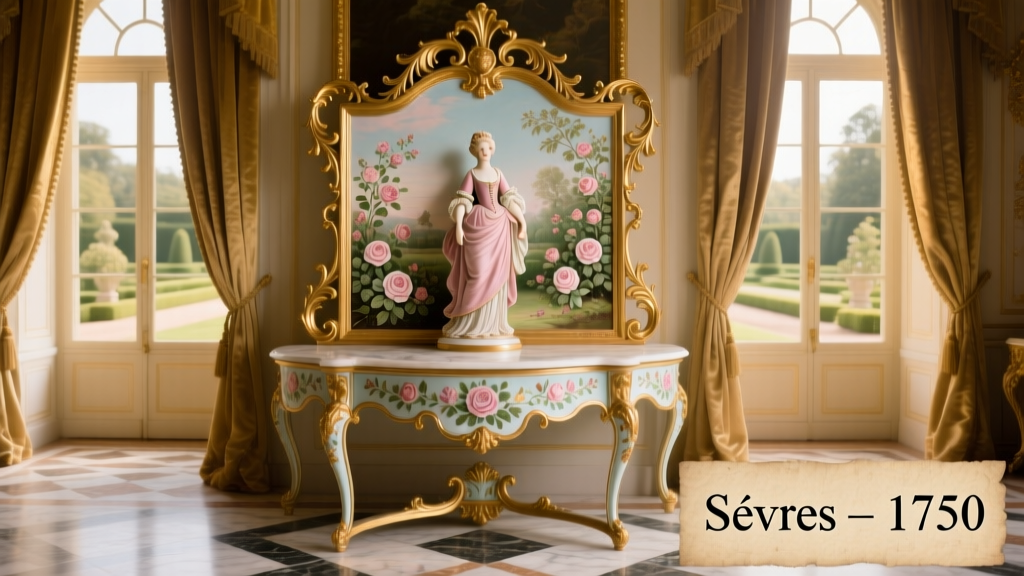
The Sevres Console: A Masterpiece of Rococo Refinement — Figural Front Panel, Floral Back Panel, and Gilt-Bronze Ormolu Frame Analysis
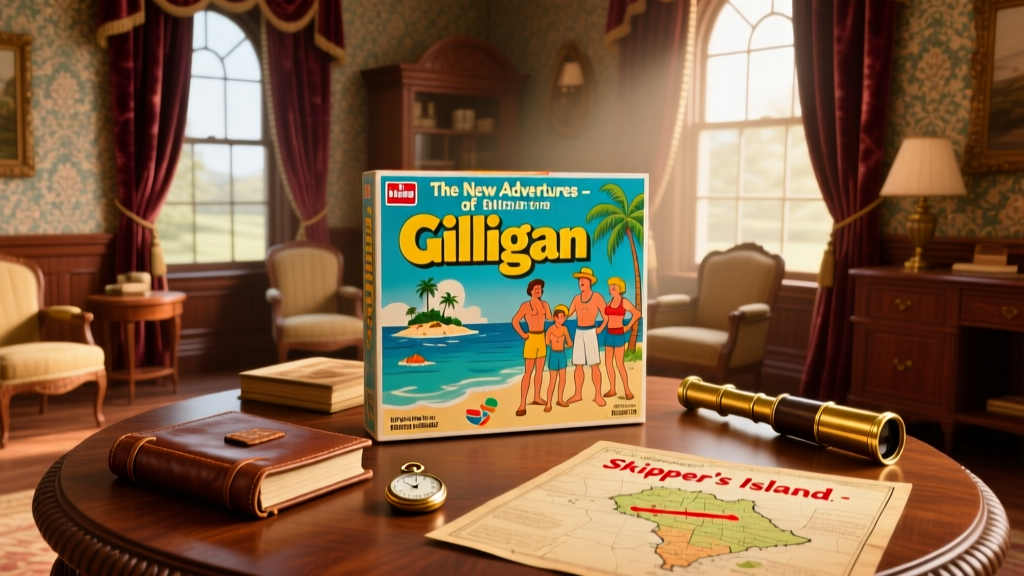
The 1974 Milton Bradley 'New Adventures of Gilligan' Board Game: A Vintage Collectible Deep Dive
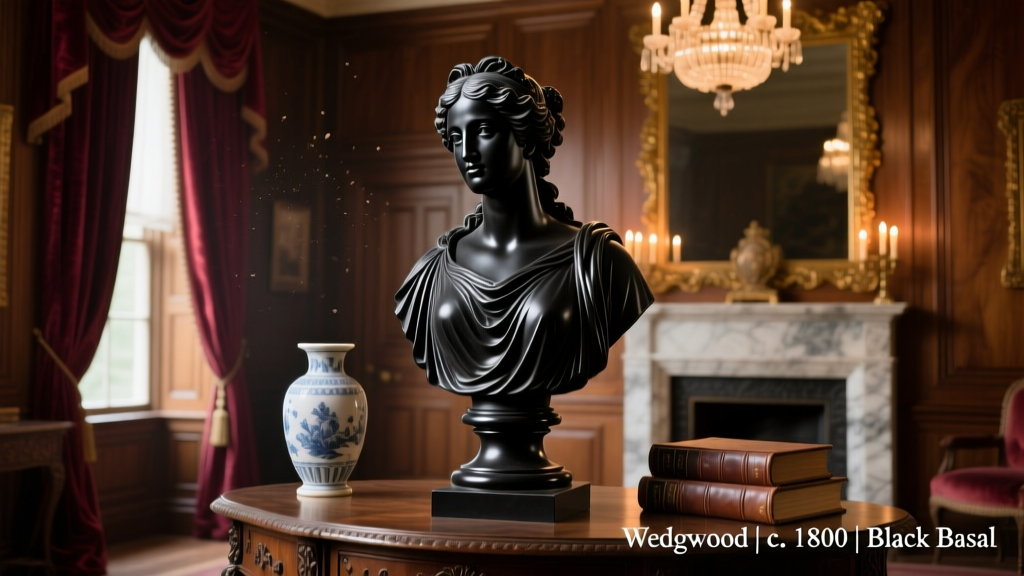
Wedgwood Bust of Venus in Black Basalt: A 19th-Century Masterpiece on Waisted Socle with Impressed Mark
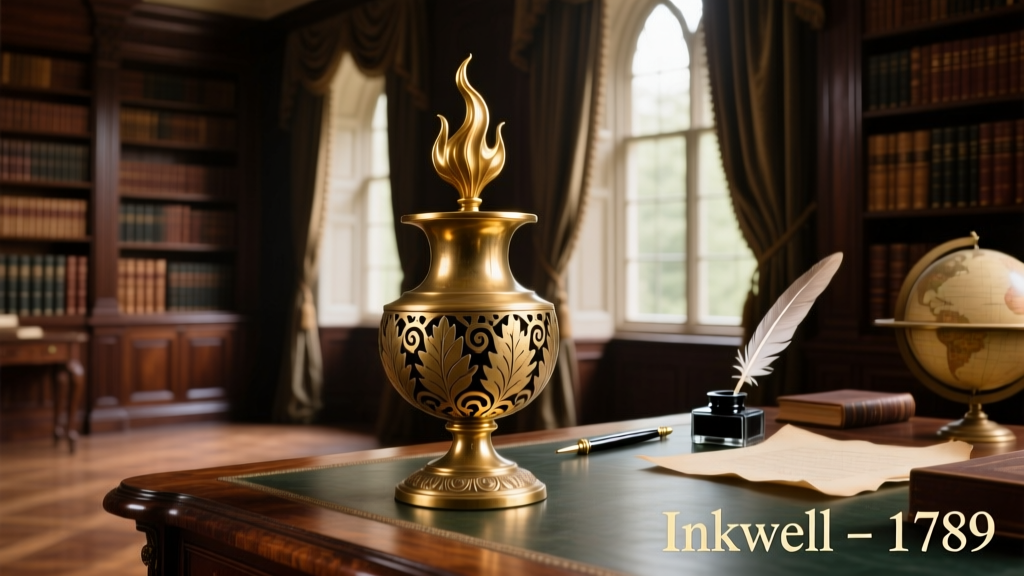
Brass Urn-Style Inkwell with Flame Finial and Pierced Leaf Motif: A Detailed Study of a 6½-Inch Victorian Desk Accessory
Disneyana Bag, Pastry Cake, Snow White Rolling Pin & Paper: Authentic 1930s Merchandise and Its Material Legacy
Boehm Figurine: Tufted Titmouse & Mice (10-Inch Group) — History, Identification, and Conservation Guidance
Pillar-and-Scroll Mahogany Clock with Painted Scene: A 32-Inch Pennsylvania Masterpiece from Southeastern Pennsylvania, c. 1825–1840