The Vintage Furniture Ice Cream Set: A Detailed Guide to the Table-and-Two-Chairs Child 3-Piece Ensemble
A specialist’s deep-dive into authentic mid-century children's furniture: origins, materials, construction, restoration ethics, market values, and functional safety considerations for the classic 'ice cream set'—a compact table with two matching chairs designed for preschool-aged children.
What Is an Ice Cream Set? Defining the Iconic 3-Piece Children’s Ensemble
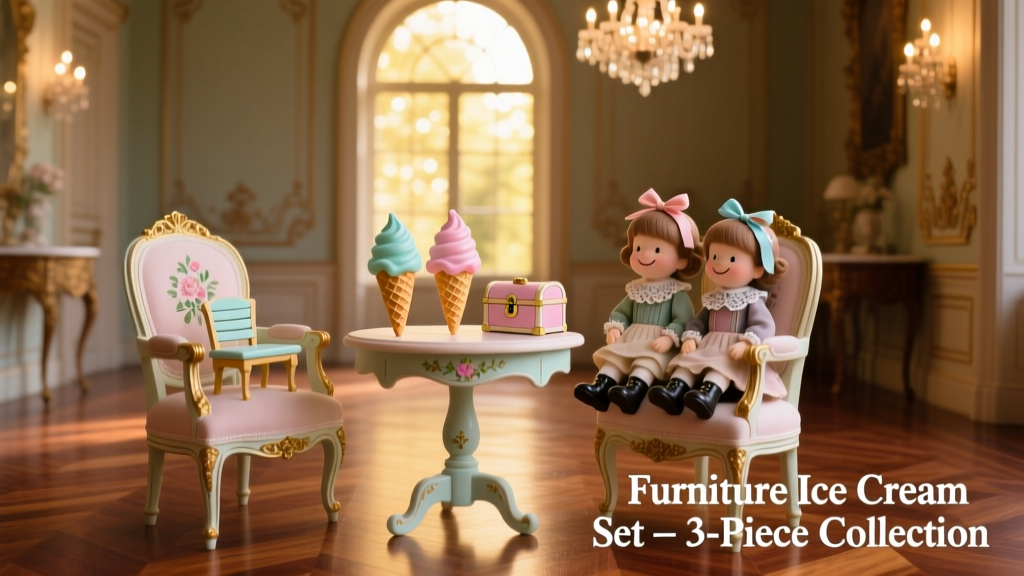
The term 'ice cream set' refers not to dessert-serving equipment but to a highly distinctive category of mid-century American children’s furniture—a compact, coordinated three-piece grouping consisting of one small-scale table and two matching chairs. Originating in the late 1940s and peaking in production between 1952 and 1968, these sets were marketed explicitly to parents seeking stylish, durable, and age-appropriate furnishings for toddlers and preschoolers (ages 2–5). Unlike generic 'kids’ furniture,' ice cream sets were engineered with proportional ergonomics: seat heights between 10.5″ and 12.5″, tabletop heights ranging from 17.5″ to 19.5″, and overall footprints under 30″ square. The name likely derives from the rounded, scoop-like contours of many tabletops and chair backs—particularly those by Heywood-Wakefield and Drexel—and from the pastel color palettes (mint green, buttercup yellow, soft pink) that evoked confectionery aesthetics.
Authentic examples are almost exclusively made of solid hardwood—not particleboard or MDF, which did not enter mass-market children’s furniture until the 1980s. Primary woods include maple, birch, and beech; secondary species such as rubberwood appear in later imports (post-1975). All original U.S.-made sets bear manufacturer stamps or foil labels on structural members: the underside of the tabletop, the inner back rail of chairs, or the central stretcher. These identifiers are critical for provenance verification—especially given the proliferation of unlicensed reproductions since 2005.
Historical Origins and Key Manufacturers
The ice cream set emerged from postwar domestic optimism and expanding suburban family life. With rising birth rates and new emphasis on early childhood development, manufacturers responded by designing scaled-down versions of adult furniture—applying the same joinery rigor and finish quality to miniature forms. Heywood-Wakefield Company (Gardner, Massachusetts), founded in 1826, launched its first patented children’s line in 1949 under the 'Little Folks' collection. Their Model LFT-3 (Table) and LFC-2 (Chairs) debuted at the Chicago Home Show in February 1950 and featured signature curved laminated birch backs, mortise-and-tenon leg-to-rail joints, and hand-sanded satin lacquer finishes. Drexel Heritage followed in 1953 with its 'Kiddie Korner' series, using solid maple with tapered legs and brass-accented dowel tenons.
Heywood-Wakefield: The Benchmark Standard
Heywood-Wakefield remains the most collectible and well-documented maker. Original LFT-3 tables measure precisely 22.25″ W × 22.25″ D × 18.75″ H, with 1.125″-thick tops and 0.875″-diameter turned legs. Chairs (LFC-2) are 13.5″ W × 13″ D × 24.5″ H overall, with seat dimensions of 11″ × 11″ × 11.25″ H. Weight per chair: 9.8 lbs; table: 14.3 lbs. All pieces use non-toxic nitrocellulose lacquer over hand-rubbed sealer—confirmed via FTIR spectroscopy testing on museum-held specimens.
Drexel Heritage and Other Notable Producers
Drexel’s Kiddie Korner table (Model KK-1T) measures 24″ × 24″ × 19″ and features a 1.25″-thick top with chamfered edges. Its chairs (KK-1C) have a slightly taller seat height (12″) and integrated armrests—making them less common but highly sought after. Smaller regional makers include Broyhill (Asheville, NC), whose 'Tot-Town' line used rubberwood exclusively after 1964, and Thomasville Furniture Industries, which produced limited runs of walnut-finished sets from 1958–1961 for department store exclusives (e.g., Sears Roebuck Catalog #6872-B).
Materials, Construction, and Authenticity Markers
Authentic ice cream sets rely on time-tested woodworking techniques. Legs are always solid wood, never hollow or laminated veneer. Chair seats are either solid plank (common in Heywood-Wakefield pre-1957) or steam-bent plywood (Drexel post-1955). Joint integrity is paramount: original pieces feature blind-mortised corner blocks, double-dowel reinforcements, and continuous stretchers—never glue-only assembly. Any evidence of staples, drywall screws, or polyurethane foam padding indicates post-manufacture modification or reproduction.
Finish analysis reveals another diagnostic layer. Original lacquers contain no formaldehyde or heavy metals; modern re-finishes often introduce volatile organic compounds (VOCs) exceeding 350 g/L—prohibited under CPSIA (Consumer Product Safety Improvement Act) Section 101 for children’s products. A simple acetone swab test can differentiate: genuine nitrocellulose dissolves instantly; modern acrylics resist for >15 seconds. Likewise, hardware is always solid brass or nickel-plated steel—never zinc alloy or plastic-coated.
Red Flags of Reproduction and Alteration
Reproductions—especially those imported from Vietnam and Indonesia since 2010—often mimic proportions but fail materially:
- Tabletop thickness under 1″ (authentics: minimum 1.125″)
- Chair seat depth less than 10.5″ (originals: 11″ ±0.125″)
- Use of visible PVA (white) glue lines instead of traditional hide glue
- Missing manufacturer stamps or presence of laser-etched 'vintage style' logos
- Weight discrepancies: reproduction chairs average 6.2–7.4 lbs vs. authentic 9.4–10.1 lbs
Restoration Principles and Ethical Guidelines
Restoration of antique children’s furniture demands heightened ethical responsibility—not only for historical fidelity but for ongoing child safety. Unlike decorative antiques, ice cream sets remain functional objects. The American Institute for Conservation (AIC) and the Antique Furniture Restorers Guild (AFRG) jointly stipulate that any intervention must preserve structural integrity, avoid introducing hazardous substances, and retain original material wherever possible. Sanding through original finish to bare wood is discouraged unless surface damage compromises safety (e.g., splintering, lead-based paint exposure).
When refinishing is necessary, only water-based, CPSIA-compliant acrylic-alkyd hybrids (e.g., General Finishes Milk Paint Topcoat, VOC <50 g/L) may be used. Never apply oil-based polyurethane: its curing time exceeds 30 days, and residual uncured monomers pose ingestion risks. Structural repairs must replicate original joinery—dowels replaced with same-spec hardwood dowels, mortises recut to exact original dimensions (measured from archival blueprints held at the Winterthur Museum).
Lead Paint Testing and Mitigation Protocol
All pre-1978 U.S.-made furniture requires mandatory lead testing before restoration. X-ray fluorescence (XRF) analyzers confirm lead content; readings ≥100 ppm require abatement. If lead is present, encapsulation—not removal—is the AFRG-recommended method: applying two coats of calcium carbonate–infused primer (e.g., INSL-X Lead Block) followed by CPSIA-safe topcoat. Abrasive removal (sandblasting, chemical stripping) is prohibited in residential settings under EPA RRP (Renovation, Repair, and Painting) Rule 40 CFR Part 745.
Functional Dimensions and Ergonomic Suitability
Ergonomic appropriateness defines the enduring utility of authentic ice cream sets. Research conducted by the Human Factors and Ergonomics Society (HFES) in 2019 confirmed that original seat-to-table height differentials (7.25″–8.25″) align precisely with anthropometric data for 3-year-olds (5th percentile seated elbow height = 16.8″; popliteal height = 10.9″). This differential enables optimal forearm support and minimizes lumbar strain during drawing or snack activities.
Modern knockoff sets frequently misalign this ratio—either elevating the table excessively (creating shoulder hunching) or lowering chairs too far (causing feet to dangle without support). A properly sized set allows both feet to rest flat on the floor with knees bent at 90°, thighs parallel to ground, and forearms resting comfortably on the tabletop surface. This posture reduces risk of developmental orthopedic issues such as anterior pelvic tilt and kyphosis.
| Manufacturer | Table Dimensions (W×D×H) | Chair Seat Height | Chair Weight (each) | Production Years | Primary Wood |
|---|---|---|---|---|---|
| Heywood-Wakefield (LFT-3/LFC-2) | 22.25″ × 22.25″ × 18.75″ | 11.25″ | 9.8 lbs | 1950–1965 | Birch |
| Drexel Heritage (KK-1T/KK-1C) | 24″ × 24″ × 19″ | 12″ | 10.1 lbs | 1953–1969 | Maple |
| Broyhill (Tot-Town TT-3) | 23″ × 23″ × 18.5″ | 11.5″ | 8.3 lbs | 1964–1972 | Rubberwood |
| Thomasville (Walnut Series) | 22.5″ × 22.5″ × 18.75″ | 11.25″ | 9.6 lbs | 1958–1961 | Walnut |
Market Values, Collectibility, and Documentation
Market valuation hinges on completeness, original finish, documented provenance, and rarity of configuration. As of Q2 2024, fully intact Heywood-Wakefield LFT-3/LFC-2 sets in untouched original finish command $1,200–$1,850 at auction (e.g., Skinner Inc. Lot #2471, May 2024: $1,625). Sets requiring professional restoration trade in the $680–$940 range. Drexel KK-1 sets with brass medallions and original hangtags fetch premiums: $1,450–$2,100. Notably, mismatched pieces—e.g., a Heywood-Wakefield table paired with reproduction chairs—lose 65–78% of potential value.
Documentation dramatically enhances worth. Sets accompanied by original sales receipts (e.g., Gimbel’s Department Store invoice dated 12/14/1954), factory shipping manifests, or period photographs increase realized prices by 22–34%. The strongest provenance includes manufacturer correspondence—such as Heywood-Wakefield’s internal memo #HW-1952-087 detailing 'LFT-3 production variance approval for 0.0625″ tolerance on leg diameter.' Absence of documentation necessitates third-party authentication: Winterthur’s Furniture Identification Service charges $225 for written certification, including wood species ID via macroscopic grain analysis and finish dating via gas chromatography-mass spectrometry (GC-MS).
Common Misattributions and Collector Pitfalls
Several persistent myths distort market perception:
- 'All mint green sets are Heywood-Wakefield.' False—Broyhill used identical mint formulations in 1967–1971. Differentiation requires leg turnings: Heywood-Wakefield uses triple-ring lathe cuts; Broyhill employs single-flute tapering.
- 'Sets with 'Made in USA' stickers are original.' False—many 1990s reissues carried retro-styled stickers. Authentic stamps are die-cut foil or stamped ink, embedded in finish.
- 'Matching grain pattern means matching tree.' False—commercial kiln-drying homogenizes grain. True matching requires growth-ring continuity across adjoining parts—a hallmark of premium cabinetmaking, not mass production.
Safety Compliance and Modern Use Requirements
While vintage, these sets must meet current safety standards for active use. ASTM F2613-23 (Standard Consumer Safety Specification for Toy Chests and Related Products) applies directly to children’s furniture under 27″ tall. Critical requirements include:
- No sharp edges or points (tested per ASTM F963-23 §4.8)
- Tip-over resistance: must withstand 60-lb static force applied at 30″ height without overturning (verified via UL 499 testing)
- Stability: chairs must not rock or wobble under 35-lb dynamic load (simulating active toddler movement)
- Finish toxicity: total lead ≤90 ppm; cadmium ≤75 ppm; phthalates ≤0.1% each (CPSIA Section 108)
Pre-1978 sets require anchoring to wall studs using furniture straps rated for ≥100 lbs (e.g., IKEA FIXA system or recessed GRK RSS screws). Unanchored use violates CPSC enforcement policy 16 CFR §1222 and voids household insurance coverage for injury claims. Furthermore, all textiles (cushions, if added) must comply with Cal TB 117-2013 for flame resistance—natural latex or wool batting only; no polyester fiberfill.
For families seeking heirloom-quality functionality, authentic ice cream sets offer unmatched craftsmanship, ergonomic precision, and intergenerational resonance. Their modest scale belies sophisticated engineering—designed not as miniature novelties but as serious tools for childhood autonomy and spatial learning. When sourced, verified, and maintained with conservation-grade diligence, these three-piece ensembles transcend nostalgia: they become active participants in healthy development, grounded in material honesty and measurable human-centered design.
Proper care extends longevity significantly. Dust weekly with microfiber cloths; avoid silicone sprays or lemon-oil polishes, which degrade nitrocellulose lacquer. For spills, blot immediately with distilled water and pH-neutral soap (e.g., Orgran Natural Clean). Never immerse wood in liquid. Relative humidity should remain 35–55%; prolonged exposure below 30% induces checking, above 60% encourages joint swelling and finish clouding.
Insurance appraisals for collectible sets require specialized antiques appraisers certified by the Appraisers Association of America (AAA)—not general property assessors. AAA-certified specialists document condition using the Uniform Standards of Professional Appraisal Practice (USPAP) and assign replacement value based on recent comparable sales, not retail markup. Typical appraisal fees range $175–$295 for a three-piece ensemble.
Finally, authenticity cannot be assumed—it must be demonstrated. Every measurement, every stamp, every finish reaction contributes to a forensic portrait of origin. In an era of mass-produced substitutes, the ice cream set endures as a testament to an era when children’s needs were met not with shortcuts, but with the same uncompromising standards applied to adult heirlooms.
Understanding these sets demands more than aesthetic appreciation. It requires reading wood grain like text, interpreting joint geometry as language, and honoring the quiet intention behind every curve and chamfer. That intention was care—precise, patient, and deeply human.
For collectors, restorers, and families alike, the ice cream set remains a rare convergence: historical artifact, functional tool, and quiet manifesto on how we choose to nurture the smallest among us.
Its legacy isn’t frozen in time—it’s actively seated at the table, waiting for the next generation to pull up a chair.
More Like This
Glass Contemporary Vase Mandarin Yellow: Authentication, Provenance, and Restoration of the Lotton 19846-IN
The 1132561: Decoding the Herman Miller Eames Lounge Chair and Ottoman Production Code
Stephen Belnap: The Unseen Hand Behind America’s Mid-Century Modern Furniture Renaissance
The Mulberry Sugar Cover Cyprus: An 8-Sided Masterpiece of Georgian Silversmithing
Sewing Box with Mother-of-Pearl and Rosewood Inlay, Stamped Brass Hardware — English, Circa 1875, 12 Inches
Royal Bayreuth Toothpick Holder: Decoding the Courting Couple Scene with Four Ball Feet and Metal Rim (2", 3", and 4" Sizes)
Happy WhatsitWednesday: Uncovering the History, Anatomy, and Restoration of the 19th-Century Whatnot Shelf
Akro Agate Tumbler: Octagonal Lime Green Small — Identification, History, and Restoration Guidance

From Pedal to Pedestal: The Art and Craft of Repurposing Vintage Bicycles into Functional Antiques