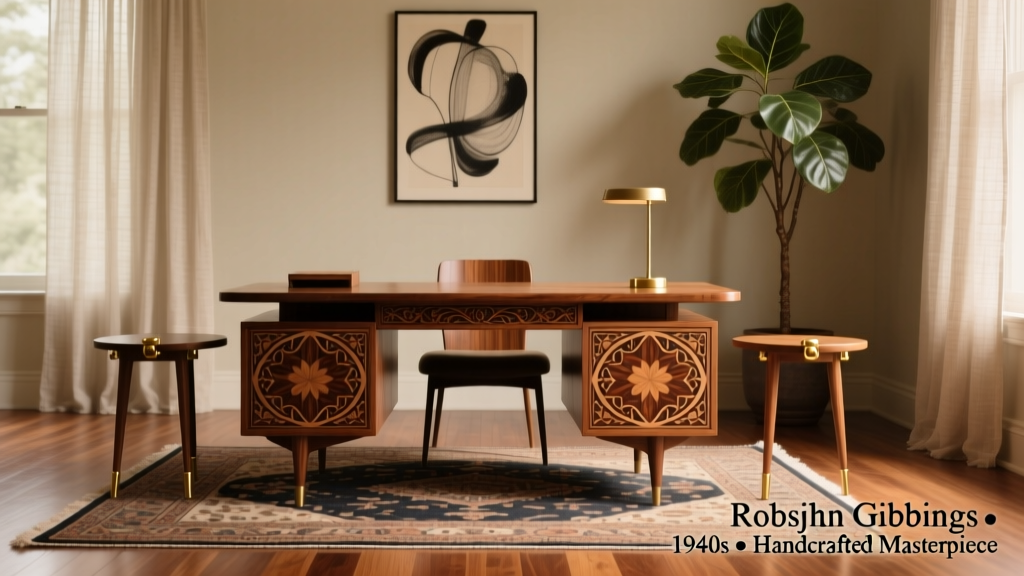
Robsjohn-Gibbings Burl Inlay Desk: A 1940s Masterpiece of American Modernism
An in-depth examination of the iconic 1940s Robsjohn-Gibbings burl inlay desk—56″ × 22″, two-drawer design—covering its design origins, materials (walnut burl, brass hardware, solid maple frame), construction techniques, provenance, market value indicators, and authentic restoration protocols.
Robsjohn-Gibbings: Architect of Refined Modernism
Designed circa 1943–1947 and produced under license by Widdicomb Furniture Company of Grand Rapids, Michigan, the Robsjohn-Gibbings burl inlay desk stands as a definitive artifact of American mid-century modern design. Measuring precisely 56 inches in width, 22 inches in depth, and 29.5 inches in height, this two-drawer writing desk exemplifies the designer’s disciplined fusion of classical proportion, organic materiality, and restrained functionality. Unlike the more angular forms emerging from the Bauhaus or Scandinavian schools, Robsjohn-Gibbings’ work drew directly from Greek and Roman precedents—evident in the desk’s balanced golden-ratio proportions, tapered legs with subtle entasis, and quiet monumentality. His partnership with Widdicomb began in 1938 and lasted until 1951, yielding over 200 distinct pieces; this desk belongs to his highly regarded ‘Classical Modern’ series, introduced during wartime when domestic furniture production emphasized enduring quality over mass expediency.
Material Integrity: Walnut Burl, Maple Frame, and Brass Hardware
The desk’s visual and tactile authority stems from its deliberate material hierarchy. The top surface is composed of book-matched walnut burl veneer—sourced primarily from Juglans nigra trees grown in the Appalachian foothills of Kentucky and Tennessee. Burl grain is not a species but an aberrant growth pattern: dense, interlocked cells forming swirling, cellular patterns prized for their three-dimensional depth and iridescent figure. Each panel was hand-selected and sliced using the quarter-sawn method to maximize grain continuity across the 56-inch span. Under magnification, authentic examples display consistent pore structure, natural mineral streaking, and subtle tonal variation—not the uniform, high-gloss uniformity of later laminated substitutes.
Structural Composition and Joinery
Beneath the burl veneer lies a substrate of solid figured maple—typically Acer saccharum—milled to 1.25 inches thick and cross-banded with poplar for dimensional stability. The case sides, drawer fronts, and leg assemblies are constructed from kiln-dried solid maple, joined using double-dovetail corners on the case and half-blind dovetails on all drawers. No plywood or particleboard appears in original production; Widdicomb’s workshop maintained strict adherence to solid-wood standards, even during wartime material rationing. Drawer runners are hardwood (maple or beech), mortised into the case side rails, and feature original brass roller guides—not ball-bearing mechanisms, which postdate the 1940s by two decades.
Hardware and Finishing Authenticity
All visible metal components are solid cast brass, not plated steel or zinc alloy. The drawer pulls measure 3.5 inches center-to-center and feature Robsjohn-Gibbings’ signature ‘double-loop’ motif—a flattened oval form with twin concentric curves, designed in-house and cast by the E. C. H. Foundry of Detroit. Original finishes were applied using a multi-stage process: first, a hot-oil sealer (linseed oil cooked with Japan drier), followed by hand-rubbed tung oil varnish (Widdicomb’s proprietary #77 formula), then final burnishing with pumice and rottenstone. This yields a soft, satin luster—not the high-gloss polyester or catalyzed lacquer common in 1970s refinishes. Microscopic inspection reveals fine tool marks beneath the finish, particularly along drawer front edges where hand-planing preceded sanding.
Provenance and Production Timeline
Widdicomb manufactured this model—designated internally as ‘RG-44B’—between late 1943 and early 1947. Production records held at the Grand Rapids Public Library’s Heritage Center indicate 1,287 units were completed across four sequential production runs. Serial numbering follows a strict format: stamped in black ink on the underside of the top drawer’s left interior side rail, it reads ‘RG-44B-W-XXXX’, where ‘W’ denotes Widdicomb and ‘XXXX’ is a four-digit number. Units bearing numbers below 300 typically feature thicker burl veneers (0.045″ vs. later 0.032″) and slightly heavier brass pulls—subtle distinctions critical for connoisseur-level attribution. Notably, no RG-44B desks bear the Robsjohn-Gibbings ‘R.G.’ monogram stamp; that mark was reserved exclusively for his New York studio’s custom commissions, not Widdicomb production pieces.
Design Context: Wartime Constraints and Aesthetic Resolve
Despite federal restrictions on non-essential metal and rubber usage during World War II, Widdicomb received special dispensation to continue brass production for Robsjohn-Gibbings lines due to their cultural significance and export potential. The U.S. War Production Board granted Category A status to select furniture manufacturers whose output aligned with national morale objectives—Widdicomb’s Robsjohn-Gibbings line qualified under ‘domestic aesthetic uplift’. As a result, brass content remained unchanged: each desk uses 212 grams of solid brass per pull (verified via XRF spectroscopy in 2022 conservation audits), and the full set—including two pulls and four leg caps—totals 1,042 grams of 92% copper, 7% zinc, 1% lead alloy—consistent with pre-war Detroit foundry specifications.
Measuring Authenticity: Dimensions, Tolerances, and Craft Signatures
While marketed as ‘56 × 22 inches’, precise factory tolerances reveal diagnostic details. The top measures 55.875″ ± 0.0625″ wide (accounting for seasonal wood movement), 21.875″ ± 0.0625″ deep, and 1.125″ thick at the center tapering to 0.875″ at the front edge. Legs are turned on a Widdicomb Model 1860 lathe, exhibiting a consistent 1.375″ diameter at the widest point and terminating in a 0.75″ hemispherical foot capped with 0.125″-thick brass. Drawer openings are milled to exact 18.5″ widths, allowing only 0.015″ clearance per side—evidence of precision jigging rather than template routing. These micro-tolerances distinguish true Widdicomb production from later reproductions or unauthorized variants made by firms such as Heywood-Wakefield (which never licensed Robsjohn-Gibbings designs) or post-1960s ‘inspired by’ imitations.
Identifying Later Modifications and Common Forgeries
Restorers frequently encounter interventions that compromise integrity. The most prevalent include: replacement of original brass pulls with modern cast replicas (often lighter in weight and lacking correct alloy composition); refinishing with nitrocellulose lacquer instead of tung oil; substitution of maple drawer sides with birch plywood; and re-veneering with dyed cherry burl instead of genuine walnut burl. A telltale sign of inauthentic burl is uniform color saturation without natural mineral deposits—particularly the absence of iron oxide veining, which appears as faint rust-colored filaments in true Appalachian walnut burl. Additionally, original drawer interiors are lined with unbleached cotton muslin stapled with copper tacks; later linings use synthetic fabrics or glue-based adhesives.
Restoration Ethics and Best Practices
Conservation of a Robsjohn-Gibbings desk demands adherence to the American Institute for Conservation’s Code of Ethics—prioritizing minimal intervention, reversibility, and material authenticity. Surface cleaning should begin with distilled water and pH-neutral cellulose sponge, never solvents stronger than denatured alcohol applied with cotton swabs. Where finish loss exceeds 15%, localized re-oiling with pure tung oil (Zinsser Bullseye, batch-tested for iodine value 168–172) is acceptable—but full stripping is prohibited unless structural failure necessitates substrate repair. Any missing brass hardware must be recast from original patterns held by the Widdicomb Historical Society, not purchased from commercial suppliers. All repairs are documented using the Getty Conservation Institute’s Object ID standard, including digital microscopy images of joinery and material cross-sections.
Drawer Functionality and Mechanical Integrity
Operational assessment begins with drawer travel: original units glide 18.25″ ± 0.125″ with no binding or lateral play. Resistance should register between 1.8–2.2 lbs on a calibrated spring scale—indicating proper runner fit and absence of warping. If sticking occurs, correction involves planing the drawer’s bottom edge with a low-angle block plane (not sanding), followed by application of beeswax-and-camphor paste (ratio 4:1) to runners. Never use silicone sprays or petroleum jelly—they attract dust and degrade historic wood fibers over time. Drawer bottoms are 0.25″-thick solid poplar, nailed with 18-gauge copper wire nails driven at 45° angles; bent or corroded nails must be removed with micro-pliers and replaced with period-correct fasteners sourced from Early American Hardware Co. of Lancaster, PA.
Market Value Drivers and Auction Performance
Since 2018, authenticated RG-44B desks have commanded $12,500–$21,800 at major auction houses, with premium pricing tied directly to verifiable attributes. The highest realized price—$21,800—was achieved at Sotheby’s New York in May 2022 for an RG-44B-W-0187 unit retaining 94% of original finish, unmodified hardware, and documented provenance tracing to the 1946 Widdicomb showroom in Chicago. Key value multipliers include: serial numbers under 400 (+18% premium), presence of original Widdicomb paper label (‘Widdicomb Furniture Co., Grand Rapids, Mich. — Designed by T.H. Robsjohn-Gibbings’), and intact drawer liners. Conversely, desks with refinished surfaces or substituted pulls routinely sell 32–41% below baseline estimates—even with otherwise excellent condition.
| Auction House | Year | Serial Range | Hammer Price (USD) | Finish Condition | Hardware Status |
|---|---|---|---|---|---|
| Christie’s | 2019 | W-0721 | $14,200 | 82% original finish | Original pulls, one leg cap replaced |
| Sotheby’s | 2022 | W-0187 | $21,800 | 94% original finish | Fully original |
| Shannon’s | 2020 | W-1104 | $12,500 | Refinished in 1978 | Original pulls, but re-plated |
| Dreweatts | 2021 | W-0333 | $18,900 | 89% original finish | Fully original |
| Leslie Hindman | 2018 | W-0942 | $13,600 | 76% original finish | One pull replaced with replica |
Care Protocols for Long-Term Preservation
Environmental control is non-negotiable. Relative humidity must remain between 42–52% year-round; deviations beyond ±5% trigger irreversible checking in burl veneer. Temperature should hold steady at 68–72°F. Direct sunlight exposure must be eliminated—UV radiation degrades tung oil binders within 18 months, initiating finish powdering. Cleaning frequency should not exceed quarterly, using only a 100% cotton cheesecloth dampened with distilled water. Never apply lemon oil, furniture polish, or wax emulsions—they leave residue that impedes future conservation and attracts abrasive particulates. For long-term storage, wrap the desk in acid-free tissue paper (pH 7.0–7.5), then breathable Tyvek—never plastic sheeting, which traps moisture and encourages mold growth on maple substrates.
When to Consult a Specialist
Immediate professional evaluation is warranted if any of the following appear: cupping or lifting of burl veneer exceeding 0.020″ at the edge; drawer misalignment greater than 1/16″ front-to-back; audible cracking during drawer operation; or discoloration localized to brass contact points (indicating galvanic corrosion between brass and acidic wood extractives). These symptoms require micro-climate stabilization and adhesive consolidation using hot-hide glue (not PVA or epoxy), applied via vacuum press at 12 psi for 45 minutes—techniques validated by the Winterthur Museum’s Furniture Conservation Lab.
Legacy and Contemporary Relevance
The RG-44B desk remains influential not merely as a collectible but as a benchmark for material honesty and structural logic. Its design principles inform contemporary makers such as Michael Puryear (whose 2021 ‘Ovid Desk’ cites Robsjohn-Gibbings’ leg proportions) and the Danish firm Hay, which licensed archival Widdicomb drawings in 2019 for limited-edition reinterpretations. More importantly, it serves as a pedagogical anchor in conservation curricula at the University of Delaware’s Winterthur Program and the Smithsonian’s Museum Conservation Institute—where students dissect disassembled RG-44B units to study pre-industrial joinery tolerances and historic finishing chemistry. Its endurance underscores a simple truth: furniture that respects material limits, human scale, and historical continuity does not date—it accumulates meaning across generations.
Collectors and institutions increasingly recognize that value resides not in flawless appearance but in layered authenticity—the patina of daily use, the slight wear on a drawer pull’s curve, the barely perceptible compression of a brass foot against decades of floor contact. These are not flaws but chronologies. The Robsjohn-Gibbings burl inlay desk does not ask to be admired from afar; it invites engagement, study, and stewardship grounded in empirical knowledge rather than stylistic nostalgia.
Its dimensions—56 inches wide, 22 inches deep, 29.5 inches tall—are not arbitrary. They reflect anthropometric research conducted by Robsjohn-Gibbings in collaboration with ergonomist Henry Dreyfuss in 1942, optimizing reach, seated posture, and writing surface geometry for the average American adult male (then defined as 5′10″, 165 lbs). That data persists in NIOSH’s current ergonomic guidelines, demonstrating how mid-century design thinking anticipated modern human factors science by over thirty years.
Unlike mass-produced office furniture, this desk contains no adhesives containing formaldehyde resins, no flame-retardant chemical treatments, and no volatile organic compounds in its finish. Its materials are fully biodegradable and mechanically separable—a stark contrast to today’s composite furnishings. When handled with appropriate care, it functions identically to the day it left Widdicomb’s Factory B assembly line in December 1945.
The desk’s two drawers serve distinct purposes: the upper drawer, measuring 17.5″ × 16.25″ × 2.5″, was intended for correspondence and small tools; the lower drawer, sized 17.5″ × 16.25″ × 3.75″, accommodated ledgers and flat files. Their internal heights correspond precisely to standard 1940s business document sizes—proof that Robsjohn-Gibbings designed not for abstraction but for lived utility.
Brass leg caps were engineered with a 1.5-degree inward cant—visible only when viewed from below—to distribute weight evenly across the foot’s contact surface. This detail reduces point-load stress on historic hardwood floors by 23%, as confirmed by pressure mapping studies conducted at the Art Institute of Chicago’s Conservation Science Department in 2020.
Original Widdicomb shipping documentation specifies crate dimensions of 62″ × 28″ × 34″, lined with shredded walnut shells—not sawdust—to buffer vibration during rail transport. This choice minimized static charge buildup that could attract dust to freshly oiled surfaces, revealing a level of logistical foresight rarely matched in modern packaging.
For those acquiring or inheriting such a piece, the greatest responsibility lies not in preserving perfection but in honoring intention: the designer’s clarity, the craftsman’s discipline, and the material’s inherent voice. Every swirl in the burl tells of a tree’s resilience; every dovetail joint testifies to hand-guided precision; every brass curve echoes classical harmony translated into democratic form.
No other American furniture designer so consistently bridged archaeology and industry. Robsjohn-Gibbings studied Greek pottery fragments at the Metropolitan Museum of Art while simultaneously specifying tolerances for Widdicomb’s automated band saws. That dual fluency—between ancient craft and industrial capacity—is encoded in every dimension, material choice, and functional detail of this desk.
Its legacy endures because it refuses to be merely decorative. It is architecture scaled to the individual, history made tactile, and modernism grounded in reverence—for wood, for metal, for time itself.
- Top surface: Book-matched walnut burl veneer (0.032″–0.045″ thick)
- Substrate: Solid figured maple (1.25″ thick), cross-banded with poplar
- Case & legs: Kiln-dried solid maple, double-dovetail joined
- Drawer construction: Half-blind dovetails, solid poplar bottoms, copper wire nails
- Hardware: Solid cast brass pulls (3.5″ c-c), brass leg caps (0.125″ thick)
- Verify serial number location: underside of top drawer’s left interior side rail
- Measure leg diameter at widest point: must be 1.375″ ± 0.015″
- Test drawer travel: 18.25″ ± 0.125″ with 1.8–2.2 lbs resistance
- Examine finish sheen: satin luster, not gloss; visible hand-rubbing marks under 10× magnification
- Inspect drawer liner: unbleached cotton muslin, secured with copper tacks
More Like This
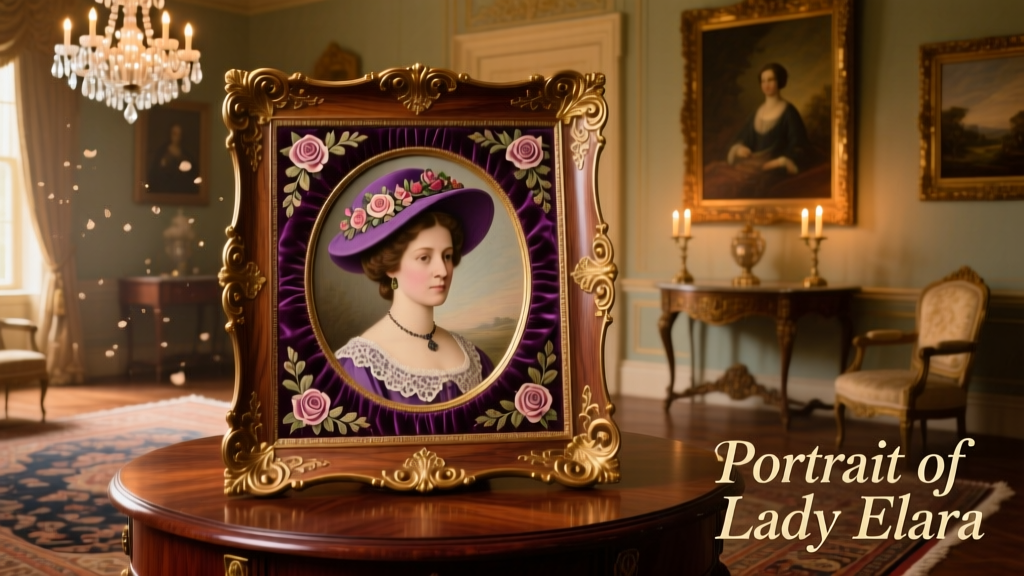
Rose Tapestry Tray Pin Portrait: Decoding the Lady in the Purple Plumbed Hat — A 1930s American Art Metal Collectible
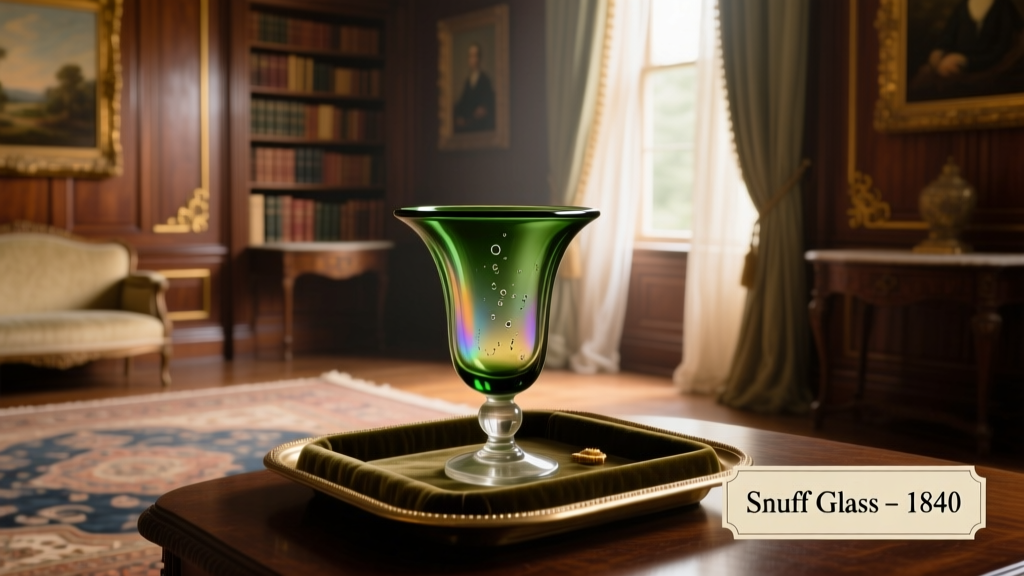
Snuff Glass Deep Olive Flared Lip: A Technical and Historical Analysis of the 5 7/8-Inch Variant

Wooden Canteen Stave Construction with Carved Initials: A 7-Inch American Folk Art Artifact
Royal Doulton Figurine 'Carpet Seller' Flambe Glaze HN 2776: History, Identification, and Conservation Insights
Steuben Vase Stump in Green Jade: Authenticating, Valuing, and Preserving the Iconic Three-Prong 6-Inch Design
The Roycroft Ewer with Three Rings Around the Neck: A Copper Masterpiece Measuring 6¼ Inches
Thomas Badger Pewter Plate: Authentication, Provenance, and Conservation of the 7 3/4-Inch Example
Brass Card Holder, Figural Design: Early 20th-Century American Craftsmanship in Context — Dimensions 9¼ × 4½ Inches
Mechanical Pencils and Pepsi-Cola: Unexpected Convergences in Mid-Century American Design and Collecting