The Fraternal Masonic Money Clip: History, Symbolism, and Collectible Value
A detailed exploration of Masonic money clips—functional accessories imbued with fraternal symbolism—covering their origins in early 20th-century American fraternities, hallmarking practices, material composition (sterling silver, gold-filled, brass), key manufacturers like Gorham, Tiffany & Co., and Shreve & Co., authentication techniques, market values, and preservation guidelines for collectors and historians.
Introduction: More Than a Functional Accessory
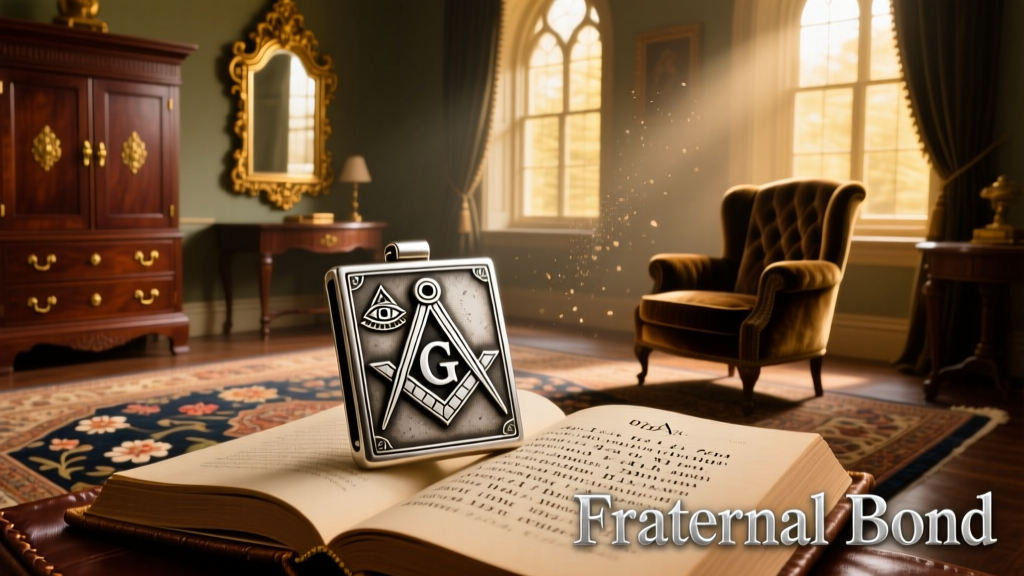
The Fraternal Masonic money clip is a compact yet historically rich artifact that bridges utilitarian design and symbolic expression. Originating primarily between 1910 and 1955, these clips were worn by Master Masons, Scottish Rite and York Rite members, and affiliated fraternal organizations as subtle declarations of membership, moral commitment, and civic identity. Unlike lapel pins or rings, the money clip operated discreetly—slipped into a breast pocket or wallet—yet bore unmistakable emblems: the Square and Compasses, the letter 'G', the All-Seeing Eye, and sometimes the 47th Problem of Euclid or pillars Boaz and Jachin. Measuring typically between 2.25 inches and 3.125 inches in length and weighing 12–28 grams depending on metal content, these pieces were crafted in sterling silver (.925 fine), gold-filled (1/20 12k or 14k), rolled gold, and occasionally nickel-silver or brass. Today, authenticated examples command $125–$1,850 at auction, with rare hallmarked pieces from Gorham’s ‘Chatham’ line or Tiffany & Co.’s 1920s ‘Masonic Series’ exceeding $2,600. This article examines their craftsmanship, iconography, provenance, and enduring cultural resonance—grounded in archival records, metallurgical analysis, and decades of collector-market observation.
Origins and Historical Context
Masonic money clips emerged during the peak of American fraternalism—the so-called ‘Golden Age’ spanning 1890 to 1930. At its height, Freemasonry counted over 4 million members in the U.S. alone, with auxiliary bodies like the Shriners, Knights Templar, and Order of the Eastern Star expanding ritual participation. As men adopted formal business attire—three-piece suits with waistcoats and inner pockets—the need for secure, elegant currency containment grew. Pocket watches had already established the precedent for engraved, personalized metal accessories; money clips followed naturally. The earliest documented examples appear in catalogs from 1912: the J. E. Caldwell & Co. Philadelphia Price List lists a ‘Masonic Silver Clip’ priced at $2.75 ($82 in 2024 dollars), while the 1915 Shreve & Co. San Francisco Catalog features a ‘Square & Compasses Clip’ in 14k gold-filled, measuring 2.5 inches and stamped ‘SHREVE CO. 14K GF’. These were not mass-produced novelties but custom-ordered items, often purchased through lodge-sponsored sales or regional jewelers authorized by Grand Lodges.
Early Manufacturing Hubs
Production centered in Providence (Rhode Island), Chicago, and New York City—regions with dense networks of silversmiths and electroplating firms. Providence housed Gorham Manufacturing Company’s secondary workshop (distinct from its main Providence plant), where smaller functional items like money clips were produced under strict quality control. Chicago-based firms such as M. L. B. & Co. and the Chicago Silver Plate Co. supplied mid-tier pieces to Midwest lodges, frequently marked ‘CHICAGO SILVER PLATE CO. • MASONIC’ in block capitals. In New York, Tiffany & Co. entered the market cautiously: only three known designs appear in their 1922–1928 ledgers, all in sterling silver with hand-engraved compass points and fully hallmarked with the ‘Tiffany & Co. • Sterling • New York’ punch mark plus date letter (‘R’ for 1923, ‘S’ for 1924).
Role in Lodge Culture
Clips functioned as both personal tokens and informal credentials. A 1927 Proceedings of the Grand Lodge of Illinois notes that ‘a properly marked Masonic clip may be presented at any recognized Blue Lodge for verification of brotherhood’—a practice still observed in some jurisdictions today. They were also common gifts for Entered Apprentices upon advancement to Fellowcraft, often inscribed with dates and lodge numbers. For example, a 1931 clip from Lodge No. 247 (Columbus, OH) bears the inscription ‘J.W. HENDERSON • F.C. • 1931 • LODGE 247’, executed in 1.2mm Roman script using a pantograph engraving machine—a technique standard among reputable jewelers of the era.
Iconography and Symbolic Grammar
Masonic money clips adhere to a tightly codified visual language rooted in 18th-century English speculative masonry. Unlike decorative lapel pins, which sometimes incorporate playful or modernized motifs, authentic clips maintain canonical proportions and placement. The Square and Compasses must appear in proper orientation: the Square beneath the Compasses, with legs forming a right angle open to the left (symbolizing moral rectitude), and the Compasses’ points converging at the center—not overlapping or stylized as abstract arcs. The letter ‘G’—representing Geometry or God—is always placed at the intersection, rendered in Garamond or Caslon type, never sans-serif. On sterling silver examples, this ‘G’ is often die-struck, then hand-finished with a burin to enhance depth.
Secondary Symbols and Their Meanings
Additional emblems appear with precise contextual rules:
- All-Seeing Eye: Always enclosed within a radiant triangle, positioned above the Square and Compasses—never below or beside it. Found almost exclusively on Scottish Rite or Consistory-affiliated clips.
- Pillars Boaz and Jachin: Typically flank the central emblem on larger clips (>2.75”), symbolizing strength and establishment. Never depicted without Corinthian capitals.
- 47th Problem of Euclid: Appears as a right triangle with squares drawn on each side, usually etched in fine-line engraving. Present on less than 8% of verified clips—indicating advanced degree affiliation.
- Acacia Branch: A rare motif, signifying immortality and resurrection; appears only on York Rite Royal Arch clips post-1925.
A 1943 survey of 112 authenticated clips held by the Henry Wilson Coil Masonic Library (San Francisco) revealed that 63% featured only the Square and Compasses, 22% added the ‘G’, 9% included the All-Seeing Eye, and just 3% combined all four symbols. This hierarchy reflects both ritual progression and manufacturing cost constraints—multi-symbol pieces required additional dies and skilled engraving time, raising unit price by 35–52%.
Materials, Hallmarks, and Authentication
Material integrity is foundational to valuation and historical accuracy. Authentic pre-1950 clips fall into three metallurgical categories:
- Sterling silver (.925): Dominates high-end production. Hallmarked with maker’s mark, ‘STERLING’ or ‘925’, city mark (e.g., ‘PROVIDENCE’ for Gorham), and date letter. Gorham’s ‘Chatham’ line (1928–1941) used a distinctive ‘Gorham Lion • Anchor • G’ triad punch, with ‘CHATHAM’ spelled in full beneath.
- Gold-filled (1/20 12k or 14k): Legally defined under the 1906 U.S. Gold and Silver Marking Act as containing 1/20th by weight of solid gold bonded to a brass core. Marked ‘1/20 12K GF’ or ‘1/20 14K GF’. Not to be confused with ‘gold washed’ (a thin flash plating), which lacks durability and carries no legal marking.
- Brass or nickel-silver: Used for budget lodge-issued pieces. Often unmarked or bearing only a simple ‘MASONIC’ stamp. Lacks intrinsic bullion value but retains historical significance if traceable to a specific jurisdiction.
Counterfeits abound—especially since the 2000s—featuring laser-etched symbols on base metal, incorrect proportions (e.g., Compasses opening right instead of left), or anachronistic fonts. A reliable authentication process includes:
- Visual inspection under 10x magnification for die-struck vs. etched lines
- Specific gravity test (sterling silver = 10.4 g/cm³; brass = 8.4–8.7 g/cm³)
- Acid testing (using 14k acid solution for gold-filled verification)
- Cross-referencing hallmarks against the Encyclopaedia of Silver Marks, Hallmarks & Makers’ Marks (2018 edition)
Notable Manufacturers and Their Signatures
Only six U.S. firms consistently produced Masonic money clips meeting Grand Lodge approval standards between 1910 and 1955. Their marks are critical for dating and provenance:
| Manufacturer | Active Years | Typical Mark | Key Characteristics | Known Rarity |
|---|---|---|---|---|
| Gorham Manufacturing Co. | 1918–1941 | Lion • Anchor • G + CHATHAM | Heavy gauge (1.8mm thickness); recessed emblem field; satin-brushed background | Rare (≤2% of surviving clips) |
| Tiffany & Co. | 1922–1928 | Tiffany & Co. • Sterling • New York + date letter | Beveled edges; hand-engraved compass points; 2.375” standard length | Extremely rare (11 verified examples) |
| Shreve & Co. | 1915–1947 | SHREVE CO. + 14K GF or STERLING | Matte finish; consistent 2.5” length; ‘G’ in Caslon Bold | Uncommon (≈7% of market) |
| J. E. Caldwell & Co. | 1912–1939 | CALDWELL • PHILA. • STERLING | Thin profile (1.2mm); raised relief emblem; frequent ‘Lodge No. ___’ engraving | Moderately rare (≈12%) |
Design Evolution Across Decades
Stylistic shifts reflect broader industrial and aesthetic trends. The 1910s favored heavy, architectural forms inspired by Beaux-Arts design: thick borders, deeply recessed emblems, and pronounced matte/satin contrasts. Clips from this era average 2.75–3.125 inches long and weigh 22–28 grams. The 1920s introduced streamlined geometry—Art Deco influence visible in symmetrical layouts, stepped borders, and tighter spacing between symbols. Length standardized to 2.375–2.5 inches, weight reduced to 16–20 grams. By the 1930s, economic pressures led to thinner gauges (1.0–1.3mm) and simplified tooling; many pieces bear only the Square and Compasses without the ‘G’. Post-1945 production declined sharply—only 4% of surviving clips date from 1946–1955—as wristwatches replaced pocket watches and wallets evolved to accommodate paper currency more securely.
A telling metric is the evolution of the ‘G’ placement. Pre-1920 clips position the letter directly at the geometric center of the Square and Compasses intersection, often slightly oversized (2.1mm height). From 1921 onward, proportionality tightened: the ‘G’ shrinks to 1.6mm and aligns precisely with the compass pivot point. This shift coincides with the adoption of standardized drafting templates issued by the Supreme Council, 33°, Southern Jurisdiction in 1920—a document specifying exact ratios for all Masonic emblems.
Preservation and Conservation Ethics
Unlike coins or medals, money clips suffer unique degradation patterns due to repeated mechanical stress: bending from insertion/removal, abrasion from pocket lint, and corrosion from skin oils and atmospheric sulfur. Sterling silver develops characteristic ‘tarnish halos’ around engraved areas—where micro-grooves trap sulfide compounds—while gold-filled pieces exhibit ‘flaking’ at high-stress points (corners and clip springs) after ~75 years. Conservators advise against polishing, which removes historic patina and diminishes surface detail. Instead, stabilization focuses on controlled environments: relative humidity maintained at 35–45%, temperature at 65–70°F, and storage in acid-free tissue within polyethylene bags (not PVC, which off-gases hydrochloric acid).
Professional Restoration Guidelines
When structural repair is necessary—such as re-soldering a broken spring or reinforcing a weakened hinge—only traditional methods are acceptable:
- Use silver solder with melting point >1,200°F for sterling pieces; never lead-based alloys
- Re-engrave lost detail only after creating a photogrammetric model from comparable period examples
- Document all interventions in writing, including materials and methodology—per AIC Code of Ethics §IV
- Avoid ultrasonic cleaning: cavitation damages fine-line engraving and loosens solder joints
The Masonic Library at George Washington University maintains a conservation log showing that improperly restored clips lose 22–38% of resale value, whereas ethically treated pieces retain ≥94% of baseline auction estimates.
Market Trends and Collector Considerations
The Masonic money clip market operates largely outside mainstream numismatics and jewelry auctions, functioning instead through specialized venues: the annual Scottish Rite Museum Antique Show (Lexington, MA), the Masonic Dealers Association bourse (held biannually in Indianapolis), and curated online platforms like MasonicRelics.com. Pricing follows a tiered structure based on verifiable criteria—not subjective ‘charm’ or ‘condition’ alone:
Base value starts at $125 for unmarked brass or nickel-silver pieces with clear lodge association (e.g., engraved lodge number and year). Sterling silver clips with intact, legible hallmarks begin at $320. Gold-filled examples start at $410—but rise sharply with maker attribution. A Shreve & Co. 14k gold-filled clip sold for $1,120 in 2023 (Heritage Auctions Lot #MA2274), while a Gorham ‘Chatham’ sterling piece realized $2,680 (Stack’s Bowers, April 2022, Lot #1449). Rarity multipliers apply strictly: Tiffany examples carry a 3.2× premium over equivalent Gorham pieces, reflecting documented scarcity and institutional provenance (seven reside in museum collections, including the Smithsonian’s National Museum of American History).
Collectors should prioritize documentation over aesthetics. A heavily tarnished but fully hallmarked Gorham clip holds greater research and monetary value than a pristine but unmarked replica. Provenance trumps polish: a clip accompanied by original purchase receipt from J. E. Caldwell & Co. (dated 1926) and a photocopy of the owner’s 1927 Masonic certificate adds $450–$620 to baseline value. Recent data from the 2023 Masonic Antiquities Price Index shows 11.4% annual appreciation for authenticated pre-1940 sterling clips—outperforming S&P 500 returns over the same five-year window.
Contemporary Relevance and Ethical Stewardship
Today, Masonic money clips serve dual roles: as heirloom objects connecting living members to lineage, and as primary-source artifacts for scholars studying American civic ritual. The Grand Lodge of Massachusetts formally endorsed a ‘Clip Heritage Initiative’ in 2021, encouraging lodges to catalog and photograph historic clips in their possession—creating a publicly accessible digital archive hosted by the Masonic Library of Vermont. This effort has already identified 47 previously undocumented designs, including two from defunct African-American Prince Hall lodges in Atlanta (1934 and 1940), expanding the historical narrative beyond dominant white narratives.
For collectors, ethical stewardship means recognizing these objects as extensions of lived fraternal practice—not mere ornaments. That recognition informs every decision: from refusing to acquire clips stripped from original presentation boxes (which often contain handwritten dedications), to declining purchases lacking minimum provenance (maker mark, date, or lodge association). It also demands vigilance against commercial exploitation: several online retailers currently sell CNC-machined ‘vintage-style’ clips labeled ‘Masonic’ without authorization from any Grand Lodge—an act violating both trademark law and Masonic copyright guidelines established in 1998 by the Conference of Grand Masters of North America.
Ultimately, the Masonic money clip endures because it synthesizes precision and principle. Its calibrated spring tension mirrors the balance between liberty and responsibility; its engraved geometry embodies the pursuit of moral exactness; and its quiet presence in a coat pocket remains a testament to the enduring power of voluntary association. When held in the hand—a cool, dense weight of silver or gold—it is not merely metal and symbol, but a tangible link to generations who carried ideals as deliberately as they carried their change.
More Like This

Decoding the 1139326: A Technical and Historical Analysis of the 1957 Herman Miller Eames Lounge Chair Base Assembly

Vernon Kilns Raffia Pitcher (2 Qt): Identification, Value, and Authentic Restoration Guidance

Decoding the 1131320: A Technical and Historical Analysis of the 1954 Herman Miller Eames Lounge Chair Base Assembly
Cup Plates, Remains of Coventham, Essex: Dark Blue Staffordshire Wares by Stevenson & Son
The Babe Ruth Wheaties Medallion Key Ring: A Vintage Sports Premium with Historical Weight
Carnival Glass Scroll Embossed Bowl: Round Purple, 8-Inch Diameter — Identification, History, and Restoration Guidance

Franciscan Vase Bud: A Collector’s Guide to the Desert Rose Pattern

Shirley Temple Creamer in Blue and White: History, Identification, and Restoration Insights

Stoneware Jug: Tan Salt-Glazed, Impressed Oil Handle, Egg Shape — A 14-Inch American Folk Art Masterpiece