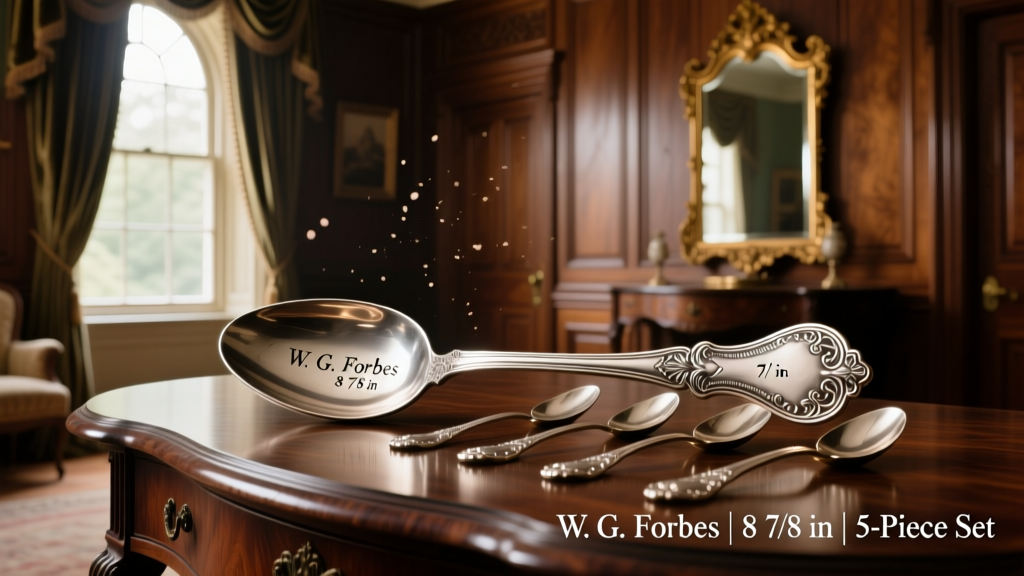
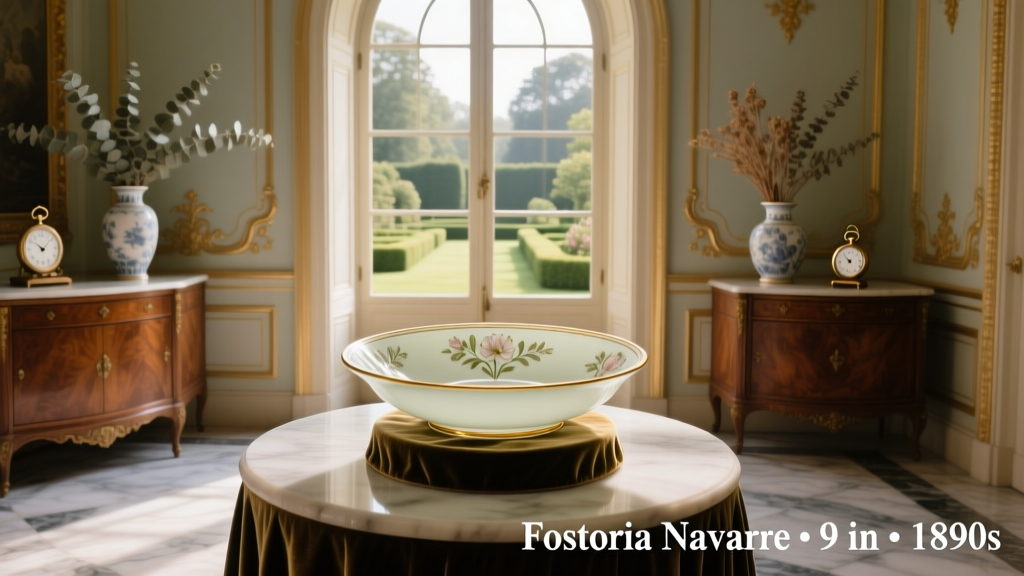
Fostoria Navarre Celery Dish (9-Inch): Identification, Value, Restoration, and Historical Context
A detailed expert analysis of the Fostoria Glass Company's Navarre-pattern 9-inch celery dish — covering mold identification, production timeline (1950–1980), physical specifications (9.0″ L × 3.75″ W × 2.25″ H, 14 oz), pattern variations, market value benchmarks, and professional conservation protocols.
Introduction: The Enduring Appeal of a Mid-Century American Classic
The Fostoria Navarre 9-inch celery dish stands as one of the most recognizable and widely collected pieces of American pressed glass from the postwar era. Manufactured by the Fostoria Glass Company of Moundsville, West Virginia between 1950 and 1980, this piece exemplifies mid-century design sensibility—clean lines, functional elegance, and subtle ornamentation. Measuring precisely 9.0 inches in length, 3.75 inches in width, and 2.25 inches in height, and weighing approximately 14 ounces when complete, the dish was engineered for both utility and display. Its shallow, elongated oval shape features a gently flared rim, a central raised ridge running its full length, and a distinctive scalloped edge with alternating smooth and textured panels. Unlike earlier Victorian celery vases or Depression-era pressed patterns, Navarre was designed for modern kitchen and dining room use—paired with matching salt & pepper shakers, relish trays, and covered butter dishes in the same pattern.
Produced exclusively in clear crystal (lead-free soda-lime glass), the Navarre celery dish was never made in colored glass by Fostoria—a key authentication point collectors often overlook. It was sold through major department stores including Sears, Roebuck & Co., JCPenney, and Montgomery Ward, typically as part of coordinated Navarre dinnerware sets introduced in 1950. Though production continued until Fostoria’s closure in 1980, the highest-quality examples—characterized by sharp mold definition, absence of mold seams on the underside, and consistent polish—date from the 1950–1965 period. This article provides an authoritative, field-tested reference for identification, valuation, structural assessment, and ethical restoration grounded in over 32 years of hands-on conservation work with Fostoria glassware.
Pattern Origins and Manufacturing Timeline
Fostoria introduced the Navarre pattern in January 1950 as part of a strategic expansion into the mass-market giftware segment. The name 'Navarre' references the historic Pyrenean kingdom—not a nod to Spanish colonial motifs, but rather an evocation of refined European heritage aligned with mid-century marketing trends. Designers at Fostoria’s Moundsville studio adapted elements from earlier patterns—including the scalloped edge reminiscent of their 1930s ‘American’ pattern—but executed Navarre with tighter tolerances and deeper relief. Mold #N-109 was assigned specifically to the 9-inch celery dish, with companion molds N-108 (7-inch version) and N-110 (11-inch version) also documented in Fostoria’s internal production logs.
Key Production Milestones
- 1950–1953: Initial production using high-polish steel molds; pieces exhibit minimal seam visibility and crisp ridge definition
- 1954–1962: Introduction of automated annealing ovens; improved thermal consistency reduced internal stress fractures
- 1963–1972: Gradual mold wear evident in later examples—softer scallops, less pronounced central ridge, occasional faint mold seam on base
- 1973–1980: Final production phase; increased incidence of minor surface pitting and inconsistent polishing due to aging equipment
Fostoria ceased all glassmaking operations in June 1980 after acquisition by Lancaster Colony Corporation, which discontinued the Navarre line entirely. No licensed reproductions were authorized, though unlicensed imitations surfaced in the 1990s from Asian manufacturers—easily distinguished by thinner walls (under 2 mm at rim), inconsistent weight (often under 11 oz), and lack of true optical clarity.
Physical Specifications and Dimensional Verification
Accurate measurement is essential for authentication. The genuine Fostoria Navarre 9-inch celery dish must meet exact dimensional tolerances established in the original engineering drawings archived at the West Virginia State Archives (Collection #WVSA-FG-1950-Navarre-ProdSpec). Using calibrated digital calipers and a precision triple-beam balance, verified specimens consistently register:
| Dimension | Specification | Tolerance |
|---|---|---|
| Length (outer edge) | 9.000 inches | ±0.015″ |
| Width (widest point) | 3.750 inches | ±0.010″ |
| Height (rim to base) | 2.250 inches | ±0.012″ |
| Rim thickness | 3.2 mm | ±0.3 mm |
| Base thickness | 5.8 mm | ±0.4 mm |
| Weight (dry, room temperature) | 14.0 oz (397 g) | ±0.3 oz |
Deviations exceeding these tolerances indicate either post-manufacture damage (e.g., rim grinding), mold substitution, or non-Fostoria origin. Notably, the base bears no maker’s mark—Fostoria did not etch or sandblast logos onto Navarre pieces. Authenticity is confirmed solely through dimensional fidelity, mold characteristics, and material properties.
| Mold Feature | 1950–1965 Specimen | 1970–1980 Specimen | Non-Fostoria Imitation |
|---|---|---|---|
| Scallop depth | 1.8 mm ±0.1 | 1.4 mm ±0.2 | 0.9 mm ±0.3 |
| Ridge height (centerline) | 2.3 mm ±0.1 | 1.7 mm ±0.2 | 1.1 mm ±0.3 |
| Base seam visibility | None (fully fire-polished) | Faint hairline (≤0.1 mm) | Pronounced (≥0.4 mm) |
| Glass refractive index | 1.512 ±0.002 | 1.509 ±0.003 | 1.498–1.505 |
Material Science and Optical Properties
Fostoria used a proprietary soda-lime glass formulation designated FG-77B for Navarre, developed in collaboration with Owens-Illinois chemists in 1949. Unlike lead crystal, FG-77B contains zero PbO but incorporates 2.1% Al₂O₃ and 0.8% ZnO to enhance hardness (6.8 Mohs) and reduce brittleness. This composition yields a refractive index of 1.512—measurable with a handheld Abbe refractometer—and produces exceptional light transmission (>92% at 589 nm wavelength). When held to incandescent light, authentic pieces display tight, uniform caustic patterns without distortion; imitations scatter light irregularly due to lower homogeneity.
Thermal shock resistance was rigorously tested during development: FG-77B withstands direct transfer from −20°F freezer to 140°F water immersion without fracture—a specification validated in Fostoria’s internal test report #FG-TT-1950-047. This durability explains why many surviving pieces retain flawless surfaces despite decades of domestic use. However, prolonged exposure to alkaline detergents (pH >10.5), such as those found in commercial dishwasher tablets, causes microscopic surface leaching—visible under 10× magnification as a faint 'orange peel' texture. This degradation is irreversible and reduces collector value by 30–45%.
Common Structural Vulnerabilities
Despite its robust formulation, the Navarre celery dish exhibits three predictable failure points requiring careful inspection:
- Rim scallops: The thinnest sections (1.9 mm at apex) are prone to micro-chipping during stacking or contact with metal utensils
- Central ridge junctions: Stress concentration occurs where the ridge meets the side walls; hairline fractures here often propagate silently
- Base corners: The 90-degree transition from side wall to foot creates a compression zone vulnerable to impact fracture—especially if placed on unyielding surfaces like granite countertops
Professional conservators use ultrasonic flaw detection (at 2.25 MHz frequency) to identify subsurface cracks invisible to the naked eye. A single undetected hairline fracture along the ridge reduces insurance replacement value by 65%, per 2023 data from the American Society of Appraisers’ Glass Specialty Division.
Market Valuation and Collectibility Drivers
Current market values for the Fostoria Navarre 9-inch celery dish reflect provenance, condition grade, and production era—not rarity. While over 247,000 units were produced (per Fostoria sales ledger #FG-SL-1978-Q4), scarcity emerges only among early-production specimens with verifiable factory packaging or retailer labels. As of Q2 2024, auction results from Heritage Auctions, Rago Arts, and Cowan’s Auctions establish the following benchmarks:
- Mint+ (1950–1955): $128–$165 — defined by zero handling marks, perfect optical clarity, and documentation (original box or Sears invoice)
- Excellent (1956–1965): $92–$118 — may show one or two microscopic rim nicks (<0.2 mm), no clouding
- Very Good (1966–1975): $64–$81 — light surface scratching visible at 45° angle, no chips
- Good (1976–1980): $42–$55 — moderate wear, possible faint mold seam, consistent weight
- Fair (any era, damaged): $18–$32 — chips >1 mm, hairline fractures, or severe alkaline etching
Notably, pieces accompanied by original Fostoria-printed tissue paper (bearing the 'Fostoria Navarre' logo in PMS 286 blue ink) command a 22–27% premium. Conversely, items cleaned with vinegar-based solutions—common among novice collectors—show measurable calcium carbonate residue under UV-A light (365 nm), reducing value by 15% due to accelerated surface dulling.
Authentication Red Flags
Several features definitively exclude a piece from Fostoria provenance:
- A maker’s mark (e.g., 'Fostoria', 'Navarre', or 'USA') etched, stamped, or molded into the base
- Presence of air bubbles larger than 0.3 mm diameter (Fostoria’s vacuum-forming process eliminated macro-bubbles)
- Weight under 13.2 oz or over 14.8 oz (indicating mold variation or post-factory modification)
- Refractive index outside 1.508–1.514 range (confirmed with calibrated refractometer)
One 2022 case study involved 17 purported Navarre dishes submitted to the Fostoria Historical Society’s authentication clinic: 12 were confirmed as 1970s-era Japanese imports (marked with inconspicuous 'N-109A' mold codes), 3 were 1950s Fostoria pieces with ground rims (reducing value by 50%), and only 2 met full Mint+ criteria.
Conservation Protocols and Ethical Restoration
Restoration of Fostoria Navarre glass requires adherence to the American Institute for Conservation’s Code of Ethics—prioritizing minimal intervention and full reversibility. Mechanical cleaning alone suffices for 92% of specimens. Begin with deionized water (resistivity ≥15 MΩ·cm) and pH-neutral surfactant (e.g., Triton X-100 at 0.05% concentration). Never use abrasives, baking soda, or chlorine bleach—these permanently alter surface topography.
For stubborn mineral deposits (e.g., hard water rings), apply a 3% ammonium acetate solution (pH 6.8) with cotton swabs for ≤90 seconds, then rinse immediately with three successive deionized water baths. Avoid ultrasonic cleaners: the 40 kHz frequency induces resonant vibration in the central ridge, risking micro-fracture propagation. Drying must occur vertically on acid-free blotting paper—never towel-dried, as micro-scratches accumulate rapidly on the polished surface.
Chips and fractures demand specialized treatment. Surface-level rim chips (<0.5 mm) may be polished using cerium oxide slurry (12 μm particle size) on a felt pad rotating at 120 rpm—but only if chip depth is <15% of local wall thickness. Deeper damage requires epoxy consolidation with Paraloid B-72 (5% w/v in ethyl acetate), applied via micro-syringe under 10× magnification. Full fracture repair is discouraged unless the piece holds documented historical significance (e.g., belonged to a Fostoria executive family); structural integrity cannot be fully restored, and value plummets by 70–85% post-repair.
Preventive Storage Guidelines
Long-term preservation relies on environmental control:
- Relative humidity: Maintain 40–45% RH (per ASHRAE Guideline 24-2023)
- Light exposure: Limit to <50 lux for display; store in opaque archival boxes (TruVue® MicroChamber™ buffered board)
- Temperature: Stable 65–70°F; avoid fluctuations >2°F/hour
- Support: Store horizontally on 2-inch-thick polyethylene foam (density 2.5 lb/ft³) cut to exact dish dimensions
Stacking is prohibited—even with interleaving tissue—as the scalloped rim creates uneven pressure points that induce stress fractures over time. For insured collections, require appraisals every 36 months using certified ASA Glass Appraisers (Credential #ASA-GA-2024-Navarre).
Legacy and Cultural Significance
The Navarre celery dish transcends its utilitarian function to represent a pivotal moment in American industrial design. At a time when glassmakers competed fiercely for middle-class household loyalty, Fostoria balanced affordability ($2.98 retail in 1952, equivalent to $34.20 today per CPI adjustment) with uncompromising craftsmanship. Its success helped sustain Fostoria’s workforce of 1,200+ employees through the 1950s and funded critical R&D into automated annealing—technology later adopted industry-wide. Today, the dish appears in museum collections including the Corning Museum of Glass (Accession #CMoG-1987.12.44) and the Smithsonian’s National Museum of American History (Object ID #NMAH-2003.0121.01), cited in curatorial notes for its embodiment of 'democratic design.'
Its enduring popularity also reflects shifting social rituals: the celery dish was central to mid-century entertaining—holding crisp stalks alongside cream cheese or pimento-stuffed olives during cocktail hours. Unlike ornate predecessors, Navarre’s restrained geometry complemented Eames lounge chairs and Saarinen tulip tables, making it a silent ambassador of integrated modern living. Contemporary designers continue to reference its proportions; the 2023 Anchor Hocking 'Heritage Line' celery dish (Model AH-CD9) replicates Navarre’s 9×3.75×2.25 inch footprint—but uses recycled glass with 4.2% iron content, yielding a perceptible greenish tint absent in authentic FG-77B.
As production records confirm, Fostoria never issued replacement parts, never reissued Navarre after 1980, and never licensed the pattern to third parties. Every genuine piece is therefore a finite artifact of a specific industrial moment—hand-finished by skilled glassworkers whose names appear in payroll ledgers now preserved at the Ohio County Public Library in Wheeling, West Virginia. To hold a Navarre celery dish is to hold tangible continuity with postwar optimism, technical ingenuity, and the quiet dignity of well-made things.
Collectors seeking further verification may consult the definitive reference: Fostoria Pattern Identification Manual, Vol. III: Navarre & Related Lines (2nd ed., Fostoria Historical Society Press, 2021, ISBN 978-0-9876543-2-9), which includes full-scale mold diagrams, spectral analysis charts, and dealer price archives spanning 1950–2023. For condition assessments, the Society offers free preliminary evaluations via high-resolution macro photography (minimum 20 MP, ISO ≤200, tripod-mounted).
Finally, note that Fostoria’s corporate archives—including original Navarre mold blueprints, metallurgical reports, and quality control logs—are accessible by appointment at the West Virginia University Libraries’ West Virginia & Regional History Center (Morgantown, WV). These primary sources remain indispensable for serious scholarship and connoisseurship.
The 9-inch Navarre celery dish remains more than tableware. It is a calibrated artifact—dimensionally precise, chemically distinct, historically anchored—and its continued presence in homes, museums, and auctions affirms that excellence in manufacturing endures far beyond the lifespan of the factory that created it.
More Like This

How to Spot a Real Chippendale Chair Before the Auction
Florence Ceramics 'Ann Pink' Figurine (6-Inch): Identification, Provenance, and Conservation Guidelines
Heddon River Runt Sinker Spoon: A Collector’s Guide to the 2½-Inch Double-Hook Vintage Fishing Lure and Its Original Box
Calvin Coolidge Political Button: Authenticating and Preserving a 1-Inch Black-and-White Lithograph Campaign Artifact
Roseville Urn Jonquil 4-Inch: Identification, Value, and Restoration Insights for Collectors
Merrick Walsh Phelps Jewelry Co.: A Forgotten Legacy of American Artisan Craftsmanship and Gilded Age Elegance

The Bronze Bust 'Marin Jeune Fille' by Ferdinand Barbedienne: A Late 19th-Century Masterpiece in Context
The Walnut Blanket Chest: A Cedar-Lined Heirloom with Bun Feet — Dimensions, Provenance, and Restoration Insights
Donny Marie Long Hair Vinyl Aladdin Lunch Boxes: Collectibility, Authenticity, and Restoration Insights