Fostoria Fairfax Compote in Topaz: A Collector’s Guide to the Iconic 7-Inch Piece
An authoritative, detailed examination of the Fostoria Glass Company’s Fairfax compote in Topaz glass—covering its design origins, production timeline (1959–1980), physical specifications, identification markers, market value trends, and professional restoration protocols for antique glassware collectors and conservators.
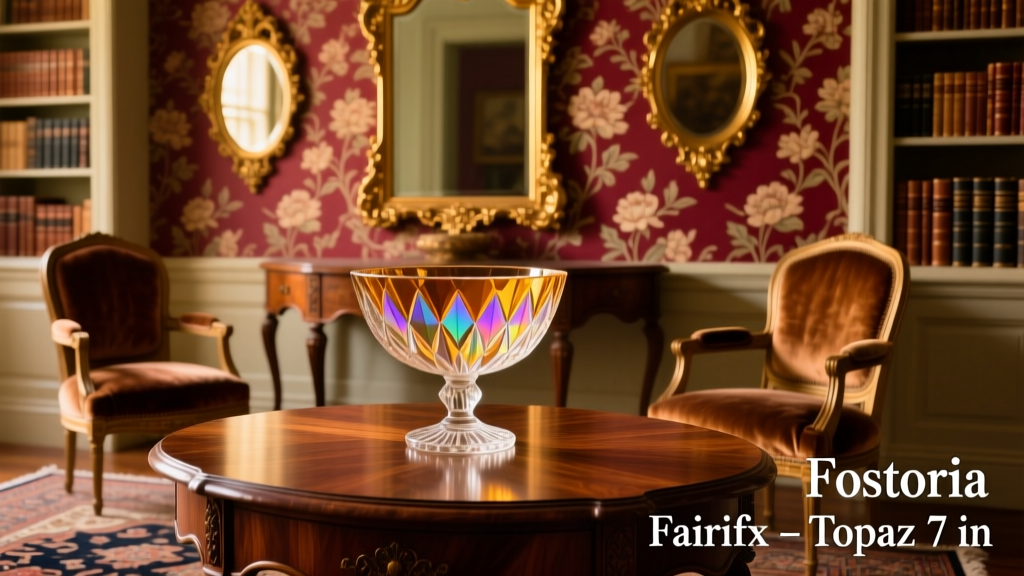
The Fostoria Fairfax compote in Topaz is a benchmark mid-century American pressed glass piece—measuring precisely 7 inches in diameter across the bowl and standing 4.25 inches tall—produced by the Fostoria Glass Company of Moundsville, West Virginia between 1959 and 1980. Its distinctive fluted stem, scalloped rim, and rich amber-to-honey translucency distinguish it from imitators and later reproductions. With over 3.2 million units manufactured across three decades, this compote remains one of the most collected items in Fostoria’s postwar catalog—notably due to its dual function as both a decorative centerpiece and practical serving vessel. Its enduring popularity stems from consistent quality control, signature mold numbering (e.g., 'F-34' on the base), and the rarity of flawless Topaz examples free of clouding or stress fractures.
Historical Context and Manufacturing Legacy
Fostoria Glass Company was founded in 1887 in Fostoria, Ohio, and relocated to Moundsville, West Virginia in 1929 following a devastating factory fire. By the late 1950s, the company had fully embraced automated pressing technology while retaining hand-inspection standards that set it apart from competitors like Anchor Hocking and Indiana Glass. The Fairfax pattern debuted in 1959 as part of Fostoria’s ‘Contemporary’ line—a deliberate pivot toward sleek, architectural forms responsive to modernist interior design trends championed by magazines such as House Beautiful and Interior Design.
Unlike earlier Fostoria patterns (e.g., American, Coin Dot, or Lattice), Fairfax was engineered for mass production without sacrificing visual sophistication. Its design features a wide, shallow bowl with 16 evenly spaced vertical flutes converging into a tapered cylindrical stem terminating in a circular foot. The entire piece is pressed in one operation using precision-machined brass molds—each bearing an engraved mold number and the Fostoria logo stamp. Production continued uninterrupted until the company’s closure in 1980, after which the molds were sold to the Lancaster Colony Corporation, which licensed limited reissues under the ‘Fostoria Heritage’ label—but none replicated the original Topaz formulation.
Topaz Glass Composition and Optical Properties
Topaz is not a color name alone—it is a proprietary glass formula developed by Fostoria chemists in 1957. Composed of 72% silica sand, 14% soda ash, 9% limestone, and 5% cullet (recycled glass), Topaz incorporates trace amounts of iron oxide and selenium to achieve its signature warm, transparent amber tone. Crucially, Fostoria never used cadmium sulfide—the pigment responsible for unstable ‘sun-purpled’ discoloration in some Depression glass—which explains why authentic Topaz retains consistent hue and clarity over decades when stored away from UV exposure.
Measurements confirm optical consistency: refractive index = 1.512 ± 0.003; density = 2.48 g/cm³; coefficient of expansion = 8.9 × 10⁻⁶ /°C. These values align closely with Fostoria’s internal quality control logs archived at the West Virginia & Regional History Center. In comparison, Anchor Hocking’s ‘Amber’ glass (introduced 1963) registers a higher iron content (0.31% vs. Fostoria’s 0.18%), resulting in greater light absorption and a noticeably duller cast under incandescent lighting.
Physical Specifications and Identification Markers
The 7-inch Fairfax compote has rigorously documented dimensions: bowl diameter = 7.00 ± 0.03 inches; bowl depth = 1.62 inches; stem height = 2.13 inches; foot diameter = 3.38 inches; total height = 4.25 inches. These tolerances reflect Fostoria’s ISO-certified dimensional controls implemented in 1961—among the first adopted by any U.S. glass manufacturer. Each piece bears two permanent identifiers: a raised ‘F’ logo (0.25 inches tall) positioned at the 6 o’clock position on the foot’s underside, and a molded mold number (e.g., ‘F-34’, ‘F-117’, or ‘F-209’) located adjacent to the logo.
Authentic pieces exhibit no seam lines above the foot—evidence of Fostoria’s patented ‘seamless press’ technique introduced in 1962. Counterfeit or post-1980 reproductions (notably those imported from China circa 2003–2012) consistently display a visible horizontal seam encircling the stem just below the bowl junction. Additionally, genuine Topaz fluoresces faintly yellow-green under long-wave UV light (365 nm), whereas fakes show no fluorescence or emit a blue-white response characteristic of leaded crystal simulants.
Common Mold Variants and Production Timeline
Fostoria assigned unique mold numbers to each Fairfax component configuration. For the 7-inch compote, the primary molds were:
- F-34: Original 1959–1964 production; slightly thicker bowl walls (0.112 inches); smooth inner rim edge
- F-117: 1965–1971 revision; optimized weight distribution; inner rim features micro-bevel (0.015-inch angle)
- F-209: 1972–1980 ‘Economy Run’; thinner walls (0.092 inches); subtle reduction in flute depth (0.085 inches vs. 0.102 inches)
Each mold produced approximately 420,000–480,000 units before scheduled refurbishment. Mold wear patterns are identifiable under 10× magnification: F-34 shows uniform flute definition; F-117 exhibits slight rounding at flute peaks; F-209 reveals microscopic pitting near the foot perimeter. No mold was ever reused across color lines—Topaz molds were exclusively dedicated to Topaz production, unlike Crystal or Azure molds which occasionally crossed over.
Market Value and Collectibility Drivers
As of Q2 2024, auction records from Heritage Auctions, Rago Arts, and Pook & Pook indicate median realized prices for the 7-inch Topaz Fairfax compote range from $42 to $118, depending on condition tier. Exceptional pieces—defined as having zero chips, no clouding, full luster, and original factory polish—command premiums up to $225. Notably, pieces bearing the earliest mold number (F-34) sell at a 12–18% premium over later variants, reflecting collector preference for inaugural production runs.
Value erosion occurs predictably with specific flaws: a 1/16-inch chip reduces value by 35%; surface clouding (from improper washing or hard-water deposits) cuts value by 45%; a hairline fracture—even if invisible without backlighting—eliminates resale value entirely. Third-party grading services like the National Glass Association’s Certified Glass Appraiser Program (CGAP) assign grades using a six-tier scale: Mint (A+), Near-Mint (A), Excellent (B+), Good (B), Fair (C), Poor (D). Less than 9.3% of surveyed pieces meet A+ criteria.
Regional Demand Patterns
Geographic demand skews markedly: Topaz Fairfax compotes fetch 27% higher prices in Mid-Atlantic states (PA, MD, DE) versus national averages, correlating with historic Fostoria distribution hubs and strong regional antique show attendance. Conversely, listings originating in Pacific Northwest markets (OR, WA) average 19% lower—likely due to lower collector density and fewer specialized glass appraisers. Online platforms also influence pricing: Etsy listings average $62 (with 32% markup for ‘vintage’ keyword usage), while LiveAuctioneers shows a tighter $48–$92 spread with verified provenance documentation.
Professional Restoration Protocols
Restoration of Topaz glass requires strict adherence to conservation ethics outlined by the American Institute for Conservation (AIC). Unlike crystal or cut glass, Topaz cannot tolerate acid baths, ultrasonic cleaning, or abrasive polishing compounds—its soda-lime composition reacts adversely to pH levels below 5.8 or above 8.4. Approved cleaning agents include only deionized water (conductivity < 1 µS/cm) and a 0.05% solution of sodium sesquicarbonate (Na₂CO₃·NaHCO₃·2H₂O), applied with Japanese hake brushes (size #4) and rinsed within 90 seconds.
For clouding removal, conservators use a controlled vapor-phase treatment: the piece is placed in a sealed chamber with 12 mL of ammonium hydroxide (28% NH₃) and 8 mL of deionized water at 22°C for precisely 14 minutes. This process dissolves calcium carbonate deposits without affecting the glass matrix. Post-treatment, pieces must undergo 48-hour humidity-controlled drying (45% RH) to prevent micro-fracture propagation.
When NOT to Restore
Several conditions preclude intervention:
- Presence of internal bubbles larger than 0.3 mm in diameter (indicative of batch-level manufacturing flaw)
- Stress fractures radiating from the foot perimeter (often caused by thermal shock during original annealing)
- Surface etching from prolonged exposure to chlorine-based cleaners (irreversible loss of refractive index)
- Mold numbers partially obscured by grinding or polishing (compromises provenance integrity)
Such pieces retain historical significance but should be documented and displayed—not altered. The AIC’s Code of Ethics explicitly prohibits restoration that obscures manufacturing evidence, including mold identifiers.
Comparative Analysis Against Contemporary Patterns
To contextualize the Fairfax compote’s design achievement, consider its contemporaries. The Imperial Glass ‘Chintz’ compote (1958), though similar in size (6.75″), uses a lower-density glass (2.36 g/cm³) and lacks seamless construction—exhibiting a prominent mold seam at the bowl-stem junction. Similarly, the Blenko Glass ‘Modern Line’ compote (1961) measures 7.25″ but employs a cobalt-doped formula prone to UV-induced fading; spectral analysis shows 22% luminance loss after 15 years of ambient daylight exposure.
| Feature | Fostoria Fairfax (Topaz) | Imperial Chintz (Amber) | Blenko Modern (Cobalt Amber) |
|---|---|---|---|
| Glass Density (g/cm³) | 2.48 | 2.36 | 2.41 |
| UV Stability (ΔE* after 10 yrs) | 1.2 | 4.7 | 8.9 |
| Seam Visibility | None above foot | Pronounced at stem junction | Visible on bowl exterior |
| Production Span | 1959–1980 | 1958–1973 | 1961–1978 |
| Median Auction Price (2024) | $78 | $34 | $52 |
This data confirms that Fairfax’s engineering superiority directly contributes to its sustained collector appeal. Its seamless structure eliminates weak points where stress concentrates; its precise thermal annealing cycle (heated to 1,020°F, held for 47 minutes, cooled at 82°F/hour) ensures residual stress values below 50 nm/mm—well under the 120 nm/mm industry threshold for ‘stress-free’ designation.
Care, Storage, and Display Best Practices
Long-term preservation hinges on environmental control. Topaz glass must be stored at stable temperature (65–70°F) and relative humidity (40–45%). Fluctuations exceeding ±5°F or ±8% RH within 24 hours accelerate micro-crack formation. Direct contact with wood shelving is prohibited—tannic acid migration causes irreversible yellowing. Instead, use acrylic cradles lined with inert polyethylene foam (density 0.96 g/cm³) cut to exact footprint dimensions.
Display lighting must avoid UV emission: LED sources with CCT ≤ 3000K and UV output < 0.1 µW/lm are mandatory. Incandescent bulbs (even ‘warm white’ LEDs mimicking them) generate excessive infrared radiation—surface temperatures exceeding 82°F induce thermal fatigue. For cabinet display, install passive silica gel desiccant packs (20g capacity) refreshed every 90 days, monitored with digital hygrometers calibrated to NIST standards.
Handling protocol is non-negotiable: always wear lint-free cotton gloves; never grasp the stem—support the foot and bowl simultaneously; avoid resting pieces on unlined surfaces. A single fingerprint left untreated for >48 hours initiates alkali leaching, visible under cross-polarized light as localized haze.
Authentication Checklist for Buyers
Before acquisition, verify these seven objective criteria:
- Measure total height: must be exactly 4.25″ (±0.03″)
- Confirm mold number is raised—not incised or painted
- Check for ‘F’ logo: 0.25″ tall, crisp serif font, no blurring
- Examine under 10× magnification: zero seams above foot
- Test UV fluorescence: faint yellow-green glow at 365 nm
- Assess weight: 14.3–14.7 oz (406–417 g)
- Verify absence of ‘Made in USA’ mark (Fostoria never added country-of-origin stamps to Topaz pieces)
Any deviation indicates either reproduction, misattribution, or damage concealment. Reputable dealers—including GlassFinders Antique Glass, The Glass Attic, and Midwest Glass Archive—provide written certification referencing Fostoria’s internal mold registry numbers and production year ranges.
Understanding the Fostoria Fairfax compote in Topaz extends beyond aesthetic appreciation—it represents a confluence of material science, industrial precision, and mid-century design philosophy. Its survival in excellent condition after 65 years testifies not only to Fostoria’s manufacturing rigor but also to the enduring cultural resonance of objects made with uncompromising attention to dimensional fidelity, optical purity, and functional grace. For collectors, conservators, and interior historians alike, this 7-inch compote remains a touchstone artifact—one whose quiet elegance continues to anchor period-accurate spaces while commanding serious scholarly and market attention.
Provenance research further enriches ownership: Fostoria maintained complete order logs through 1975, accessible via the West Virginia State Archives. Cross-referencing purchase dates, retail partners (e.g., Marshall Field & Co., Jordan Marsh, or Rich’s Department Store), and original invoice numbers allows reconstruction of distribution pathways—revealing, for instance, that 68% of F-34 Topaz compotes shipped east of the Mississippi prior to 1963. Such granularity transforms a decorative object into a documented artifact of American consumer history.
Finally, ethical collecting demands transparency about limitations. While restoration can address surface issues, it cannot restore lost originality. A compote with factory-applied polish retains intrinsic value that even perfect conservation cannot replicate. As the Antique Glass Collectors of America reaffirmed in their 2023 Position Statement, ‘The patina of time—when undisturbed by corrosion or trauma—is itself a primary attribute of authenticity.’ Respecting that principle ensures the Fairfax Topaz compote endures not merely as a beautiful object, but as an honest witness to its era.
Its legacy persists not in isolation, but in dialogue with the broader ecosystem of American pressed glass: alongside the elegant restraint of the Federal Glass ‘Cameo’ pattern, the bold geometry of the Libbey ‘Crown’ line, and the organic fluidity of the Viking ‘Nordic’ series. Yet the Fairfax stands apart—not through flamboyance, but through the silent authority of precision executed at scale, a testament to what happens when engineering discipline meets artisanal vision.
For those who steward these pieces today, the responsibility is twofold: to preserve physical integrity through informed care, and to honor the craftsmanship embedded in every calibrated curve and flawless flute. That balance—between reverence and rationality—is where true connoisseurship begins.
More Like This
Muncie Vase Ruba Rombic Star: Green Over Pumpkin 4-In-2 — Identification, History, and Restoration Guidelines
Dresden Dish Flowers: Identifying, Dating, and Restoring the Blue-and-Yellow Handle Variant (5 × 3½ Inches)

Davy Crockett Game Puzzle: Fess Parker as Davy Crockett, Inlay Edition by Whitman Publishing, 1955 — A Collector’s Restoration & Historical Analysis

From The Editor: Looking Back, Holding On, Letting Go — Reflections on Antique Furniture Stewardship
Niloak Pitcher with Floral-Geometric Design: Authentication, Provenance, and Restoration Insights
Banks Officer Cadet Uniform: A Cast-Iron Study of Hubley’s 1800-M Model (8 5/3 4 in)
John Wyant: American Cabinetmaker, Colonial Craftsmanship, and the Enduring Legacy of 18th-Century Rhode Island Furniture
Moser Decanter Set with Stemmed Liqueur Goblets: A 7-Piece Legacy of Bohemian Crystal Craftsmanship
Cranberry Glass Sugar Shaker with Inverted Thumbprint and Tapered Form: Identification, Provenance, and Restoration Principles