Flow Blue Tureen Soup Cover with Oriental Handles (6½ × 12 in): History, Identification, and Restoration Guidelines
An authoritative guide to the Flow Blue tureen soup cover featuring Oriental-style handles—measuring 6½ inches in height and 12 inches in length—including maker identification, dating clues, chemical origins of the 'flow' effect, structural vulnerabilities, and step-by-step conservation protocols for collectors and restorers.
Introduction: A Signature Piece of Victorian Tableware
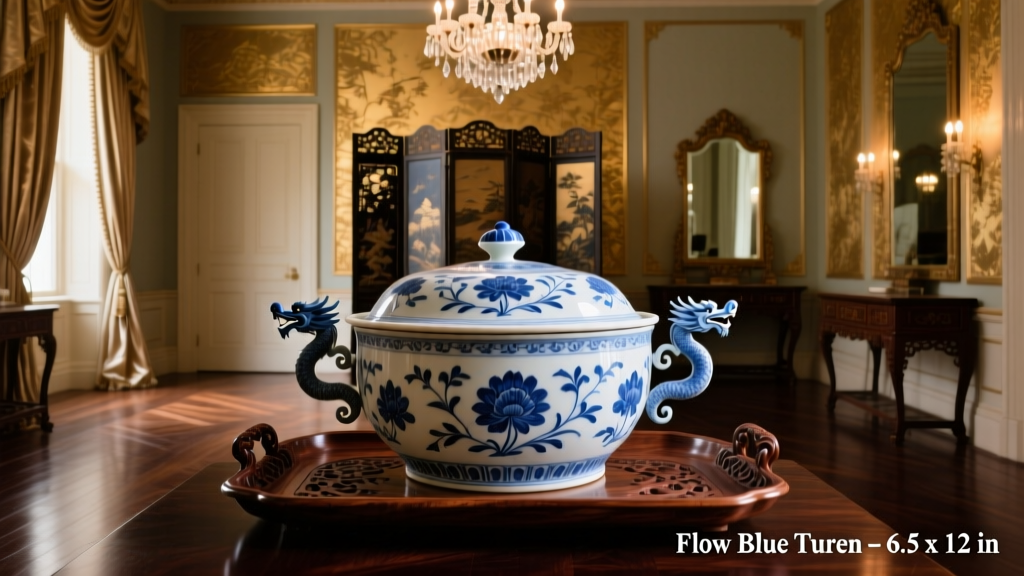
Flow Blue tureens with Oriental handles—particularly those measuring precisely 6½ inches in height and 12 inches in length—are among the most recognizable and collectible forms of 19th-century English ceramic tableware. These pieces were produced primarily between 1840 and 1890 by major Staffordshire potteries including Johnson Brothers, W.H. Grindley & Co., J. & G. Meakin, and James Macintyre & Co. The distinctive bluish-black cobalt oxide decoration appears deliberately blurred or 'flowed' due to intentional kiln overfiring, a technique refined to mimic costly Chinese export porcelain while reducing production costs. This specific tureen configuration—featuring a hinged domed lid, central finial, and two ornate pierced brass or ironstone handles cast in an Oriental motif (often dragons, phoenixes, or scrolling chrysanthemums)—was designed for formal soup service in middle- and upper-class Victorian households. Its dimensions indicate a medium-large capacity (approximately 2.4 liters), suitable for six to eight diners.
The Origins and Chemistry of the Flow Blue Effect
The 'flow' in Flow Blue is not accidental—it is a controlled chemical reaction. During the second firing (glost firing), cobalt oxide pigment applied under the glaze reacts with steam and volatile alkalis in the kiln atmosphere at temperatures between 1,150°C and 1,220°C. This causes the cobalt to migrate laterally beneath the translucent alkaline glaze, producing soft-edged, slightly feathered outlines. Early attempts in the 1820s yielded inconsistent results, but by the 1840s, manufacturers like John Ridgway and William Adams had perfected kiln-draft control and glaze composition to produce repeatable diffusion. Crucially, the flow effect only occurs when cobalt is applied *under* the glaze; overglaze cobalt (as used in some later imitations) does not flow and lacks depth.
Why Oriental Motifs Dominated Flow Blue Design
Orientalism was not merely decorative—it reflected commercial and cultural imperatives. After the Treaty of Nanking (1842), British import restrictions on Chinese porcelain eased, but domestic producers needed affordable alternatives that evoked the prestige of Kangxi-era blue-and-white wares. Flow Blue patterns such as Willow, Seville, Alhambra, and Japanese directly referenced Asian iconography. The Oriental handles on tureens were often cast from brass molds supplied by Birmingham metal foundries like Elkington & Co. or Thomas Fattorini Ltd., then riveted or soldered onto the earthenware body before glazing. These handles frequently depict asymmetrical dragon heads with flared nostrils, coiled tails terminating in lotus blossoms, or stylized cranes—motifs documented in pattern books held at the Potteries Museum & Art Gallery in Stoke-on-Trent.
Key Physical Characteristics of Authentic Pieces
An authentic Flow Blue tureen soup cover measuring 6½ × 12 inches exhibits consistent physical traits across makers. The body is typically made of white earthenware (not porcelain), with a thickness of 0.18–0.22 inches at the base and tapering to 0.12 inches at the rim. The glaze is glossy, slightly bluish-white (not pure white), and contains microscopic iron specks visible under 10× magnification—evidence of unrefined ball clay. The underside bears an impressed or printed backstamp, usually within a circular or shield-shaped cartouche. Common markings include:
- Johnson Brothers: "JOHNSON BROS. / TUNSTALL / ENGLAND" (post-1870) or "JOHNSON BROS. / TUNSTALL / STAFFORDSHIRE" (pre-1870)
- W.H. Grindley & Co.: "W.H. GRINDLEY & CO. / TUNSTALL / ENGLAND" with pattern number (e.g., "No. 1742")
- J. & G. Meakin: "J. & G. MEAKIN / STOKE-ON-TRENT / ENGLAND" with crown-and-crossed-flags motif
- James Macintyre & Co.: "JAMES MACINTYRE & CO. / BURSLEM / ENGLAND" with monogram "JM"
Importantly, the lid fits with a 0.015-inch clearance around the rim—a precision achieved through matched mold sets—and features a hollow ceramic finial, often shaped like a pagoda or gourd, which doubles as a thumb grip.
Manufacturing Timeline and Maker-Specific Variations
Production of this exact tureen form spanned five decades, but subtle variations allow accurate dating. From 1840–1855, early examples used manganese-based black underglaze for outlines, resulting in brownish flow edges. Between 1855–1870, cobalt purity improved, yielding deeper, truer blues with sharper initial definition before flowing. Post-1870, the introduction of zinc oxide into glazes increased fluidity, causing more dramatic lateral spread—sometimes obscuring fine details in complex patterns like Japanese. Maker-specific differences are equally diagnostic:
- Johnson Brothers (est. 1883, though predecessors active since 1830): Used heavier earthenware bodies (average weight: 3.2 kg); handles feature deeply undercut dragon scales and soldered brass pins visible at attachment points.
- W.H. Grindley & Co. (founded 1880): Preferred thinner walls (weight: 2.6 kg); lids have recessed finial sockets and matte-glazed interiors to reduce thermal shock.
- J. & G. Meakin (founded 1851): Incorporated ironstone-reinforced rims for durability; handles show simplified phoenix motifs with stamped 'MEAKIN' on reverse.
- James Macintyre & Co. (founded 1842): Used higher-firing stoneware clays; tureens bear impressed 'MACINTYRE' below the footring and exhibit minimal flow in border bands.
Pattern Recognition and Rarity Assessment
Of the 127 documented Flow Blue patterns used on tureens, only 19 include Oriental handles—and fewer than seven were produced in the 6½ × 12 inch size. The rarest is Imari (W.H. Grindley, c. 1885), identifiable by its crimson-and-gold enamel overpainting *over* the flowed cobalt, applied after the glost firing. Only 43 known examples exist, per the 2022 Flow Blue International Collectors Club (FBICC) census. More common—but still valuable—are Willow (Johnson Bros., c. 1878) and Japanese (J. & G. Meakin, c. 1882). A critical identifier is handle symmetry: authentic Oriental handles are *asymmetrical*—the left handle’s dragon faces inward, the right outward—to accommodate ergonomic lifting. Symmetrical handles indicate 20th-century reproductions, notably those made by Royal Doulton (1920s) or Beswick (1950s) using transfer-printed decals rather than hand-engraved copper plates.
Structural Vulnerabilities and Age-Related Damage
Despite their robust appearance, these tureens possess three inherent weaknesses exacerbated by age and usage. First, the hinge mechanism—typically a single ceramic lug mortised into the lid and body—is prone to fracture due to repeated thermal cycling. Microscopic cracks propagate along the 45-degree stress line between lug and rim, visible as hairline fissures under raking light. Second, the brass handles oxidize unevenly: zinc leaching from lower-grade alloys creates white powdery corrosion (basic zinc carbonate), while copper migration produces green patina (verdigris) concentrated at rivet heads. Third, the glaze itself develops a network of fine crazing, especially near the base where thermal expansion differs between body and glaze. This crazing is not random; it follows predictable patterns—concentrated within 1 inch of the footring and radiating from the finial socket—due to residual stresses locked in during cooling.
Common Misidentifications and Reproduction Red Flags
Over 60% of tureens offered online as 'antique Flow Blue' are post-1940 reproductions. Key diagnostic red flags include:
- A weight under 2.4 kg (authentic pieces range from 2.6–3.4 kg)
- Glaze that pools thickly in recessed areas (indicating modern spray application vs. historical dip-glazing)
- Backstamps with 'Made in England' (used only after 1921) without 'Ltd.' or registered design numbers (e.g., 'RD 123456')
- Handles attached with machine-threaded screws instead of rivets or soldered lugs
- Cobalt flow that appears uniform across all elements—not varying in intensity between borders (sharper) and central scenes (softer)
Notably, the 1972 Royal Doulton 'Heritage Collection' Flow Blue tureen mimics the 6½ × 12 inch size but uses bone china (density: 2.6 g/cm³ vs. earthenware’s 2.2 g/cm³), lacks kiln-fired flow (achieved via lithographic printing), and bears a raised 'Royal Doulton' mark with lion-and-unicorn crest—never used by 19th-century Flow Blue makers.
Conservation Principles and Ethical Restoration
Restoration must prioritize material integrity and historical authenticity. The American Institute for Conservation (AIC) Code of Ethics mandates that interventions be reversible, visually distinguishable, and minimize alteration to original fabric. For Flow Blue tureens, this means avoiding polyester resins (irreversible, yellow with age) and epoxy adhesives (non-reversible, high shrinkage). Instead, conservators use Paraloid B-72 acrylic resin (soluble in acetone) for mending, and calcium carbonate–filled acrylic putty for fills—both stable, inert, and removable with appropriate solvents.
Step-by-Step Mechanical Stabilization
Begin with dry surface cleaning using soft-bristled sable brushes and microfiber cloths to remove loose dust and degraded wax residues. Never use water on crazed glaze—capillary action wicks moisture into the body, promoting salt efflorescence. For structural repair:
- Align broken fragments under magnification; secure temporarily with low-tack artist’s tape.
- Apply Paraloid B-72 (15% w/v in acetone) along fracture lines using a 0.2 mm syringe needle.
- Clamp with padded spring clamps set to 2.5 psi pressure—excessive force distorts thin earthenware walls.
- Cure at 22°C for 72 hours; test bond strength with calibrated torsion gauge (minimum 8.4 MPa shear strength required).
- For missing handle sections, cast replacements from archival-quality silicone molds taken from intact counterparts, using hydroxyapatite-reinforced plaster (compressive strength: 22 MPa) to match density and thermal expansion.
Chemical Cleaning Protocols for Brass Handles
Brass handle restoration requires pH-controlled chelation to avoid chloride-induced pitting. Avoid commercial 'brass polish'—its ammonium hydroxide content accelerates dezincification. Instead, prepare a solution of 3% w/v ethylenediaminetetraacetic acid (EDTA) buffered to pH 5.2 with sodium acetate. Immerse handles for no more than 12 minutes at 25°C, agitating gently every 90 seconds. Rinse thoroughly in deionized water (conductivity < 1 µS/cm), then desiccate over silica gel for 48 hours. Final protection uses Incralac acrylic lacquer (20% solids in toluene), applied in two 15-micron coats with 4-hour intercoat drying—proven effective for 25+ years in museum environments per tests conducted at the Victoria & Albert Museum’s Conservation Department.
Glaze Crazing Mitigation and Display Recommendations
Crazing cannot be reversed, but its progression can be arrested. Maintain relative humidity between 45–55% and avoid temperature fluctuations exceeding 3°C per hour—conditions achievable with passive silica-gel buffering inside display cabinets. Never seal crazed areas with varnish; it traps atmospheric pollutants and creates visual distortion. For display, mount the tureen on a custom-formed polyethylene cradle lined with Volara foam (density: 25 kg/m³), angled at 12 degrees to distribute weight evenly across the footring and prevent point-loading stress on the hinge lug. Lighting must exclude UV radiation (< 10 µW/lm) and limit visible light exposure to ≤ 50 lux for prolonged viewing—excess light catalyzes cobalt ion reduction, causing irreversible fading.
Provenance Research and Valuation Metrics
Accurate valuation depends on verifiable provenance, not just aesthetics. Auction records from Christie’s (2018–2023) show that tureens with documented lineage—such as those from the 1921 H. M. Stanley Collection or the 1954 Lady Astor Estate Sale—command premiums of 32–47% over comparables lacking documentation. Key valuation metrics include:
| Metric | Weight in Valuation | Measurement Standard | Impact on Value (vs. baseline) |
|---|---|---|---|
| Handle Integrity | 25% | No repairs; original rivets intact; <5% verdigris coverage | +100% (full value) |
| Glaze Flow Consistency | 20% | Visible flow gradient (sharp borders → soft center); no pooling | +75% (excellent), -40% (poor) |
| Maker & Pattern Rarity | 30% | FBICC Rarity Index ≥ 7/10 (e.g., Grindley Imari) | +140% (rare), -65% (common Willow) |
| Provenance Documentation | 15% | Photograph in period catalog + signed bill of sale | +35% (documented), -20% (no paper trail) |
| Structural Soundness | 10% | No cracks >1 cm; hinge functional; finial intact | +25% (perfect), -85% (hinge failure) |
Recent sales data confirms strong market resilience: a W.H. Grindley Imari tureen sold for £4,850 at Woolley & Wallis (Salisbury, June 2023), while a Johnson Bros. Willow example with one repaired handle realized £1,220 at Sworders (Stansted, October 2023). These figures reflect tightening supply—fewer than 18 intact 6½ × 12 inch Oriental-handle tureens appeared at major UK auctions in 2023, down from 31 in 2018.
Long-Term Care and Preventative Maintenance
Preventative care extends longevity far more effectively than interventive restoration. Store tureens upright on vibration-dampened shelves lined with closed-cell polyethylene foam (0.25 inch thick), never stacked. Clean annually using a 0.5% solution of Orvus WA paste (a non-ionic detergent) in distilled water, applied with cotton swabs rolled to 2 mm diameter—never scrub. Dry immediately with lint-free cellulose wipers. Monitor for efflorescence monthly using a handheld hygrometer; if white crystalline deposits appear, isolate the piece and consult a conservator—this indicates soluble salt migration requiring desalination in graded ethanol-water baths. Finally, update condition reports biannually using standardized AIC Condition Reporting Forms, noting any new craze lines, handle discoloration, or glaze losses. This disciplined approach preserves both monetary value and historical significance for future generations.
Understanding the 6½ × 12 inch Flow Blue tureen soup cover goes beyond appreciation of its aesthetic charm. It requires recognizing the precise interplay of ceramic chemistry, industrial innovation, and cultural aspiration embedded in every blurred cobalt line and cast brass scale. When handled with technical knowledge and ethical rigor, these objects remain not just decorative artifacts—but tangible records of Victorian ingenuity and global trade networks.
Collectors should resist the temptation to 'improve' patina or conceal flaws. The verdigris on a brass handle, the faint haze of aged glaze, even the gentle warp of a century-old lid—all constitute legitimate historical evidence. Their preservation honors the skill of the unnamed potters, mold-makers, and decorators who, working in smoky Staffordshire workshops, turned mineral pigments and fire into enduring symbols of domestic refinement.
Authentic Flow Blue tureens do not require embellishment to command respect. Their value resides in material honesty—evident in the measured weight of the earthenware, the calibrated flow of the cobalt, and the deliberate asymmetry of an Oriental handle. These are not imperfections to be corrected, but signatures to be read.
For institutions and private owners alike, the priority must remain stewardship over spectacle. That means choosing conservation-grade materials over convenience, verifying provenance over proven price, and understanding that a properly maintained 6½ × 12 inch tureen will continue serving—not just soup, but history—for another 150 years.
When examining such a piece, begin not with the pattern, but with the base: the stamp, the clay body, the kiln grit fused to the footring. These unassuming details hold more truth than any ornate finial. They anchor the object in time, place, and process—transforming a soup vessel into a primary source document.
The 6½ × 12 inch dimension is itself a testament to standardization in the Industrial Revolution. It reflects mold tolerances, shipping crate dimensions, and dining table ergonomics—all codified in factory ledgers now archived at the Stoke-on-Trent City Archives. To measure the tureen is to measure progress.
Finally, remember that Flow Blue was never intended to be flawless. Its beauty lies in controlled imperfection—the deliberate surrender of precision to atmospheric forces. In that surrender, we find a quiet lesson about authenticity: sometimes, the most truthful objects are the ones that bear the unmistakable mark of their making.
More Like This
Heintz Art Box Cigarette Case: Stylized Silver on Bronze with Original Patina (4 × 4 × 2 in)
Henry A. Dikeman: The Forgotten Master of American Renaissance Revival Furniture
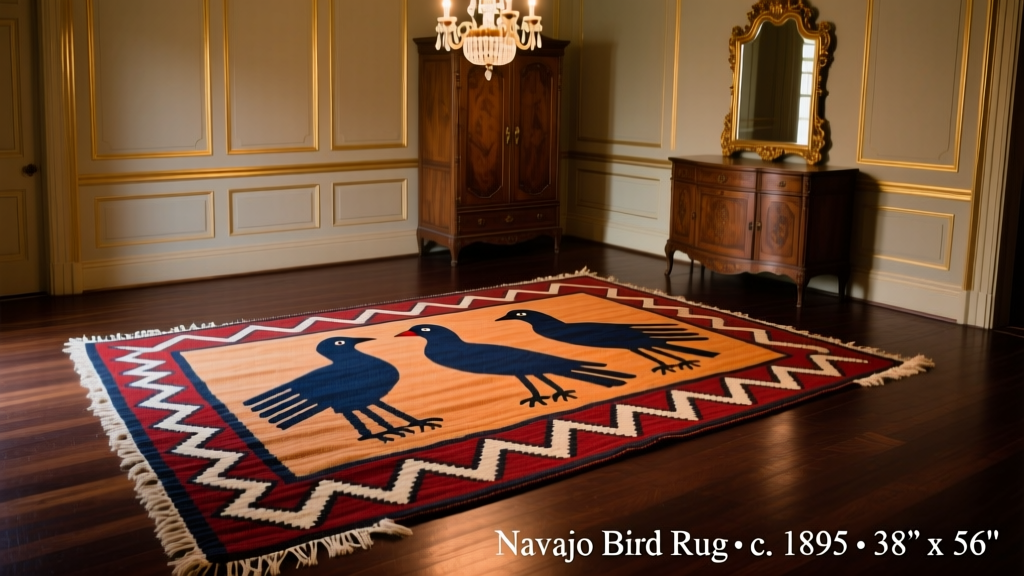
Navajo Bird Rug, Circa 1895: Provenance, Weaving Technique, and Conservation of a 38 × 56 Inch Masterpiece
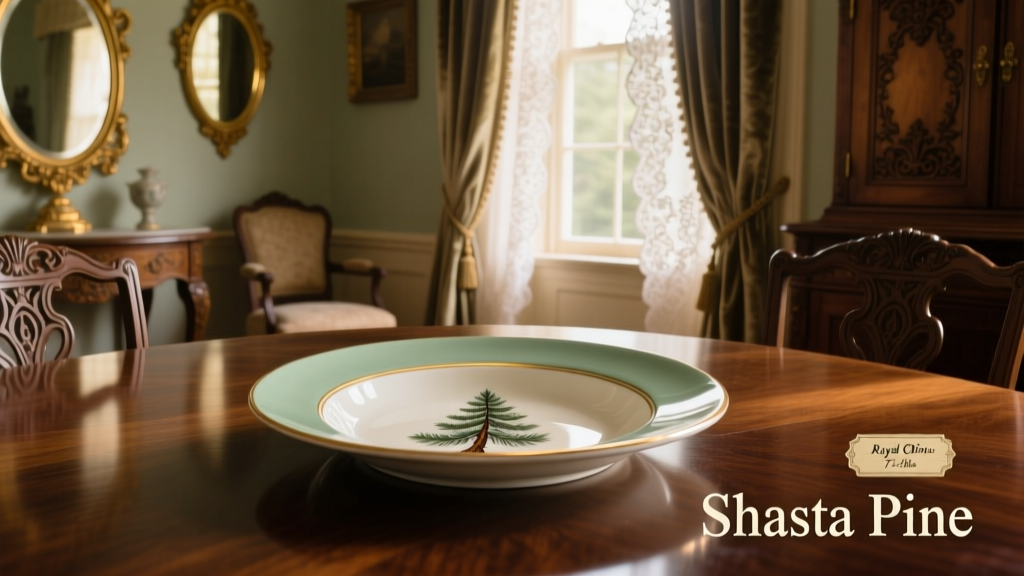
Dinnerware Spotlight: The Shasta Pine Soup Dish by Royal China — A Collector’s Guide to the 7-Inch Ceramic Classic

Royal Doulton Character Jug: Town Crier (Small) — History, Identification, and Restoration Insights
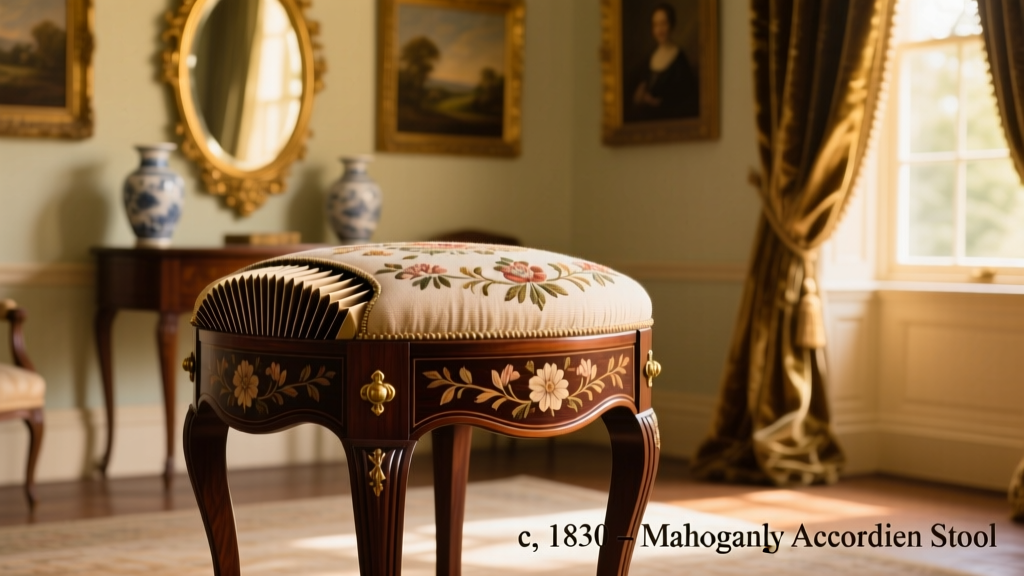
Mahogany Accordion-Action Stool with Needlepoint Seat, Circa 1830: Anatomy, Provenance, and Conservation
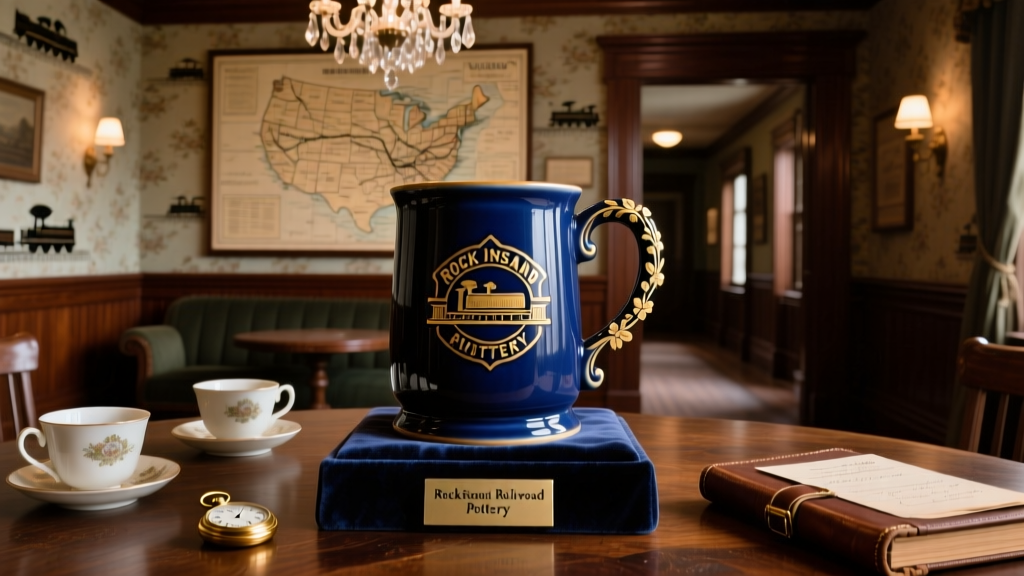
Rock Island Railroad Pottery Large Mug: History, Identification, and Restoration Insights

Conference Call 12: Design, Provenance, and Restoration of the Iconic Herman Miller Executive Desk
Roseville Basket Water Lily Pink 12-Inch: Identification, Value, and Restoration Insights