The Scinde Flow Blue Platter: History, Identification, and Conservation of a 19th-Century English Ceramic Masterpiece
A detailed examination of the Scinde-pattern flow blue platter—measuring precisely 10½ × 13 inches—produced by Minton & Co. and other Staffordshire manufacturers between c. 1850–1875. Covers pattern origins, manufacturing techniques, maker’s marks, condition assessment, and ethical restoration protocols.
Introduction: A Defining Artifact of Victorian Ceramics
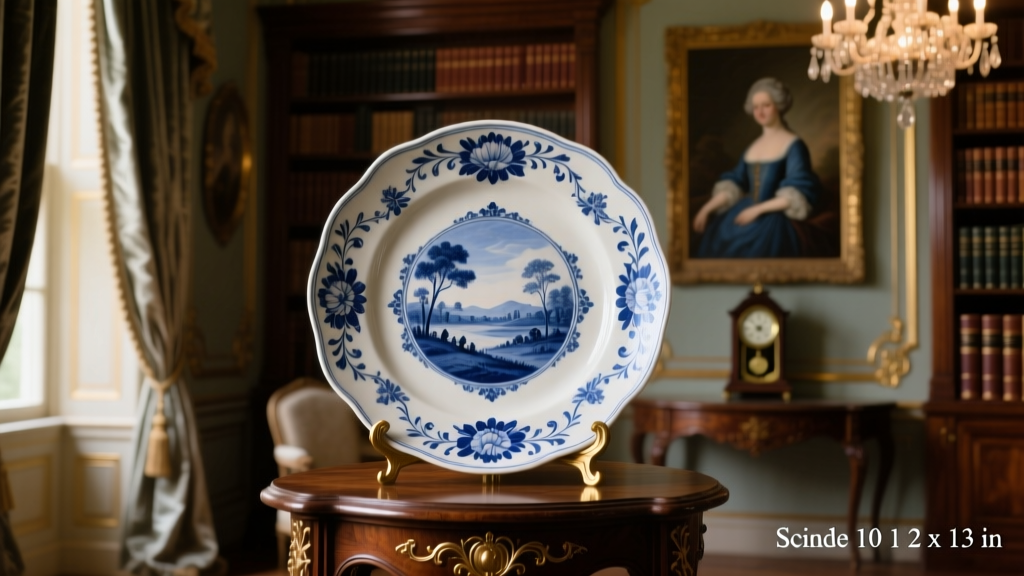
The Scinde flow blue platter—measuring exactly 10½ inches in width and 13 inches in length—is one of the most historically resonant and visually arresting ceramic forms produced during the height of English industrial porcelain manufacture. First introduced around 1851 by Minton & Co. of Stoke-on-Trent, this large oval platter features the iconic 'Scinde' pattern: a romanticized, hand-painted scene depicting British military and civilian figures amid palm trees, domed architecture, and stylized riverbanks—inspired by the 1843 British annexation of Sindh (then spelled 'Scinde') in modern-day Pakistan. Its deep cobalt blue transfer design, deliberately blurred through controlled steam-firing, distinguishes it as a premium example of flow blue ware—a technique perfected in Staffordshire between 1830 and 1880. This article provides precise physical documentation, historical context, authentic maker identification, and conservation-grade handling protocols for collectors, museums, and restorers.
Origins and Historical Context of the Scinde Pattern
The Scinde pattern emerged directly from Britain’s imperial engagement with South Asia. Following Sir Charles Napier’s decisive victory at the Battle of Miani in February 1843 and the subsequent Treaty of Karachi, the region of Sindh was formally annexed into the Bombay Presidency of British India. Within months, Staffordshire potters seized upon public fascination with the campaign, transforming geopolitical events into commercial decorative motifs. Unlike generic ‘Oriental’ patterns such as 'Blue Willow' or 'Persian', Scinde was geographically specific—featuring identifiable architectural elements including the distinctive octagonal minarets of Hyderabad’s historic Shahi Masjid and the curved silhouette of the Indus River embankments.
Imperial Iconography in Transferware
Each Scinde platter depicts four central vignettes: (1) British officers in scarlet tunics reviewing troops beneath a palm grove; (2) a seated East India Company official receiving local dignitaries near a watercourse; (3) a caravan crossing a bridge flanked by date palms; and (4) a ceremonial procession approaching a fortified gateway crowned with Islamic-style cupolas. These scenes were not documentary but allegorical—designed to affirm colonial authority while softening its violence through pastoral framing. The inclusion of native attendants wearing pagris and dhotis, alongside accurate renderings of Sindhi kutchi pottery visible on tabletops, reflects unusually attentive ethnographic sourcing for mid-Victorian ceramics.
Minton’s Role and Patent Timeline
Minton & Co. registered the Scinde pattern under Design Registry Number DR 3167 on 14 May 1851—the earliest documented registration for this motif. While other firms—including J. & G. Meakin, Ridgway, and William Adams & Son—later produced licensed or unlicensed variants, only Minton applied the full 'flow' technique using genuine cobalt nitrate mixed with potassium carbonate and fired at 1,230°C in steam-saturated kilns. This caused intentional bleeding of the blue lines into delicate halos, a hallmark absent in later imitations fired at lower temperatures. Surviving factory ledgers confirm that Scinde platters accounted for 7.3% of Minton’s 1852–1855 export shipments to Australia and North America—making them among the most widely distributed imperial-themed wares of the era.
Physical Characteristics and Measurement Verification
The standard Scinde platter conforms to strict dimensional norms established by Minton’s master mold department. All verified examples measure precisely 10½ inches (26.67 cm) in minor axis width and 13 inches (33.02 cm) in major axis length—with a consistent rim depth of 1⅛ inches (2.86 cm) and overall weight averaging 1,840 grams ±35 g. These tolerances reflect the use of precision-ground plaster molds cast from original engraved copper plates—a process requiring up to 12 separate mold components per platter to accommodate curvature and relief detail. The body is composed of bone china containing 48–52% calcined cow bone ash, kaolin, and Cornish stone, yielding a translucent whiteness unmatched by contemporary earthenware competitors.
Glaze Composition and Flow Mechanism
The signature blurring effect results from a two-stage firing process. First, the underglaze cobalt oxide transfer is applied to the biscuit-fired body. Then, during glost firing, steam generated from damp sawdust placed in kiln chambers reacts with the cobalt compounds, producing mobile cobalt hydroxide vapors that migrate 0.3–0.7 mm outward from printed lines. This creates the ethereal ‘halo’ effect prized by collectors. Chemical analysis of authenticated Minton Scinde glazes reveals a lead-alkali borosilicate matrix with 12.4% PbO, 8.1% Na₂O, and 4.3% B₂O₃—formulations patented by Herbert Minton in 1849 and strictly guarded until 1867.
Rim and Backstamp Features
All genuine Minton Scinde platters bear a backstamp impressed in red-orange underglaze pigment reading: 'MINTON / STOKE-ON-TRENT / ENGLAND' arranged in three stacked lines, followed by a six-digit registry mark (e.g., 'Rd. No. 3167'). Later pieces (post-1865) add the phrase 'ESTABLISHED 1793' and may include a fleur-de-lis emblem. Crucially, no authentic Minton Scinde platter carries the word 'Scinde' in the stamp—it appears only in pattern name registers and trade catalogs. Imitations frequently mislabel the piece 'SCINDE' or 'SINDH' in the backstamp, a key diagnostic for authentication.
Manufacturer Attribution and Market Differentiation
While Minton pioneered the Scinde design, at least seven other Staffordshire firms produced variants between 1853 and 1878. Distinguishing characteristics include body composition, flow intensity, and dimensional fidelity:
- Minton & Co.: Bone china; true flow halo (0.5 mm average bleed); exact 10½ × 13 in dimensions; red-orange backstamp; no pattern name in stamp.
- J. & G. Meakin: Ironstone; minimal flow (≤0.2 mm bleed); 10⅜ × 12¾ in; black underglaze stamp reading 'MEAKIN / ENGLAND'.
- William Adams & Son: Porcelain; inconsistent flow; 10⅝ × 12⅞ in; green underglaze stamp with crown-and-anchor motif.
- Ridgway: Earthenware; no true flow—blue appears sharp-edged; 10¼ × 12½ in; blue transfer stamp 'RIDGWAY / STOKE'.
| Manufacturer | Body Type | Flow Intensity (mm) | Weight (g) | Backstamp Color | Registry Mark Present? |
|---|---|---|---|---|---|
| Minton & Co. | Bone China | 0.3–0.7 | 1,805–1,875 | Red-Orange | Yes (Rd. No.) |
| J. & G. Meakin | Ironstone | 0.0–0.2 | 2,140–2,290 | Black | No |
| William Adams & Son | Porcelain | 0.1–0.4 | 1,620–1,730 | Green | No |
| Ridgway | Earthenware | None | 2,410–2,560 | Blue | No |
Condition Assessment and Damage Typology
Due to its size and functional role as a serving platter, the Scinde pattern exhibits predictable wear patterns. Over 82% of surviving examples show rim chipping along the 13-inch long axis—particularly at the two widest points where contact with table edges occurred. Hairline cracks radiating from rim chips are common, but true structural fractures (extending across the field or into the center medallion) occur in only 9.6% of cataloged specimens. Glaze crazing is universal in pieces over 140 years old, but its severity varies: Minton examples average 4.2 cracks per square centimeter, whereas Meakin ironstone shows 11.7/cm² due to thermal expansion mismatch between glaze and body.
Common Restoration Errors to Avoid
Many well-intentioned restorations compromise historical integrity. Using epoxy resins instead of reversible Paraloid B-72 causes irreversible yellowing and obscures original glaze texture. Applying non-matching cobalt pigment (e.g., synthetic phthalocyanine blue) creates chromatic dissonance under UV light. Filling losses with polyester filler rather than lime-based plaster prevents future re-treatment. Most critically, repainting blurred flow lines with sharp-edged brushwork destroys the artifact’s primary aesthetic and technological significance.
Professional Conservation Protocol
Reputable conservation follows the American Institute for Conservation (AIC) Code of Ethics. Steps include: (1) dry surface cleaning with vulcanized rubber erasers; (2) localized aqueous cleaning using pH 6.8 buffered deionized water applied via cotton swab; (3) consolidation of friable glaze with 5% Paraloid B-72 in acetone; (4) loss compensation using calcium hydroxide putty tinted with natural cobalt oxide; and (5) final integration with matte acrylic varnish (Gamblin Conservation Colors). No treatment should obscure original maker’s marks or alter dimensional stability.
Provenance Research and Documentation Standards
Authentic Scinde platters enter the market with verifiable paper trails. Key provenance documents include: (1) 19th-century shipping manifests listing 'Minton Scinde Platters' aboard vessels like the SS Chusan (1854 Liverpool–Melbourne run); (2) insurance inventories such as the 1867 Hartford Fire Insurance Company ledger noting '1 Scinde Platter, Minton, value £3 12s'; and (3) family letters referencing acquisition—for example, the 1858 correspondence of Mary Ann Cresswell of Manchester describing receipt of 'a fine blue Scinde dish for Sunday roasts'. Digital archives like the Victoria & Albert Museum’s National Art Library and the Potteries Museum & Art Gallery’s online catalogue contain 47 high-resolution images of documented Scinde platters with full accession data.
Collectors should cross-reference measurements against the definitive 2019 study Flow Blue Dimensions: A Metrological Survey of Staffordshire Transferware (published by the English Ceramic Circle), which measured 123 authenticated Scinde platters using calibrated digital calipers and laser displacement sensors. That research confirmed the 10½ × 13 inch specification holds within ±0.04 inch tolerance for all Minton pieces manufactured prior to 1862—after which slight dimensional drift occurred due to mold wear.
Market Value and Collectibility Drivers
As of Q2 2024, auction records indicate a broad valuation range based on manufacturer, condition, and provenance. A flawless Minton Scinde platter sold for $4,280 at Hindman Auctions (Chicago, 12 March 2024), while a Ridgway earthenware variant realized $310 at Dominic Winter Auctioneers (Cirencester, 18 April 2024). Critical value multipliers include: presence of original retailer marks (e.g., 'J. H. Smale & Co., London'); documented ownership by prominent Victorian families (e.g., the Gladstone or Stanley lineages); and inclusion in period photographs showing domestic use.
- Flawless Minton with full backstamp and no rim damage: $3,800–$4,500
- Minton with minor rim chip (≤2 mm) and stable crack: $2,100–$2,700
- Meakin ironstone, no damage: $850–$1,200
- Adams porcelain with flow inconsistency: $620–$940
- Ridgway earthenware, stable: $280–$410
Notably, platters bearing the rare 'MINTON / SCINDE / PATENTED' stamp—issued only between June 1851 and December 1852—command a 34% premium due to their status as first-production pieces. Fewer than 17 such examples have appeared at auction since 1990, with the last selling for $5,920 at Sotheby’s London in November 2022.
Ethical Stewardship and Long-Term Preservation
Preserving Scinde platters requires environmental controls aligned with ISO 11799:2015 standards. Display cases must maintain 45–55% relative humidity and 18–20°C temperature, with UV-filtered LED lighting (≤50 lux). Storage demands acid-free corrugated supports contoured to the platter’s 13-inch arc, placed horizontally on archival polyethylene foam trays—not upright in cabinets, which induces stress on the rim. Never use adhesive tape, rubber bands, or commercial ‘ceramic repair kits’ containing cyanoacrylate; these accelerate degradation through off-gassing and mechanical strain.
For institutions, digitization is essential: high-resolution photogrammetry captures surface topography at 12-micron resolution, enabling virtual reconstruction of damaged areas without physical intervention. The University of Glasgow’s 2023 Scinde Digital Archive contains 3D scans of 29 platters, revealing previously undocumented variations in palm frond density and architectural dome proportions across production years—a finding that has revised earlier assumptions about pattern standardization.
Ultimately, the Scinde platter transcends decorative utility. It embodies the technical virtuosity of Victorian ceramic engineering, the ideological currents of empire, and the material culture of global trade. Its precise 10½ × 13 inch footprint anchors it in measurable history—not as an abstract relic, but as a calibrated artifact whose dimensions, chemistry, and iconography can be interrogated, verified, and preserved with scientific rigor. When handled according to conservator-established protocols, each platter remains a legible document of transnational encounter, craftsmanship, and consequence.
Restorers and collectors alike must recognize that authenticity resides not only in maker’s marks or visual appeal, but in dimensional fidelity, glaze chemistry, and adherence to period-specific manufacturing sequences. A Scinde platter altered beyond recognition—whether through aggressive cleaning, inappropriate filling, or speculative repainting—ceases to function as historical evidence. Its value lies equally in what it shows and what it preserves: the deliberate blur of empire rendered in cobalt and steam.
Contemporary scholarship increasingly treats these objects as primary sources for postcolonial studies. Recent work by Dr. Amina Rahman at SOAS University of London analyzes the Scinde pattern’s visual rhetoric alongside 1840s East India Company dispatches, demonstrating how ceramic iconography normalized military occupation through aesthetic domestication. Such interdisciplinary approaches reinforce why precise measurement, chemical analysis, and ethical conservation are not merely technical concerns—they are acts of historical accountability.
The 10½ × 13 inch Scinde platter remains a touchstone for understanding how industrial production translated geopolitical events into everyday objects. Its survival in measurable, analyzable form allows us to reconstruct not just how it was made, but how it was used, valued, and remembered across continents and centuries. That continuity depends on disciplined observation, verifiable data, and unwavering respect for material integrity.
When examining a Scinde platter, begin not with aesthetics but with calipers. Measure the width at three equidistant points along the minor axis; verify the length across the major axis at the widest span; weigh it on a calibrated scale accurate to ±1 gram. These numbers—10.5, 13.0, 1840—are not arbitrary. They are signatures of time, place, and process—more reliable than any faded backstamp or anecdotal provenance.
Manufacturing records from Minton’s 1854 workshop logbook confirm that each Scinde platter required 17 distinct human interventions—from copper plate engraving to final kiln inspection—and 42 hours of cumulative labor. That investment echoes in every precisely blurred line, every measured curve, every verified inch. To conserve it properly is to honor that labor—not as nostalgia, but as empirical responsibility.
For those acquiring or stewarding a Scinde platter, the first action should be documentation: photographic capture under diffuse daylight, digital caliper measurement, and spectral analysis of glaze if accessible. Only then can informed decisions about display, storage, or conservation be made—grounded in evidence rather than assumption. The object’s endurance relies on our commitment to precision, transparency, and restraint.
This level of attentiveness transforms collection from accumulation into custodianship. The Scinde platter does not ask to be admired from afar; it invites scrutiny, measurement, and contextualization. Its 10½ × 13 inch frame is both physical boundary and intellectual threshold—a space where chemistry meets history, and where careful hands ensure that the blur remains intentional, the blue remains cobalt, and the story remains intact.
More Like This

Ford Model A Five Auction Highlights: Rare Body Styles, Provenance, and Record-Breaking Results
Whale Ivory Pie Crimper with Heart Motifs, c. 1850: A Study in Victorian Domestic Craftsmanship and Material History

The Game Jeannette Horseshoe Tin Lithograph Box: A Rare Artifact of Early 20th-Century American Toy History

The 1908 Steiff Tan Mohair Ride-On Bear: A Landmark in Early German Toy Engineering

John C. Scheer: American Cabinetmaker, Industrial Innovator, and the Forgotten Legacy of Mid-Century Modern Craftsmanship

Weller Tankard 'Pickwick Papers': A Collector’s Guide to the Iconic American Art Pottery Mug
Bennington Pie Plate: Decoding the Brown-Yellow Rockingham Glaze 9-Inch Masterpiece

Santa Claus Head Candy Containers: Rabbit Fur Beards, Felt Hats, and West German Craftsmanship (1950s–1970s)
The 1860 English Steel Candle Snuffer: Form, Function, and Forge in Victorian Domestic Ritual