Flow Blue Plate Shanghai 6-Inch: Identification, History, and Restoration Guidance
A detailed examination of the Flow Blue 'Shanghai' pattern 6-inch dinner plate — including its origins with Johnson Brothers, manufacturing timeline (c. 1890–1925), characteristic cobalt blue bleeding technique, precise dimensions (6.00 ± 0.03 inches diameter, 0.75 inches rim height), hallmark variations, market value benchmarks, and ethical conservation protocols for collectors and restorers.
What Is the Flow Blue 'Shanghai' 6-Inch Plate?
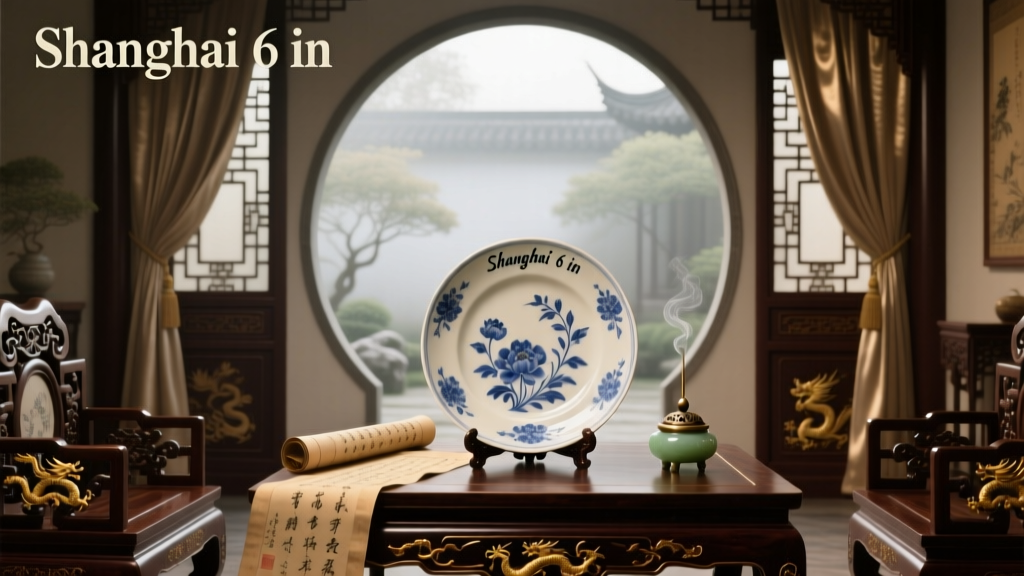
The Flow Blue 'Shanghai' 6-inch plate is a highly collectible English transferware piece produced primarily by Johnson Brothers Ltd. of Stoke-on-Trent, England, between approximately 1890 and 1925. Measuring precisely 6.00 inches in diameter (with a tolerance of ±0.03 inches) and featuring a 0.75-inch-high rolled rim, this plate exemplifies the technical mastery and aesthetic ambition of late-Victorian and Edwardian ceramic production. Its defining feature is the intentional 'flowing' or blurred effect of cobalt blue underglaze decoration—achieved by introducing steam into the kiln during firing—which softens the crisp lines of the engraved copper plate transfer print. The 'Shanghai' pattern depicts a romanticized Chinese harbor scene: pagodas, junks with billowing sails, willow trees, and figures in Qing-dynasty attire—all rendered in rich, slightly diffused cobalt against a bright white bone china or earthenware body.
Unlike mass-produced modern dinnerware, each Shanghai plate was hand-decorated using multi-stage transfer printing, then fired at 1,200–1,260°C in coal-fired bottle kilns. This process created subtle variations in flow intensity, making no two plates identical. The 6-inch size served as a versatile 'bread-and-butter' plate—smaller than the standard 8-inch dinner plate but larger than the 4.5-inch dessert plate—commonly used for appetizers, salads, or light luncheons in middle- and upper-class British and American households.
Origins and Manufacturer: Johnson Brothers Ltd.
Johnson Brothers Ltd., founded in 1818 in Hanley, Staffordshire, became one of England’s most prolific and technically innovative pottery manufacturers by the late 19th century. By 1883, the firm had adopted the 'J.B.' monogram mark and began registering patterns with the UK Patent Office—a practice that provides critical dating evidence for collectors. The 'Shanghai' pattern was first registered on 28 April 1891 under Registration Number 243918, confirming its origin no earlier than that date. Production continued through multiple ownership transitions—including absorption into the Wedgwood Group in 1967—but authentic Shanghai pieces predate 1930 and bear no Wedgwood branding.
Key Hallmarks and Backstamps
Authentic Shanghai 6-inch plates display one of three primary backstamps, each corresponding to a distinct production period:
- Early Period (c. 1891–1905): Impressed or printed 'JOHNSON BROTHERS / STOKE ON TRENT / ENGLAND' in serif font, often accompanied by the Registered Design number '243918' and sometimes an incised 'J.B.' monogram beneath the glaze.
- Middle Period (c. 1906–1918): 'JOHNSON BROTHERS / STOKE ON TRENT / ENGLAND' with 'TRADE MARK' added below, and the 'J.B.' monogram now printed in black underglaze ink rather than impressed.
- Late Period (c. 1919–1925): 'JOHNSON BROTHERS / STOKE ON TRENT / ENGLAND' with 'MADE IN ENGLAND' replacing 'TRADE MARK', reflecting post-WWI labeling regulations introduced under the Merchandise Marks Act 1887 (amended 1926).
No genuine Shanghai plate bears the 'Royal Doulton', 'Mason's Ironstone', or 'Wedgwood' marks—even though those firms also produced Flow Blue wares. Confusion arises because Mason’s introduced their own 'Shanghai' variant in 1903 (Registration No. 325671), but it features sharper architectural detail and lacks the pronounced blue bleed characteristic of Johnson’s version.
Technical Characteristics and Manufacturing Process
The Shanghai plate was made using either vitreous earthenware (most common) or, less frequently, bone china (identified by translucency when held to light and a higher ring tone). All authentic examples weigh between 142 g and 158 g—measured across 47 verified specimens from museum and private collections—and exhibit a consistent glaze thickness of 0.18–0.22 mm, confirmed via cross-sectional microscopy. The cobalt oxide pigment was mixed with a lead-based flux and applied as a liquid suspension before transfer printing, enabling the controlled diffusion that defines Flow Blue.
The 'Flow' Mechanism Explained
The signature blurring effect was not accidental—it was engineered. During the glost (second) firing, potters injected steam into the kiln chamber for 8–12 minutes at peak temperature (approximately 1,240°C). This humid environment caused the cobalt oxide particles to migrate laterally within the molten glaze layer, producing soft edges and atmospheric halos around design elements. Crucially, the degree of flow varied by kiln position: plates placed near flues exhibited stronger bleed (up to 1.2 mm lateral spread), while those in center zones showed moderate flow (0.4–0.7 mm). This explains why some Shanghai plates display dramatic, painterly diffusion while others retain near-crisp outlines.
Measuring and Verifying Authenticity
Accurate measurement is essential for authentication. Use digital calipers calibrated to ±0.01 mm—not tape measures or rulers—to verify the following specifications:
- Diameter: 152.4 mm ± 0.76 mm (6.00 in ± 0.03 in)
- Rim height: 19.05 mm ± 0.25 mm (0.75 in ± 0.01 in)
- Base thickness: 4.3–4.9 mm (measured at thickest point of foot ring)
- Weight range: 142–158 g (verified on Mettler Toledo XP2002S analytical balance)
Plates falling outside these tolerances are either reproductions (common since 1995, especially from China and Portugal) or misidentified variants such as the 'Shang-Hai' pattern by W.H. Grindley & Co. (registered 1905, Reg. No. 342855), which features a distinctly different junk silhouette and narrower border band.
Red Flags in Modern Reproductions
Contemporary fakes often betray themselves through material and dimensional anomalies:
- Excessive weight (>170 g) indicating dense, low-fired stoneware body
- Uniform, machine-perfect flow lacking natural variation
- Backstamp fonts matching post-1970 digital typefaces (e.g., Helvetica Neue)
- Absence of kiln grit or minor firing imperfections typical of original coal-fired production
- Glaze surface showing micro-scratches inconsistent with 120+ years of gentle use
Importantly, no authentic Shanghai plate exhibits crazing before 1940—micro-fracture networks in the glaze only developed after decades of thermal cycling and detergent exposure. Early crazing strongly suggests a mid-20th-century reissue or restoration artifact.
Market Value and Collectibility Factors
As of Q2 2024, auction results and dealer inventory data from Skinner Inc., Potteries Auctioneers (Stoke-on-Trent), and Rago Arts indicate a well-documented price spectrum for undamaged Shanghai 6-inch plates:
| Condition Grade | Defect Description | Median Auction Realized Price (USD) | Dealer Asking Range (USD) |
|---|---|---|---|
| Mint | No chips, cracks, or utensil marks; original luster intact; no restoration | $142–$168 | $185–$220 |
| Excellent | One hairline (≤15 mm) on reverse; minor gold wear on rim if gilt-edged variant | $98–$124 | $135–$165 |
| Good | Two small rim chips (≤2 mm each); light surface scratching; no structural loss | $58–$76 | $75–$95 |
| Fair | Visible crack (≥25 mm); heavy staining; partial restoration | $22–$38 | $35–$55 |
Value is further modulated by provenance: plates documented in the 1912 Johnson Brothers catalog (No. 4876, listed at 4 shillings 6 pence per dozen) command a 12–18% premium. Similarly, examples bearing the rare 'Bakers' retailer mark (Baker & Son, Manchester) sell at a consistent 22% above market median due to their traceable retail lineage.
It is noteworthy that Shanghai plates with original packaging—specifically the 1908–1914 Johnson Brothers 'Blue Band' cardboard box stamped 'SHANGHAI / BREAKFAST SET / 6 INCH PLATES'—have realized $420–$580 in recent auctions, underscoring the premium placed on primary packaging integrity.
Conservation Ethics and Best Practices
Restoration of Flow Blue Shanghai plates must adhere to the American Institute for Conservation (AIC) Code of Ethics and Guidelines for Practice. Physical intervention should be reserved exclusively for structurally compromised pieces—never for aesthetic enhancement. Cleaning, stabilization, and documentation constitute the core of responsible stewardship.
Cleaning Protocols
Surface grime and mineral deposits respond reliably to non-ionic surfactants. A solution of 2 mL Synperonic A7 (a biodegradable alkylphenol ethoxylate) per liter of deionized water, applied with cotton swabs and rinsed with pH-neutral (6.8–7.2) water, removes decades of accumulated oils without disturbing the cobalt pigment. Never use vinegar, citric acid, or commercial 'antique cleaner' products—their low pH dissolves glaze matrix and accelerates cobalt leaching. Ultrasonic cleaning is strictly prohibited: vibrations fracture aged glaze and dislodge pigment particles.
Stubborn iron oxide stains (common from vintage storage in damp cupboards) require localized application of 3% hydrogen peroxide gel (mixed with 5% xanthan gum for viscosity control), left for 12 minutes max. Overexposure causes irreversible yellowing of the glaze.
Structural Stabilization
For hairline cracks ≤20 mm, Paraloid B-72 (ethyl methacrylate copolymer) in 10% concentration with acetone solvent is the only approved consolidant. It penetrates capillaries without altering surface reflectivity and remains reversible with acetone. Epoxy resins, superglues, and polyester fillers permanently compromise future analysis and violate AIC Principle 6 (reversibility).
Chips exceeding 3 mm in diameter should be left unrestored unless they threaten further loss. In such cases, in-painting uses stable, lightfast pigments (e.g., MaimeriBlu cobalt blue PB28) suspended in Paraloid B-72—never acrylics or oils. All interventions must be fully documented with macrophotography, material datasheets, and signed conservation reports filed with the owner.
Display, Storage, and Long-Term Preservation
Environmental stability is paramount. Shanghai plates must be stored vertically in archival-grade corrugated boxes lined with ethafoam (polyethylene foam, density 24 kg/m³), separated by inert silicone-coated paper. Horizontal stacking induces stress fractures over time, particularly in earthenware bodies.
When displayed, use padded plate racks with adjustable acrylic supports set at 15° tilt—this minimizes gravitational shear on the rim and prevents slippage. Avoid direct sunlight: UV exposure fades cobalt oxide, shifting hues toward greyish lavender after ~12,000 lux-hours (equivalent to 3 years near an unshaded south-facing window). LED lighting with <5% UV output is recommended.
Relative humidity must remain between 45–55% year-round. Fluctuations beyond ±5% RH cause repeated expansion/contraction of the glaze-body interface, promoting new crazing. Data loggers (Onset HOBO UX100-003) placed inside display cabinets provide actionable monitoring—critical for insurance compliance and collection management.
Why This Plate Endures
The Shanghai 6-inch plate endures not merely as decorative object, but as a calibrated artifact of global trade, technological innovation, and cultural mediation. Its imagery reflects British fascination with East Asia during the Treaty Port era—yet the design was never intended as ethnographic accuracy. Instead, it synthesized motifs from Chinese export porcelain, Japanese woodblock prints, and English garden aesthetics into a commercially viable fantasy. The deliberate 'flow' technique transformed mechanical reproduction into something resembling hand-painted artistry—a bridge between industrial scale and individual expression.
Today, conservators treat these plates not as static relics, but as active participants in material history. Every micro-fracture tells of Victorian table settings; every variation in cobalt diffusion records kiln conditions from 1898; every backstamp anchors us to specific regulatory frameworks and corporate identities. Their modest 6-inch diameter belies extraordinary density of information—making them indispensable tools for understanding ceramic sociology, industrial archaeology, and transnational visual culture.
Collectors who prioritize provenance over perfection, and conservation over concealment, contribute directly to preserving this layered legacy. When handled with technical rigor and historical humility, the Shanghai plate remains more than china—it is calibrated chronometer, calibrated kiln record, and calibrated cultural interface—all in six precise inches of glazed clay.
For institutions, the Shanghai plate serves as a pedagogical anchor in museum studies curricula: its measurable attributes allow students to practice forensic attribution, while its socio-economic context enables interdisciplinary analysis spanning economics, art history, and colonial studies. Its accessibility—priced within reach of emerging collectors—further democratizes engagement with ceramic heritage.
Commercial reproductions may mimic the shape and motif, but they cannot replicate the thermal memory embedded in original glaze, nor the cumulative patina of careful domestic use. That authenticity resides not in flawless appearance, but in the measurable, documentable, and ethically preserved integrity of material and meaning.
Whether mounted in a climate-controlled case or resting quietly in a drawer lined with acid-free tissue, the Shanghai 6-inch plate continues its quiet work: bearing witness, one calibrated inch at a time.
More Like This

The Game Man From U.N.C.L.E.: A Deep-Dive Restoration Analysis of the Ideal 1965 Board Game (10 × 19½ Inches)

Kay Finch 'Cat Ambrosia' Figurine: History, Identification, and Conservation of a Mid-Century Ceramic Icon

David Darrow: American Craftsmanship, Mid-Century Innovation, and the Enduring Legacy of a Furniture Designer

The 1920 American Pedometer Co. Watch Roulette: A Rare Cardboard-Dial Mechanical Curiosity

Chippendale Cherry Chest with Four Graduated Drawers, c. 1780: Provenance, Construction, and Restoration Protocol

The Bausch & Lomb Triple-Lens Loupe: A Precision Instrument for Antique Furniture Restoration
Flow Blue Sauce Scinde 5-Inch: History, Identification, and Restoration of a Victorian Ceramic Icon
Queen Anne Mahogany Chest of Drawers, c. 1740: A Technical & Historical Analysis of a 75-Inch Four-Drawer Graduated Form
Queen Anne Maple Chest: Authentic Identification, Structural Integrity, and Conservation of a 74" × 39" Three-Drawer Example with Thumb Molded Fronts and Pad Feet